
Nail Consultation Form: Professional Guide for Salon Owners & Nail Technicians

Quick Answer: What Is a Nail Consultation Form?
A nail consultation form is a professional documentation tool that records client health information, service preferences, consent, and contraindications before nail treatments. It serves as the foundation for safe service delivery, client protection, and business liability documentation.
Key functions: Client safety screening, informed consent documentation, allergy and contraindication identification, service history tracking, and professional standards demonstration.
Why it matters: A properly structured consultation form protects your client, protects your business, demonstrates professional duty of care, and provides the documentation foundation that supports your professional practice.
Why Every Nail Professional Needs a Consultation Form
Professional nail services carry responsibility. Before applying any product or performing any treatment, nail technicians and salon owners must understand their client’s health status, medical history, and specific contraindications that could affect service delivery or client safety.
A consultation form is not merely an administrative task—it is your first line of defence in protecting both your client and your business. It establishes informed consent, documents important health information, and creates a professional record that demonstrates duty of care.
Without a properly completed consultation form, you cannot truly claim to have provided professional nail services. If an incident occurs and no consultation form exists, demonstrating that you exercised appropriate care becomes significantly more difficult.
What a Consultation Form Actually Does
A professional nail consultation form serves multiple critical functions simultaneously:
- Identifies contraindications: Reveals medical conditions, allergies, medications, or health factors that could make certain treatments unsafe or require modifications to your usual procedures.
- Establishes informed consent: Documents that the client understands what service they are receiving, what products will be used, and what reasonable expectations they should have.
- Creates legal documentation: Provides written evidence that you performed appropriate safety screening and acted responsibly in your professional capacity.
- Supports professional standards: Demonstrates to clients, insurers, and regulatory bodies that you follow recognised professional protocols.
- Tracks service history: Records what treatments have been performed, what products have been used, and how the client’s nails have responded over time.
- Facilitates effective communication: Ensures nothing important is forgotten during verbal consultations and creates a permanent reference for future appointments.
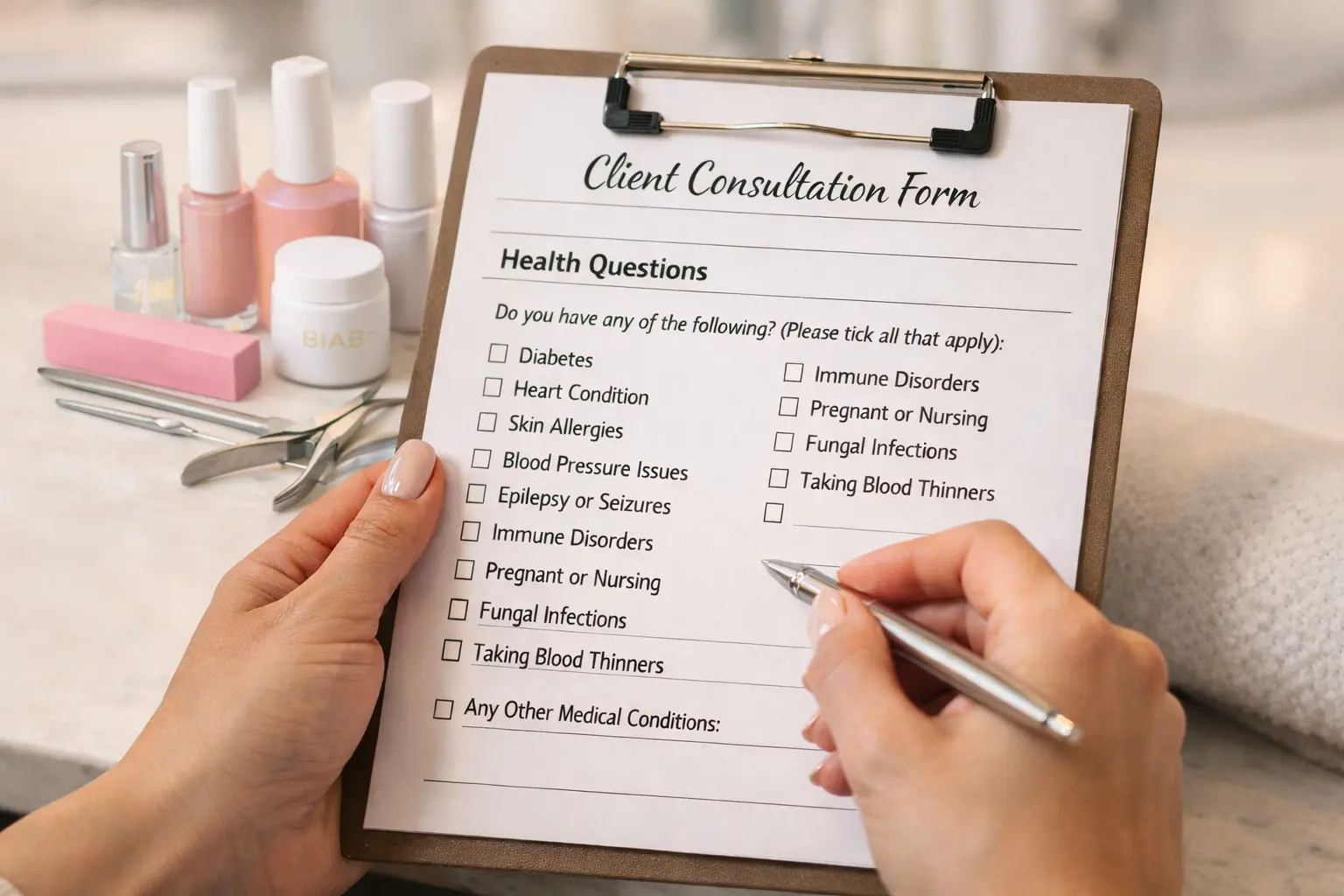
Essential Questions for Your Nail Consultation Form
A comprehensive consultation form must gather specific information across multiple categories. Each question serves a distinct purpose in building a complete understanding of the client’s suitability for treatment and identifying potential risk factors.
Personal Information Section
Basic identification and contact details establish the client record and enable follow-up communication if necessary:
- Full name (including preferred name if different)
- Contact telephone number (mobile preferred for appointment reminders)
- Email address (for digital communications and appointment confirmations)
- Date of birth (age can affect treatment suitability and product choices)
- Emergency contact name and number (essential if a medical incident occurs during treatment)
- How they found your business (marketing intelligence—referral, social media, search engine, etc.)
Medical History and Health Screening
This section identifies contraindications and conditions requiring treatment modifications:
- Current medical conditions (diabetes, circulatory disorders, immune system conditions, skin conditions, respiratory conditions)
- Current medications (blood thinners, chemotherapy, steroids, immunosuppressants—these can affect healing, product reactions, and service suitability)
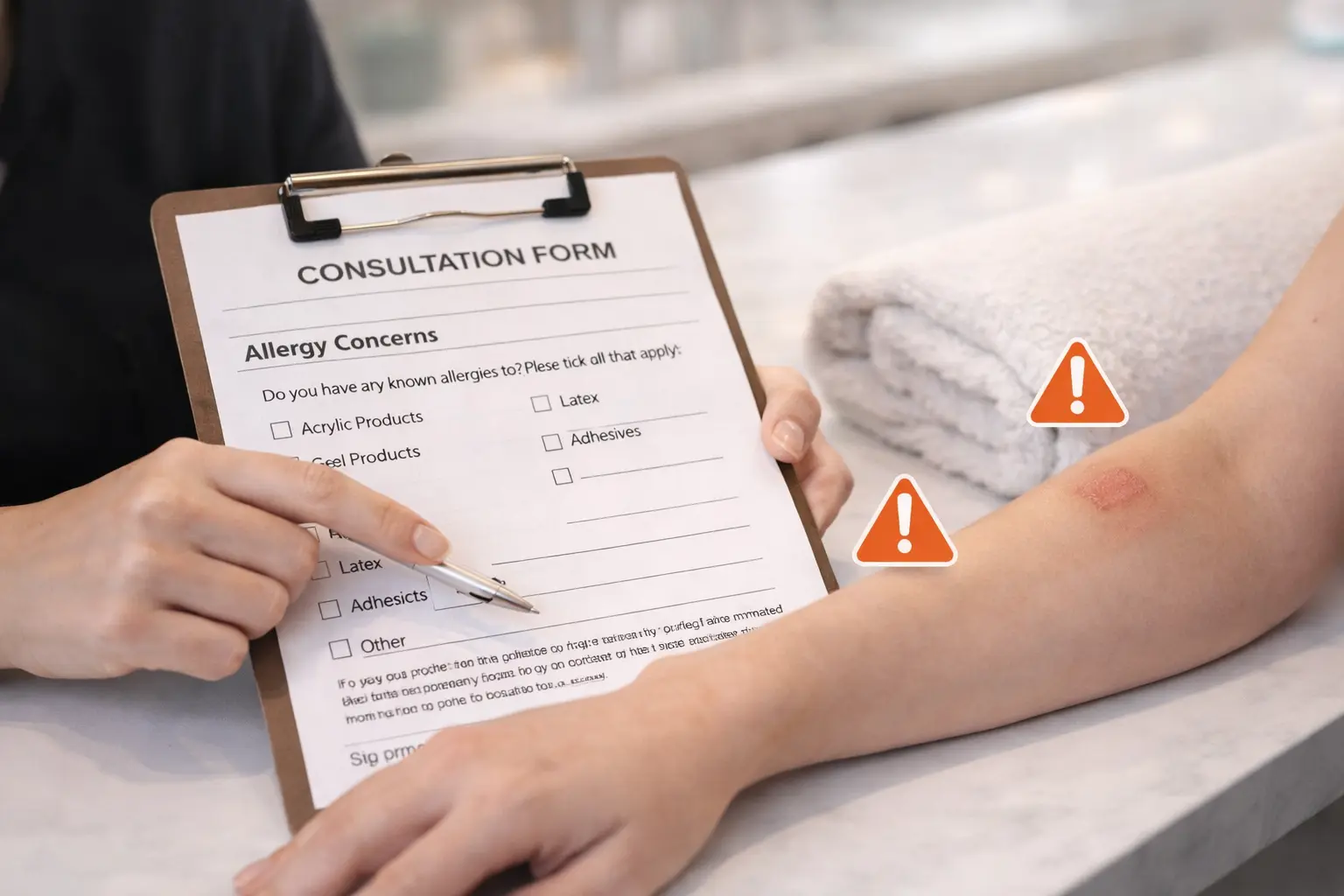
- Known allergies (particularly to nail products, adhesives, acrylates, formaldehyde, latex, specific chemicals)
- Previous allergic reactions to nail products (itching, redness, swelling, blistering around nails or fingers)
- Pregnancy or breastfeeding status (affects product selection and ventilation requirements)
- Recent illnesses or infections (fungal infections, bacterial infections, viral infections affecting hands or general health)
⚠️ Critical Health Questions
Certain medical conditions require particularly careful attention in nail services. Understanding the implications of these conditions is essential for safe service delivery:
- Diabetes: Affects healing, infection risk, and circulation to extremities—requires specific service modifications
- Blood thinning medication: Increases bleeding risk during cuticle work—requires adjusted techniques
- Immunosuppression: Reduces ability to fight infections—requires enhanced sanitation protocols
- Chemotherapy: Causes nail fragility and reduced product tolerance—may require service decline or alternative approaches
- Circulatory conditions: Affects healing capacity—requires modified service approaches
Learning exactly how to adapt your services for each condition protects both client safety and your professional practice.
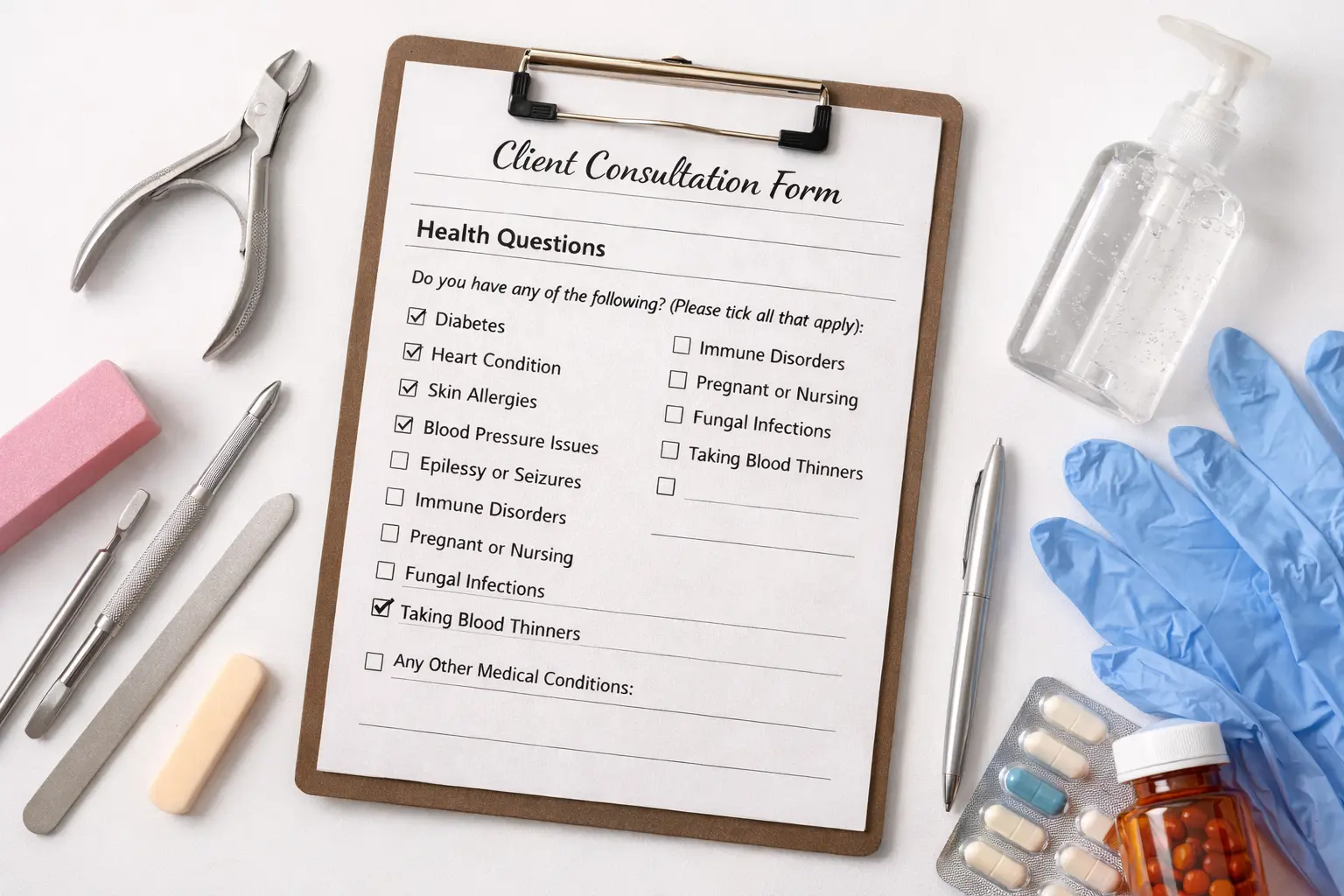
Nail Health and Service History
Understanding the client’s nail condition and previous treatments informs appropriate service selection:
- Current nail condition (strong, weak, brittle, peeling, damaged, bitten)
- Previous nail enhancement experience (acrylic, gel, BIAB, dip powder, polygel—and how nails responded)
- History of nail problems (lifting, breaking, infections, allergic reactions, onycholysis)
- Current nail routine (regular manicures, home care practices, product usage)
- Specific nail concerns (wanting to grow nails, repair damage, strengthen weak nails, address specific issues)
- Occupation and lifestyle (manual work, water exposure, chemical exposure—affects product selection and longevity expectations)
Service Preferences and Expectations
This section ensures the client and technician have aligned expectations about the service outcome:
- Desired service type (overlay, extension, gel polish, specific technique)
- Desired nail length and shape (realistic assessment of what client’s natural nails can support)
- Colour and design preferences (nude, colour, nail art complexity)
- Lifestyle considerations (how hands are used daily, maintenance commitment, budget constraints)
- Maintenance expectations (frequency of appointments, home care willingness)
Consent and Agreement Section
The legal foundation of the consultation form includes explicit consent statements:
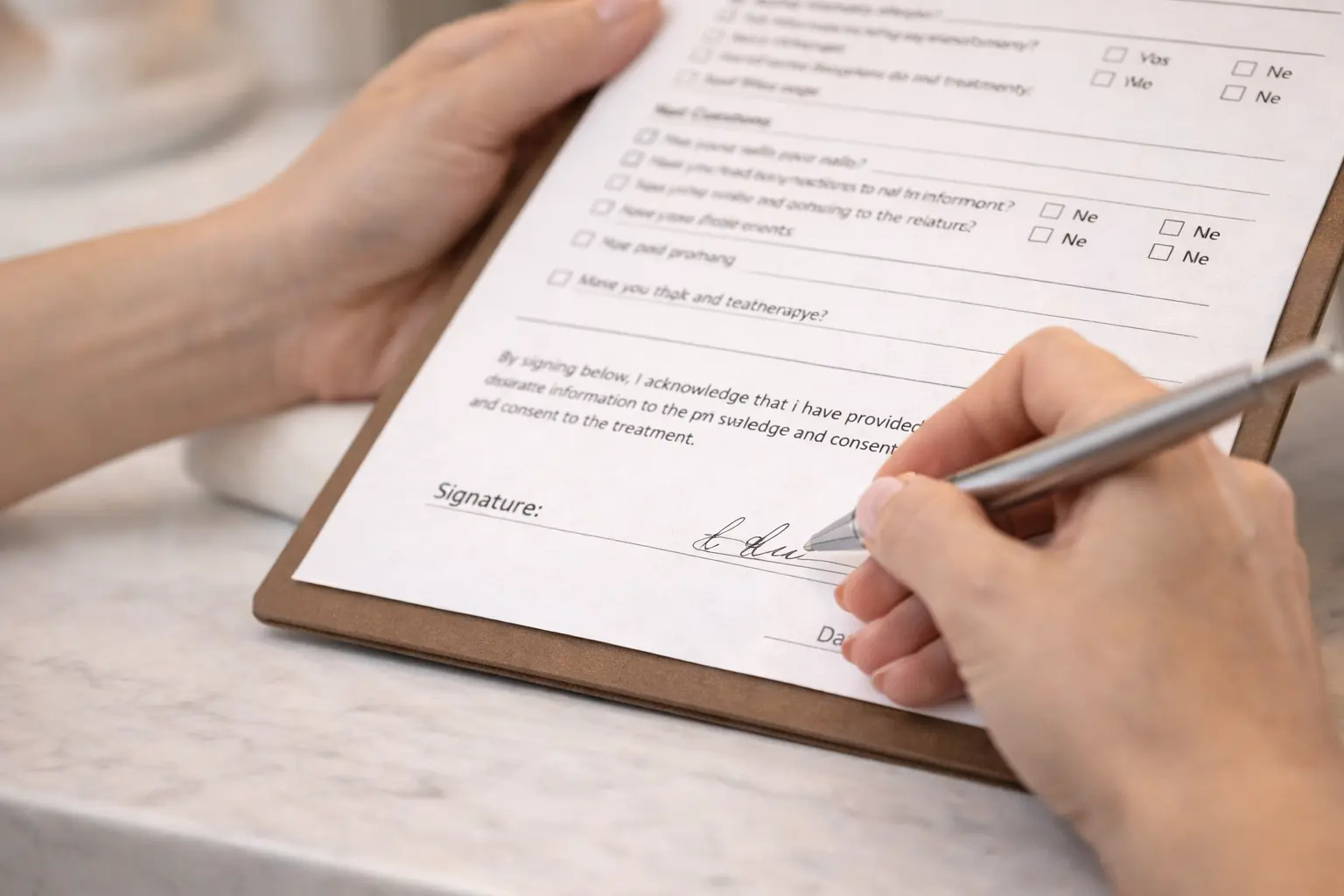
- Accuracy declaration: Client confirms all provided information is complete and accurate to the best of their knowledge
- Update obligation: Client agrees to inform the technician of any health changes, new medications, or relevant developments
- Service understanding: Client acknowledges they understand the service being provided and have had opportunity to ask questions
- Aftercare responsibility: Client accepts responsibility for following provided aftercare instructions
- Realistic expectations: Client understands that nail enhancements require maintenance and that natural nail characteristics affect service longevity
- Signature and date: Legal confirmation of consent and agreement
Professional Template Includes All Essential Sections
The Nail Consultation Form course provides a complete, professionally structured template covering all necessary questions, with in-depth video guidance explaining why each question matters, how to interpret client responses, and exactly what to do when specific health conditions or contraindications are identified.
Digital vs Printable Consultation Forms
Professional consultation forms can be implemented in either digital or paper format, each offering distinct advantages depending on your business setup and workflow preferences.
Digital Consultation Forms
Digital forms offer modern convenience and integration capabilities:
- Automatic storage and retrieval: Client records are instantly saved and searchable without physical filing systems
- Integration with booking systems: Forms can connect to appointment scheduling platforms like Fresha, Phorest, Zenoti, Boulevard, Vagaro, or Ovatu
- Client convenience: Forms can be completed at home before appointments, reducing in-salon time
- Automatic reminders: Digital systems can prompt clients to update forms annually or when health changes occur
- Reduced paper waste: Environmentally friendly option with no physical storage requirements
- Easy duplication and backup: Cloud storage ensures forms are never lost to fire, flood, or physical damage
Popular Digital Form Platforms
Several platforms support professional consultation form creation and management:
- Google Forms: Free, simple, integrates with Google Workspace
- Typeform: Professional appearance, good user experience, paid plans offer advanced features
- JotForm: Extensive templates, GDPR compliance features, payment integration
- Integrated booking systems: Many salon software platforms include built-in consultation form capabilities:
- Fresha – Free booking platform with customisable intake forms
- Phorest – Comprehensive salon management with detailed form builders
- Boulevard – Modern booking with elegant form design
- Vagaro – Popular platform with automated reminders
- Ovatu – UK-based system with GDPR compliance features
- Zenoti – Enterprise-level with advanced customisation
Digital Implementation Made Simple
The professional consultation form from this course is designed for easy adaptation to any digital platform or direct import into booking systems.
Printable Paper Forms
Traditional paper forms remain relevant and practical in many professional contexts:
- Universal accessibility: Works for all clients regardless of technology comfort or digital access
- Immediate physical signature: Handwritten signatures provide traditional legal documentation
- No technology dependence: Immune to software crashes, internet outages, or device failures
- Familiar process: Some clients prefer traditional paperwork, particularly older demographics
- Suitable for home-based businesses: Mobile technicians can carry printed forms without requiring reliable internet connectivity
- Professional appearance: High-quality printed forms on branded stationery create professional first impressions
Paper Form Best Practices
- Use professional design: Clean layout, consistent branding, easy-to-read fonts
- Provide clipboards and quality pens: Professional presentation matters
- Create secure storage system: Lockable filing cabinet for confidential client information
- Implement backup system: Scan completed forms to create digital backups protecting against physical loss
- Regular form review: Update printed forms annually to ensure questions remain relevant and compliant
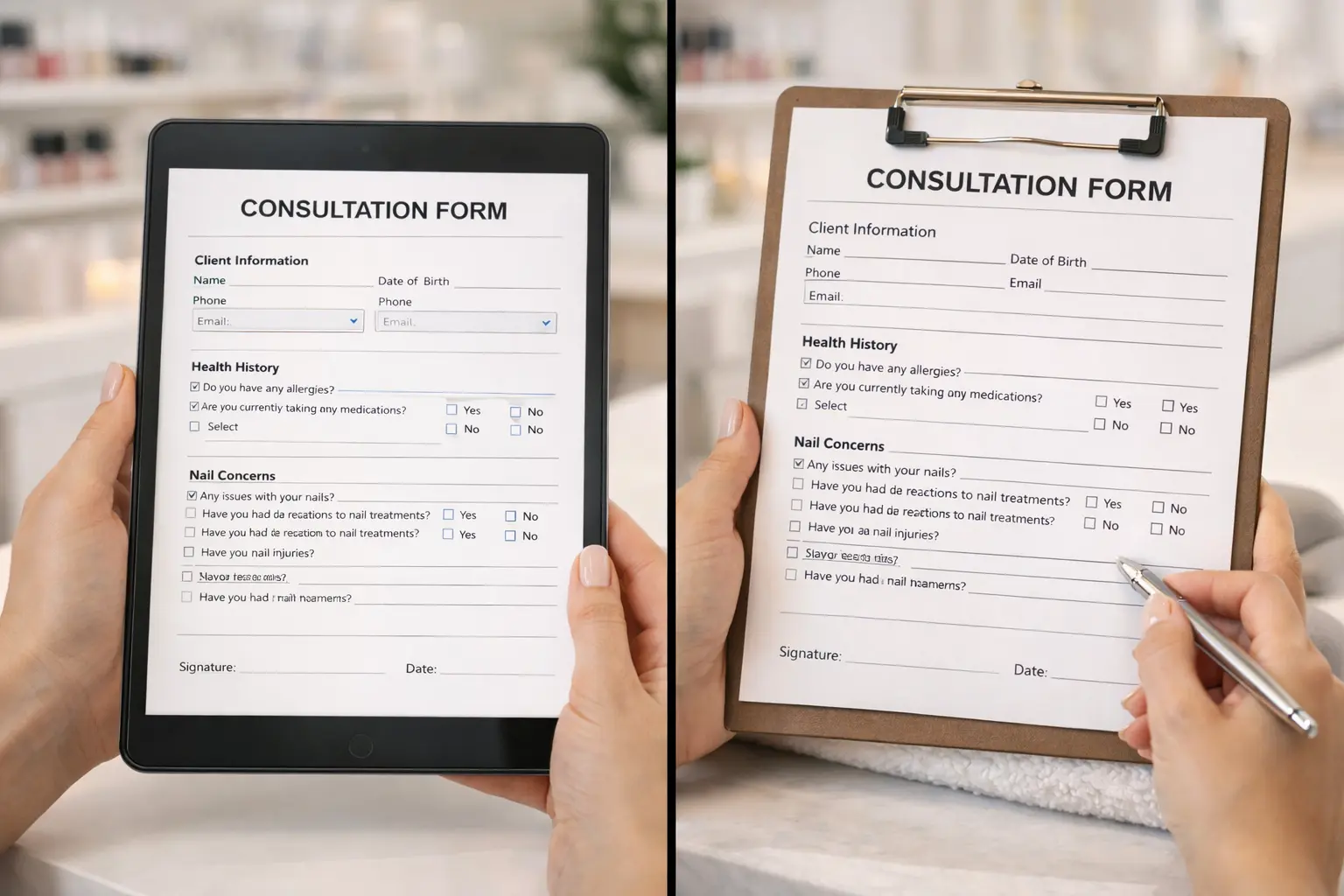
Implementing Consultation Forms in Your Nail Business
Having a professional form template is only the first step—successful implementation requires systematic integration into your client onboarding process and ongoing business operations.
New Client Onboarding Process
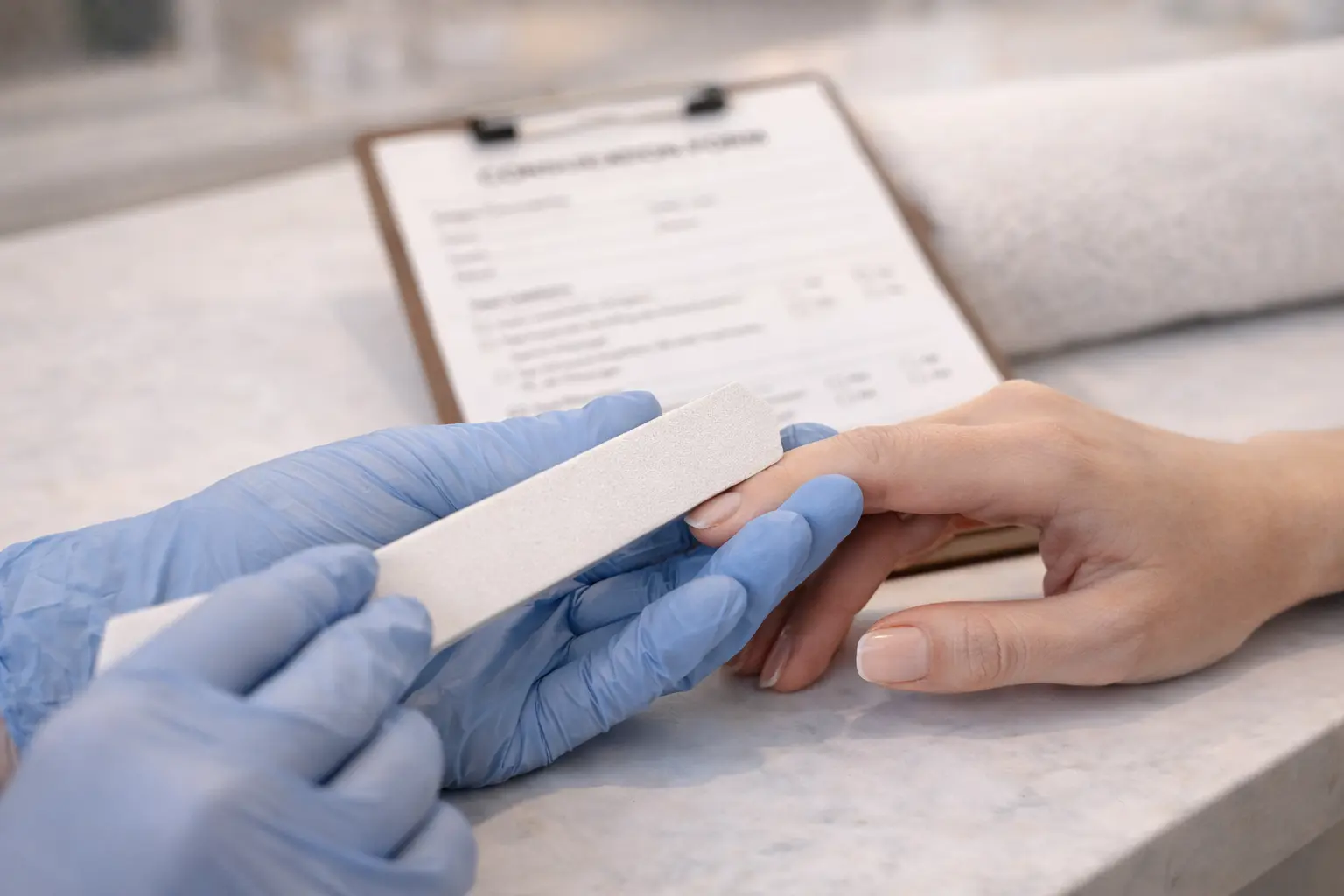
Consultation forms should be completed before the first service begins:
- Digital forms: Send via email or text when appointments are booked, requesting completion before arrival
- Paper forms: Provide immediately upon check-in with comfortable seating for completion
- Review process: Always review completed forms with clients, clarifying any health concerns
- Store securely: File forms in confidential storage compliant with data protection requirements
Returning Client Updates
Consultation forms require periodic review and updates as client circumstances change:
- Regular verification: Most booking systems save client information from previous appointments, allowing clients to review and confirm or update their details at each visit
- Health change protocol: Clients should inform you immediately if health conditions, medications, or allergies change between appointments
- Verbal confirmation at each visit: Brief check-in asking “Has anything changed with your health since your last visit?” before every service
- Document updates: Note any reported changes directly on the consultation form or in the client record with date
⚠️ Never Skip Consultation Forms
Some technicians are tempted to skip consultation forms for “quick” services like simple gel polish changes. This creates inconsistent professional standards and leaves gaps in your protection. Every client, every service, requires documented consultation. If a client develops an allergic reaction during a “quick polish change” and no consultation form exists, demonstrating that you acted appropriately becomes significantly more difficult.
Staff Training on Consultation Forms
If you employ other technicians, consistent consultation form usage requires proper training:
- Why consultation matters: Ensure all team members understand the professional, safety, and business protection reasons behind thorough consultation
- How to review forms effectively: Train staff to identify important health information, contraindications, and situations requiring service modifications or decline
- Client communication skills: Teach tactful ways to discuss sensitive health information and explain service limitations when necessary
- Documentation standards: Establish clear protocols for form completion, storage, update procedures, and confidentiality
- Scenario practice: Role-play challenging situations such as declining services due to health concerns, addressing allergy histories, and managing unrealistic client expectations
Comprehensive staff training on consultation forms ensures consistent professional standards across your entire team and reduces liability risks from inconsistent practices.

Digital vs Paper Forms: Practical Comparison
| Factor | Digital Forms | Paper Forms |
|---|---|---|
| Initial Setup Cost | Free to moderate (depending on platform) | Minimal (printing costs) |
| Ongoing Costs | Subscription fees for premium platforms | Printing and storage supplies |
| Storage Requirements | Cloud-based, no physical space needed | Filing cabinets, physical storage space |
| Accessibility | Accessible from any device with internet | Must be physically present to access |
| Search and Retrieval | Instant search by name, date, keyword | Manual filing system, slower retrieval |
| Backup and Security | Automatic cloud backups, encrypted storage | Manual scanning required for backups |
| Client Convenience | Can complete at home before appointment | Must complete in salon |
| Technology Requirements | Requires devices, internet, client digital literacy | No technology needed |
| Environmental Impact | Minimal paper waste | Ongoing paper consumption |
| Booking System Integration | Seamless integration possible | Manual data entry required |
| Best For | Tech-comfortable clients, high-volume salons, multiple locations | Traditional clients, mobile technicians, backup system |
Hybrid Approach: Many successful salons use both systems—digital forms as the primary method with paper backup forms available for clients who prefer traditional completion or when technology fails.
Client Data Protection and Privacy
Consultation forms contain sensitive personal and medical information, creating legal obligations around data protection and confidentiality.
UK Data Protection Requirements (GDPR)
Under UK GDPR (General Data Protection Regulation), businesses collecting personal information must comply with specific requirements:
- Lawful basis for processing: You must have a legitimate reason to collect and store client health information (legitimate interest for service safety and contractual necessity)
- Transparency: Clients must be informed what data you collect, why you collect it, how it will be used, and how long it will be stored
- Data minimisation: Only collect information genuinely necessary for safe service delivery
- Secure storage: Implement appropriate security measures protecting data from unauthorised access, loss, or damage
- Access rights: Clients have the right to request copies of their stored information
- Correction rights: Clients can request corrections to inaccurate information
- Retention limits: Do not store consultation forms indefinitely—establish reasonable retention periods (typically 6-7 years for service-related records)
Privacy Policy Requirement
Your business should have a clear privacy policy explaining how client data is collected, used, stored, and protected. The professional consultation form course includes guidance on data protection compliance.

Secure Storage Practices
For paper forms:
- Store in lockable filing cabinets in areas not accessible to clients or unauthorised personnel
- Implement a secure check-out system if forms need to be temporarily removed for reference
- Shred forms when retention period expires rather than disposing in regular rubbish
- Consider scanning forms as backup and storing originals in secure off-site location
For digital forms:
- Use password-protected platforms with strong authentication requirements
- Ensure cloud storage providers comply with UK data protection standards
- Limit staff access to consultation forms based on genuine need to know
- Implement regular password changes and never share login credentials
- Enable two-factor authentication where available for additional security
Common Consultation Form Mistakes to Avoid
Even well-intentioned professionals make consultation form errors that undermine the document’s protective value and professional utility.
Mistake 1: Using Generic Templates Without Customisation
Downloaded generic templates often include irrelevant questions or omit nail-specific considerations. Your form should reflect your actual services, common client concerns in nail services, and specific contraindications relevant to nail treatments rather than generic beauty therapy.
Mistake 2: Making Forms Too Long or Too Complex
Consultation forms should be thorough but not overwhelming. Excessive length or overly technical language discourages careful completion. Aim for clarity and brevity whilst covering all essential safety information—typically 2-3 pages maximum for comprehensive coverage.
Mistake 3: Not Reviewing Forms With Clients
Simply handing a form to complete and collecting it without discussion misses the entire purpose. The consultation is a conversation, not just paperwork. Briefly review completed forms with every client, clarifying anything unclear and discussing implications of disclosed information.
Mistake 4: Failing to Update Forms Regularly
Consultation forms completed years ago become increasingly unreliable as client health status changes. Implement systematic annual updates minimum, with verbal confirmation of “no changes” at every appointment between written updates.
Mistake 5: Inconsistent Implementation
Requiring forms for some services but not others, or only for new clients but not returning clients, creates professional inconsistency and gaps in protection. Every client, every time, requires consultation—no exceptions.
Mistake 6: Poor Storage and Retrieval Systems
Consultation forms provide no value if they cannot be found when needed. Implement organised filing systems (alphabetical, numerical client ID, or date-based) that allow quick retrieval. Digital systems should be backed up regularly.
Mistake 7: Ignoring Data Protection Requirements
Leaving consultation forms visible on reception desks, storing them in unlocked drawers, or disposing of them in regular rubbish violates data protection principles and client confidentiality. Treat these documents with the same security as medical records.
⚠️ The Biggest Mistake: Not Using Consultation Forms At All
Some nail technicians—particularly those working from home or offering mobile services—skip consultation forms entirely, relying on verbal questions only. This is professionally inadequate and leaves both client and business unprotected. Verbal consultations are forgotten, misremembered, and impossible to verify if disputes arise. Always use written consultation forms, regardless of where or how you work.
Professional Consultation Form Template & Training
Stop using inadequate generic templates. Get a professionally structured nail consultation form designed specifically for nail technicians and salon owners, complete with:
- ✓ Complete question set covering all essential safety areas
- ✓ Appropriate professional wording that meets documentation standards
- ✓ Digital-ready format for easy adaptation to booking systems
- ✓ Printable version for traditional paper implementation
- ✓ Detailed video guidance explaining why each question matters and how to interpret responses
- ✓ Step-by-step guidance on identifying contraindications and making service decisions
When Consultation Forms Indicate You Should Not Proceed
Consultation forms exist to protect both parties—sometimes they reveal situations where providing nail services would be inappropriate or unsafe.
Clear Contraindications Requiring Service Decline
❌ Active Infections
Visible fungal infections, bacterial infections (paronychia), or viral infections (warts) around the nail area require treatment from a healthcare professional before nail services can proceed. Providing services over active infections spreads contamination, worsens the condition, and puts other clients at risk.
❌ Severe Nail Damage or Disease
Significantly damaged nail plates (extensive splitting, severe onycholysis, trauma-induced detachment) or nail diseases require medical assessment before cosmetic treatments. Nail enhancements cannot repair medical conditions and may worsen underlying problems.
❌ Recent Allergic Reactions to Similar Products
Clients reporting recent severe allergic reactions to gel products, acrylates, or nail system components should not receive services using similar chemistry without comprehensive medical patch testing and clearance. Re-exposure risks increasingly severe reactions.
❌ Unrealistic Expectations Despite Education
If a client insists on services their consultation form reveals are unsuitable (extreme lengths on very weak nails, enhancements over active infections, treatments contraindicated by medical conditions) despite your professional explanation, declining service protects both parties from inevitable dissatisfaction and potential harm.
Situations Requiring Service Modification
Some consultation responses do not require service decline but do require treatment adjustments. Professional consultation form training teaches specific protocols for each situation, but general considerations include:
- Diabetes: Requires extra caution during cuticle work, enhanced sanitation, and client education on infection monitoring
- Blood thinning medication: Requires modified cuticle techniques and immediate response protocols for any bleeding
- Pregnancy: Requires excellent ventilation, potential product modifications, and flexibility for client comfort
- Previous mild product sensitivity: May benefit from HEMA-free alternatives, patch testing, and careful monitoring throughout service
- Very weak or damaged nails: Requires conservative service recommendations, appropriate product selection, and realistic length goals
Each condition requires specific knowledge to make appropriate professional decisions about service delivery, product selection, and client communication.
How to Decline Services Professionally
Refusing service requires tact and clear communication. Professional consultation form training covers appropriate communication strategies for difficult situations whilst maintaining client relationships and protecting your business.

Customising Consultation Forms for Your Specific Services
Whilst core consultation questions remain consistent across nail businesses, specific services may require additional targeted questions.
BIAB and Builder Gel Services
Additional considerations for BIAB and builder gel overlay services:
- Previous experience with gel systems and how nails responded
- History of gel product allergies or sensitivities
- Expectations about nail strength after removal (education opportunity about realistic outcomes)
- Willingness to maintain regular infill appointments
- Understanding that removal requires professional processes (soaking or filing) to prevent damage
Nail Extension Services
Specific questions for clients requesting acrylic, hard gel, or polygel extensions:
- Desired length and whether it is realistic for their natural nail foundation and lifestyle
- Previous extension experience (acrylic, gel, dip powder) and satisfaction with results
- Understanding of maintenance requirements (infills every 2-3 weeks)
- Occupational demands that might affect extension durability
- Realistic discussion of removal methods and commitment required
Russian Manicure and E-File Services
Additional safety screening for dry manicure and e-file work:
- Skin sensitivity and healing response to cuticle work
- Blood clotting concerns or medication affecting healing
- Previous experience with dry manicure techniques
- Understanding that more aggressive cuticle removal has different sensation than traditional wet manicures
Nail Art and Complex Design Services
Questions specific to detailed artistic services:
- Patience for longer appointment duration
- Reference images or design inspiration
- Understanding that intricate art requires additional service time and cost
- Willingness to commit to careful aftercare protecting delicate designs
Integrating Consultation Forms into Booking Systems
Modern salon software platforms offer native consultation form capabilities, streamlining client documentation and reducing administrative workload.
Popular Booking Systems with Form Integration
Fresha (formerly Shedul): Free booking platform with customisable intake forms that clients complete during online booking or via email link before appointments. Forms automatically attach to client profiles.
Phorest: Comprehensive salon management system with detailed consultation form builders, automatic form reminders, and integration with client history and treatment notes.
Zenoti: Enterprise-level platform offering advanced form customisation, conditional logic (questions appearing based on previous answers), and compliance tracking features.
Boulevard: Modern booking system with elegant form design capabilities, client portal access for form updates, and seamless integration with appointment scheduling.
Vagaro: Popular booking platform with form builder functionality, automated form completion reminders, and mobile-optimised client experience.
Ovatu: UK-based booking system with customisable consultation forms, GDPR compliance features, and client self-service form update options.
Implementation Best Practices
- Test thoroughly before client use: Complete the form yourself as a test client to identify any unclear questions or technical issues
- Mobile optimisation essential: Ensure forms display properly on smartphones as majority of clients will complete on mobile devices
- Automatic reminders: Configure system to send form completion reminders 24-48 hours before appointments
- Staff notification: Set up alerts notifying technicians when new forms are submitted requiring review
- Annual update prompts: Programme systems to flag clients due for consultation form updates based on last completion date
- Backup system: Even with digital integration, maintain paper form copies available for technology failures or client preferences
Template Ready for Any System
The professional consultation form from this comprehensive course is designed for easy adaptation to any booking system platform.
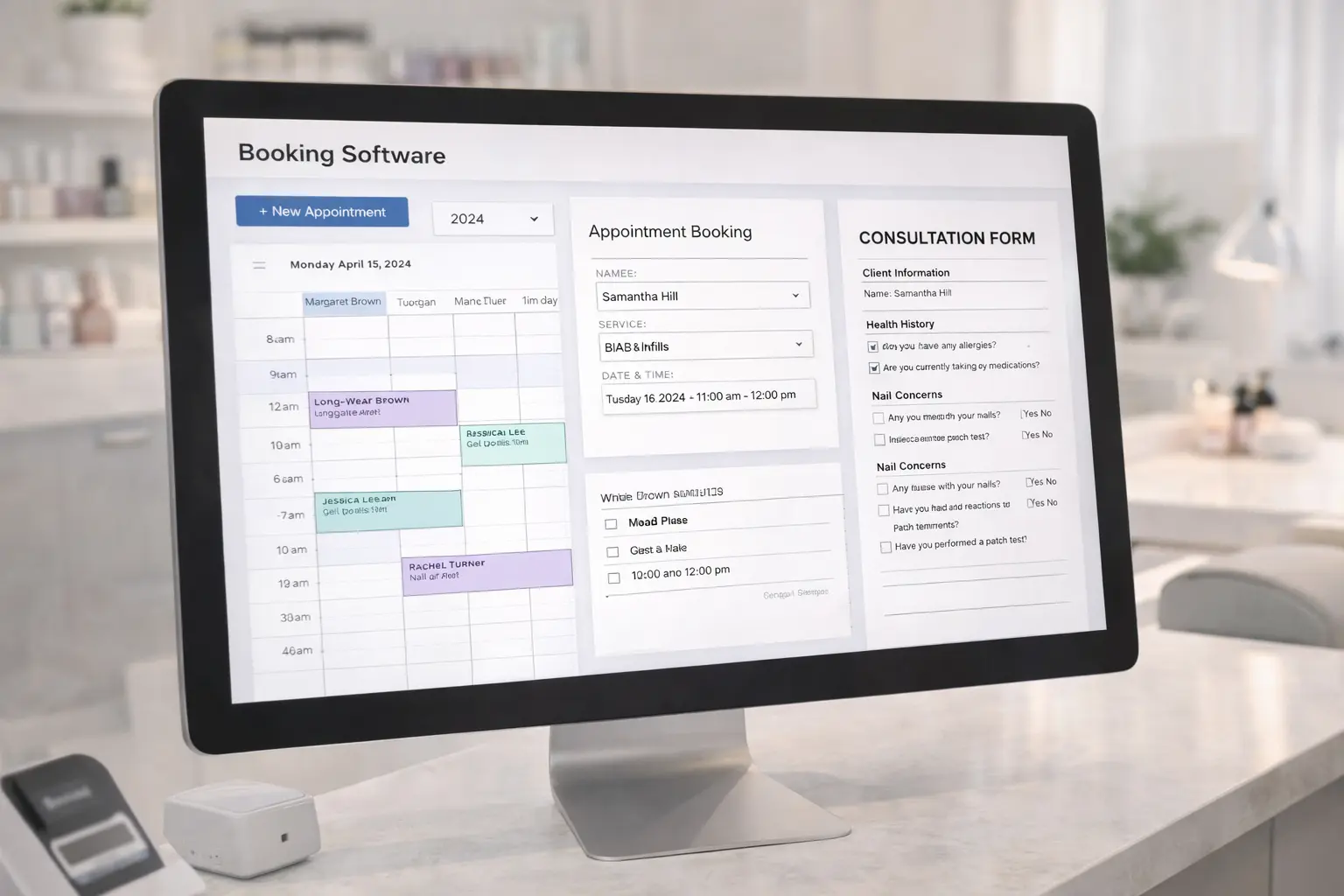
Frequently Asked Questions About Nail Consultation Forms
Do I really need consultation forms for every client?
Yes. Professional consultation forms are essential for every client before every new service, regardless of whether they are new or returning clients. The form demonstrates professional standards, protects both client safety and business liability, and provides documentation if incidents occur. Verbal consultations alone are insufficient and create no permanent record.
What questions must be included in a nail consultation form?
Essential questions include: personal contact information, medical conditions and current medications, known allergies (particularly to nail products), previous nail service history, current nail condition and concerns, service preferences and expectations, and explicit consent statements. Specific services may require additional targeted questions beyond these foundations.
Should consultation forms be digital or paper?
Both formats are professionally acceptable. Digital forms offer convenience, automatic storage, and booking system integration. Paper forms work universally without technology dependence and suit clients preferring traditional processes. Many successful businesses use hybrid approaches—digital primary with paper backup. Choose based on your client demographic, business setup, and operational preferences.
How do I integrate consultation forms into my booking system?
Most modern booking platforms (Fresha, Phorest, Zenoti, Boulevard, Vagaro, Ovatu) include native form builder capabilities. You can create customised consultation forms within these systems that clients complete during online booking or via automated email links before appointments. Forms automatically attach to client profiles for easy reference and comply with data protection requirements through platform security measures.
How long should I keep completed consultation forms?
Recommended retention period for service-related documentation in the UK is 6-7 years from the date of last service. This timeframe aligns with potential legal claim limitation periods. After retention period expires, securely destroy paper forms (shredding) or permanently delete digital records in compliance with GDPR requirements.
What do I do if a client refuses to complete a consultation form?
If a client refuses consultation form completion, you should decline to provide services. Explain that consultation is a professional requirement for client safety and business protection, not optional paperwork. Most clients understand when reasoning is clearly communicated. Clients refusing basic safety documentation are high-risk from liability perspective—protecting yourself by declining service is appropriate.
Can I use a generic beauty therapy consultation form for nail services?
Generic templates often omit nail-specific considerations and include irrelevant questions for other beauty treatments. Your consultation form should reflect actual nail services offered, common contraindications specific to nail treatments (gel allergies, nail infections, conditions affecting nail plate health), and realistic expectation discussions relevant to nail enhancements. Nail-specific forms demonstrate specialised professional knowledge.
How often should returning clients update their consultation forms?
Minimum annual updates are recommended even if health status appears unchanged. Additionally, request immediate notification if health conditions, medications, or allergies change between scheduled updates. Brief verbal confirmation (“Has anything changed with your health since last visit?”) at every appointment provides interim monitoring between written updates.
What information is too sensitive to include on consultation forms?
Consultation forms should collect only information genuinely necessary for safe service delivery. Avoid questions about unrelated medical history, sexual health, detailed mental health information, or other personal matters not directly affecting nail service safety or contraindications. Data minimisation principle requires collecting only essential information with clear service-safety justification.
Do consultation forms protect me from being sued?
Consultation forms do not provide absolute legal immunity, but they significantly strengthen your defence by demonstrating that you: conducted appropriate safety screening, identified and documented potential contraindications, obtained informed consent, and followed professional standards. In disputes, consultation forms provide evidence you acted responsibly and professionally—without them, proving duty of care becomes substantially more difficult.
How do I store consultation forms securely and comply with GDPR?
Paper forms require storage in lockable filing cabinets in areas not accessible to unauthorised persons, with secure disposal (shredding) after retention period. Digital forms should use password-protected platforms with appropriate encryption, restricted staff access based on genuine need, and compliance with UK data protection standards. Both methods require privacy policy explaining data collection, use, and storage practices to clients.
What if a client has a medical condition I have never heard of?
If a client discloses an unfamiliar medical condition, do not guess implications or proceed assuming it is irrelevant. Politely ask the client to explain how the condition affects them, research the condition if time allows, or defer service until you can verify with the client’s healthcare provider whether nail treatments are appropriate. Professional responsibility requires understanding contraindications—not simply collecting information and ignoring it.
Should I charge for consultation appointments?
Most nail businesses include consultation as part of the first service appointment rather than charging separately. However, extended consultations for complex cases (severe nail damage requiring multiple service options discussion, allergy concerns requiring detailed product review) can justifiably be treated as separate paid appointments, particularly if significant professional time is required before services can be scheduled.
Can clients complete consultation forms at home before their appointment?
Yes, particularly with digital forms. Many booking systems automatically email consultation forms when appointments are booked, allowing completion at client convenience before arrival. This approach saves in-salon time and allows clients to gather information (medication names, detailed health history) without time pressure. However, always briefly review completed forms with clients in person before starting services to clarify any concerns.
What is the difference between a consultation form and a consent form?
A consultation form gathers health information and client history to determine service suitability. A consent form documents that the client understands and agrees to the proposed treatment. Professional nail consultation forms typically combine both functions—health screening questions plus explicit consent statements—creating comprehensive documentation in one document rather than requiring separate forms.
Building Professional Standards Through Proper Consultation
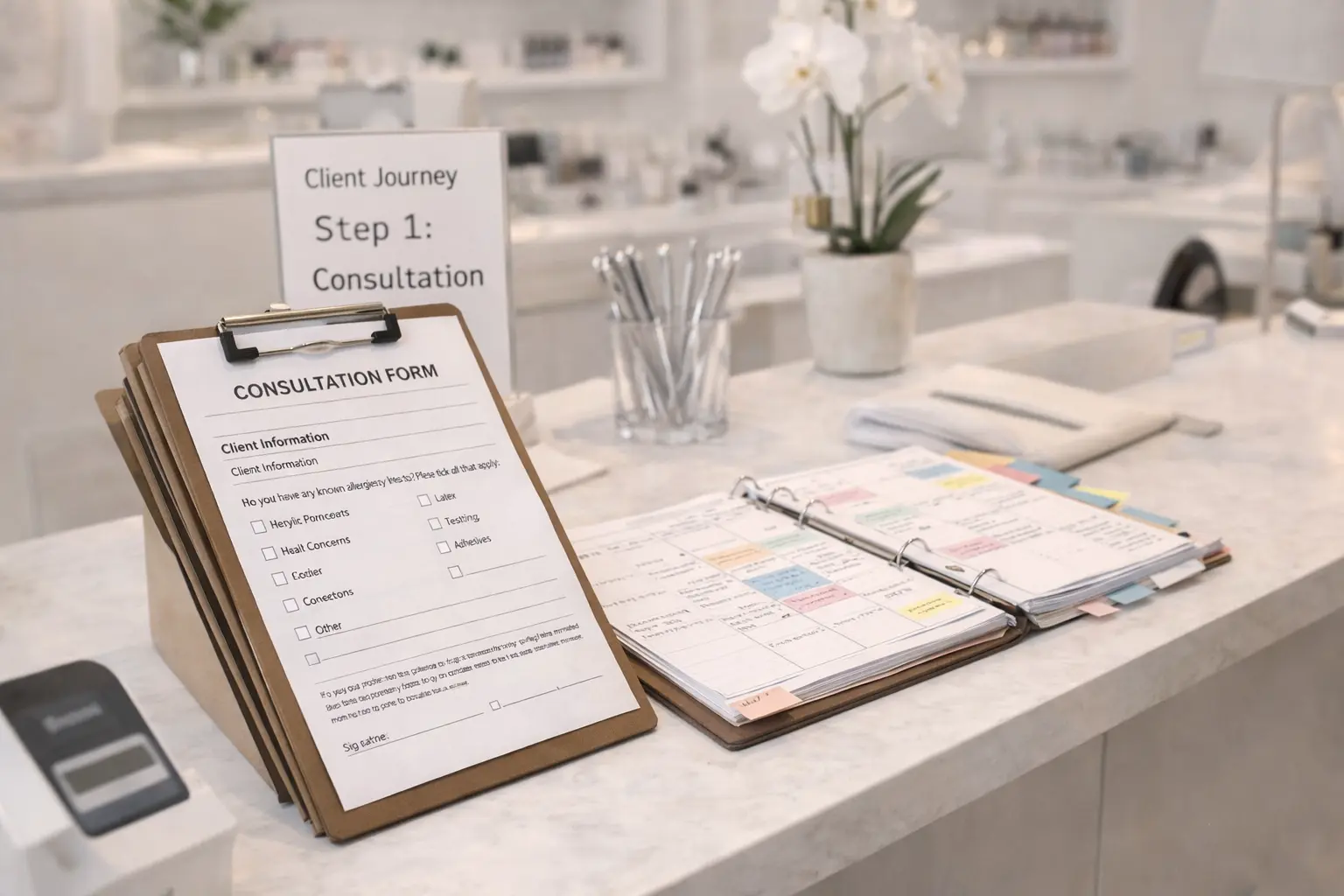
Consultation forms represent far more than administrative paperwork—they are the foundation of professional nail services, demonstrating that you understand and fulfil your duty of care to every client.
A well-structured consultation process protects your clients by identifying contraindications before problems occur, protects your business by documenting professional standards, and protects your reputation by establishing you as a knowledgeable, responsible practitioner who takes safety seriously.
Every professional nail technician and salon owner should implement comprehensive consultation forms as standard practice, regardless of business size, service type, or years of experience. The small investment of time in proper consultation prevents significant problems whilst building client trust and professional credibility.
Ready to Implement Professional Consultation Forms?
Stop using inadequate templates or skipping consultation entirely. Access a professionally designed nail consultation form system complete with:
- ✓ Complete, professionally structured template ready to use immediately
- ✓ Detailed video guidance explaining every question’s purpose and importance
- ✓ Step-by-step training on interpreting client responses and identifying contraindications
- ✓ Both digital and printable format options for any business setup
- ✓ Professional wording that meets documentation standards
- ✓ Guidance on exactly when to proceed, modify, or decline services based on health information
Access Professional Consultation Form Course →
Lifetime access • Immediate download • Professional certificate • Start protecting your business today
Looking to perfect your technical skills alongside professional business practices? Explore comprehensive nail education at Artistic Touch – Nail Training Academy.
About the Author: This guide was created by Radina Ignatova, Professional Nail Expert and Founder of Artistic Touch – Nail Training Academy, based in Dundee, Scotland, UK. Radina specialises in professional nail education, client safety protocols, and business protection strategies for nail technicians and salon owners.
About TheNailWiki: TheNailWiki provides free, evidence-based nail education to nail professionals and enthusiasts worldwide. Our content is written by experienced professionals and designed to build knowledge, improve professional standards, and support safe, ethical nail care practices.