Sandwich Dual Form Bottom Placement: Safe Application Method
By Radina Ignatova, Professional Nail Expert | Last Updated: April 2026
Quick Summary
Sandwich dual form bottom placement requires placing the form under the nail first, then applying minimal gel product to secure it—not flooding the form with product before placement. The flooding method commonly demonstrated online creates three serious problems: direct skin contact with uncured gel (increasing sensitisation risk), a built-in ridge that appears after two to three weeks of growth, and increased lifting risk. The safe method eliminates all three issues by controlling exactly where product is placed and ensuring no gel contacts the hyponychium or lateral nail folds.
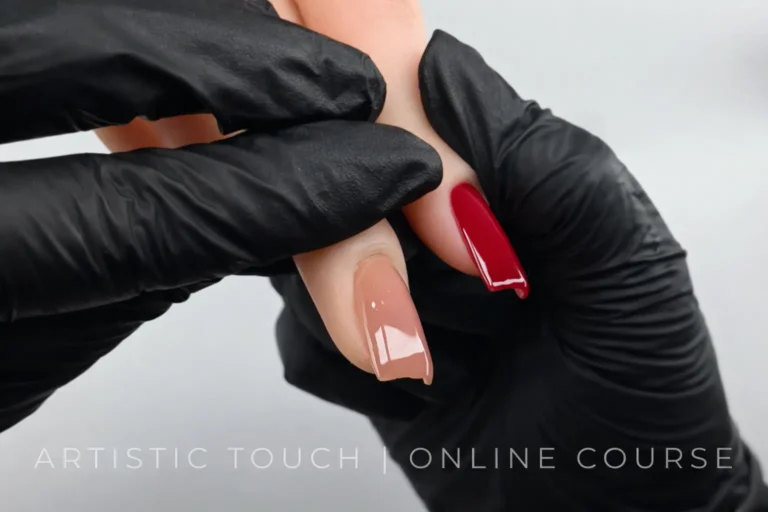
Demonstration of correct versus incorrect sandwich dual form bottom placement technique
© TheNailWiki
Contents
Sandwich dual forms offer precise control over nail enhancement structure when applied correctly. The bottom form placement technique, however, represents the most critical safety checkpoint in the entire system. Incorrect placement creates direct contact between uncured gel and living tissue, establishing conditions for potential contact sensitisation whilst simultaneously compromising structural durability.
The flooding method—applying excess gel product to the bottom form before placement—appears frequently in online demonstrations because it photographs well and creates visually clean top surfaces. Professional assessment of the underside, however, reveals three predictable problems: gel pushed into the hyponychium, product contact with lateral nail folds, and excess material accumulation that creates structural weakness. Each problem stems from the same technical error: attempting to use product volume to achieve what should be accomplished through mechanical positioning.
Understanding correct bottom form placement requires examining why the unsafe method fails, what the timing of product application affects, and how the safe technique eliminates all three failure modes whilst maintaining structural integrity. This knowledge forms the foundation for consistent, safe sandwich dual form application across varying nail conditions and client presentations.
The Unsafe Flooding Method
The flooding technique involves applying gel product to the sandwich dual form bottom before positioning it under the natural nail. Technicians load the form with what they judge to be an appropriate amount of product, then press the form into position and cure. From the top view—the angle shown in most tutorial photographs—the result appears clean, with product distributed evenly across the visible nail surface.
Examination of the underside tells a different story. The act of pressing a gel-loaded form onto the nail forces product outward in all directions. Physics dictates that this product must go somewhere. It travels to the areas of least resistance: the gap between the form and the hyponychium, and the spaces along the lateral nail folds where the form meets the sidewalls.
This creates direct contact between uncured gel and living tissue. The gel remains in contact with skin throughout the entire flash cure and subsequent building process. Even if visible excess is wiped away from the top surface, product trapped underneath and along the sides maintains skin contact. This extended exposure increases sensitisation risk, particularly for clients with existing sensitivities or those who receive frequent nail services.
Safety Warning
Uncured gel product contacting the skin creates potential for contact sensitisation. Professional nail services must avoid all unnecessary skin contact with enhancement products. The flooding method violates this fundamental safety principle by design rather than by accident. Understanding proper contraindications and safety protocols is essential for responsible professional practice.
The structural consequences emerge as the enhancement grows out. That excess product underneath creates a thick ridge at the junction between the enhancement and the natural nail. This ridge becomes visible and palpable within two to three weeks of growth. More significantly, it creates a stress concentration point where the rigid product layer meets the flexible natural nail. This stress often manifests as lifting, typically beginning at the sidewalls or tip where the excess accumulation is greatest.
Why Product Placement Timing Matters
The critical difference between safe and unsafe sandwich dual form application lies not in the amount of product used, but in when that product is applied. This timing determines where the product can travel and what surfaces it contacts during the application process.
When product is applied to the form before placement, it exists as a mobile liquid with no constraints on its movement. Pressing the form into position under the nail creates hydraulic pressure that forces this liquid outward. The technician cannot control this movement through finger pressure or form positioning. The gel will travel to areas of lower pressure regardless of technique refinement or experience level.
The gel has not yet cured, so it maintains full mobility throughout positioning. Even after the form appears correctly seated, product continues to spread into gaps and spaces. It contacts the hyponychium, flows along the lateral folds, and accumulates in any irregular spaces created by the nail’s natural contours. This product remains in contact with tissue until the flash cure polymerises it into solid form.
Contact time matters for sensitisation risk. Brief contact during product application represents lower risk than extended contact throughout a curing cycle. The flooding method maximises contact time by design. The gel sits against skin for the entire duration of form positioning, adjustment, flash curing, and subsequent building steps. This extended exposure creates conditions for sensitisation that brief, controlled contact does not.
The Safe Sandwich Dual Form Method
The safe technique reverses the sequence of operations. The bottom sandwich dual form is placed under the nail without any product on it. The technician positions the form using finger pressure to ensure proper alignment and contact with the natural nail plate. This mechanical positioning creates the foundation for secure attachment without relying on product volume.
Once the form sits correctly positioned, a minimal amount of gel product is applied at the junction between the form and the natural nail plate. This product serves one function: to secure the form in position during the building process. It is not creating structure, filling gaps, or establishing adhesion to surrounding tissue. It simply joins two surfaces that are already in mechanical contact.
The amount of gel required is substantially less than most technicians initially estimate. A single small drop typically provides sufficient adhesion. The goal is surface-to-surface bonding, not gap filling or foundation building. After application of this minimal product amount, the form is flash cured immediately to set it in position.
Step-by-Step Safe Application Protocol
- Select and prepare the bottom sandwich dual form according to nail size and shape requirements
- Position the form under the natural nail without any product, ensuring proper alignment and contact
- Secure the form with finger pressure to establish mechanical positioning before product application
- Apply minimal gel product (single small drop) at the junction between form and nail plate only
- Flash cure immediately to set the form in position before proceeding with building
- Verify clean underside with no product contact at hyponychium or lateral folds
This method eliminates skin contact when executed correctly. The gel touches only the natural nail plate and the sandwich form surface. The underside remains clean, with no product pushed into the hyponychium or along the lateral nail folds. The enhancement can grow out without developing the characteristic ridge created by excess product accumulation. Structural integrity is maintained through proper mechanical positioning rather than compensatory product volume.
What Technicians Struggle With Most
The sandwich dual form system requires precision across three interconnected skill areas: product control, form positioning, and flash curing technique. Difficulties arise when these elements are treated as independent actions rather than as components of an integrated sequence.
Product Control
Product control means using the minimum amount necessary to achieve secure attachment without creating excess that recreates the flooding problem. Technicians transitioning from the flooding method often apply too much product initially, as they have learned to rely on product volume rather than mechanical positioning for security.
The adjustment requires recalibrating expectations about how much gel is actually needed. A properly positioned form requires surprisingly little product for secure attachment. Excess product applied after placement still creates problems, though typically less severe than flooding before placement. The goal is precise application of minimal product to achieve the singular objective of securing the form during building.
Form Positioning
Form positioning requires understanding how the sandwich dual form should sit relative to the natural nail’s architecture. The form must follow the nail’s natural curve without creating gaps, but it cannot press so tightly that it distorts the nail plate or creates excessive pressure on the nail bed.
This balance becomes automatic with practice, but initial attempts typically position the form either too loosely or too tightly. Loose positioning creates gaps that would traditionally be filled with excess product. Tight positioning creates discomfort and potential nail bed trauma. The correct middle ground requires tactile feedback and visual assessment that develop through repetition across varying nail anatomies.
Flash Curing Technique
Flash curing determines whether the form remains securely positioned during the building phase. Insufficient curing leaves the attachment gel in a partially polymerised state, allowing the form to shift when top layer product is applied. This shifting recreates alignment problems and can introduce product into areas where skin contact becomes possible.
Over-curing creates a different problem: excessive heat generation that causes client discomfort or, in extreme cases, thermal nail bed damage. The flash cure duration must be calibrated to the specific combination of lamp output and gel formulation being used. Standard manufacturer recommendations provide starting points, but individual systems may require adjustment based on actual performance testing.
Real Nail Application Standards
Professional nail services operate under conditions that tutorial demonstrations can control or eliminate. Real nails present variables that affect every application decision: differing nail plate flexibility between clients, varying moisture content that affects product adhesion, natural oils that must be managed without complete dehydration, and clients who cannot remain perfectly motionless throughout extended procedures.
The safe sandwich dual form placement method works consistently across these variables because it relies on mechanical positioning rather than product volume. A properly positioned form remains secure regardless of individual nail characteristics. Product volume cannot compensate for poor positioning, but correct positioning requires minimal product to function effectively.
This principle distinguishes professional technique from demonstration technique. Professional work must succeed under variable, uncontrolled conditions. Demonstration work can be optimised for visual appeal under controlled circumstances. Techniques that look impressive on camera but require perfect conditions to function safely do not translate to consistent professional practice. The flooding method represents exactly this pattern: it photographs beautifully but creates predictable problems under real service conditions.
Professional Training Resources
Correct bottom form placement represents one component within the complete sandwich dual form system. Full professional competence requires understanding form selection and sizing protocols, top form placement and alignment techniques, product application and distribution strategies, curing schedules and heat management, and finishing procedures that preserve structural integrity whilst achieving aesthetic requirements.
Each system component interacts with the others. Correct bottom placement delivers results only when combined with appropriate top form technique. Precise product control becomes ineffective if curing protocols create incomplete polymerisation. The sandwich dual form system functions as an integrated whole rather than as a collection of isolated techniques that can be mixed and matched according to preference.
Professional Training
Comprehensive training on sandwich dual form systems, including bottom placement protocols, product control techniques, and structural integrity principles, is available through structured professional courses designed for nail technicians seeking safe, consistent application methods.
Professional education addresses not only what techniques to use, but why those techniques work, when they fail, and how to adapt them to varying client presentations and service conditions. Understanding the principles behind procedures enables technicians to troubleshoot problems, modify approaches for individual circumstances, and maintain safety standards across all applications rather than achieving success only under ideal conditions.
Related Articles
-
Dual Forms: Complete Professional Guide
Comprehensive overview of dual form systems, types, and applications
-
Contact Sensitisation and Nail Allergies
Understanding sensitisation mechanisms and prevention protocols
-
Contraindications in Nail Services: Complete Safety Guide
Professional safety protocols and client assessment procedures
-
Professional Nail Consultation Forms
Client consultation protocols and documentation requirements
Frequently Asked Questions
Why does the flooding method create skin contact issues?
When gel product is applied to the form before placement, pressing the form onto the nail creates hydraulic pressure that forces the uncured gel outward in all directions. This product travels to areas of least resistance: the hyponychium and lateral nail folds. The gel maintains direct contact with living tissue throughout positioning, adjustment, and curing, creating extended exposure that increases sensitisation risk.
How much gel product should be used to secure the bottom form?
A single small drop of gel typically provides sufficient adhesion when the form is properly positioned mechanically. The product serves only to secure the form during building—it is not creating structure or filling gaps. Proper mechanical positioning of the form against the natural nail reduces product requirements to minimal amounts, eliminating the need for volume-based attachment methods.
What causes the ridge that appears after two to three weeks of growth?
Excess product underneath the nail from flooding creates a thick ridge at the junction between the enhancement and natural nail. This high concentration of rigid product cannot flex at the same rate as the natural nail during everyday use, creating a visible and palpable step as the nail grows. This ridge often becomes the initiation point for lifting as stress concentrates at the junction.
Can the safe method be used with all gel formulations?
The placement-first method works across gel formulations because it relies on mechanical positioning rather than product-specific properties. Flash cure timing may require adjustment based on the specific gel viscosity and lamp output, but the fundamental sequence—position form first, apply minimal securing product, cure immediately—remains consistent regardless of product brand or formulation type.
How do you know if the form is positioned correctly before applying product?
Correct positioning is achieved when the form follows the natural nail curve without gaps, sits snugly without creating excessive pressure, and maintains alignment parallel to the nail’s natural growth direction. Visual assessment from multiple angles combined with tactile feedback from finger pressure confirms proper positioning. The form should feel stable and secure through mechanical contact alone before any product is applied.
What should you do if the form shifts during the building process?
Form shifting during building indicates either insufficient flash curing of the securing product or inadequate initial positioning. The enhancement should be removed, the nail re-prepped, and the bottom form repositioned with attention to both mechanical placement and appropriate flash cure duration. Attempting to continue with a shifted form creates structural problems and often results in skin contact that should have been prevented.
Does the safe method take longer than the flooding method?
Initial application may take slightly longer as technicians adjust to the new sequence and develop precision in minimal product application. With practice, the safe method becomes faster than flooding because it eliminates the need to clean excess product from underneath and sidewalls. More importantly, it prevents the lifting and ridge formation that require early rebalancing appointments, reducing long-term service time.
Can you switch to the safe method mid-service on a client who has existing enhancements?
The safe method can be implemented at any rebalancing or fill appointment. Existing enhancements applied with the flooding method will need to grow out naturally, but all new growth and fresh enhancements can be executed with correct placement technique. Clients often notice improved comfort and durability even when existing enhancements remain on some nails whilst new applications use the safer method.
Professional Disclaimer
This educational content is designed for qualified nail technicians and students in professional training programmes. Sandwich dual form application requires proper training in product chemistry, nail anatomy, and safety protocols. All nail enhancement services should be performed by trained professionals following current health and safety regulations. Clients with nail or skin conditions should consult healthcare professionals before receiving services. This information does not constitute medical advice.
About the Author
Radina Ignatova is a Professional Nail Expert since 2014 and International Nail Educator based in Scotland, United Kingdom. She is the Founder of Artistic Touch Nail Training Academy and TheNailWiki, specialising in professional nail education with focus on BIAB systems, dual form techniques, advanced E-File work, and Russian Manicure.
Radina’s teaching philosophy centres on honest education: showing real salon challenges, real mistakes, and real performance testing rather than idealised demonstrations. Her professional training programmes serve qualified nail technicians seeking to advance their technical skills through safety-led, professionally informed education.
TheNailWiki is an educational resource providing safety-led and professionally informed nail care information for technicians, students, and clients. All content is written from professional nail industry experience and practice.
© 2026 TheNailWiki