
Onychocytes: The Cells That Build the Nail Plate
Author: Radina Ignatova – Nail Expert, International Nail Educator | Last Updated: July 2026
Quick Answer: Onychocytes are the fully keratinised cells that make up the nail plate — flattened, non-living units with no nucleus or internal organelles, produced continuously by the nail matrix. What is less often explained is how they are arranged: rather than sitting as a single uniform sheet, onychocytes overlap in flattened, closely interlocking layers, similar to shingles or flagstones. This overlapping arrangement is a large part of why the nail plate behaves the way it does under filing, hydration change, and product application.
What Onychocytes Are
An onychocyte is a single unit of fully keratinised nail plate — a cell that has completed the transformation described on the Keratinisation Process page. By the time a cell reaches this state, it has lost its nucleus and internal organelles, flattened, and filled with cross-linked keratin protein. The full chemistry of what onychocytes are made from — the keratin types involved, the sulphur cross-links, and the intercellular cement that holds them together — is covered in detail on the Nail Plate page.
What matters for this page is simpler: the nail plate is not one continuous, uniform slab of material. It is built from a very large number of individual onychocytes, and how those individual units are arranged relative to each other has real, practical consequences.
How Onychocytes Are Arranged
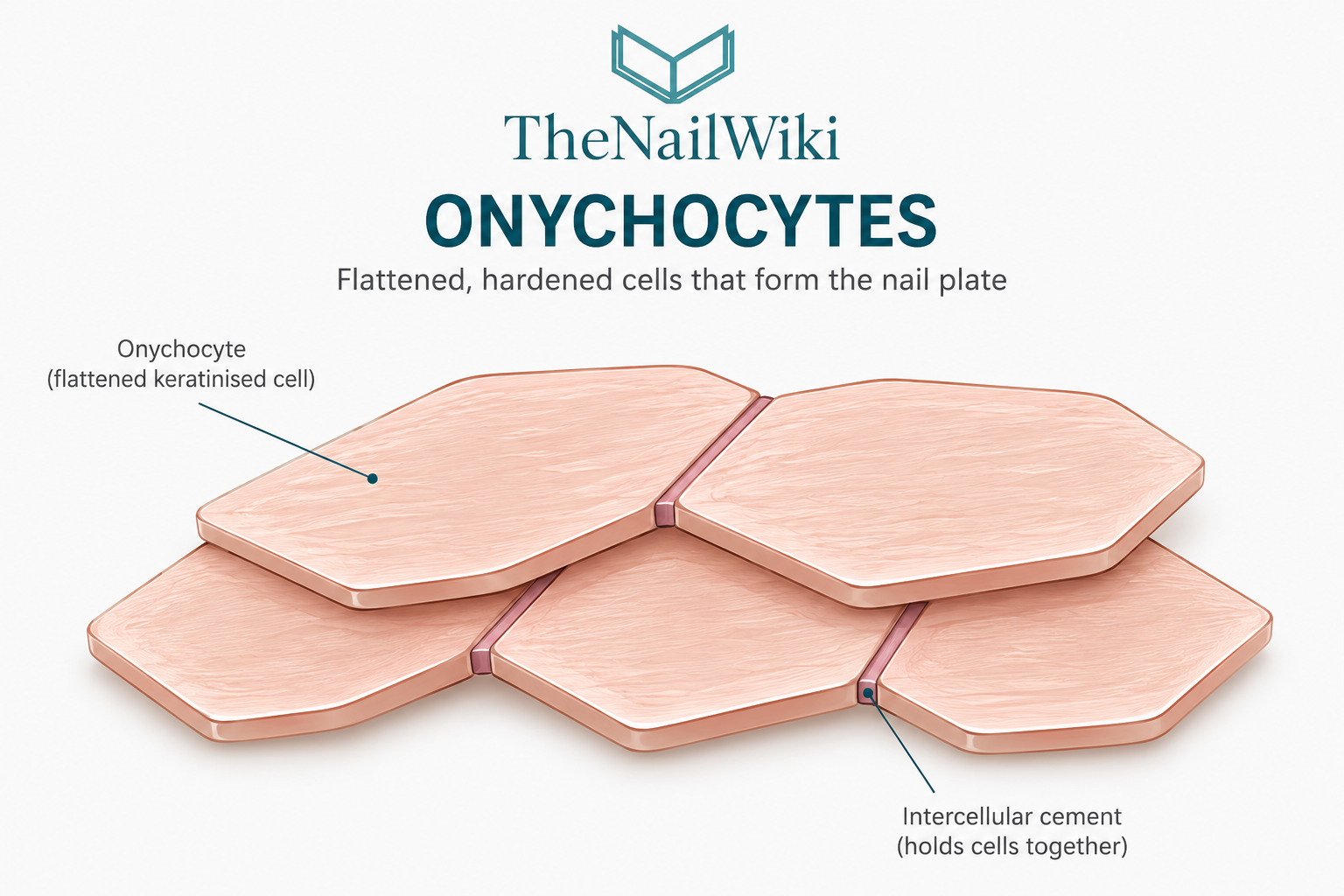
Onychocytes are flat, broad, and thin — closer in shape to a scale or a flagstone than to a typical rounded cell. Within the nail plate, they do not sit end to end in a single row. Instead, they overlap extensively with their neighbours, in a closely interlocking pattern similar to roof shingles or overlapping flagstones.
© TheNailWiki
This overlapping arrangement is repeated through the thickness of the plate, and the orientation of the cells differs between different depths of the plate — which is one of the main reasons the nail plate is described as layered rather than uniform. A structure built from many overlapping, interlocking units behaves differently under force than a single continuous sheet would: stress is distributed across many small overlapping joints rather than concentrated in one place, and a crack or split affecting one part of the structure does not automatically continue through the material beneath or above it in the same direction.
Why This Still Matters, Even Though the Cells Are Dead
It is easy to assume that because onychocytes are non-living, their individual structure is not particularly relevant to nail practice. The opposite is closer to the truth. Nail plate behaviour — how it responds to filing, how readily it takes up or loses water, and how well a product can bond to its surface — is determined largely by this cell-level structure, not by any ongoing biological activity.
The overlapping arrangement of onychocytes, and the intercellular material that holds them together, forms the actual surface that enhancement products need to bond to. This is one reason why nail plate preparation matters as much as it does — surface oils, residual moisture, or an uneven surface interfere with how well a product can engage with this cell-level structure, independent of anything the product itself is capable of.
Frequently Asked Questions
What is an onychocyte?
An onychocyte is a fully keratinised cell of the nail plate — a flattened, non-living unit with no nucleus or internal organelles, produced by the nail matrix and compacted together with other onychocytes to form the finished nail plate.
Are onychocytes alive?
No. By the time a cell is properly described as an onychocyte, it has already lost its nucleus and internal organelles and has no remaining biological activity. The nail matrix, which produces these cells, is living tissue — the finished onychocytes are not.
How are onychocytes arranged in the nail plate?
Onychocytes are flat and broad, and they overlap extensively with neighbouring cells in a closely interlocking pattern, similar to shingles or flagstones. This arrangement is repeated through the thickness of the plate, with orientation differing between the plate’s different layers.
Why does onychocyte arrangement matter for nail technicians?
The overlapping cell structure is the actual surface that enhancement products bond to. Surface oils, residual moisture, or an uneven surface interfere with how well a product can engage with this structure, which is a large part of why thorough nail plate preparation affects service performance.
Are onychocytes the same throughout the nail plate?
No. Their orientation and arrangement differ between the nail plate’s different layers, which contributes to the plate being described as a layered structure rather than a single uniform sheet.
Continue Your Professional Learning
Understanding how onychocytes are arranged explains why nail plate preparation has such a direct effect on adhesion and product performance. If you would like to see how this cell-level structure translates into real service outcomes, continue your learning below.
🎓 Professional Training
New to Artistic Touch?
🎁 Free Mini Classes — Why Your Nails Do Not Last
Related Library Pages
Nail Anatomy
Nail Science & Mechanics
Professional Disclaimer
This page is provided for professional educational purposes and describes the general cellular structure of the nail plate. It is not a diagnostic resource. Persistent or unexplained nail changes should be assessed by a qualified medical professional.
About the Author
Radina Ignatova
Professional Nail Expert | International Nail Educator
Radina Ignatova is a Professional Nail Expert since 2014, International Nail Educator, and Founder of TheNailWiki and Artistic Touch Nail Training Academy. She specialises in Russian Manicure, dual form systems, polygel, advanced e-file techniques, and nail safety protocols, and continues to work actively in salon practice, ensuring that all education reflects real client scenarios and current industry standards.
Her teaching philosophy is built on honest education — showing real salon challenges, real mistakes, and real performance testing rather than presenting only perfect demonstrations. This is how genuine technical competence is developed and how nail professionals become truly confident and capable.
Read full bio →© 2026 TheNailWiki. All rights reserved.