
The Nail Matrix: What It Is, What It Does and Why It Matters
Author: Radina Ignatova, Professional Nail Expert & International Nail Educator | Last Updated: March 2026
Quick Summary
The nail matrix is the living tissue responsible for producing the nail plate. It sits beneath the proximal nail fold at the base of the nail and is the only part of the nail unit capable of generating new nail plate cells. The pale crescent visible at the base of some nails — the lunula — is the visible portion of the matrix.
For nail professionals, the matrix is the most important structure in the nail unit to understand and protect. Any damage to it — from trauma, aggressive filing near the base, infection, or inflammatory disease — can permanently alter the quality, shape, and thickness of the nail plate it produces.
Contents
- What Is the Nail Matrix?
- Where Is It and What Does It Look Like?
- What Does the Nail Matrix Do?
- The Lunula — the Visible Part of the Matrix
- The Matrix and Nail Growth
- What Happens When the Matrix Is Damaged?
- What This Means in the Salon
- Conditions That Affect the Nail Matrix
- Common Misconceptions
- Frequently Asked Questions
What Is the Nail Matrix?
The nail matrix is the specialised tissue that produces the nail plate. It is a living, actively dividing zone of cells located at the base of the nail unit, tucked beneath the proximal nail fold. Every single cell in the nail plate — every layer of keratin from the root to the free edge — originated in the nail matrix.
Unlike the nail plate itself, which is inert once formed, the matrix is living tissue with a blood supply and nerve endings. It is constantly active — producing new cells, pushing the existing plate forward, and determining the thickness, shape, and surface quality of everything the nail plate becomes. If the nail plate is the product, the matrix is the factory. And like any factory, what comes out is entirely dependent on the condition of the machinery inside.
The matrix is also the reason that nail damage can be either temporary or permanent. Surface damage to the nail plate — scratches, thinning from filing, peeling — will resolve as the plate grows out, because the matrix that produces it is unaffected. But damage to the matrix itself tells a very different story. If the matrix cells are injured, scarred, or destroyed, their ability to produce a structurally normal nail plate is reduced or lost — and that change can be lasting.
Where Is It and What Does It Look Like?
The nail matrix sits at the very base of the nail unit, hidden beneath the proximal nail fold — the fold of skin you see at the bottom of the nail. From the outside, you cannot see the matrix directly. What you can sometimes see is the lunula — the pale, half-moon shaped area at the base of the nail plate — which is the most forward portion of the matrix showing through the plate above it.
The matrix extends further back under the proximal nail fold than most people realise. It is not simply a thin line at the nail base — it occupies a meaningful depth beneath that skin fold, which is precisely why aggressive work in this zone carries risk. Tools, files, or pressure applied too close to or beneath the proximal nail fold are working in the immediate vicinity of the matrix, whether the technician is aware of it or not.
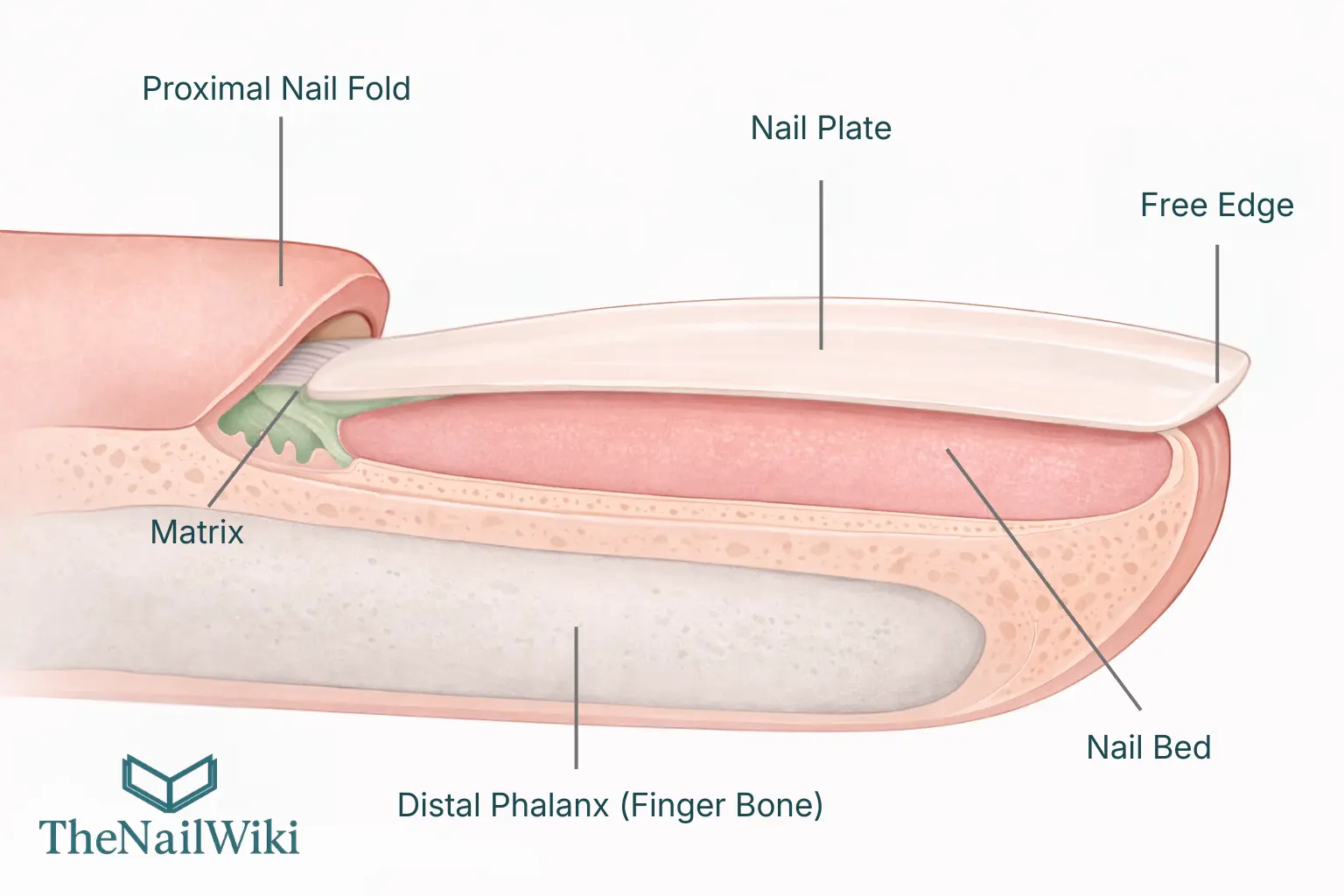
The size of the matrix varies between individuals and between digits on the same hand. A larger matrix generally produces a wider, thicker nail plate; a smaller matrix produces a narrower one. This is one reason nail plate dimensions vary so much between people — it is not simply genetics determining the shape of the finished plate, but the size and output capacity of the matrix producing it.
What Does the Nail Matrix Do?
The matrix has one primary job: to produce the nail plate. It does this through a continuous process of cell division and keratinisation. Matrix cells divide, multiply, and then progressively flatten and harden as they are pushed forward and outward. By the time they reach the nail plate proper, they have lost their nucleus and internal structures entirely — they are now fully keratinised onychocytes, the building blocks of the plate itself.
This process never stops under normal circumstances. Unlike skin, which can rest and repair, the matrix produces nail plate continuously throughout a person’s life. It is this constant output that drives nail growth — not a sudden burst of activity, but a steady, uninterrupted production line that advances the plate approximately 3 to 3.5 mm per month in a healthy adult fingernail.
The matrix also determines the physical characteristics of the plate it produces. The thickness of the nail plate, its surface smoothness, the degree of natural curvature, and the overall structural integrity of the finished plate are all direct outputs of matrix function. A healthy, well-nourished matrix with a consistent blood supply produces a smooth, evenly thick plate. A matrix that has been disrupted — by trauma, disease, nutritional deficiency, or systemic illness — will show its difficulties in the appearance and quality of the plate that emerges.
The matrix as a health recorder
Because the nail plate is a direct record of matrix output over time, changes in the plate’s appearance can often be traced back to events that affected the matrix weeks or months earlier. A period of illness, nutritional disruption, or physical trauma may show up in the plate long after the triggering event has resolved — making the nail plate a useful, if delayed, indicator of past systemic health. This is the basis for clinical nail assessment in medical settings, and it is why nail professionals should take unexplained changes in plate quality seriously rather than attributing them solely to product use.
The Lunula — the Visible Part of the Matrix
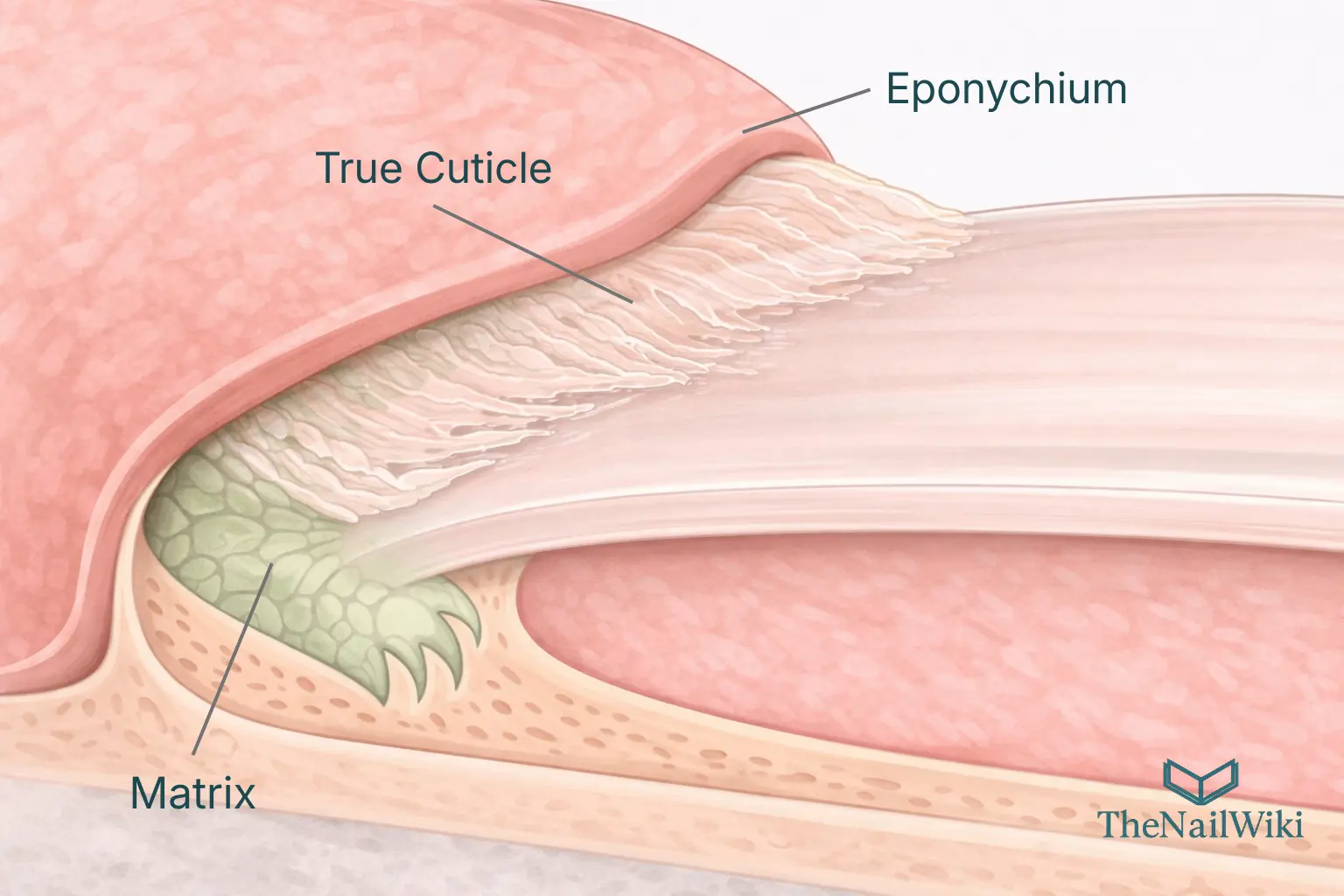
The lunula is the pale, half-moon shaped area visible at the base of the nail on some digits. It appears lighter than the rest of the nail plate because in this zone the cells emerging from the matrix have not yet fully completed their keratinisation process — they still retain some opacity, which scatters light differently from the more transparent plate further along.
Not everyone has a visible lunula on every finger. On some digits — particularly the little finger — it may be entirely hidden beneath the proximal nail fold and not visible at all. This is completely normal and does not indicate any abnormality in matrix function. The lunula is most consistently visible on the thumb, where the nail plate is widest and the matrix extends furthest forward relative to the skin fold above it.
The lunula matters practically because it marks the boundary of the matrix zone. Work performed at or below the lunula — heavy filing, cuticle cutting, or product application that extends deep into the base area — is being carried out immediately over living matrix tissue. This is not a zone to treat casually. Any trauma here that reaches the matrix can alter the plate being produced at that moment, potentially resulting in a visible ridge, white mark, or structural change that grows forward over the following weeks.
Professional note: The white half-moon marks that sometimes appear on the nail plate after trauma — for example after hitting a finger, or after aggressive work near the nail base — are often the direct result of disruption to the matrix at the point of the lunula. They are not surface marks; they are embedded in the plate at the moment it was being formed and will travel forward with the plate as it grows. They cannot be buffed out.
The Matrix and Nail Growth
Nail growth is entirely driven by the matrix. There is no other tissue in the nail unit capable of producing new plate — the nail bed beneath the plate does not contribute to plate production in the same way. The rate at which the matrix produces new cells determines how fast the nail grows, and that rate is influenced by a range of factors including age, nutrition, systemic health, and circulation to the digit.
Under healthy conditions, a fingernail grows at approximately 3 to 3.5 mm per month. This means a complete nail plate — from the matrix to the free edge — takes roughly six months to grow out in full. Toenails grow more slowly, at approximately 1.5 to 1.6 mm per month, taking twelve to eighteen months for a full cycle. These timelines are clinically important whenever a client is recovering from matrix disruption, because any change in plate quality caused by a matrix event will take the full growth cycle to clear the nail completely.
Growth rate reference
- Fingernails: approximately 3.0 – 3.5 mm per month
- Toenails: approximately 1.5 – 1.6 mm per month
- Full fingernail regrowth from matrix to free edge: approximately 6 months
- Full toenail regrowth: approximately 12 – 18 months
Growth rate declines with age and may be temporarily reduced during illness, nutritional deficiency, or periods of poor circulation.
The matrix is sensitive to changes in the body’s overall condition. During periods of significant illness, the matrix may slow or temporarily reduce its output — producing a thinner section of plate that later becomes visible as a transverse groove, known as a Beau’s line, as growth resumes and that thinner band travels forward. Nutritional deficiencies — particularly of protein, iron, and certain vitamins — can also reduce the quality and rate of matrix output, resulting in brittle, ridged, or structurally weak plates over time.
What Happens When the Matrix Is Damaged?
Matrix damage is the most serious category of nail unit injury, because its consequences can outlast the original trauma by months, years, or permanently. The severity of the outcome depends on how extensively the matrix tissue has been disrupted and whether scarring has occurred within it.
Temporary disruption
When the matrix is temporarily disturbed — by a single impact, a period of illness, or a short-term reduction in its blood supply — the plate it produces during that window may be thinner, softer, or slightly irregular. This shows up in the finished plate as a visible change: a transverse groove, a white area, or a patch of different texture. Crucially, once the cause resolves and normal matrix function resumes, the affected section grows forward and eventually out, and the plate returns to its previous quality. No lasting structural change to the matrix has occurred.
Permanent damage and scarring
When damage is severe enough to cause scarring within the matrix — from deep trauma, burns, surgery, chronic inflammatory disease, or repeated aggressive mechanical insult over time — the consequences are of a different order. Scar tissue within the matrix does not produce normal nail plate cells. Instead, it either produces structurally compromised cells or produces nothing at all in the affected area. The result may be a permanently ridged plate, a split that runs the length of the nail, thinning that does not resolve, or in the most severe cases, a nail that fails to regrow at all in the scarred zone.
Why this matters for nail professionals
A persistent longitudinal ridge running the full length of a nail — one that has been present for years and does not change — is frequently the result of old matrix scarring. It is not a product issue, not a prep issue, and not something that will respond to a different application technique. Understanding this distinction protects the professional from attempting to correct something that cannot be corrected at the service level, and from the client’s frustration when the ridge reappears after every appointment.
Any new, unexplained, or progressive longitudinal change in a single nail warrants referral for medical assessment — particularly if it involves pigmentation — as some serious conditions can present in this way.
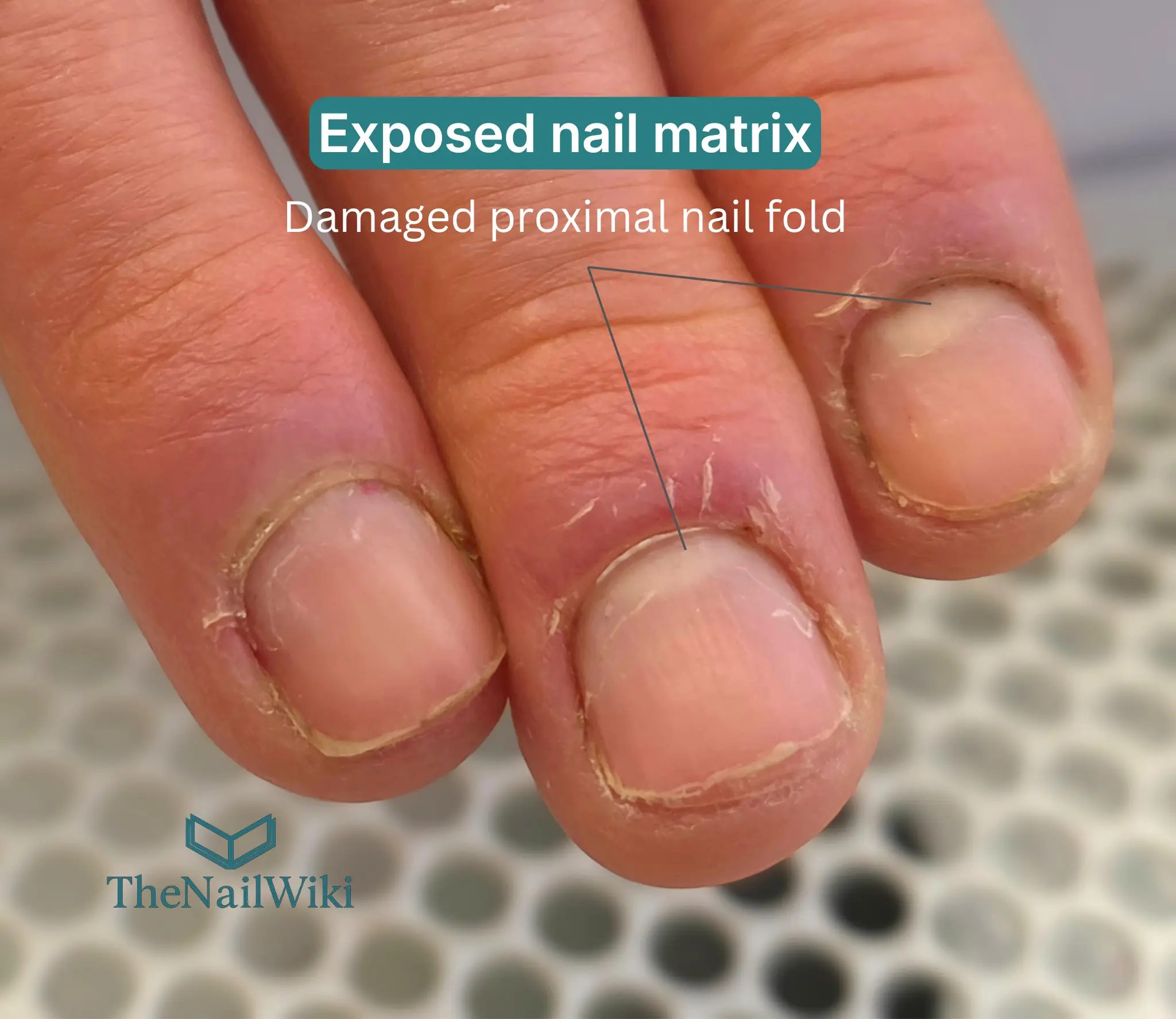
Causes of matrix damage relevant to nail professionals
- Trauma to the nail base: crushing injuries, catching the nail, or repetitive low-grade impact near the proximal nail fold can all disturb matrix function, temporarily or permanently depending on severity
- Aggressive filing near the matrix zone: filing that extends too close to the proximal nail fold — particularly with an e-file at too high a speed or with an inappropriate bit — can generate heat or mechanical stress in the matrix area, disrupting the cells actively producing plate
- Chemical injury: strong chemicals reaching the matrix zone through the skin fold can damage matrix cells; this is one reason that proper application technique and avoiding product flooding near the proximal fold is a safety standard, not a cosmetic preference
- Inflammatory skin conditions: psoriasis and lichen planus affecting the nail unit can involve the matrix directly, producing changes in the plate that reflect active inflammation at the matrix level
- Infection: severe or untreated infections reaching the matrix zone can cause scarring with lasting consequences for plate production
What This Means in the Salon
The proximal nail fold is a boundary, not just a starting point
Many nail professionals think of the proximal nail fold as simply the area where the nail begins. It is more accurate to understand it as the roof over the matrix. Work performed at this boundary — cuticle removal, filing, e-file techniques, or product application extending beneath the fold — is being carried out directly adjacent to living, actively producing tissue. Respecting this boundary is not about aesthetics; it is about protecting the client’s long-term nail health.
This is one of the core reasons that e-file technique in the proximal nail fold area requires specific training and a thorough understanding of the underlying anatomy. The margin between effective cuticle work and matrix disruption at this zone is measured in millimetres. Speed settings, bit selection, angle, and pressure all matter — and understanding why they matter requires knowing what sits beneath the skin at this location.
Distinguishing matrix issues from product or preparation issues
One of the most practically useful things a nail professional can do with their knowledge of the matrix is use it to correctly identify the source of a problem. A ridge that runs the full length of a nail and is present on a fresh, uncoated plate is a matrix issue — not a prep issue, not a product issue. Treating it as a surface problem and attempting to correct it with filing or product will not resolve it and may worsen the overall condition of the plate.
Conversely, a ridge that appeared after a specific trauma or illness and has been slowly moving forward with nail growth is a temporary matrix disruption — the affected section will eventually grow out. Being able to explain this to a client, with confidence and accuracy, is a mark of genuine professional expertise and builds the kind of trust that retains clients long term.
Nail consultation and matrix history
A thorough nail consultation should include questions about past nail trauma, previous nail conditions, and any history of nail plate abnormality. Many clients will present with existing matrix-related changes and have no idea what caused them — or will attribute them incorrectly to previous nail products. Gathering this history before a service begins allows the professional to set appropriate expectations, make informed decisions about which services are suitable, and ensure that any pre-existing matrix changes are documented clearly.
Professional training that covers nail anatomy in depth — including the matrix, its location, and its clinical significance — equips technicians to have these conversations with authority. Structured courses covering anatomy, safety, and informed practice are available through Artistic Touch Nail Training Academy.
Conditions That Affect the Nail Matrix
Important: The conditions described below are educational in purpose. Nail professionals are not diagnosticians. Any client presenting with unexplained, progressive, or pigmented changes in the nail plate — particularly changes originating at the base of the nail — should be referred for medical assessment without delay.
Psoriasis
When psoriasis involves the nail matrix, it typically produces changes in the nail plate itself — most commonly nail pitting (small surface depressions), crumbling of the plate surface, or leukonychia (white areas within the plate). These are distinct from the nail bed changes that psoriasis also causes — such as onycholysis and salmon-patch discolouration — and the two sets of signs can appear together or independently.
Lichen Planus
Lichen planus is an inflammatory condition that can affect the nail matrix directly and is one of the more serious nail unit conditions a professional may encounter. When it involves the matrix, it can produce progressive thinning of the nail plate, pronounced longitudinal ridging, splitting, and in severe or untreated cases, permanent scarring of the matrix leading to partial or complete loss of the nail plate. Early referral to a dermatologist significantly improves outcomes — this is not a condition where continuing with nail services is appropriate.
Alopecia Areata
Alopecia areata — an autoimmune condition primarily associated with hair loss — can also affect the nail matrix in some individuals. The most characteristic nail finding is a regular, fine pitting pattern sometimes described as a geometric or grid-like arrangement, which differs from the deeper, more randomly distributed pitting seen in psoriasis. Trachyonychia (rough, sandpaper-like nail surface) can also occur and is associated with diffuse matrix inflammation.
Trauma and Post-Surgical Changes
Physical trauma to the nail base — from accidents, crushing injuries, or surgical intervention — is a common cause of lasting matrix change. The degree of permanent alteration depends on how deeply the matrix tissue was disrupted and whether the healing process involved scar formation. Post-surgical clients, or those with a history of significant finger or toe injury, should always be assessed carefully before services begin, and existing plate abnormalities should be documented and discussed honestly before any commitment to outcomes is made.
Common Misconceptions
❌ “The nail grows from the base of the nail plate”
The nail plate itself does not grow — it is an inert structure that is pushed forward by new plate being produced behind it. Growth originates in the matrix, beneath the proximal nail fold, not from the visible base of the plate. The plate is a conveyor belt of material; the matrix is the engine driving it.
❌ “If the lunula is not visible the matrix is unhealthy”
The lunula is simply the forward portion of the matrix showing through the nail plate. Whether it is visible or not depends on the size of the matrix relative to the proximal nail fold covering it. A hidden lunula — particularly on smaller digits — is entirely normal and carries no clinical significance on its own.
❌ “A white mark after trauma will buff out”
White marks caused by trauma to the matrix area are embedded within the structure of the plate at the moment it was forming. They are not surface marks. Buffing the surface of the plate above them will not remove them — it will only thin the plate unnecessarily. The only resolution is to wait for the affected section to grow out completely.
❌ “Ridges caused by old matrix damage can be corrected with products”
A permanent longitudinal ridge originating from matrix scarring reflects a structural change in the tissue producing the plate. No topical product, base coat, or nail treatment can alter what the matrix produces. Products can visually minimise the appearance of a ridge on the surface, but they cannot change the underlying cause. Setting this expectation clearly with clients from the outset prevents frustration and protects professional credibility.
Frequently Asked Questions
What is the nail matrix?
The nail matrix is the living tissue located beneath the proximal nail fold at the base of the nail unit. It is the only structure capable of producing the nail plate. Matrix cells divide continuously, progressively keratinise, and are pushed forward to form the compacted layers of the nail plate. The pale lunula visible at the base of some nails is the forward-most visible portion of the matrix.
Where exactly is the nail matrix located?
The matrix sits beneath the proximal nail fold — the skin fold at the very base of the nail. It is not visible from the surface except where the lunula shows through the nail plate above it. The matrix extends further back under the skin fold than its visible portion suggests, which is why work near the proximal nail fold always carries an element of risk to the matrix beneath.
Can a damaged nail matrix repair itself?
It depends on the extent of the damage. Minor, temporary disruption — from a single impact or a short period of illness — allows the matrix to recover and resume normal plate production once the cause resolves. The affected section of plate grows out and is replaced by normal plate. However, damage severe enough to cause scarring within the matrix cannot be reversed. Scar tissue does not produce normal nail plate cells, and the resulting change in plate quality or structure is likely to be permanent.
What does the lunula tell us about the matrix?
The lunula marks the boundary between the fully keratinised nail plate and the zone where cells are still completing their transformation. Its visibility and size reflect the size of the matrix relative to the proximal nail fold above it. A larger lunula generally indicates a larger matrix producing a thicker plate; a smaller or absent lunula simply means the matrix sits further back under the skin fold. Changes in the appearance of the lunula — new discolouration, loss, or alteration in shape — can in some cases indicate changes in matrix health and warrant monitoring.
Why does illness affect the nail plate?
Because the nail plate is a direct record of matrix output over time, anything that disrupts normal matrix function leaves a visible trace in the plate. A significant illness, nutritional deficiency, or physiological stressor can temporarily reduce the matrix’s output, producing a thinner section of plate that travels forward as growth resumes and becomes visible as a transverse groove — a Beau’s line. The position of the groove on the nail can help estimate when the disruption occurred, based on average growth rates.
Is it safe to apply nail products over the lunula?
Product application that covers the lunula area of the visible nail plate is standard practice and does not carry risk to the matrix below, provided the product remains on the plate surface and does not extend beneath the proximal nail fold. The risk to the matrix comes from mechanical tools or chemicals reaching beneath the skin fold, not from product sitting on top of the visible nail plate above the lunula.
How long does it take for a nail to grow out after matrix disruption?
A fingernail takes approximately six months to grow out fully from the matrix to the free edge. If the disruption occurred at the matrix and the cause has now resolved, the affected section of plate will take the full remaining growth cycle to clear the nail completely — which could be anywhere from a few weeks to the full six months depending on where in the growth cycle the disruption occurred. Toenails take twelve to eighteen months for a full cycle.
Related Library Pages
Nail Anatomy
Nail Conditions
Professional Safety
Some linked pages are currently in development and will be published progressively. The library is updated regularly.
Professional Disclaimer
The information on this page is provided for educational purposes and is intended to support the professional knowledge of nail technicians and nail educators. It does not constitute medical advice. Any client presenting with nail changes that may indicate underlying pathology — particularly progressive, pigmented, or unexplained changes originating at the nail base — should be advised to seek assessment from a qualified medical professional without delay.

About the Author
Radina Ignatova
Professional Nail Expert since 2014 | International Nail Educator | Founder of TheNailWiki and Artistic Touch Nail Training Academy
Radina Ignatova is a Professional Nail Expert since 2014 and an International Nail Educator specialising in dual forms, gel systems, polygel application, advanced nail structure, E-File techniques and professional salon safety.
She founded TheNailWiki to provide clear, safety-led nail education accessible to everyone, and Artistic Touch Nail Training Academy to deliver structured professional online nail courses.
Her teaching philosophy is centred on honest education — demonstrating real salon challenges, practical corrections and performance-based techniques rather than presenting only polished results.
Based in Scotland, UK, Radina contributes to advancing professional standards within the nail industry through structured educational resources and technical training.
Read full bio →About TheNailWiki
TheNailWiki is an independent educational platform dedicated to providing accurate, safety-led and professionally informed nail care information to professionals and enthusiasts worldwide. All content is created by qualified nail industry professionals and reviewed for technical accuracy.
Our mission is to provide accurate, safety-focused and professionally informed nail education that is accessible to everyone. For structured professional training, advanced masterclasses, and specialist technique courses, visit Artistic Touch Nail Training Academy.
This library page is published by TheNailWiki — an independent nail education resource maintained by nail industry professionals. Content is safety-led and professionally informed. TheNailWiki is editorially independent and does not accept payment to influence library content. For editorial standards, visit thenailwiki.com/editorial-standards/.