
The Nail Bed: Structure, Function and Clinical Significance
Author: Radina Ignatova, Professional Nail Expert & International Nail Educator | Last Updated: March 2026
Quick Summary
The nail bed is the soft tissue that sits directly beneath the nail plate, extending from the base of the plate to the point where the plate lifts away from the finger at the hyponychium. It is richly supplied with blood vessels, which is why healthy nails appear pink — the colour of the nail bed is visible through the translucent plate above it.
The nail bed anchors the nail plate to the finger and plays a critical role in maintaining plate integrity. When the nail bed is healthy and its attachment to the plate is intact, the nail sits flat, appears pink, and is structurally stable. When that attachment breaks down — from trauma, infection, disease, or product misuse — the result is visible change in the nail’s appearance and, often, a compromised nail service outcome.
Contents
- What Is the Nail Bed?
- Structure of the Nail Bed
- What Does the Nail Bed Do?
- Plate-to-Bed Attachment
- Nail Bed Colour and What It Indicates
- What Disrupts the Nail Bed?
- Onycholysis — When the Plate Separates from the Bed
- What This Means in the Salon
- Conditions That Affect the Nail Bed
- Common Misconceptions
- Frequently Asked Questions
What Is the Nail Bed?
The nail bed is the layer of specialised soft tissue that the nail plate rests upon. It runs the full length of the underside of the nail plate, beginning where the plate emerges from the nail matrix at the base and ending at the hyponychium — the point at the free edge where the plate naturally lifts away from the fingertip.
Unlike the nail matrix, which is the engine of nail production, the nail bed does not generate new nail plate cells. Its role is supportive: it holds the plate in position, contributes to its structural integrity, and supplies it with nutrients and blood flow. It is also the tissue responsible for the pink colour that healthy nails display — the dense network of blood vessels within the nail bed is clearly visible through the translucent plate above it.
The nail bed matters enormously in a professional context because it is both a diagnostic indicator and a structural requirement for successful nail services. Its colour, attachment quality, and condition all communicate important information about the client’s nail health — and its integrity is a prerequisite for safe, long-lasting product application.
Structure of the Nail Bed
The nail bed is composed of two distinct layers. The upper layer — the epidermis of the nail bed — is closely bonded to the underside of the nail plate. Unlike the epidermis on most of the body’s surface, this layer does not shed in the typical way; instead, it is continuously carried forward with the plate as it grows, maintaining a firm adhesive bond between the two structures throughout the nail’s growth cycle.
Beneath this epidermal layer lies the dermis of the nail bed — a richly vascular connective tissue layer that contains the blood vessels and nerve endings responsible for the nail bed’s sensitivity and its characteristic pink appearance. This dermal layer is also directly bonded to the periosteum of the distal phalanx — the bone of the fingertip — which means the nail bed has essentially no independent movement. It is fixed firmly to the bone below and to the plate above, creating a stable sandwich structure that gives the finger remarkable protective capacity.
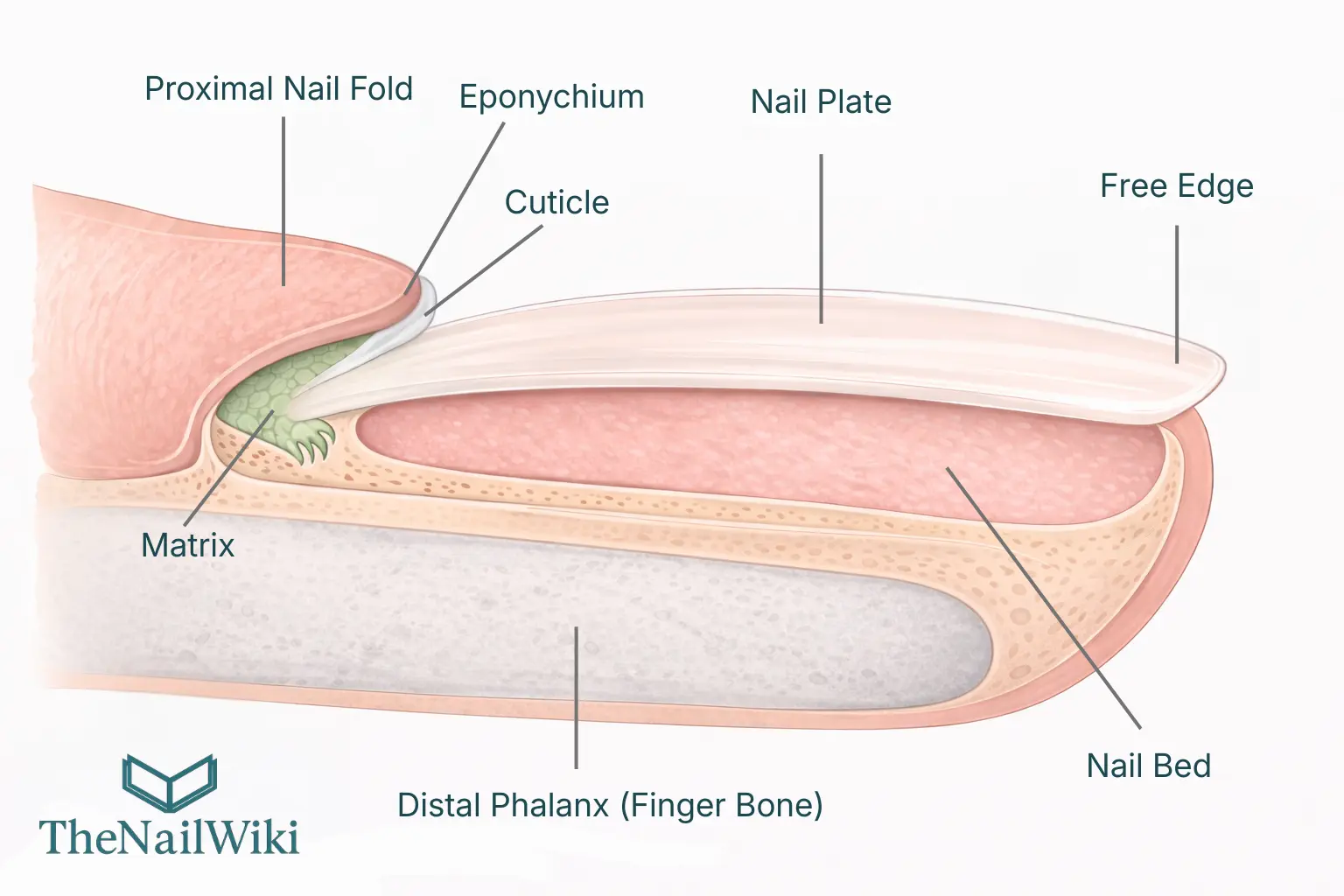
The nail bed also features a pattern of longitudinal ridges and grooves on its surface — fine parallel lines that run from the base to the free edge. These interlock with corresponding ridges on the underside of the nail plate, creating a mechanical connection that significantly reinforces the adhesive bond between the two structures. This interlocking system is one reason why the nail plate, despite being a relatively thin and rigid structure, stays reliably attached to the finger under considerable mechanical stress.
What Does the Nail Bed Do?
The nail bed serves several interconnected functions, each of which contributes to the overall health and stability of the nail unit.
Anchoring the nail plate. The nail bed holds the plate firmly against the fingertip throughout its growth cycle. Without this adhesion, the plate would lift away from the finger long before it reached the free edge. The combination of epidermal bonding and the interlocking ridge system keeps the plate seated correctly even during daily physical activity.
Supporting plate integrity. The nail bed provides a continuous, stable surface for the plate to rest upon. This support contributes to the plate’s resistance to bending and cracking under pressure. A nail plate that has lost contact with its bed — as in onycholysis — becomes noticeably more fragile and prone to breakage in the separated zone, precisely because the underlying support has gone.
Nourishing the nail plate. Although the nail plate is inert — it has no living cells once formed — the nail bed contributes moisture and some nutrients to the underside of the plate as it travels forward. This ongoing contact helps maintain the plate’s flexibility and prevents excessive brittleness in the body of the nail.
Protecting the fingertip. The combination of the nail plate and nail bed working together creates a protective covering for the highly sensitive distal phalanx below. The nail bed, fixed directly to the bone, transmits sensory information from the nail plate above — which is why pressure on the nail plate is felt, even though the plate itself has no nerve endings.
Why nail bed health matters for product performance
Nail products — gel, builder gel, acrylic — adhere to the nail plate surface, not directly to the nail bed. However, the nail bed’s condition directly affects how the plate behaves beneath the product. A nail plate that is well-attached to a healthy bed is stable, flexible in the right measure, and unlikely to flex excessively during wear. A plate that is partially lifted or poorly supported by a compromised bed will flex differently, creating stress at the product-to-plate bond and increasing the likelihood of lifting, cracking, or premature service failure.
Plate-to-Bed Attachment
The bond between the nail plate and the nail bed is one of the most clinically significant relationships in the nail unit. It is not simply a surface-level adhesion — it is a genuine biological attachment maintained by the epidermal layer of the nail bed, which bonds continuously to the ventral surface of the plate as it advances forward.
This attachment begins at the lunula — where the newly produced plate first makes contact with the bed — and is maintained all the way to the hyponychium at the free edge. The strength and completeness of this bond varies naturally between individuals and can be influenced by hydration levels, systemic health, and the mechanical demands placed on the nails through daily activity or nail service wear.
Once this attachment is broken — whatever the cause — it does not spontaneously re-form in the separated area. The space between the lifted plate and the now-exposed nail bed creates a dark, often moist environment that is highly susceptible to secondary problems including bacterial and fungal colonisation. This is why identifying and addressing onycholysis early is so important, and why attempting to push a lifted plate back down or apply product over a separation is both ineffective and potentially harmful.
Professional rule: Never apply product over onycholysis. The separated zone cannot provide a stable foundation for any product, and sealing over it traps moisture and debris against the exposed nail bed — significantly increasing infection risk. The correct approach is to trim the lifted section back to the point of attachment, advise the client on cause and care, and allow the bed to re-establish a new attachment as the plate grows forward.
Nail Bed Colour and What It Indicates
Because the nail plate is translucent, the colour of the nail bed is visible through it and determines the overall appearance of the nail. A healthy, well-perfused nail bed produces the familiar pink of a normal nail. Changes in that colour — whether they appear as white, yellow, green, brown, or dark areas — are often the first visible sign that something has changed in the nail bed or the structures around it.
Important: Any dark streak running the length of a nail — particularly if it is new, widening, or accompanied by pigmentation spreading onto the surrounding skin — should always be referred for medical assessment. This is not within the scope of a nail professional to diagnose or treat, and timely referral is a core professional responsibility.
Why nail products must be removed before surgery
Medical staff monitor nail bed colour during surgical procedures as a visual indicator of circulation and oxygenation. A pale, white, or bluish nail bed can signal reduced oxygen in the blood — a critical warning sign during anaesthesia. Nail enhancements and nail polish obscure the nail bed entirely, making this assessment impossible at a glance.
Additionally, pulse oximeters — the small clip-on devices placed on the fingertip to measure blood oxygen levels — read by passing light through the finger and nail bed. Nail products, particularly dark or heavily pigmented polishes and opaque enhancements, can interfere with the accuracy of this reading.
This is why surgical teams routinely ask patients to arrive with bare nails. It is not a preference — it is a patient safety requirement. Nail professionals whose clients are preparing for surgery should advise them to remove all nail products in advance and allow adequate time for any enhancement removal before the procedure date.
What Disrupts the Nail Bed?
The nail bed is relatively resilient under normal conditions, but several factors can disrupt the plate-to-bed attachment or compromise the bed tissue itself.
- Physical trauma: a sharp impact, catching the nail, or repeated low-grade mechanical stress can break the plate-to-bed adhesion, beginning a separation that may progress further if the cause continues
- Aggressive filing of the free edge underside: filing beneath the free edge — a practice sometimes used to clean under the nail — can physically disrupt the hyponychium seal and initiate onycholysis if performed too aggressively or too deeply
- Product lifting left untreated: when a nail enhancement lifts at the free edge and is not removed promptly, the mechanical leverage of the lifting product can force the plate away from the bed beneath it, causing or extending a separation
- Moisture and chemical exposure: prolonged exposure to water, harsh cleaning products, or solvents softens and weakens the epidermal bond between plate and bed; repeated exposure over time contributes to chronic onycholysis in some clients
- Skin conditions: psoriasis affecting the nail bed is a common cause of onycholysis and discolouration, producing the characteristic salmon-patch appearance and oil-drop sign visible through the plate
- Systemic illness and medication: certain medications — particularly tetracycline antibiotics in combination with sun exposure — can cause photo-onycholysis; thyroid conditions, anaemia, and other systemic factors can also affect nail bed perfusion and attachment quality
Onycholysis — When the Plate Separates from the Bed
Onycholysis is the term for separation of the nail plate from the nail bed. It is one of the most commonly encountered nail conditions in a professional salon setting and one of the most frequently mismanaged. It presents as a white or pale area beginning at the free edge and progressing towards the base — the white appearance is caused by air filling the space between the separated plate and the now-exposed bed beneath.
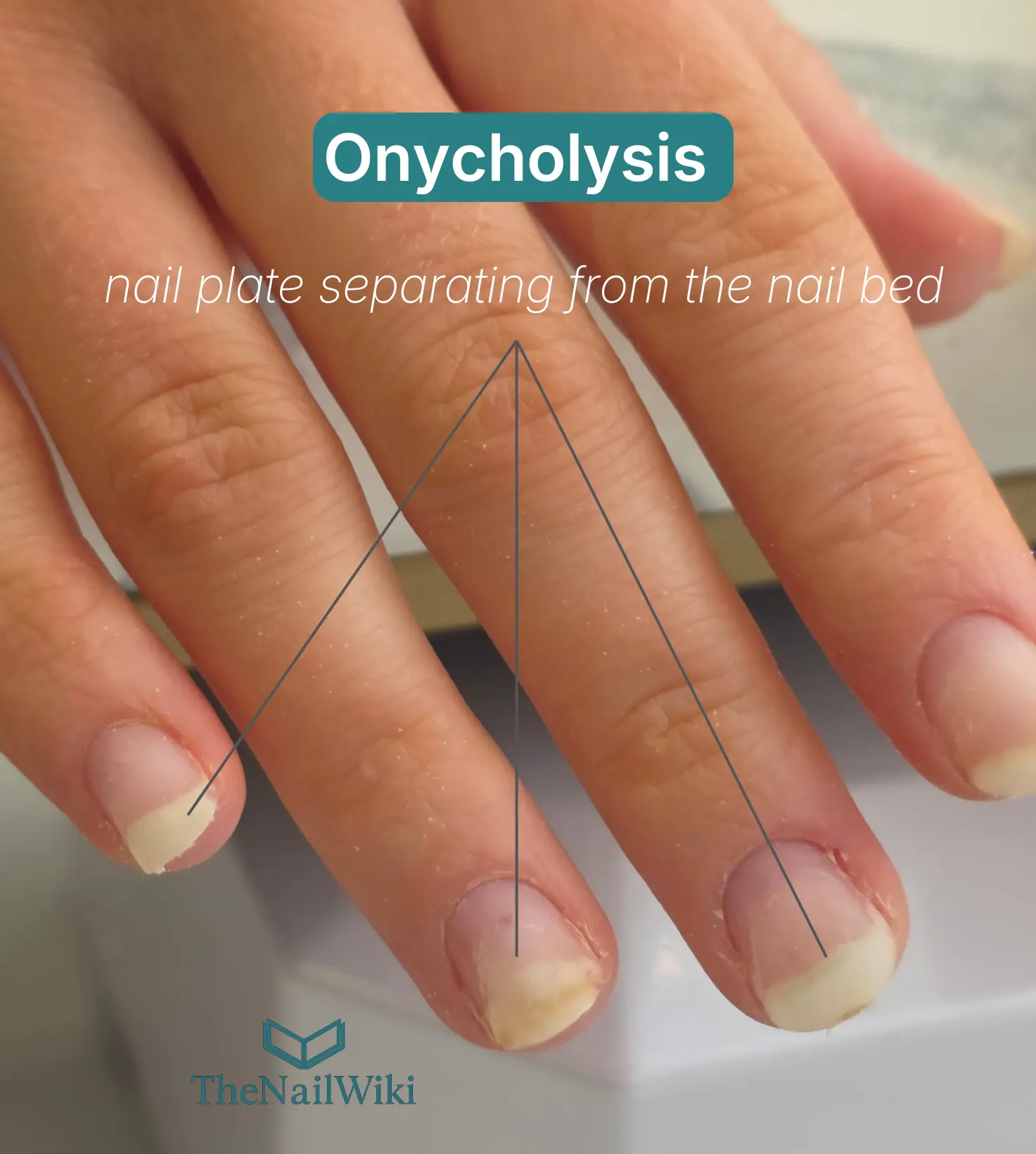
The progression of onycholysis is almost always distal to proximal — it starts at or near the free edge and advances towards the base. Onycholysis that begins at the base or sides of the nail, or that advances rapidly, warrants medical assessment to rule out systemic or dermatological causes rather than a purely mechanical origin.
Managing onycholysis in the salon
The professional approach to onycholysis is straightforward but requires clarity of communication with the client:
- Trim the nail plate back to the point of solid attachment — no further. Do not attempt to push the plate back down or apply product over the separation
- Keep the area clean and dry; moisture in the separation space increases infection risk
- Identify the likely cause with the client — trauma, product lifting, moisture exposure, or an underlying condition — and address it
- Do not apply nail enhancements over the separated area
- If the cause is not apparent, if the separation is progressing rapidly, or if there are other nail changes present, advise the client to seek medical assessment
The nail bed will form a new attachment to the advancing plate as it grows forward — but only if the cause of the original separation has been resolved. Recovery time depends on how far back the separation extends and the individual’s nail growth rate. For a fingernail growing at approximately 3 to 3.5 mm per month, a separation extending halfway up the nail may take three months or more to fully resolve.
What This Means in the Salon
Assessment before every service
The nail bed should be assessed visually at every appointment — not just at the initial nail consultation. Before removing a previous enhancement, before applying product, and whenever a client reports sensitivity or a change in appearance, checking the nail bed condition is part of professional due diligence. Changes that were not present at the last appointment need to be documented and considered before proceeding.
The green nail — what it means and why product must stop
A green discolouration in the nail bed — often discovered when removing an enhancement — is almost always caused by Pseudomonas aeruginosa bacteria colonising the space between a lifted nail product and the nail bed beneath. It is not caused by the product itself and it is not mould. The green pigment is a byproduct of bacterial metabolism in the warm, moist environment created by a lifting enhancement.
The correct response is to remove all product, trim the plate back to solid attachment, keep the area clean and dry, and advise the client that no further product should be applied until the discolouration has completely grown out. Attempting to apply a new enhancement over a green nail is not appropriate under any circumstances — it seals bacteria against the nail bed and allows the infection to continue or worsen beneath the new product.
Nail bed length and the appearance of enhancements
The length of a client’s nail bed — the distance from the base of the nail to the hyponychium — directly affects how nail enhancements look and how much natural length is achievable. A long nail bed creates a longer pink area and a shorter-looking free edge even at the same overall nail length. A short nail bed means the white free edge appears proportionally longer, and extensions may look more pronounced relative to the nail bed beneath them. Understanding this helps set realistic expectations with clients about the appearance of their nails, particularly when they request styles or lengths that their nail bed proportions may not naturally support.
Professional training that covers nail anatomy thoroughly — including the nail bed, its clinical significance, and how to assess and respond to bed-related changes — is available through Artistic Touch Nail Training Academy.
Conditions That Affect the Nail Bed
Important: The conditions listed below are described for educational purposes. Nail professionals are not diagnosticians. Any unexplained, progressive, or pigmented nail bed change should be referred for medical assessment without delay.
Psoriasis
Psoriasis affecting the nail bed produces characteristic changes distinct from those caused by matrix involvement. The most recognisable are the salmon patch — an orange-yellow discolouration visible through the plate — and onycholysis, which in psoriatic nails often has a distinctive red or pink border at the edge of the separation. Subungual hyperkeratosis — a build-up of scale beneath the plate — is also common, causing the plate to appear thickened and lifted from below. Read the full Nail Psoriasis library page →
Onychomycosis (Fungal Nail Infection)
Onychomycosis — fungal infection of the nail — typically begins in the nail bed and advances forward and upward into the plate. Early signs include discolouration of the nail bed (white, yellow, or brown), thickening of the plate, and subungual debris. It is a contraindication for nail services — any client presenting with suspected fungal nail infection should be referred for medical assessment and treatment before any product application is considered. Read the full Onychomycosis library page →
Subungual Haematoma
A subungual haematoma — bleeding beneath the nail plate into the nail bed — most commonly results from acute trauma. It presents as a dark red, purple, or black area beneath the plate, which may be painful if the pressure is significant. Small haematomas resolve as the plate grows out. Large, painful haematomas may require medical attention. Any dark area beneath the nail that does not have a clear traumatic cause, or that has an irregular border or does not resolve with growth, requires dermatological referral. Read the full Nail Haematoma library page →
Lichen Planus
When lichen planus affects the nail bed, it may produce onycholysis, thinning, and in severe cases, permanent scarring that results in partial or complete loss of the nail. Like matrix involvement, nail bed involvement in lichen planus can have lasting consequences if not identified and treated promptly. Early referral to a dermatologist is essential. Read the full Lichen Planus library page →
The conditions listed above are a selection of those that can affect the nail bed — they are not a complete list. TheNailWiki covers a wide range of nail conditions in dedicated library pages. Browse the full Nail Wiki Library →
Common Misconceptions
❌ “The green colour under a lifted enhancement is mould”
The green discolouration found beneath lifted nail products is caused by Pseudomonas aeruginosa bacteria, not mould. Mould requires a very specific set of conditions that are not typically present in the nail environment. Understanding the correct cause matters because it determines the correct response — bacteria require a clean, dry environment to resolve, not antifungal treatment.
❌ “Pushing a lifted plate back down will re-attach it”
Once the plate-to-bed attachment has broken, it cannot be mechanically re-established by pressing the plate back against the bed. The epidermal bond that maintains attachment must re-form naturally as new plate grows forward over the recovering bed. Pressing a lifted plate down forces it against the exposed bed without any adhesive mechanism and does nothing to restore attachment.
❌ “The nail bed produces the nail plate”
The nail plate is produced entirely by the nail matrix. The nail bed supports and anchors the plate but does not generate it. This distinction matters clinically — damage to the nail bed affects plate attachment and appearance but does not prevent the matrix from continuing to produce new plate; damage to the matrix is what disrupts production itself.
❌ “A short nail bed cannot be lengthened”
The length of the nail bed is largely fixed by anatomy, but regular manicure care — keeping nails consistently clean and trimmed, and avoiding habits that cause the hyponychium to recede — can preserve and in some cases gradually extend the effective nail bed length over time. This is a common benefit clients notice with regular professional nail care, and it is worth explaining as part of managing expectations about nail appearance.
Frequently Asked Questions
What is the nail bed?
The nail bed is the layer of specialised soft tissue that sits directly beneath the nail plate, running from the base of the plate to the hyponychium at the free edge. It anchors the plate to the finger, supplies it with moisture and nutrients, and is responsible for the pink colour visible through the translucent nail plate.
Why does the nail bed appear pink?
The nail bed is richly supplied with blood vessels, which give it a pink-red colour. Because the nail plate above it is translucent, this colour shows through and gives healthy nails their characteristic pink appearance. Any change in nail bed colour — white, yellow, green, or dark — indicates a change in the tissue or the space between the plate and bed, and warrants investigation.
What causes onycholysis?
Onycholysis — separation of the nail plate from the nail bed — can be caused by physical trauma, prolonged moisture or chemical exposure, lifting nail enhancements that are not promptly removed, skin conditions such as psoriasis, fungal infection, thyroid disorders, and certain medications. Identifying the cause is essential to preventing recurrence.
Can I apply nail products over onycholysis?
No. Applying product over onycholysis seals the separation — creating a warm, moist environment where bacteria or fungi can thrive. The correct approach is to trim the plate back to the point of solid attachment, keep the area clean and dry, address the underlying cause, and allow the bed to re-establish a new attachment as the plate grows forward.
How long does onycholysis take to resolve?
Recovery depends on how far the separation extends and the client’s nail growth rate. Since fingernails grow approximately 3 to 3.5 mm per month, a separation extending halfway up the nail may take three or more months to fully grow out, provided the cause has been resolved and no further separation occurs.
What is the green colour sometimes found under lifted nail enhancements?
The green discolouration found beneath lifting nail products is caused by Pseudomonas aeruginosa bacteria, which colonise the warm, moist space created by a lifting enhancement. It is not mould. All product must be removed, the plate trimmed back to solid attachment, and the area kept clean and dry. No new product should be applied until the discolouration has completely grown out.
Does nail bed length affect how enhancements look?
Yes. A longer nail bed creates a greater pink area relative to the free edge, producing a more balanced appearance even with shorter overall nail length. A shorter nail bed means the free edge appears proportionally more prominent. This affects how enhancement styles look on a given client and should be taken into account when discussing length and shape options.
Related Library Pages
Nail Anatomy
Nail Conditions
Professional Safety
Some linked pages are currently in development and will be published progressively. The library is updated regularly.
Professional Disclaimer
The information on this page is provided for educational purposes and is intended to support the professional knowledge of nail technicians and nail educators. It does not constitute medical advice. Any client presenting with nail changes that may indicate underlying pathology — particularly dark streaks, progressive discolouration, or unexplained nail bed changes — should be advised to seek assessment from a qualified medical professional without delay.
About the Author
Radina Ignatova
Professional Nail Expert since 2014 | International Nail Educator | Founder of TheNailWiki and Artistic Touch Nail Training Academy
Radina Ignatova is a Professional Nail Expert since 2014 and an International Nail Educator specialising in dual forms, gel systems, polygel application, advanced nail structure, E-File techniques and professional salon safety.
She founded TheNailWiki to provide clear, safety-led nail education accessible to everyone, and Artistic Touch Nail Training Academy to deliver structured professional online nail courses.
Her teaching philosophy is centred on honest education — demonstrating real salon challenges, practical corrections and performance-based techniques rather than presenting only polished results.
Based in Scotland, UK, Radina contributes to advancing professional standards within the nail industry through structured educational resources and technical training.
Read full bio →About TheNailWiki
TheNailWiki is an independent educational platform dedicated to providing accurate, safety-led and professionally informed nail care information to professionals and enthusiasts worldwide. All content is created by qualified nail industry professionals and reviewed for technical accuracy.
Our mission is to provide accurate, safety-focused and professionally informed nail education that is accessible to everyone. For structured professional training, advanced masterclasses, and specialist technique courses, visit Artistic Touch Nail Training Academy.
This library page is published by TheNailWiki — an independent nail education resource maintained by nail industry professionals. Content is safety-led and professionally informed.