E-File Glove Catches: Causes, Prevention, and Safety Response
By Radina Ignatova, Professional Nail Expert | Last Updated: April 2026
Quick Summary
E-file glove catches occur through two distinct mechanical interactions: belly catches when the bit is positioned upright rather than parallel (allowing the belly of the bit to contact glove material), and wrap catches when the top of the bit contacts loose glove material near supporting fingers (causing material to wrap around the rotating bit). Both situations require immediate machine stoppage before attempting glove removal. Prevention strategies include correct glove sizing, parallel bit positioning, controlled hand movements, stable hand support, and immediate response to any sensation of resistance during work.
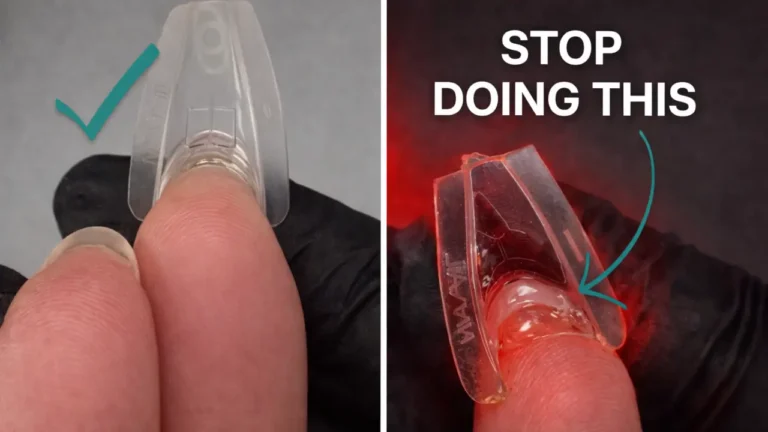
Real e-file glove catches filmed in slow motion during actual client infill work
© TheNailWiki
Contents
E-file glove catches represent a specific safety consideration in professional nail services that requires understanding both the mechanical causes and the appropriate immediate response. These incidents occur even amongst experienced technicians, making knowledge of prevention and response protocols essential for all professionals using e-file equipment in nail services.
Glove catches manifest through two distinct mechanical interactions, each created by different technical errors during work. The belly catch occurs when bit positioning allows the belly of the rotating bit to contact glove material. The wrap catch occurs when loose glove material near supporting fingers contacts the top of the bit, causing the material to wrap around the rotation. Understanding these mechanisms enables technicians to prevent occurrence and respond correctly when catches happen.
Real professional practice includes these scenarios. Most nail education content excludes footage of errors, presenting only perfect execution. This creates a knowledge gap where technicians encounter situations in practice that their training never addressed. Comprehensive professional education must include both ideal technique and real error scenarios with appropriate response protocols.
Why Gloves Are Necessary in E-File Work
Gloves protect nail technicians from repeated dust exposure and contact with professional chemicals including gel products, acetone, cleansers, and finishing products. E-file work generates fine particulate dust from nail plate material and enhancement products. This dust becomes airborne during filing and settles on all surfaces within the working area, including technician hands.
Without gloves, this dust contacts skin repeatedly throughout the working day. Over time, repeated exposure increases sensitisation risk. Gloves create a barrier that prevents direct dust contact whilst allowing the dexterity and tactile feedback required for precise e-file control. Professional gloves designed for nail services balance protection with functionality.
Proper glove use combined with correct e-file techniques maintains safety for both technicians and clients. The goal is not to eliminate glove use due to catch risk, but to understand how to prevent catches whilst maintaining the protection gloves provide. Understanding contraindications and safety protocols forms the foundation for responsible professional practice.
Belly Catch: Bit Position Error at the Sidewall
The belly catch occurs during work near the sidewall and stress point areas when the bit tilts from parallel positioning to an upright angle. In correct parallel positioning, the working edge of the bit contacts the product whilst the belly maintains safe distance from surrounding surfaces. When the bit tilts upright, the belly becomes the primary contact point.
If glove material exists in the space where the upright bit belly now sits, the rotating belly catches that material. The rotation pulls the material against the bit surface, creating the characteristic catch sensation. The technician feels immediate resistance that signals an error has occurred.
This specific error often results from fatigue combined with workspace variables. When micro-control decreases due to tiredness, maintaining precise parallel positioning throughout extended work becomes more difficult. Environmental changes such as different lighting positions or adjusted chair heights can require repeated hand position modifications that increase positioning error likelihood.
Safety Note: Fatigue Recognition
Fatigue compromises the micro-control essential for safe e-file work. Hand steadiness, positioning precision, and response time all deteriorate when tired. Professional practice requires recognising when fatigue affects your ability to maintain safety standards and adjusting service schedules accordingly. No appointment is worth compromising technician or client safety.
Wrap Catch: Finger Proximity Error
The wrap catch creates a different mechanical interaction than the belly catch. In this scenario, the supporting finger that stabilises the client’s hand during work sits too close to the rotating bit. If the glove material is slightly loose, excess material exists between the finger and the bit.
The top of the rotating bit contacts this loose material. Because the material has flexibility and the bit maintains constant rotation, the material begins to wrap around the bit rather than being pushed away. This creates a small but distinct wrapping motion that the technician can feel as resistance.
The bit is not embedded in the glove—it is wrapping loose material through rotation. This distinction matters for the response protocol. Immediate machine stoppage allows the wrapped material to release as rotation ceases. The material unwinds naturally when the bit stops turning.
Immediate Safety Response Protocol
When a glove catch occurs, the immediate priority is machine stoppage. As soon as resistance is felt, stop the machine completely before taking any other action. Do not attempt to pull the glove whilst the bit continues rotating. Full stoppage first, then address the catch.
Technicians using foot pedals can stop rotation immediately by releasing pedal pressure. This eliminates the delay between feeling resistance and stopping the machine. For e-file work, a foot pedal functions as a safety feature that reduces response time in exactly these situations. The ability to stop with your foot whilst your hands remain in position prevents the instinctive pulling motion that can worsen a catch.
Immediate Response Steps
- Feel resistance — recognise the specific sensation that signals a catch
- Stop the machine immediately — use foot pedal or hand controls to cease rotation
- Wait for complete stoppage — do not touch the glove until the bit is fully stopped
- Remove or replace the glove — assess for damage and replace if necessary
- Identify the cause — determine whether it was positioning, proximity, or fatigue
- Correct the error — adjust technique before continuing service
Response instincts develop with practice. The first glove catch may cause panic. The second occurrence teaches recognition. By the third, the response becomes automatic. Your nervous system learns to identify the specific resistance sensation and trigger immediate stoppage without conscious thought. This automatic response develops only through experience combined with correct technique knowledge.
Prevention Strategies for Glove Catch Reduction
Correct Glove Sizing
Gloves that are slightly too large create wrinkly bits of excess material across the surface. This excess material increases catch risk because it provides more surface area that can contact the rotating bit. When you position your hand in working position and observe wrinkles across the glove surface, the glove is too large for your hand.
Correctly fitted gloves sit smooth against your hand without excess material. They allow full finger movement without restriction whilst eliminating loose material that can be caught. Glove sizing should be assessed whilst hands are in working position, not whilst relaxed, as hand shape changes with finger positioning.
Parallel Bit Positioning
Maintaining parallel bit positioning throughout sidewall and stress zone work prevents belly catches by keeping the belly of the bit away from surrounding surfaces. Parallel means the bit sits flat against the nail surface with the working edge in contact whilst the belly maintains clearance.
Upright positioning reverses this relationship. The belly becomes the contact point whilst the working edge loses effective contact with the product. This position not only creates catch risk but also reduces filing efficiency because the wrong part of the bit contacts the work surface. Parallel positioning serves both safety and effectiveness.
Controlled Hand Movement Speed
Slowing hand movements—not machine RPM—improves positioning control during critical work areas. This does not mean working at an impractically slow pace throughout entire services. It means recognising zones where precision matters most for safety and adjusting hand movement speed in those specific areas.
Sidewall work, cuticle area filing, and any work near skin contact zones benefit from deliberate, controlled hand movements that prioritise positioning accuracy over speed. Faster hand movements in safer zones maintain service efficiency whilst slower movements in critical zones maintain safety standards.
Stable Hand Support
Proper hand support when holding the client’s hand creates a stable foundation that reduces unintended movement during work. Always anchor your working hand by resting one finger on the nail or surrounding area. This anchor point prevents drift and maintains consistent positioning throughout the filing motion.
Without stable support, small movements accumulate throughout the service. Each small drift can change bit positioning slightly, and these small changes compound to create positioning errors. The anchor finger provides constant feedback about hand position and prevents drift before it becomes problematic.
The Fatigue Factor in E-File Safety
Fatigue affects three critical aspects of e-file control: hand steadiness, positioning precision, and response time to unexpected situations. When tired, fine motor control deteriorates. The micro-adjustments required to maintain parallel bit positioning throughout complex nail contours become more difficult to execute consistently.
Professional nail work often involves extended service days with multiple consecutive appointments. Technicians may not recognise gradual fatigue accumulation until control errors become noticeable. The first glove catch of the day often signals that fatigue has reached a level that compromises safety standards.
Responsible professional practice requires recognising when fatigue affects your ability to maintain safety standards and adjusting accordingly. This might mean scheduling breaks between appointments, limiting the number of e-file services per day, or choosing alternative techniques for later appointments when fatigue is present. No appointment is worth compromising the safety that protects both technician and client.
Professional Training
Professional training on e-file safety protocols, bit selection and positioning, and comprehensive nail techniques is available through structured professional courses designed for nail technicians seeking to advance their technical skills.
Related Articles
-
E-File Manicure: Professional Technique Guide
Comprehensive overview of e-file systems, techniques, and safety protocols
-
Contraindications in Nail Services: Complete Safety Guide
Professional safety protocols and client assessment procedures
-
Russian Manicure: Technique and Safety Standards
Advanced e-file cuticle work protocols and safety considerations
-
Professional Nail Consultation Forms
Client consultation protocols and documentation requirements
Frequently Asked Questions
Why does the e-file catch gloves in two different ways?
The belly catch occurs when the bit is positioned upright rather than parallel, allowing the belly of the bit to contact glove material near the nail surface. The wrap catch occurs when the top of the bit contacts loose glove material near supporting fingers, causing the material to wrap around the rotating bit. Both create different mechanical interactions but require the same immediate response: stop the machine completely before addressing the catch.
Should you pull the glove off when it catches?
Never pull the glove whilst the machine is still spinning. Stop the machine completely first, wait for full rotation cessation, then address the catch. Pulling whilst the bit is rotating can worsen the situation and potentially cause injury. Your immediate action must be machine stoppage, not glove removal.
How do you know if your gloves are the correct size?
Position your hand in working position and examine the glove surface. If you see wrinkly bits of excess material, the glove is slightly too large. Correctly fitted gloves sit smooth against your hand without excess material that can be caught by rotating bits. Assess glove fit whilst hands are in working position, as hand shape changes with finger positioning.
Does fatigue really affect e-file control?
Fatigue significantly reduces the micro-control required for safe e-file work. When tired, hand steadiness decreases, positioning precision suffers, and response time to unexpected situations slows. Professional nail work requires recognising when fatigue compromises your ability to maintain safety standards and adjusting service schedules or technique choices accordingly.
Why is parallel bit positioning important at the sidewalls?
Parallel positioning keeps the working edge of the bit in contact with the product whilst the belly of the bit maintains safe distance from surrounding surfaces including gloves and skin. When the bit tilts upright, the belly becomes the primary contact point, creating catch risk with any material in that space. Sidewall work requires consistent parallel positioning for both effectiveness and safety.
Is a foot pedal necessary for e-file safety?
A foot pedal is not mandatory, but it significantly improves safety response time. When a glove catch occurs, you can stop the machine immediately with your foot rather than reaching for controls with your hands. This eliminates the delay between feeling resistance and stopping rotation. For professional e-file work, a foot pedal functions as a safety feature that enhances control and reduces response time in critical situations.
What should you do after a glove catch occurs during a service?
After stopping the machine and addressing the catch, replace the glove and assess what caused the error. Was it bit positioning, finger proximity, fatigue, or workspace changes? Correct the underlying cause before continuing. If fatigue was the contributing factor, consider whether continuing the service maintains safety standards. The service can continue once the cause is identified and corrected.
Do glove catches only happen to inexperienced technicians?
Glove catches happen to experienced technicians as well as beginners. Fatigue, workspace changes, distraction, and momentary positioning errors can affect any technician regardless of experience level. The difference is that experienced technicians recognise the sensation immediately and respond correctly without panic. Experience builds response instincts and error recognition, not immunity to errors themselves.
Professional Disclaimer
This educational content is designed for qualified nail technicians and students in professional training programmes. E-file work requires proper training in equipment operation, bit selection, speed control, and safety protocols. All nail services should be performed by trained professionals following current health and safety regulations. This information does not constitute professional safety certification or replace structured training requirements.
About the Author
Radina Ignatova is a Professional Nail Expert since 2014 and International Nail Educator based in Scotland, United Kingdom. She is the Founder of Artistic Touch Nail Training Academy and TheNailWiki, specialising in professional nail education with focus on BIAB systems, dual form techniques, advanced E-File work, and Russian Manicure.
Radina’s teaching philosophy centres on honest education: showing real salon challenges, real mistakes, and real performance testing rather than idealised demonstrations. Her professional training programmes serve qualified nail technicians seeking to advance their technical skills through safety-led, professionally informed education.
TheNailWiki is an educational resource providing safety-led and professionally informed nail care information for technicians, students, and clients. All content is written from professional nail industry experience and practice.
© 2026 TheNailWiki