
Nail Cleansers, Alcohol & Prep Liquids: What They Do and When to Use Them
Author: Radina Ignatova, Professional Nail Expert & International Nail Educator | Last Updated: April 2026
Quick Answer: Nail cleansers, isopropyl alcohol, and prep liquids are used at different stages of the nail service to remove surface debris, oils, dust, and residue. They are not interchangeable with each other, and none of them replaces a dedicated nail dehydrator. Each product has a specific function and a specific place in the preparation sequence. Using the wrong product at the wrong stage — or using one product to cover all stages — is one of the most common preparation errors in professional nail services.
Quick Summary
Nail cleansers and prep liquids are surface cleaning products — they remove what is on top of the nail plate. They address visible oils, dust from buffing, and surface residue. They do not penetrate the nail plate surface to address moisture within the upper layers of the plate — that is the function of a dehydrator.
Isopropyl alcohol (IPA) is the most widely used cleansing agent in nail services — it evaporates cleanly, dissolves surface oils effectively, and leaves no residue. Branded nail cleansers typically contain IPA as their primary active ingredient, often alongside additional ingredients to support surface preparation or fragrance masking. Both have legitimate uses at specific points in the preparation and finishing sequence.
Contents
- What Nail Cleansers and Prep Liquids Are
- Types of Cleansing Product
- Cleanser vs Dehydrator — the Critical Difference
- When to Use Each Product
- IPA Concentration — Does It Matter?
- How to Apply Correctly
- Common Mistakes
- Gel Cleanser — Wiping the Inhibition Layer
- What Clients Should Know
- Frequently Asked Questions
What Nail Cleansers and Prep Liquids Are
Nail cleansers and prep liquids are solvent-based products designed to clean the nail plate surface at specific points during a nail service. Their primary purpose is physical cleaning — removing surface oils, buffing dust, skin cells, and any other debris that has settled on the nail plate before or during the service.
In professional nail services, cleansing products are used at two distinct points: before product application as part of the preparation sequence, and after product curing to remove the inhibition layer that gel products leave on the surface. These are different applications requiring different timing and — in some systems — different products.
The term “prep liquid” is sometimes used as a general label covering both cleansers and dehydrators — particularly in beginner nail kits. This creates confusion because the two perform different functions. A prep liquid that simply cleans the surface is not the same as a nail dehydrator, and using a cleanser in place of a dehydrator will not achieve the same result.
Types of Cleansing Product
Isopropyl alcohol (IPA)
Isopropyl alcohol is the standard cleansing agent used across professional nail services. It dissolves surface oils and residue, evaporates completely without leaving residue of its own, and does not react with gel or acrylic products in a way that compromises adhesion. IPA is available in various concentrations — typically between 70% and 99% for professional nail use.
Pure IPA has no fragrance, no added conditioning ingredients, and no colour. It is a straightforward solvent. Many nail technicians prefer it precisely because it is predictable — there are no additional ingredients that might interfere with product adhesion or cause an unexpected reaction on the nail plate.
Branded nail cleansers
Branded nail cleansers sold by nail product manufacturers typically use IPA as their primary active ingredient, formulated alongside additional components. These may include fragrance to mask the alcohol smell, conditioning agents, or pH-adjusting ingredients intended to support the specific product system the manufacturer sells alongside it.
Some branded cleansers are formulated specifically for use as gel cleanser — to wipe the inhibition layer after curing — and may have a slightly different formulation than those intended for pre-service surface cleaning. Always check the manufacturer’s guidance on which cleanser is recommended for which stage of their specific system.
Acetone
Acetone is a stronger solvent used primarily for product removal — dissolving gel polish, builder gel, and other coatings during the removal process. It is not a nail cleanser in the preparation sense and should not be used to clean the nail plate before product application. Acetone is too aggressive for pre-service cleansing and can leave the nail plate surface in a compromised state if used at the wrong point in the service sequence.
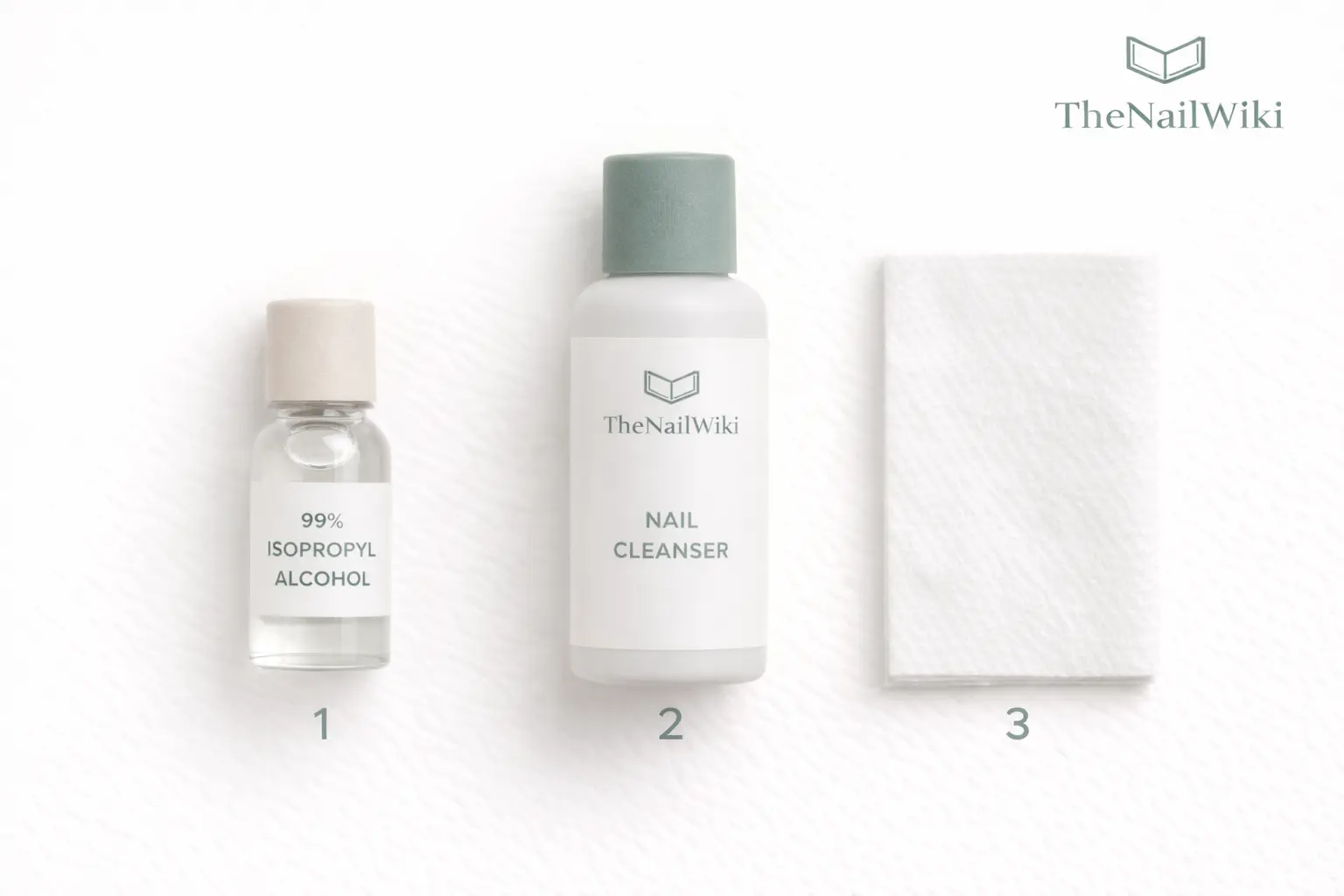
Cleansing products at a glance
- IPA (70–99%): standard surface cleanser, pre-service and gel cleanser use
- Branded nail cleanser: IPA-based with additional ingredients, system-specific
- Acetone: product removal only — not a preparation cleanser
- Nail dehydrator: separate product, different function entirely — see below
© TheNailWiki
Cleanser vs Dehydrator — the Critical Difference
The most important distinction in nail preparation chemistry is the difference between a cleanser and a dehydrator. These two products are frequently confused — particularly in beginner-level nail kits where both may be labelled as “prep” products — but they address completely different preparation problems.
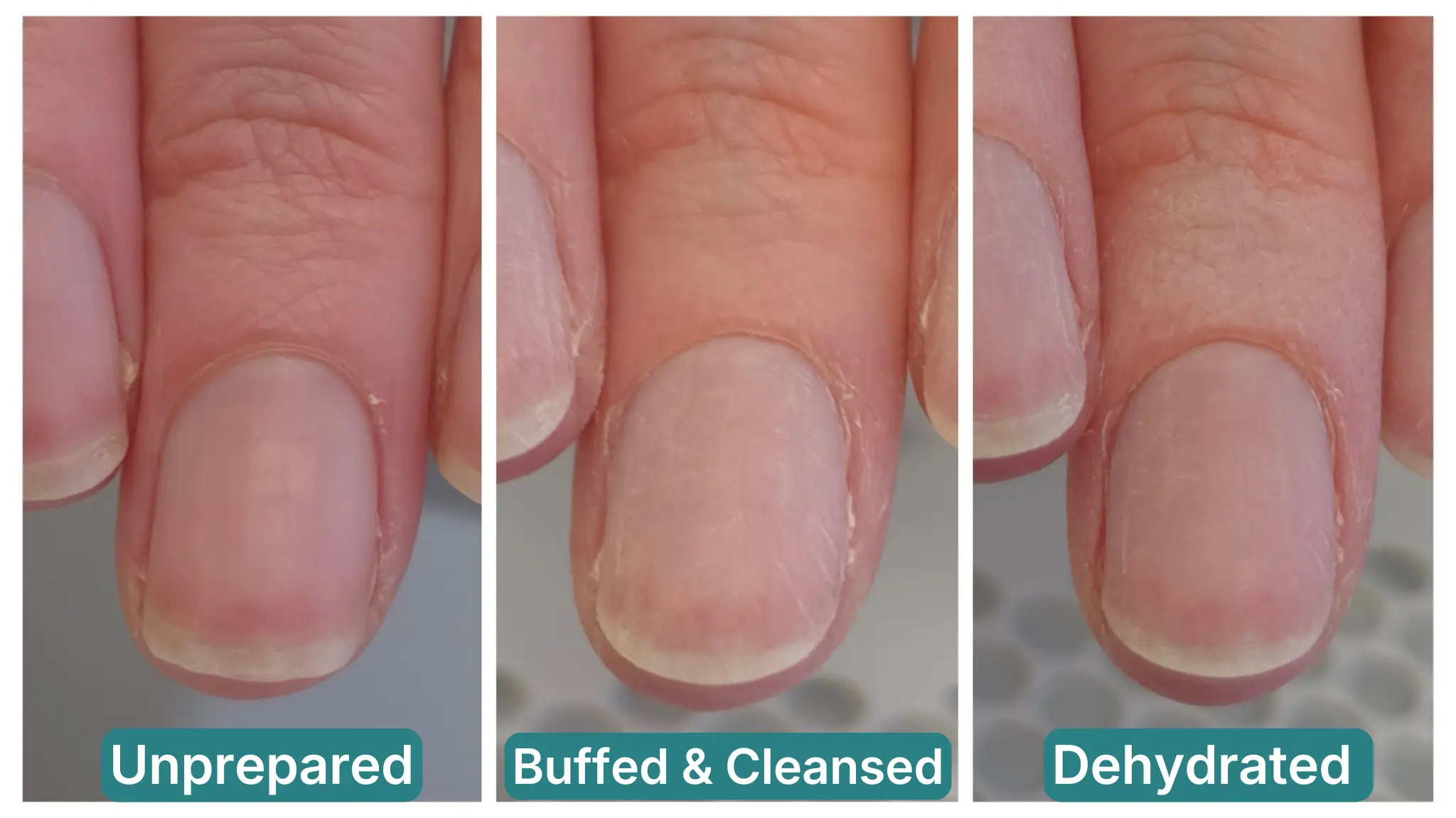
Cleansing the surface with IPA removes what is sitting on top of the nail. It does not address residual moisture within the upper layers of the nail plate — moisture that the nail plate naturally contains and that can compromise product adhesion from beneath the surface. A dehydrator addresses this by temporarily reducing the moisture content at the surface layer. The two products work at different depths and perform different functions.
Using IPA as a dehydrator does not work. IPA evaporates quickly and removes surface oils effectively, but it does not have the dehydrating properties of a dedicated dehydrator product. Clients with naturally oily nail plates in particular will see this in their service longevity — products applied over a surface-cleansed but not dehydrated nail plate will lift earlier and more consistently than over a correctly dehydrated plate.
© TheNailWiki
When to Use Each Product
Understanding where each cleansing product belongs in the preparation sequence is fundamental to achieving consistent adhesion. The full nail plate preparation sequence determines the order — cleansing sits after buffing and before dehydration.
Stage 1 — Before product application (pre-service cleansing)
After cuticle work and buffing, the nail plate carries buffing dust, dead skin particles, and surface oils. A lint-free wipe saturated with IPA or nail cleanser removes this debris before the next preparation step. This is the cleansing step — it clears the surface so the dehydrator and any subsequent products can work on a clean plate.
After cleansing, the nail must not be touched with bare skin. The dehydrator is applied immediately after cleansing while the nail is still clean, followed by primer or base coat depending on the product system in use. For full details on the sequence, see: Nail Plate Preparation →
Stage 2 — After gel curing (gel cleanser / inhibition layer removal)
Most gel products leave a tacky inhibition layer on the surface after curing. This layer is uncured product residue — it requires removal before the nail can be finished, shaped, or have additional product applied. IPA or a dedicated gel cleanser is used to wipe this layer away using a lint-free wipe in a single, firm stroke.
Not all gel top coats leave an inhibition layer — some are formulated as no-wipe. Always check whether the specific top coat in use requires wiping before the nail is finished. Wiping a no-wipe top coat with IPA can dull the surface — a common finishing error.
Correct sequence summary
- Cuticle work
- Buffing (nail buffer or nail file)
- Cleansing — IPA or nail cleanser on lint-free wipe (or Radina Double Cleanse Method — see below)
- Dehydration
- Primer (where required by system)
- Base coat — product application begins
- After curing — gel cleanser (IPA on lint-free wipe) to remove inhibition layer where applicable
IPA Concentration — Does It Matter?
IPA is available in concentrations ranging from around 70% through to 99% for professional and laboratory use. In nail services, the most commonly used concentrations are 70%, 91%, and 99%. The difference in concentration affects both the evaporation speed and the cleaning efficacy.
70% IPA
70% IPA contains 30% water alongside the alcohol. This concentration is effective for surface sanitation — the water component slows evaporation, which prolongs the contact time and can improve antimicrobial efficacy. However, the water content makes it less ideal for nail plate preparation because it reintroduces moisture to the nail surface at the point of cleansing. For pre-service nail cleansing, a higher concentration is preferable.
91–99% IPA
Higher concentration IPA evaporates more rapidly and contains significantly less water. It removes surface oils effectively and leaves the nail plate surface dry and clean quickly after application. 99% IPA in particular is widely used in professional nail settings for both pre-service cleansing and inhibition layer removal. It is the concentration most commonly recommended by professional nail product manufacturers for nail preparation use.
For nail preparation: use 91% or 99% IPA, or a branded nail cleanser formulated for preparation use. Avoid 70% IPA for the pre-service cleansing step — the water content is counterproductive at a stage where you are actively trying to reduce surface moisture before dehydration.
How to Apply Correctly
Always use lint-free wipes — never cotton wool
Lint-free wipes are the correct application tool for nail cleansers. Cotton wool pads and cotton rounds shed fibres onto the nail surface — fibres that then become trapped under product and can compromise the finish or cause adhesion problems. This is one of the most frequent preparation errors in home nail care and is sometimes seen in professional settings too.
Lint-free wipes may be pre-cut squares or roll-style wipes. Both work — the key is that they produce no fibre shedding when saturated with IPA. Always use enough product to saturate the wipe adequately — a lightly dampened wipe spread across ten nails is not sufficient for effective cleansing.
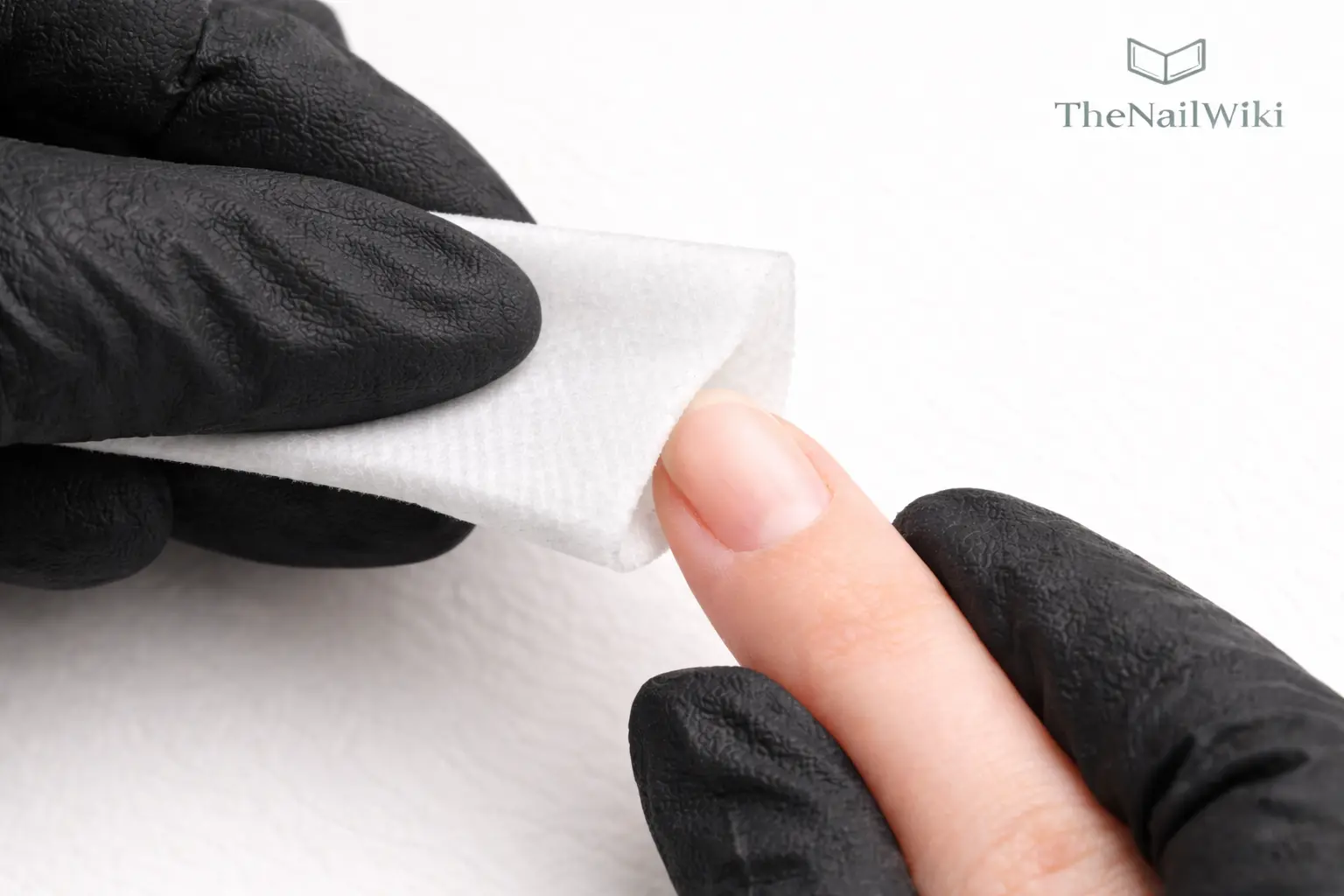
Wipe in one direction
When cleansing the nail plate, wipe in one direction — from the cuticle area towards the free edge. Scrubbing back and forth redistributes the oils and debris you are trying to remove rather than lifting them off the nail surface. A single, firm stroke with a freshly saturated wipe is more effective than multiple back-and-forth passes with the same section of wipe.
© TheNailWiki
Do not touch the nail after cleansing
Once the nail plate has been cleansed, it must not be contacted with bare skin — neither the technician’s fingers nor the client’s own hands. Natural skin oils transfer immediately and undo the cleansing step. The dehydrator must be applied directly after cleansing without any interim contact with the nail surface.
⚡ The Radina Double Cleanse Method — A Signature Preparation Technique
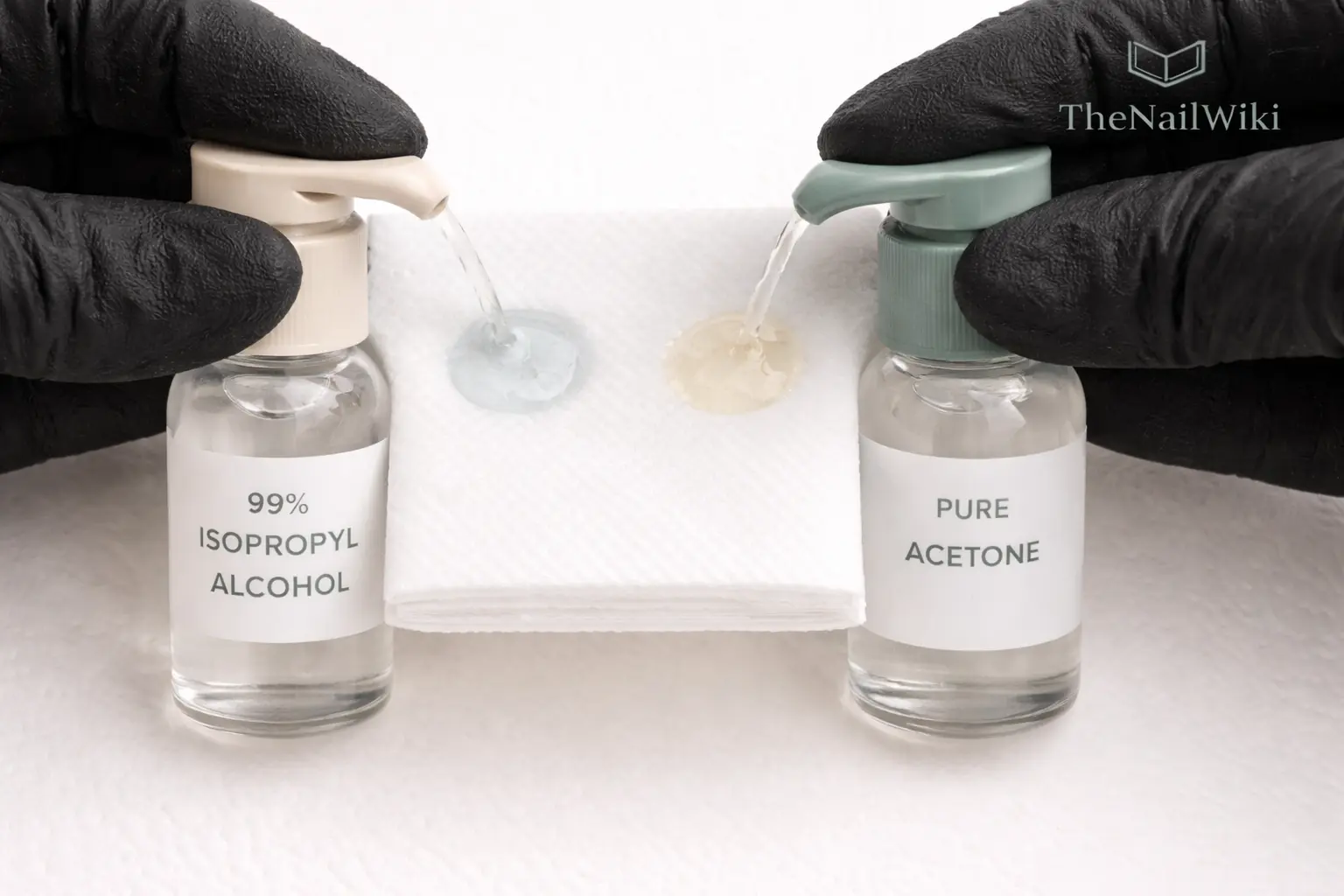
One pump of IPA and one pump of acetone on the same lint-free wipe — applied together in a single cleansing stroke — acts as a double-action cleanser before the dehydrator is used. This preparation approach, developed and taught by Radina Ignatova as part of her professional nail preparation method, is not a shortcut that replaces dehydration. It is an enhanced cleansing step that prepares the nail surface more thoroughly than IPA alone — and one that directly addresses one of the most common but least understood causes of gel shrinkage from edges.
The reason this works is that IPA and acetone dissolve different compounds on the nail plate surface. IPA is effective at breaking down water-soluble residues and surface oils. Acetone targets a different range of surface residues — including heavier oils, product traces, and certain types of nail plate buildup — that IPA alone does not fully address. Together, they produce a more comprehensively clean surface in a single pass. When gel is applied over a nail that has been surface-cleansed but not fully cleared of these heavier compounds, the product does not bond evenly — and as it cures, it can contract away from the areas of weakest adhesion, pulling back from the edges. The Radina Double Cleanse Method eliminates this at the preparation stage.
After the double cleanse, the nail dehydrator is still applied as normal — the double cleanse addresses surface contamination, while the dehydrator addresses residual moisture within the nail plate layer. The two steps work at different levels and neither replaces the other. For the full chemistry explanation of why IPA and acetone target different surface compounds — and why this makes gel shrinkage less likely — see the Nail Dehydrator page →
© TheNailWiki
Common Mistakes
Using a cleanser instead of a dehydrator
Cleansing and dehydration are separate steps with different functions. IPA removes surface debris — it does not dehydrate the nail plate. Skipping the dehydrator and relying on IPA alone leaves residual moisture within the upper nail plate layer, which contributes to early product lifting — particularly for clients with naturally oily or hydrated nail plates.
Using cotton wool instead of lint-free wipes
Cotton wool fibres shed onto the nail surface when saturated with IPA and become invisible once dry. These fibres are then sealed under product and create uneven adhesion, small bumps in the finish, or points of weakness in the coating.
Wiping a no-wipe top coat
Wiping a no-wipe top coat with IPA dulls the surface by disrupting the cured film. Always check whether the top coat in use requires inhibition layer removal before wiping. If uncertain, check the manufacturer’s instructions before proceeding.
Touching the nail between cleansing and product application
Any contact with the cleansed nail plate — by the technician’s fingers, the client adjusting their hand, or the client touching their face or hair — reintroduces surface oils and undoes the cleansing step. Both technician and client should be aware of this during the preparation stage.
Using 70% IPA for pre-service cleansing
70% IPA contains 30% water. Using it as a pre-service cleanser before dehydration reintroduces moisture to the nail surface at exactly the point where you are trying to reduce it. Use 91% or 99% IPA, or a branded nail cleanser formulated for preparation use.
Gel Cleanser — Wiping the Inhibition Layer
Most gel products — including gel polish, BIAB, and builder gels — leave a tacky inhibition layer on the surface after curing. This layer is a thin film of uncured product residue that forms where the gel meets the air during the curing process. It is a normal part of how gel chemistry works and does not indicate a problem with the product.
The inhibition layer must be removed before the nail is finished. If left in place and the nail is filed or buffed, the tacky layer clogs the abrasive and produces an uneven surface. If left under a top coat without removal, it can create a weak point in the finish.
To remove the inhibition layer, saturate a lint-free wipe with IPA or a dedicated gel cleanser and wipe each nail with a single, firm stroke. Some technicians use a fresh wipe for each nail — particularly when working with very light or white gel colours where any residue smear could be visible. Others work across all nails with the same wipe folding to a clean section for each nail. Either approach is correct provided the wipe is adequately saturated and a clean section is used for each nail.
No-wipe top coats
No-wipe top coats are formulated to cure without leaving an inhibition layer. They do not require wiping after curing — the surface is ready immediately. Wiping a no-wipe top coat with IPA is a common finishing error that dulls the surface. If using a no-wipe top coat, always skip the gel cleanser step after curing the final layer.
What Clients Should Know
For clients who do their own nails at home, understanding what nail cleansers and prep liquids do — and what they cannot do — is important for achieving results that last. The most common source of poor adhesion in home nail care is incomplete preparation, and within that, confusing the cleansing step with the dehydration step is one of the most frequent causes.
The wipe-and-start approach does not work
Many home nail kits include a single “prep wipe” or small bottle of prep liquid as the entire preparation step before applying gel polish. Wiping the nail once with a prep liquid and immediately applying product skips dehydration, skips any cuticle work, and often skips buffing entirely. The result is a coating applied over a nail plate that has been surface-wiped but not properly prepared — which is why home gel manicures frequently lift within days rather than lasting two or more weeks.
Wash hands before the appointment — but not immediately before
Clean hands make nail preparation more effective. However, washing hands immediately before a nail appointment and then applying hand cream introduces both water and conditioning agents to the nail surface at exactly the wrong moment. Wash hands before the appointment but avoid hand cream, hand sanitiser gel, or any other product on the hands in the final thirty minutes before the service begins. Alcohol-based sanitiser sprays dry quickly and are less problematic than gel-based ones — but even these should be avoided immediately before nail preparation begins.
Frequently Asked Questions
Can I use IPA instead of a nail dehydrator?
No — IPA is a surface cleanser, not a dehydrator. It removes oils and debris from the surface of the nail plate but does not address residual moisture within the upper nail plate layers. A dedicated nail dehydrator is required for the dehydration step and cannot be substituted with IPA.
What is the difference between a nail cleanser and a gel cleanser?
The terms are often used interchangeably but can refer to different points in the service. A nail cleanser used before product application removes buffing dust and surface oils as part of preparation. A gel cleanser is used after curing to remove the inhibition layer from gel products. Both typically use IPA as the active ingredient — the difference is the timing and purpose of use, not necessarily the product itself.
Why does it matter whether I use lint-free wipes or cotton wool?
Cotton wool sheds fibres onto the nail surface when saturated with IPA. These fibres are invisible once dry and become sealed under product — contributing to uneven adhesion, small surface imperfections, or weak points in the coating. Lint-free wipes do not shed fibres and are the correct tool for all nail cleansing steps.
Which IPA concentration should I use for nail preparation?
91% or 99% IPA is recommended for pre-service nail cleansing. 70% IPA contains 30% water and is better suited to surface sanitation — the water content makes it less appropriate for nail plate preparation where you are trying to reduce surface moisture before dehydration.
Do I need to wipe gel after every coat?
Only the final cured layer typically requires inhibition layer removal before finishing. Intermediate layers — such as multiple coats of colour gel — do not require wiping between coats as the next coat of product adheres to the inhibition layer naturally. Wipe after the final coat before filing, buffing, or finishing. Always check the manufacturer’s specific guidance for the product system in use.
Is branded nail cleanser better than plain IPA?
Not necessarily — branded nail cleansers are primarily IPA with additional ingredients. For straightforward surface cleansing and inhibition layer removal, 99% IPA performs the same function. Branded cleansers may offer advantages in terms of fragrance, compatibility with a specific product system, or additional preparation properties — but the active cleansing ingredient is the same in both cases.
Professional training in nail preparation
Preparation sequencing, product selection, and application technique for all nail services are covered as part of the structured training courses at Artistic Touch Nail Training Academy.
Related Library Pages
Preparation Sequence
- → Nail Plate Preparation — The Full Sequence
- → Nail Dehydrator — What It Does and When to Use It
- → Nail Primers — Acid vs Acid-Free
- → Base Coats
Preparation Tools
Nail Types & Adhesion
- → Oily Nail Plate
- → Dry / Dehydrated Nail Plate
- → Nail Adhesion Surface
- → Nail Porosity
- → Product Lifting Issues
Safety
Some linked pages are currently in development and will be published progressively.
Professional Disclaimer
The information on this page is provided for educational purposes and is intended to support the professional knowledge of nail technicians and nail educators. Nail services should only be performed by trained professionals. Any client with nail conditions, skin sensitivities, or relevant health concerns should be assessed by a qualified professional before any nail service is undertaken.
About the Author
Radina Ignatova
Professional Nail Expert since 2014 | International Nail Educator | Founder of TheNailWiki and Artistic Touch Nail Training Academy
Radina Ignatova is a Professional Nail Expert since 2014 and an International Nail Educator specialising in advanced nail preparation, BIAB, dual form systems, e-file techniques, and professional salon safety. Based in Scotland, UK, she teaches nail technicians internationally through structured online courses.
Her teaching philosophy is centred on honest education — demonstrating real salon challenges, practical corrections, and performance-based technique rather than presenting only polished results.
Read full bio →About TheNailWiki
TheNailWiki is an independent educational platform dedicated to providing accurate, safety-led and professionally informed nail care information to professionals and enthusiasts worldwide. All content is created by qualified nail industry professionals and reviewed for technical accuracy.
For structured professional training, advanced masterclasses, and specialist technique courses, visit Artistic Touch Nail Training Academy.
This library page is published by TheNailWiki — an independent nail education resource maintained by nail industry professionals. Content is safety-led and professionally informed.