
Nail Files & Grit Guide: Types, Grits, and When to Use Each
Author: Radina Ignatova, Professional Nail Expert & International Nail Educator | Last Updated: April 2026
Quick Answer: Nail file grit refers to the coarseness of the abrasive surface — the lower the number, the more aggressive the file. For natural nails, 240 grit is the safe standard for de-shining and light shaping. Files below 180 grit are designed for enhancements and should never be used on the natural nail plate. The right file for the job depends on what you are filing — natural nail, gel, acrylic, or enhancement product — and what you are trying to achieve.
Quick Summary
Nail files are abrasive tools used to shape, refine, and prepare the nail surface. They are available in a wide range of grits, shapes, and materials — each suited to a specific purpose. Using the wrong file on the wrong surface is one of the most common causes of nail damage in both professional and home settings.
Understanding what each file is designed to do — and what it should never be used for — is a fundamental part of safe nail practice for professionals and clients alike. This guide covers grit numbers, file types, shapes, materials, and the rules that protect the natural nail plate from unnecessary damage.
Contents
What Is Grit and How Does It Work?
Grit refers to the size of the abrasive particles embedded in a nail file’s surface. The grit number is derived from the mesh size used to sort abrasive particles — a higher number means smaller particles, which produce a finer, less aggressive filing action. A lower number means larger particles, which remove material faster and more aggressively.
This is the same system used in sandpaper and other abrasive tools. A 100-grit nail file has the same level of abrasiveness as 100-grit sandpaper — coarse enough to remove material quickly, and far too aggressive for anything as thin and delicate as the natural nail plate.
Understanding grit is not just useful — it is essential for anyone working on or maintaining nails. Using a file that is too coarse for the task removes more material than intended, generates excess heat from friction, and can cause thinning, splitting, peeling, and long-term structural weakness in the nail plate.
The rule of thumb
- Lower grit number = more abrasive = removes more material
- Higher grit number = finer = gentler on the surface
- Always use the highest grit that achieves the result you need
- Move to a lower grit only when a higher grit cannot do the job
The Grit Guide — Numbers and Uses
Different grit ranges are designed for different tasks. Below is a guide to the most commonly used grit ranges in professional nail work and what each is appropriate for.
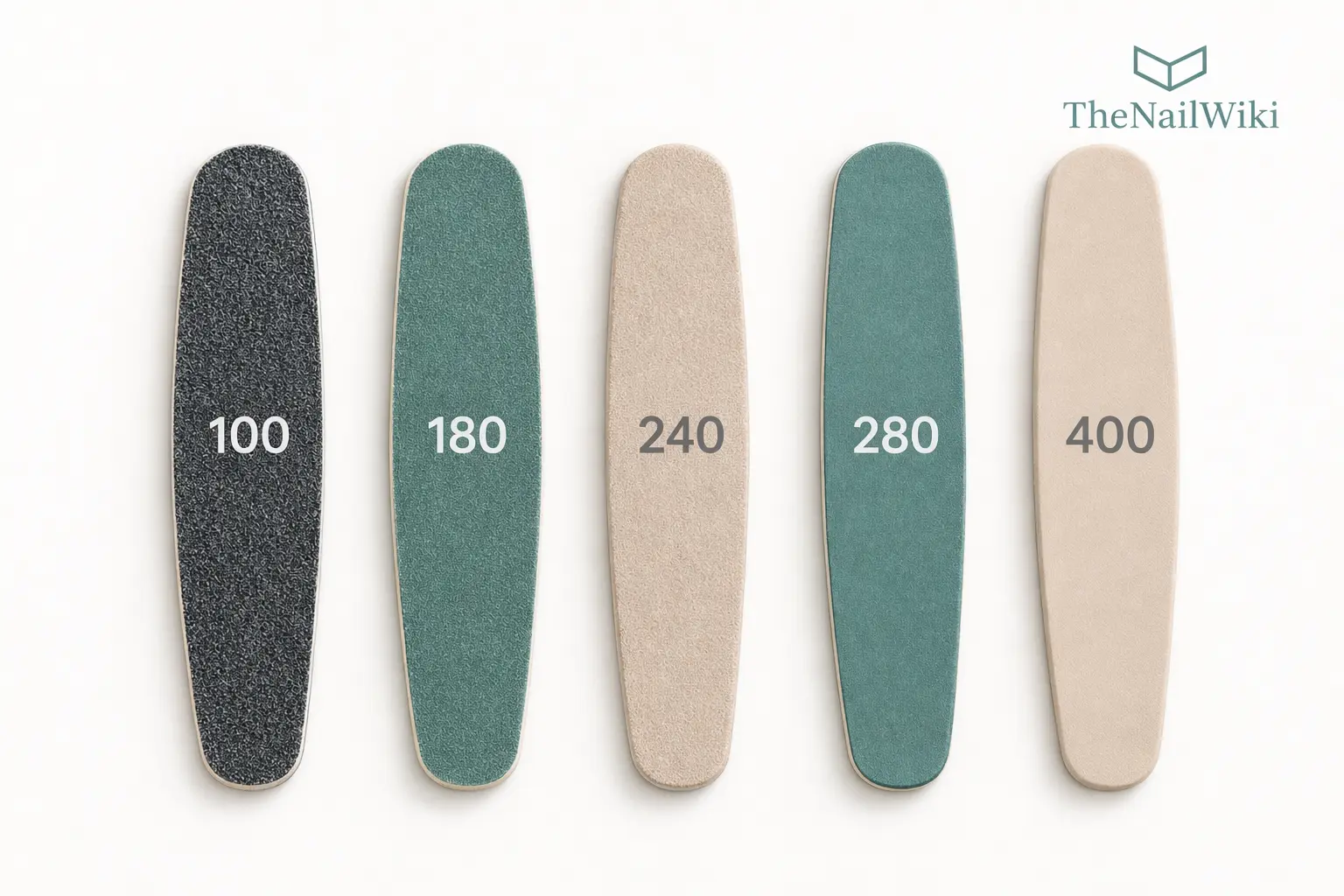
© TheNailWiki
The Natural Nail Rule
The natural nail plate is significantly thinner and more delicate than any enhancement product applied over it. This is the most important distinction to understand when selecting a file — a grit that is perfectly appropriate for shaping acrylic or hard gel can cause serious and lasting damage if used on an unprotected natural nail.
⚠️ Never use a file below 180 grit on the natural nail plate
Files in the 80–150 grit range are designed to remove product — acrylic, hard gel, enhancement material. When used on a natural nail plate, they remove the nail itself. The plate is not thick enough to withstand this level of abrasion without thinning, splitting, or becoming permanently weakened.
If a product manufacturer instructs the use of a file below 180 grit on the natural nail plate as part of their preparation protocol, this is a significant red flag. The 240-grit buffer is the safe standard for de-shining the natural nail during nail preparation.
The free edge exception
A 180-grit file can be used carefully on the free edge of the natural nail — the part that extends beyond the nail bed — for shaping purposes. The free edge is thicker and more compacted than the nail plate surface, and light shaping with a 180-grit file is generally acceptable. Even here, the aim is to shape, not to aggressively remove material. A 240-grit file is always the safer choice and can achieve the same result with slightly more passes.
The plate surface — the top of the nail that sits above the nail bed — should never be filed with anything below 240 grit. This surface is where coatings bond, where the nail plate is thinnest, and where over-filing causes the most damage. See: Nail Plate Preparation →
File Types and Materials
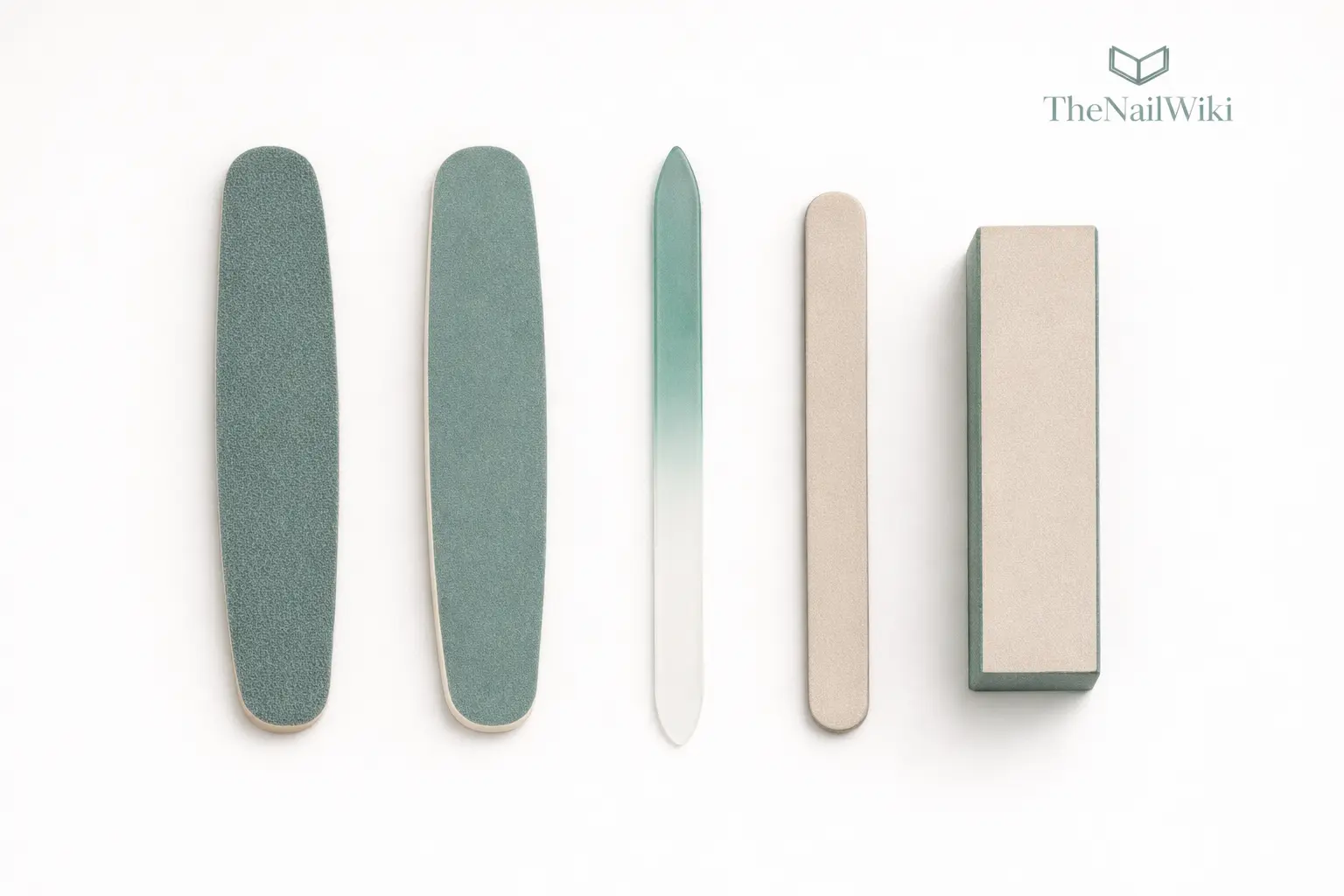
Nail files are made from a range of materials, each with different properties in terms of abrasiveness, durability, hygiene, and suitability for different tasks. The material of the file affects not only how it performs but also how it can be cleaned, whether it can be reused, and whether it is appropriate for professional or home use.
Abrasive board files (emery boards)
The most common and widely available type of nail file — a flat board with an abrasive coating applied to one or both sides. They are inexpensive and available in a wide range of grits, making them the most versatile option for both professional and home use.
The abrasive surface wears down with use and cannot be fully sterilised — once used on a client in a professional setting, they should be disposed of or given to the client for single-person continued use. They should never be shared between clients.
Cushion files (foam core files)
A cushion file has a soft foam core between the abrasive layers, which gives it a degree of flexibility. This flexibility makes cushion files particularly effective for contouring around curved surfaces — such as the sidewalls of enhancements or the curved surface of the nail plate — without the rigidity of a flat board file causing uneven pressure.
Cushion files are a staple of professional nail work and are available in a wide range of grits. Like emery boards, they cannot be fully sterilised and should be single-use per client.
Glass and crystal files
Glass and crystal files have a finely etched glass surface that is often marketed as the gentlest option for natural nails. In practice, they are less straightforward to use than emery files — controlling pressure and angle consistently on a glass surface requires more care than with a standard abrasive board. A good quality fine-grit emery file achieves the same result and is easier to work with for most people, professional or otherwise. Glass files can be washed, but they are not the superior option they are often presented as — they are simply a different material with different handling requirements.
Metal files
Metal files have a perforated or etched metal surface and are extremely durable. Whilst they can be sterilised, they are too harsh for natural fingernails and are not recommended — for professionals or clients at home. Their abrasive action tends to tear rather than smooth the nail edge, causing splitting, peeling, and edge damage with regular use. They should be avoided on natural nails entirely.
Ceramic files
Ceramic files are made from finely ground ceramic material and can be sterilised for reuse. Like glass files, they are sometimes presented as a premium alternative to emery boards — but in practice, a good quality emery file performs comparably and is simpler to use for most nail work. Ceramic files are not a strong recommendation over a well-chosen emery board.
The recommended choice — emery board files
For both professional use and home use, a good quality emery board or cushion file in the correct grit is the most practical and reliable choice. A quality 240-grit emery file is the recommendation for home use — it is safe on natural nails, effective for shaping and de-shining, and straightforward to use correctly.
For home use, a 240-grit emery file can be reused by the individual with care — keep it clean, store it dry, and replace it when it no longer files efficiently. Metal files are not recommended for natural nails for anyone.
© TheNailWiki
File Shapes and What They Are For
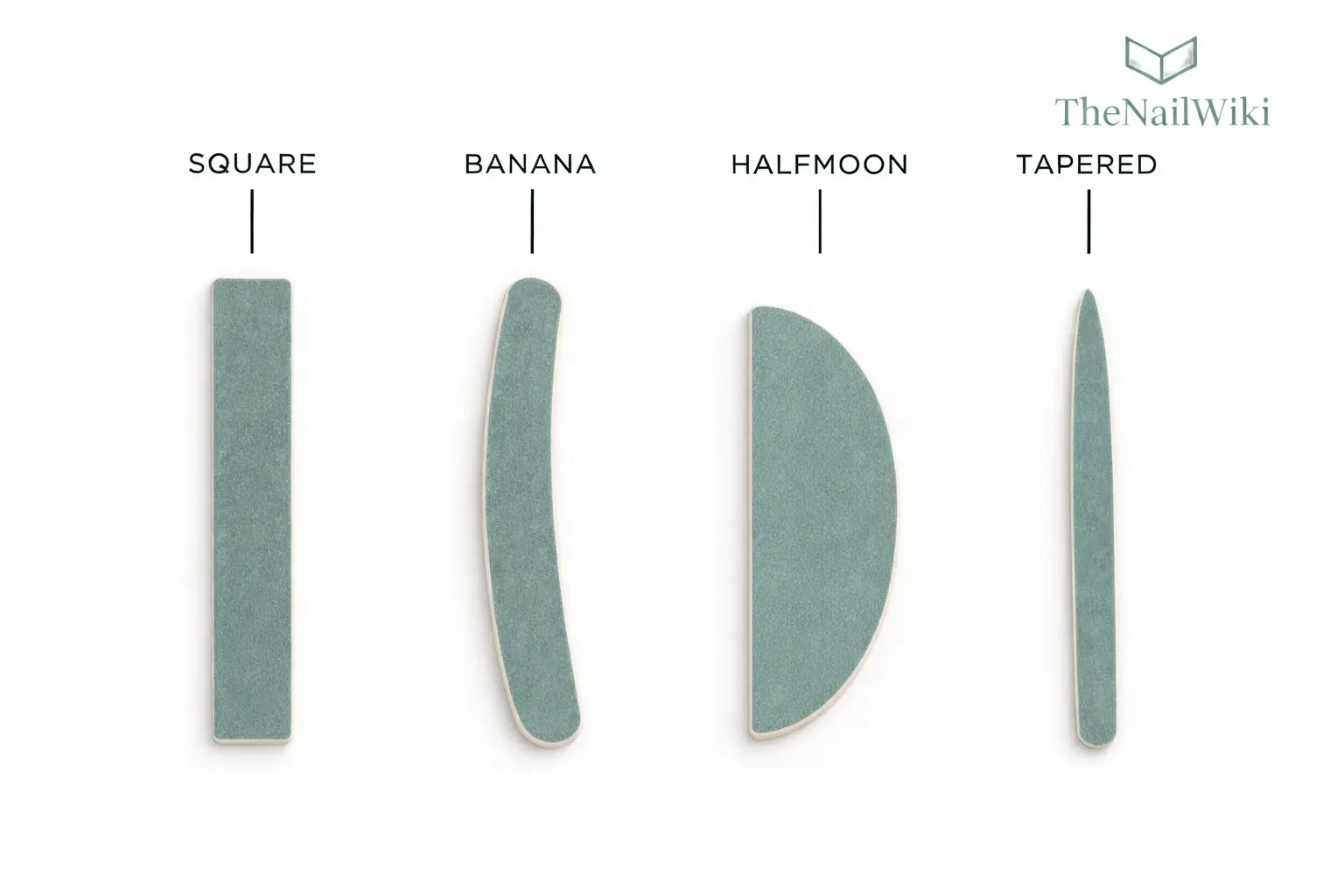
The shape of a nail file determines how it reaches different areas of the nail and enhancement surface. Different shapes are suited to different tasks — and using a flat file where a contoured one is needed can result in uneven filing, flat spots, or missed areas.
Straight / flat files
The most common shape — a rectangular or slightly tapered flat file. Suitable for shaping the free edge, filing the top surface of enhancements, and general nail work. The flat surface makes it easy to apply even pressure across the nail. Most professional files are this shape in various widths.
Banana / curved files
A file with a gently curved shape along its length — sometimes called a banana file. The curve allows the file to follow the natural contour of the nail surface more closely than a flat file, making it particularly useful for filing the top surface of enhancements without creating flat spots or pressure lines.
Half-moon / D-shaped files
A file with one flat edge and one curved edge. The curved edge can be used to file the underside of the free edge or to access the sidewall areas of enhancements — areas that a flat file cannot reach without awkward repositioning.
Narrow / pointed files
A file that tapers to a narrower end, allowing access to tight areas — particularly the sidewalls of the nail and the corners of the free edge where a standard-width file is too wide to work precisely. Useful for detailed work on enhancements and for clients with narrow nail beds.
Block buffers
A multi-sided block format — typically four sides with different grits or finishes ranging from coarse to polishing. Each side is used in sequence to take a nail surface from rough to smooth to polished. Block buffers are common in home nail care and are used in professional settings for finishing and polishing natural nails. Read more: Nail Buffers Guide →
© TheNailWiki
Choosing the Right File for the Task
Shaping the free edge of a natural nail
A 240-grit file or a glass file. Both are gentle enough to shape without causing splitting or tearing at the nail edge. File in one direction — from the outer edge toward the centre — rather than sawing back and forth, which weakens the nail edge and causes fraying.
De-shining the nail plate before product application
A 240-grit buffer, applied lightly in one direction across the plate surface. This is the step that removes the natural gloss from the nail and creates a surface that gel or enhancement products can adhere to. Do not use anything below 240 grit for this purpose. See: Nail Plate Preparation →
Shaping and refining gel or builder gel enhancements
A 180-grit file for initial shaping and bulk reduction, followed by a 240-grit file to refine the surface. The 180 grit removes the enhancement material efficiently; the 240 grit smooths the surface ready for finishing. If filing a Sandwich Dual Form or dual form enhancement, minimal filing should be needed — if significant filing is required, the application rather than the finishing is where to review.
Shaping acrylic or hard gel enhancements
A 100–150-grit file for bulk removal and initial shaping, stepping up to 180 and then 240 for refinement. These harder materials require a more aggressive grit to shape efficiently — attempting to use a fine-grit file on hard gel or acrylic is ineffective and will wear the file rapidly without achieving the intended result.
Finishing and polishing
A 280–320-grit file to smooth the surface, followed by a polishing buffer of 400 grit or higher for a shine finish. This sequence is used on natural nails when no coating is being applied, or on enhancements before a top coat where a smooth base is required.
Professional training in nail preparation and filing
Correct filing technique — including grit selection, direction, pressure, and use for specific services — is covered as part of the Nail Plate Preparation online course at Artistic Touch Nail Training Academy.
Filing Technique
Selecting the correct grit is only part of safe filing — how a file is used matters as much as which file is chosen. Poor filing technique can cause damage even when the grit is appropriate.
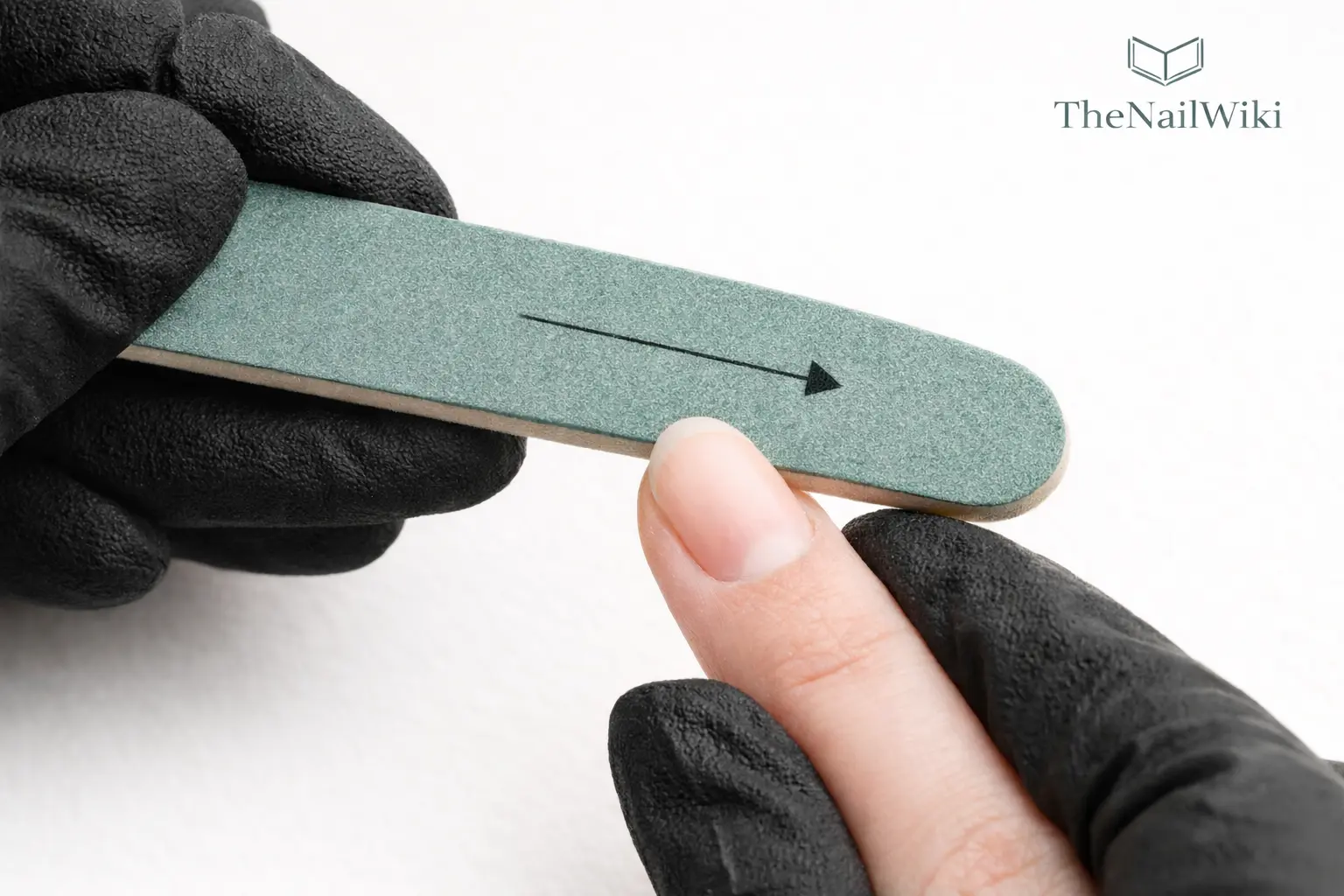
File in one direction
Whether shaping the free edge or de-shining the plate surface, filing should always be done in one direction — not back and forth. The sawing motion that many people use instinctively creates friction, generates heat, frays the nail edge, and disrupts the nail plate surface unevenly. A single, controlled stroke in one direction is more effective and significantly less damaging.
When shaping the free edge, work from the outer corner toward the centre on each side. When de-shining the plate surface, work across the nail in a single stroke from one side to the other. Repeat as needed — do not change direction mid-stroke.
© TheNailWiki
Use light, even pressure
Filing does not require significant force. The abrasive surface of the file does the work — pressing harder does not make a file work faster, it simply increases friction and heat and applies uneven pressure. Light, consistent strokes with an appropriate grit will always produce a better result than aggressive pressure with any grit.
On the natural nail plate during preparation, the aim is to just remove the surface shine. A light touch with a 240-grit buffer achieves this in a single pass on most nails. If it takes many passes, check whether the grit is appropriate for the task.
Check the file regularly
A worn file is no longer the grit it started as — the abrasive particles wear down with use, and a file that began as 240 grit may behave closer to 320 after heavy use. Worn files are less effective and require more passes and pressure to achieve the same result, which increases the risk of damage. Replace files regularly — particularly coarser grits that are used for heavier work.
File Hygiene and Replacement
File hygiene is a professional safety matter, not simply a preference. Nail files used in a professional setting accumulate nail dust, debris, skin cells, and potentially pathogens during use. Using the same file on multiple clients without appropriate cleaning and disposal protocols creates a cross-contamination risk.
Professional single-use files
Abrasive board and cushion files — the most common types used in professional nail services — cannot be fully sterilised. The abrasive coating traps debris that cannot be fully removed by cleaning. In a professional setting, these files should be used on a single client and either disposed of or given to that client for their own continued use. They should never be reused on a different client, even if wiped or sprayed with sanitiser.
Reusable files — glass, ceramic, and metal
Glass, ceramic, and metal files can be washed with soap and water to remove surface debris, then sterilised using an appropriate sterilisation method — autoclave for metal, UV steriliser, or hospital-grade disinfectant solution for glass and ceramic, depending on the material and the manufacturer’s guidance. Always follow the specific guidance for the file material being sterilised.
When to replace a file
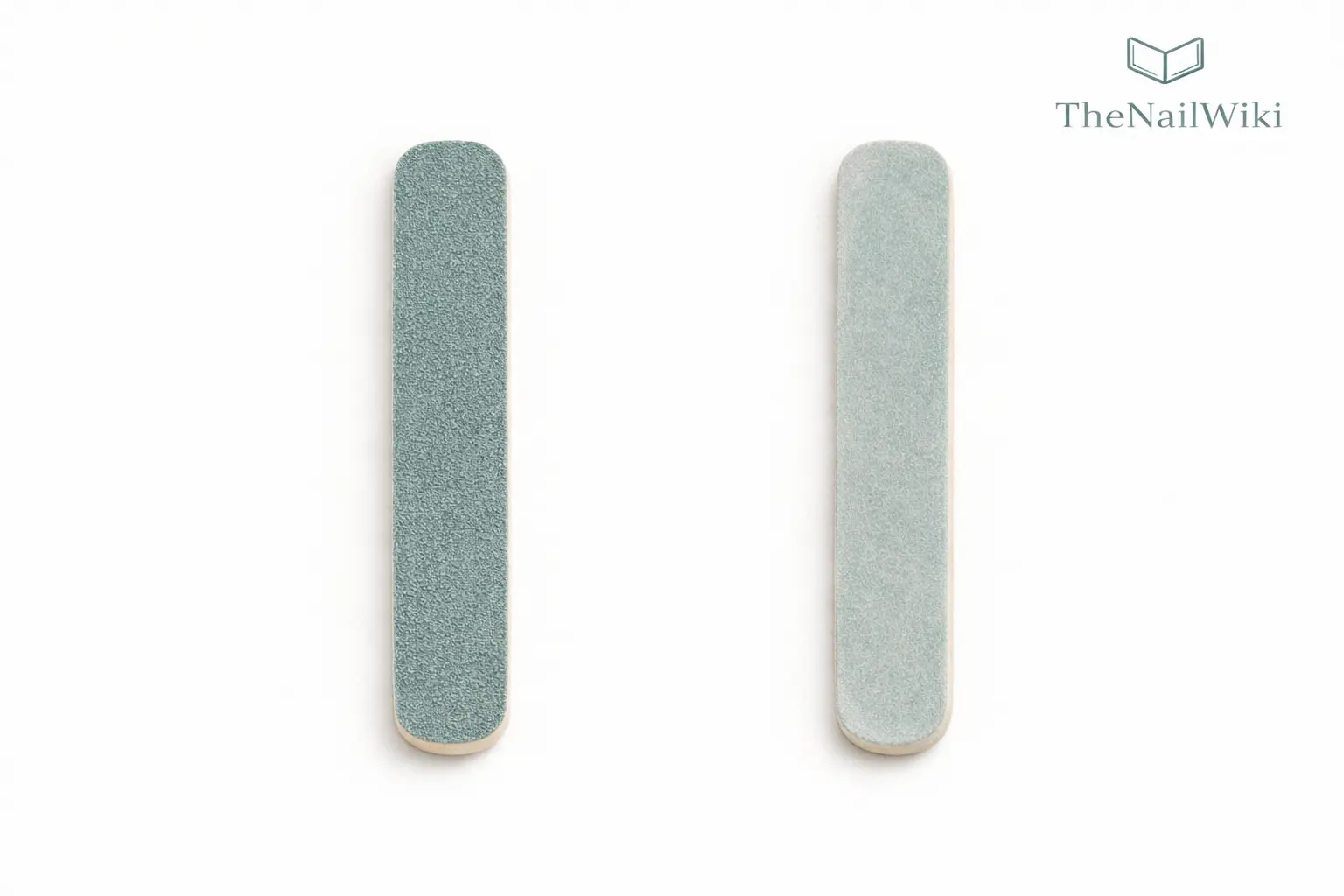
Replace a file when it no longer files efficiently at the expected grit — when more passes or more pressure are needed to achieve the same result as a new file. A worn file wastes time and increases the risk of over-working the nail surface. Glass files should be replaced if chipped, cracked, or if the surface feels rough or sharp in a way that differs from how it felt when new.
© TheNailWiki
Files used on clients with active bacterial nail conditions — such as green nail syndrome — must be disposed of immediately after use and never returned to the general file stock. This applies even to files that would otherwise be cleaned and reused.
What Clients Should Know
Many of the nail issues that clients attribute to weak nails or poor products are directly caused by incorrect home filing — wrong grit, wrong technique, or the wrong type of file for the nail type. Understanding the basics of nail file selection can make a significant difference to natural nail health between salon appointments.
The best file for home use on natural nails
A good quality 240-grit emery file is the best and most practical option for home use on natural nails. It is safe, effective for both shaping and light de-shining, and easy to use correctly. For home use by a single individual, it can be reused with care — keep it clean, store it somewhere dry, and replace it when it is no longer filing efficiently. Metal files should be avoided on natural nails entirely, regardless of the setting.
Never file nails with gel or enhancement on them at home
Filing over gel, BIAB, or any enhancement product at home with a standard nail file risks filing through the enhancement into the natural nail beneath — particularly if the enhancement has already been thinned by wear. If a nail has chipped or broken and needs attention between appointments, contact your nail technician rather than attempting to file or reshape it at home.
Do not peel, pick, or bite filed nails
Filing creates a clean edge — but a nail that has been filed incorrectly (wrong grit, back-and-forth motion) may have a rough or frayed edge that encourages picking. If the free edge feels rough after filing, use a finer grit to smooth it rather than peeling or biting the edge, which removes layers of the nail plate and causes lasting thinning and damage.
Home filing quick guide
- Use a good quality 240-grit emery file on natural nails
- File in one direction only — never back and forth
- Use light pressure — the file does the work
- Never use a coarse file (below 180) on natural nails
- Do not use metal files on natural nails
- Do not file over gel or enhancement product at home
- A 240-grit emery file can be reused by one person with care — keep it clean and dry, replace when worn
Frequently Asked Questions
What grit nail file should I use on natural nails?
A 240-grit file is the safe standard for de-shining the nail plate and for light shaping. For shaping the free edge, a 240-grit file or a glass file are both appropriate. Never use a file below 180 grit on the natural nail plate — files in the 80–150 grit range are designed for enhancements, not natural nails.
Why should you never file nails back and forth?
Filing back and forth creates friction and heat, frays the nail edge, and disrupts the nail plate surface unevenly. It weakens the nail edge over time and can cause splitting and peeling. Filing in one direction — from the outer edge toward the centre — is more effective and significantly less damaging.
Are glass nail files better than emery boards?
Not necessarily. Glass files are often marketed as the gentler, superior option — but in practice they require more care to use correctly and a good quality 240-grit emery file is equally effective and easier to handle for most people. For home use by a single individual, a quality 240-grit emery file is a practical and reliable choice. Metal files are not recommended on natural nails for anyone.
Can I file gel nails at home?
It is not recommended. Filing over gel or enhancement product at home risks thinning or filing through the enhancement into the natural nail, particularly if the enhancement has already been worn thin. If a nail needs attention between appointments, contact your nail technician. Home filing of enhancement products without the correct grit, technique, and awareness of remaining thickness can cause significant damage.
How often should nail files be replaced?
Replace a file when it no longer files efficiently — when more passes or more pressure are needed to achieve the same result. In a professional setting, abrasive board and cushion files should be single-use per client. For home use, replace emery boards regularly as they wear quickly. Glass files last much longer but should be replaced if chipped or cracked.
What is the difference between a nail file and a nail buffer?
A nail file is used to shape and reduce the nail — shaping the free edge, filing enhancements, or de-shining the plate surface. A nail buffer is used to smooth and refine the nail surface — removing ridges, evening texture, and producing a shine finish. Buffers are typically finer grit than files and are used after filing to finish the surface. Read more: Nail Buffers Guide →
Related Library Pages
Preparation and Tools
- → Nail Plate Preparation
- → Nail Buffers Guide
- → Nail Dehydrator
- → Nail Primers — Acid vs Acid-Free
- → Base Coats
- → Nail Cleansers, Alcohol & Prep Liquids
Techniques
- → Russian Manicure
- → E-File Manicure
- → Sandwich Dual Form System
- → BIAB — Builder In A Bottle
- → Gel Polish Explained
Nail Anatomy
Nail Conditions
Some linked pages are currently in development and will be published progressively.
Professional Disclaimer
The information on this page is provided for educational purposes and is intended to support the professional knowledge of nail technicians and nail educators. Nail services should only be performed by trained professionals. Any client with nail conditions, skin sensitivities, or relevant health concerns should be assessed by a qualified professional before any nail service is undertaken.

About the Author
Radina Ignatova
Professional Nail Expert since 2014 | International Nail Educator | Founder of TheNailWiki and Artistic Touch Nail Training Academy
Radina Ignatova is a Professional Nail Expert since 2014 and an International Nail Educator specialising in advanced nail preparation, e-file techniques, BIAB, dual form systems, and professional salon safety. Based in Scotland, UK, she teaches nail technicians internationally through structured online courses.
Her teaching philosophy is centred on honest education — demonstrating real salon challenges, practical corrections, and performance-based technique rather than presenting only polished results.
Read full bio →About TheNailWiki
TheNailWiki is an independent educational platform dedicated to providing accurate, safety-led and professionally informed nail care information to professionals and enthusiasts worldwide. All content is created by qualified nail industry professionals and reviewed for technical accuracy.
For structured professional training, advanced masterclasses, and specialist technique courses, visit Artistic Touch Nail Training Academy.
This library page is published by TheNailWiki — an independent nail education resource maintained by nail industry professionals. Content is safety-led and professionally informed.