
Dual Forms for Nails: What They Are, How They Work, and What the Myths Get Wrong
Author: Radina Ignatova, Professional Nail Expert & International Nail Educator | Last Updated: April 2026
Quick Answer: A dual form is a reusable or single-use mould pressed over the nail to shape gel product into a clean, defined nail extension or overlay in a single step. The form sits over the nail, gel product is cured inside it, and the form is removed to reveal a shaped, glossy result without the need for filing to create the basic shape. Dual forms are a legitimate professional technique when used correctly — but they are also one of the most widely misunderstood tools in the nail industry, surrounded by myths that either overstate what they can do or dismiss them as a shortcut of no value. Neither is accurate.
Quick Summary
Dual forms work by using the mould’s internal shape to define the nail’s structure — the c-curve, the length, and the surface contour — while the product cures inside it. The technique is faster than traditional sculpting for certain nail types and well-suited to creating consistent, clean results across multiple nails. It is not a beginner shortcut — correct dual form work requires thorough preparation, correct product selection, precise application, and understanding of the apex, stress zone, and c-curve.
The Sandwich Dual Form System — a specific dual form technique developed for professional use — addresses many of the limitations of basic dual form application and is covered in its own dedicated guide.
Contents
- A Brief History of Dual Forms
- What Dual Forms Are
- How They Work
- The Benefits of Dual Forms — When Done Correctly
- Types of Dual Form
- Dual Form Myths — What the Internet Gets Wrong
- How Nail Type Affects Dual Form Application
- Preparation — Why It Cannot Be Skipped
- Dual Forms vs the Sandwich Dual Form System
- Dual Forms vs Traditional Sculpting
- Common Mistakes
- Frequently Asked Questions
A Brief History of Dual Forms
The concept of using a pre-shaped mould to create nail extensions is not new — nail forms and tip systems have existed in professional nail services since the 1970s and 1980s when acrylic nail technology was first commercialised. The idea of pressing a single mould over the entire nail to shape both the extension and the overlay simultaneously, however, evolved much more recently alongside the growth of gel nail technology.
Early dual form-style moulds were used in the nail industry primarily in Asian nail markets — particularly in South Korea and Japan — where the gel nail industry developed rapidly through the 2000s and early 2010s. Korean nail technicians were early adopters of clear dual forms used with builder gel, a practice that spread through social media and nail education channels into European and global markets through the mid-2010s.
The technique gained significant mainstream visibility when short-form social media content — particularly 60-second and 30-second videos — showed what appeared to be complete, professional-quality nail sets produced in minutes using dual forms and UV gel. This visibility brought both genuine interest in the technique and a wave of misinformation about what dual forms could and could not do — much of which persists in online discussion today.
Key milestones
- 1970s–80s: Acrylic nail systems commercialised — early nail forms and tip systems established the principle of moulded nail extensions
- 2000s–early 2010s: Clear gel dual forms developed and refined in Korean and Japanese professional nail markets
- Mid 2010s: Dual form technique spreads into European nail education through trade shows, international educators, and social media
- Late 2010s–2020s: Viral social media content brings dual forms to mainstream awareness — alongside widespread misunderstanding of the technique
- 2020s: Professional refinement of dual form systems — including the development of techniques such as the Sandwich Dual Form System — addresses limitations of basic application
What Dual Forms Are
A dual form is a pre-shaped nail mould — typically made from clear or semi-transparent flexible plastic — that is pressed over the natural nail to shape gel product as it cures. The term “dual” reflects the form’s dual function: it defines both the extension length and the surface shape of the nail simultaneously, acting as both a nail tip and a surface mould in one piece.
Dual forms come in sets sized to different nail widths and shapes. The inside surface of the form is the working surface — gel product is applied to the nail and the form is pressed over it, with the inside surface of the form creating the top surface of the finished nail. The form is cured with the product inside it under a nail lamp, then removed to reveal the shaped result.
Some dual forms are designed for single use. Others — particularly the harder plastic or acrylic forms — are reusable and can be cleaned and used across multiple services. The form type in use determines the technique required and what product systems are compatible with it.
How They Work
After thorough nail plate preparation — including cuticle work, surface preparation, cleansing with the Radina Double Cleanse Method, dehydration, and base coat application — gel product is applied to the nail plate in a specific placement designed to position the apex and stress zone correctly when the form is pressed over it.
The dual form is then pressed over the nail starting at the cuticle area at a 45-degree angle, pressing down and forwards towards the free edge to seat the form correctly and avoid air pockets. The pressure distributes the product within the form, the inside surface of the form creates the top shape of the nail, and the c-curve of the form defines the transverse arch of the finished nail. A flash cure lamp is commonly used to tack the product at the cuticle area to prevent the form from sliding before full curing, after which the hand is placed under the nail lamp for a full cure.
Once cured, the form is removed — typically by gently flexing it from the sides and lifting at the free edge. The result is a shaped, glossy nail that requires minimal filing compared to traditionally sculpted nails. The underside of the nail and the cuticle area are then refined and the service is completed as normal.
The Benefits of Dual Forms — When Done Correctly
Dual forms, when applied with the correct preparation, correct product, and correct form selection, deliver specific benefits that distinguish them from other enhancement approaches.
Clean, precise cuticle imprint
A hybrid form with a soft cuticle zone creates a clean, defined imprint at the proximal nail fold — producing a crisp cuticle line that would require significant skill and time to achieve through manual sculpting. This is one of the primary reasons experienced technicians choose dual form technique.
Perfectly smooth surface
The inside surface of a quality dual form produces a glossy, smooth top surface on the finished nail that requires minimal refinement. The surface is created by the form itself — not by filing — which means less material is removed and the finished result retains full product thickness and integrity.
Built-in architecture
The form defines the c-curve, the apex zone position, and the overall nail architecture as the product cures. When product is placed correctly inside the form, the structural elements of the enhancement are built in during the curing process rather than carved out through filing afterwards. This produces a structurally sound result efficiently.
Reduced treatment time
Because the form creates the surface and basic architecture during curing, the filing and shaping stage is significantly reduced compared to traditional sculpting. For suitable nail types, this makes dual form services faster without compromising quality — a meaningful benefit in a professional salon context.
Thick and bulky nails — not a dual form failure
One of the most common complaints about dual forms — particularly from those new to the technique — is nails that come out thick or bulky. This is not a failure of the dual form itself. It is a failure to understand how product placement inside the form determines the final nail thickness. Too much product, incorrectly placed, will always produce a thick result regardless of the technique. Understanding how to place the correct amount of product in the correct zones within the form, and selecting the right form for the nail type, is what produces a refined result. This understanding comes from proper training — not from trial and error.
Types of Dual Form
Dual form technology has evolved significantly. The market has moved well beyond the basic soft or rigid categories into more sophisticated hybrid constructions that solve the problems of earlier designs. Understanding the difference between form types matters — the wrong form for the nail type produces poor results that are often wrongly blamed on the technique itself.
Hybrid — soft cuticle, semi-rigid body
The most widely used professional dual forms today combine a soft, flexible cuticle area with a semi-rigid body. Forms such as the Imenka V2 are a good example of this construction. The soft cuticle zone conforms closely to the natural curve of the proximal nail fold, creating a clean, precise cuticle imprint with minimal gap between the form and the skin. The semi-rigid body maintains structural integrity through the body and free edge of the form, ensuring the architecture — the c-curve, the apex zone, the extension shape — holds correctly during product placement and curing. This combination gives the best of both: a clean cuticle seal and a structurally sound result.
Fully soft flexible forms
Forms where the entire construction is very soft and pliable can be problematic — particularly for less experienced practitioners. While a fully soft form conforms easily to varied nail shapes, it lacks the structural integrity to hold the architecture of the nail during product placement. The form can flex, shift, or collapse under pressure, which distorts the c-curve and produces thick, uneven, or architecturally weak results. For beginners, a fully soft form makes correct technique significantly harder, not easier.
Fully rigid forms
Fully rigid dual forms are the original construction — made from hard, thick plastic or acrylic. They hold their shape precisely but offer no flexibility at the cuticle area, which means the cuticle imprint is less clean and gaps between the form and the proximal fold are common. Fully rigid forms have largely been replaced by hybrid constructions in professional use. They still serve a purpose in certain applications but are no longer the professional standard.
C-curve variations — arched, natural, and strong curve
Dual forms are available in different c-curve depths — from a flatter, more natural curve through to a pronounced strong curve. Forms such as the Imenka range offer different curve depths labelled by size — L and XL indicating progressively stronger curves. Each serves a different nail type and client preference. A flatter c-curve suits clients with naturally flatter nail plates or those who prefer a more natural look. A stronger c-curve creates a more pronounced transverse arch suited to clients with already arched nails or those who want a more structured, defined nail shape. Matching the form’s c-curve to the client’s natural nail plate and their desired result is one of the most important selection decisions in dual form work — see the free How to Pick Dual Forms mini masterclass →
Shape variations
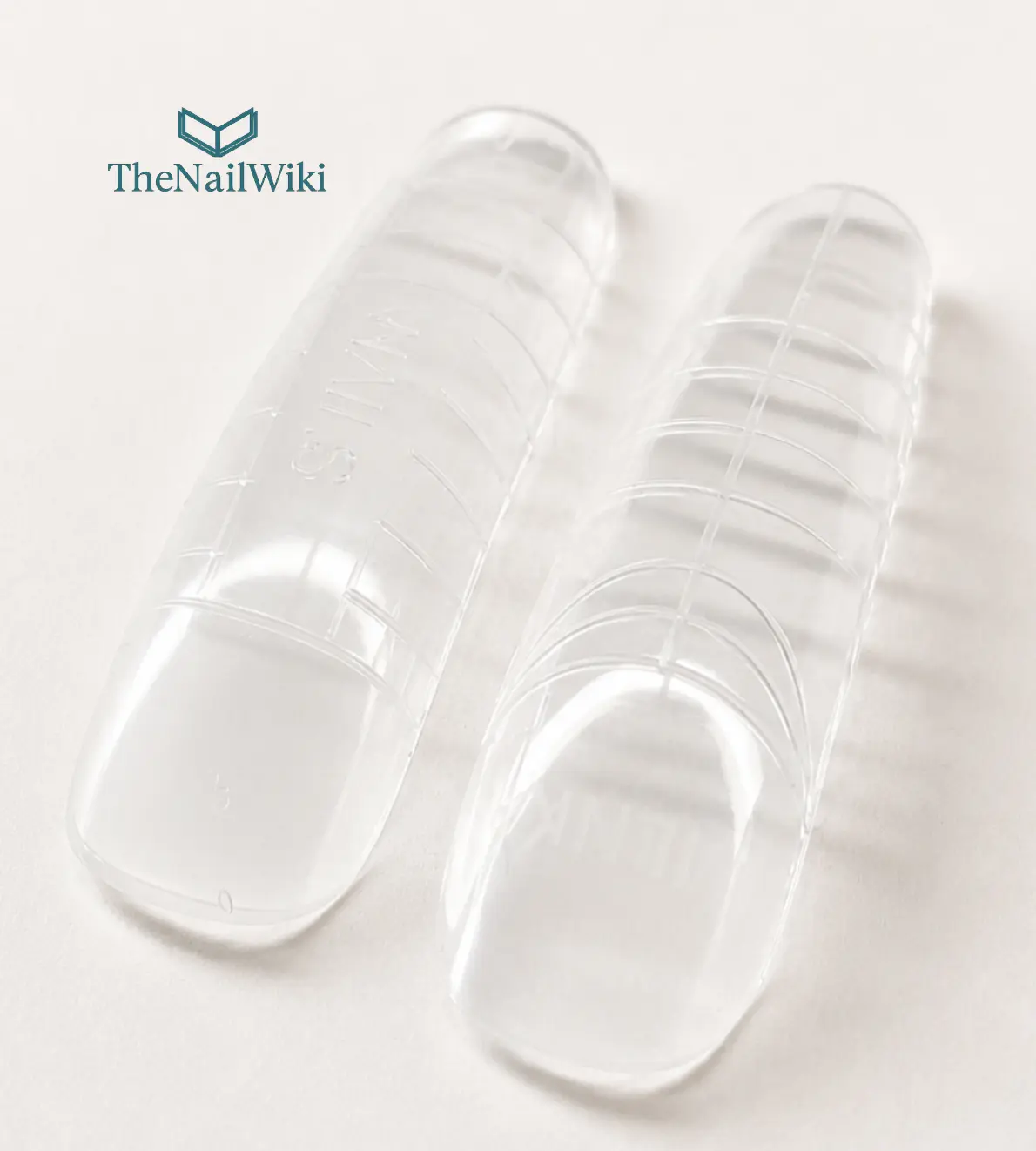
Silicone dual form moulds for nail art
A separate category of dual form mould exists specifically for nail art — silicone moulds designed to imprint 3D textures, patterns, and designs directly into the product surface as it cures. These are not structural dual forms in the same sense — they are used to create decorative surface effects that would otherwise require skilled hand-sculpting. This is a growing area of dual form application with its own techniques and product requirements. A dedicated guide to silicone moulds for nail art is in development at TheNailWiki.
Free: How to Pick Dual Forms Mini Masterclass
Choosing the right dual form for each nail type is one of the most important skills in dual form work — and one of the most commonly skipped steps. Radina Ignatova has produced a dedicated free guide covering exactly this: how to assess the nail, how to match the form, and what to look for before any product is applied.
Access the Free Mini Masterclass →Dual Form Myths — What the Internet Gets Wrong
Few nail techniques have attracted as much online misinformation as dual forms. Social media has simultaneously promoted them as a miracle shortcut and dismissed them as damaging and unprofessional. Both positions are wrong. Here are the most common myths addressed directly.
Myth: Dual forms damage the nails
Dual forms do not damage nails — incorrect preparation, incorrect removal, and incorrect product application damage nails. A dual form service performed on a correctly prepared nail plate with appropriate product and removed correctly causes no more damage than any other gel nail service. The myth persists because badly executed dual form services — rushed, without preparation, with forced removal — do cause damage. The damage comes from the poor execution, not the technique itself.
Myth: Dual forms are a beginner shortcut with no professional application
Dual forms are a legitimate professional technique used by experienced nail technicians globally. They are not easier than traditional sculpting — they require the same understanding of nail structure, product behaviour, and preparation. What they offer is a different workflow that suits certain nail types and service contexts particularly well. Dismissing the technique as a shortcut reflects a misunderstanding of what dual form work actually requires.
Myth: What you see in 30-second social media tutorials is real dual form technique
Social media nail tutorials are edited for entertainment and engagement, not professional education. A 30-second dual form video almost never shows the preparation sequence, the base coat application, the product placement decisions, the flash cure technique, the removal process, or the finishing work. What is shown is the visually interesting moment of pressing the form and removing it. This is not a complete technique — it is a clip of one step in a much longer process. Attempting to replicate social media dual form content without the full technical context is one of the primary causes of damaged nails attributed to dual forms.
Myth: Any gel product works in a dual form
Product selection is critical in dual form work. The product must have sufficient viscosity to stay in position when the form is pressed without flowing into the cuticle area, and must cure fully through the form material under the lamp. Thin gel polish applied in a dual form does not produce a structured extension. Builder gel or BIAB formulated for dual form use is the correct product choice.
Myth: Dual forms always produce perfect c-curves
The form defines the c-curve — but only if the form fits the nail correctly. A form with a tighter c-curve than the client’s natural nail will create pressure points and lifting. A form that is too wide will not seal correctly and the product will spread unevenly. Matching the form to the nail shape and width is a skill that requires assessment and experience, not just picking the closest size from the set.
Myth: Dual forms require no filing and no finishing
Dual forms significantly reduce the filing needed to create the basic shape — but they do not eliminate finishing work. The underside of the free edge, the sidewalls, the cuticle area, and any surface imperfections from the form still require refinement. A dual form service completed without finishing work is not a professional result.
How Nail Type Affects Dual Form Application
Dual form results are not determined by technique alone. They depend on how the natural nail structure interacts with the form. Dual forms do not adapt to the nail — the nail must be compatible with the form. Correct assessment before application allows you to select the right form shape and depth, control the structure before curing, and avoid predictable failures. Incorrect assessment means the structure is already wrong before any product has been applied.
Normal nail type
A balanced nail plate with a moderate natural c-curve is the most straightforward nail type to work with in dual form services. The form sits without resistance, placement is predictable, and the growth points — the side areas where the natural nail transitions into the free edge — are generally easy to cover and support correctly within the form. This nail type is often used as a baseline when first learning dual form systems.
Flatter nail plates
Flatter nail plates with a minimal natural c-curve are particularly well-suited to dual forms. The form introduces a c-curve that the natural nail lacks, creating strength and structure without heavy sculpting. The key advantage is that the form defines the architecture instead of the nail resisting it — and on flat plates, growth point coverage is generally clean and consistent because the nail offers less natural variation in curvature across its width.
Arched or convex nail plates
Naturally arched or convex nail plates already have a pronounced c-curve. This requires careful form selection — the curvature of the dual form must closely match the natural nail. If the form is flatter than the nail, pressure is created at the sidewalls, the growth points become compressed rather than supported, lifting is more likely, and the structure can distort during curing. The form must accommodate the existing architecture of the nail, not work against it.
Hooked or downward-growing nails
Hooked nails grow forward and downward, creating a directional conflict with the dual form. The form attempts to extend straight or slightly upward, while the natural nail pulls downward — this creates tension within the structure, misalignment of the extension, a weak stress area, and a high likelihood of lifting or breakage at the free edge. Growth point coverage on hooked nails is also more complex because the nail’s natural direction affects how the sidewalls sit within the form. These nails require advanced control and are not ideal for standard dual form application.
Koilonychia and ski jump nails
Koilonychia — commonly referred to as ski jump nails — presents a reversed or upward growth pattern. This behaves differently from both flat and hooked nails and requires a separate structural approach. Dual forms can be used but only with correct adaptation of apex placement, extension angle, and product distribution. Standard dual form selection and placement without adaptation will not produce a correct structural result on this nail type.
Not suitable — damaged or severely compromised nail plates
Damaged nail plates with significant thinning, lifting, or active conditions should not have dual form enhancements applied until the nail plate has recovered. Check for any contraindications before proceeding with any enhancement service.
Growth points and the most common dual form mistake
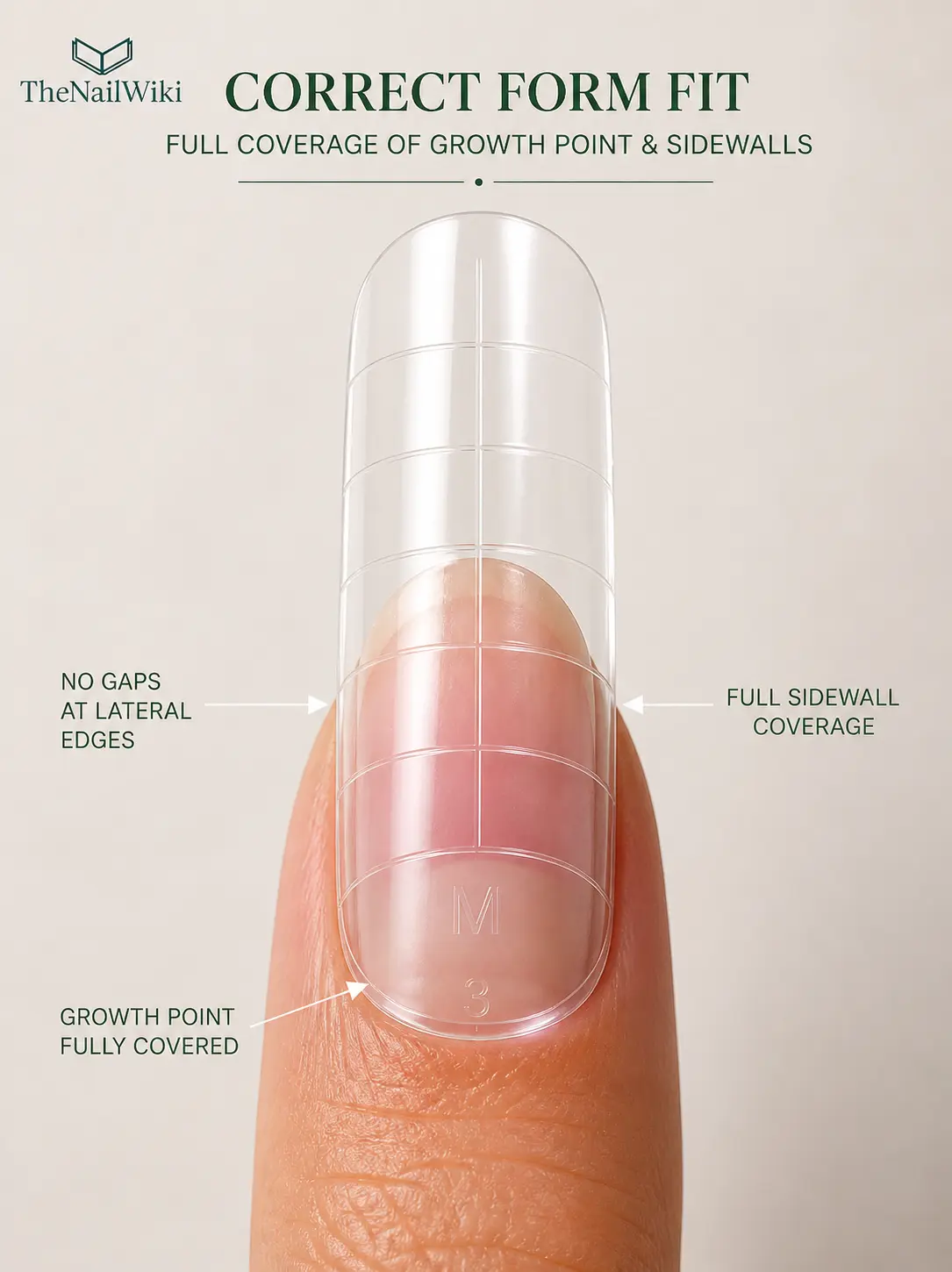
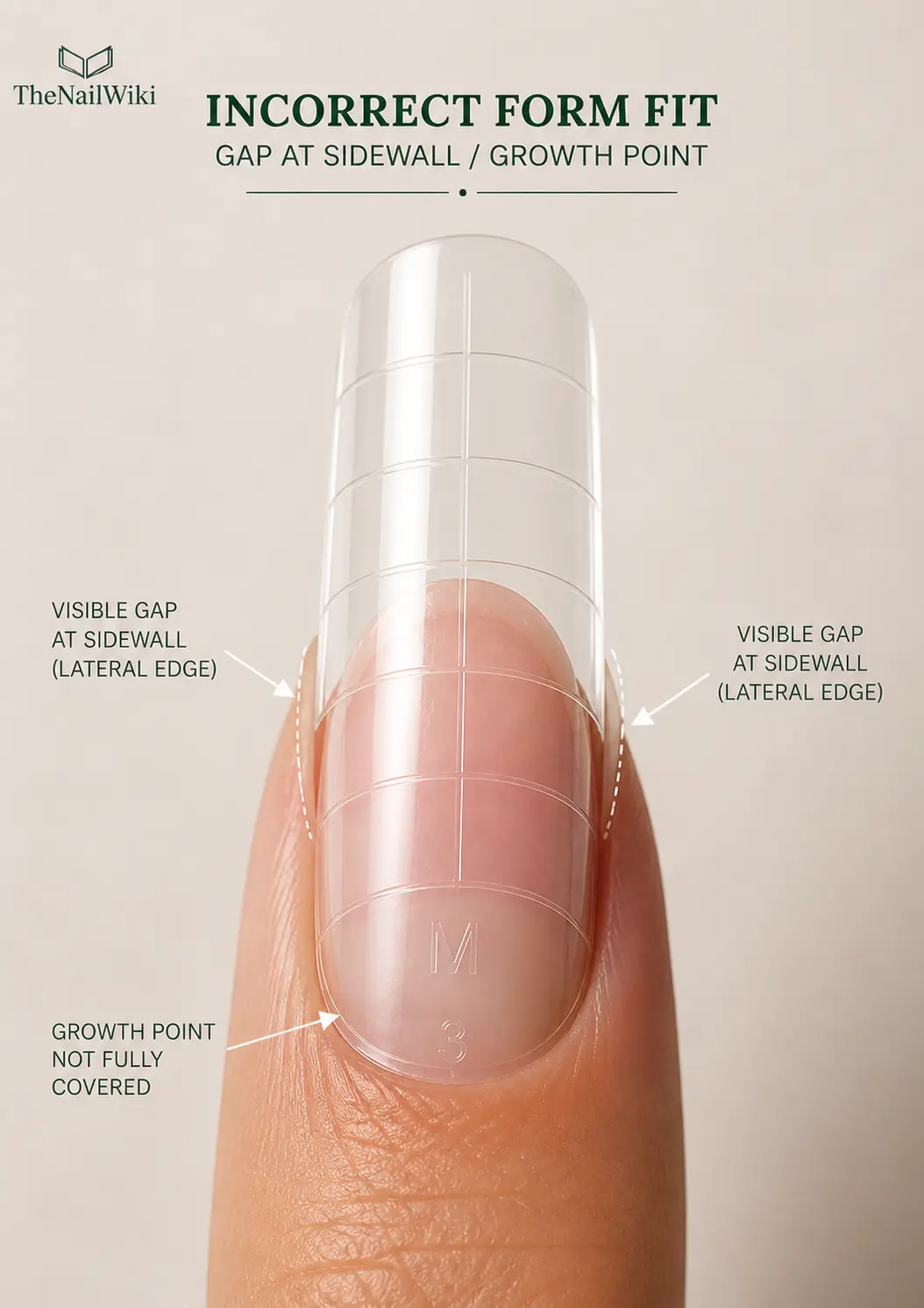
Growth points are the side areas where the natural nail transitions into the free edge. They define the width, direction, and structural support of the nail. In dual form work, growth points must be fully supported and enclosed within the form. If they are not correctly covered, the structure becomes unstable regardless of the product used.
The most frequent mistake is selecting a form based on width alone, while ignoring c-curve depth and growth point coverage. A form can appear to fit correctly from a top-down view and fail structurally the moment pressure is applied. The result is exposed or compressed growth points, gaps at the sidewalls, product leakage or thin areas, and lifting within days of the service.
A form that is too flat or too narrow for the nail does not support the growth points — it either pushes against them, leaves them uncovered, or distorts the structure during placement. Dual form selection must be based on volume and curvature, not just width. The form should fully cover both growth points, match the natural curvature of the nail, and sit without pressure or gaps before any product is applied.
Dual forms do not fix structure after placement. They define it during placement. If growth point coverage is incorrect before curing, no amount of filing or finishing will correct the underlying structural weakness.
© TheNailWiki
© TheNailWiki
Preparation — Why It Cannot Be Skipped
Preparation for a dual form service is identical in standard and rigour to preparation for any other gel enhancement service. There is no version of dual form work where preparation can be abbreviated because the form is doing the shaping — the form shapes the product, but the product’s adhesion to the nail plate depends entirely on how well the nail was prepared before the form was applied.
The preparation sequence must include cuticle work to remove all dead cuticle from the nail plate surface, surface preparation, cleansing using the Radina Double Cleanse Method, full dehydration, and base coat application. The primer step is included where the product system requires it. The full sequence guide is at: Nail Plate Preparation →
If the dual form result lifts, shrinks, or separates — the preparation was not correct. The form does not cause lifting. Incomplete preparation causes lifting. This is the most consistent finding across all dual form service failures — not the product, not the form, not the lamp. The preparation.
Dual Forms vs the Sandwich Dual Form System
The Sandwich Dual Form System is a specific professional technique that builds on standard dual form application by using both the top and bottom of the form — applying product both inside the form and onto the nail, then pressing the form over to create a sandwich of product that produces greater thickness, structure, and adhesion than single-application dual form work.
Standard dual form application places product only on the nail before pressing the form. The Sandwich System adds product to the inside of the form as well, creating a more complete bond and allowing greater control over the distribution of product through the nail’s structure — particularly at the apex and stress zone. This makes the Sandwich System more suitable for clients who want significant length or need greater structural reinforcement.
For the complete Sandwich Dual Form System guide — product placement, flash cure technique, removal, and the full nail type suitability assessment — see: Sandwich Dual Form System →
Dual Forms vs Traditional Sculpting
Common Mistakes
Skipping or abbreviating preparation
The form creates the shape — it does not create adhesion. Preparation creates adhesion. Skipping any preparation step produces a result that looks complete but will lift, shrink, or separate within days. Full preparation is non-negotiable regardless of how quickly the service appears to go.
Using the wrong size form
A form that is too narrow creates pressure at the sidewalls and does not seal correctly at the lateral folds. A form that is too wide allows product to spread unevenly and the edges to lift. Correct size selection — width and c-curve — for each individual nail is essential before any product is applied.
Using the wrong product
Thin gel polish or insufficiently viscous product does not hold position in a dual form. Builder gel or BIAB with appropriate viscosity for dual form application is the correct product choice. Using whatever product is available without considering its suitability for this specific technique produces poor results.
Forcing removal
Forcing a dual form off rather than flexing and lifting gently can pull product from the nail plate or damage the nail. If a form does not release easily, it was not fully cured, the form is not the correct fit, or the product has bonded to the form rather than the nail. Forced removal is one of the primary sources of nail damage attributed to dual forms.
No flash cure at the cuticle
Without a flash cure at the cuticle area after placing the form, the product shifts and the form slides as the hand is moved to the lamp. This produces uneven product distribution and often lifting at the cuticle zone. Flash curing to set the product in position before full curing is standard professional practice in dual form work.
Frequently Asked Questions
Do dual forms damage natural nails?
Dual forms do not damage natural nails when used correctly. Damage occurs when preparation is skipped, removal is forced, or the technique is executed incorrectly. A properly prepared, correctly applied, and gently removed dual form service is no more damaging than any other gel enhancement service.
Are dual forms suitable for beginners?
Dual forms are not a shortcut for beginners. They require the same preparation knowledge, product understanding, and technical awareness as any other enhancement technique. They may appear simpler from watching social media content — but that content does not show the full process. Proper training before attempting dual form services on clients is essential.
What product should I use with dual forms?
Builder gel or BIAB is the appropriate product for dual form work — the gel must have sufficient viscosity to stay in position when the form is pressed without flowing into the cuticle area or sidewalls. Gel viscosity behaves differently depending on temperature, brand, and formula. Understanding how your specific product moves and holds position under a form is something that develops through practice and training — there is no universal rule other than that thin gel polish does not provide the structure or holding behaviour needed for dual form application. Always confirm the product cures fully through the form material under your lamp.
What is the difference between dual forms and the Sandwich Dual Form System?
Standard dual form application places product on the nail before pressing the form. The Sandwich Dual Form System places product both on the nail and inside the form, creating a sandwich of product that produces greater thickness, structure, and adhesion. The Sandwich System is better suited to clients who want significant length or greater structural reinforcement.
Can dual forms be reused?
It depends on the form type. Soft flexible forms are typically single-use or low-reuse. Rigid forms made from harder plastic or acrylic are designed for repeated use and can be cleaned between services. Always follow the manufacturer’s guidance on the specific form type in use.
Why does my dual form result lift at the cuticle?
Lifting at the cuticle area is almost always a preparation issue — dead cuticle left on the nail plate surface, insufficient dehydration, or the nail being touched after dehydration before the form was applied. It can also be caused by product flooding onto the surrounding skin during application, or by skipping the flash cure step that holds the form in position during the full curing cycle.
Professional training in dual form technique
The Sandwich Dual Form System — including full preparation protocol, product placement, flash cure technique, nail type assessment, and removal — is taught as a structured online course at Artistic Touch Nail Training Academy.
Related Library Pages
Dual Form Systems
Preparation
- → Nail Plate Preparation — The Full Sequence
- → Nail Cleansers — The Radina Double Cleanse Method
- → Nail Dehydrator
- → Base Coats
- → Nail Primers
Nail Structure
Products & Tools
Safety
Some linked pages are currently in development and will be published progressively.
Professional Disclaimer
The information on this page is provided for educational purposes and is intended to support the professional knowledge of nail technicians and nail educators. Nail enhancement services should only be performed by trained professionals. Any client with nail conditions, skin sensitivities, or relevant health concerns should be assessed by a qualified professional before any nail service is undertaken.

About the Author
Radina Ignatova
Professional Nail Expert since 2014 | International Nail Educator | Founder of TheNailWiki and Artistic Touch Nail Training Academy
Radina Ignatova is a Professional Nail Expert since 2014 and an International Nail Educator specialising in Russian Manicure, BIAB application, advanced e-file techniques, and nail safety protocols. Based in Dundee, Scotland, UK, she operates a professional salon whilst teaching nail technicians internationally through online courses.
Her teaching philosophy is centred on honest education — demonstrating real salon challenges, practical corrections and performance-based techniques rather than presenting only polished results.
Read full bio →About TheNailWiki
TheNailWiki is an independent educational platform dedicated to providing accurate, safety-led and professionally informed nail care information to professionals and enthusiasts worldwide.
For structured professional training visit Artistic Touch Nail Training Academy.
This library page is published by TheNailWiki — an independent nail education resource. Content is safety-led and professionally informed.