
C-Curve — Transverse Arch: What It Is and Why It Matters in Nail Enhancement
Author: Radina Ignatova – Nail Expert, International Nail Educator | Last Updated: July 2026
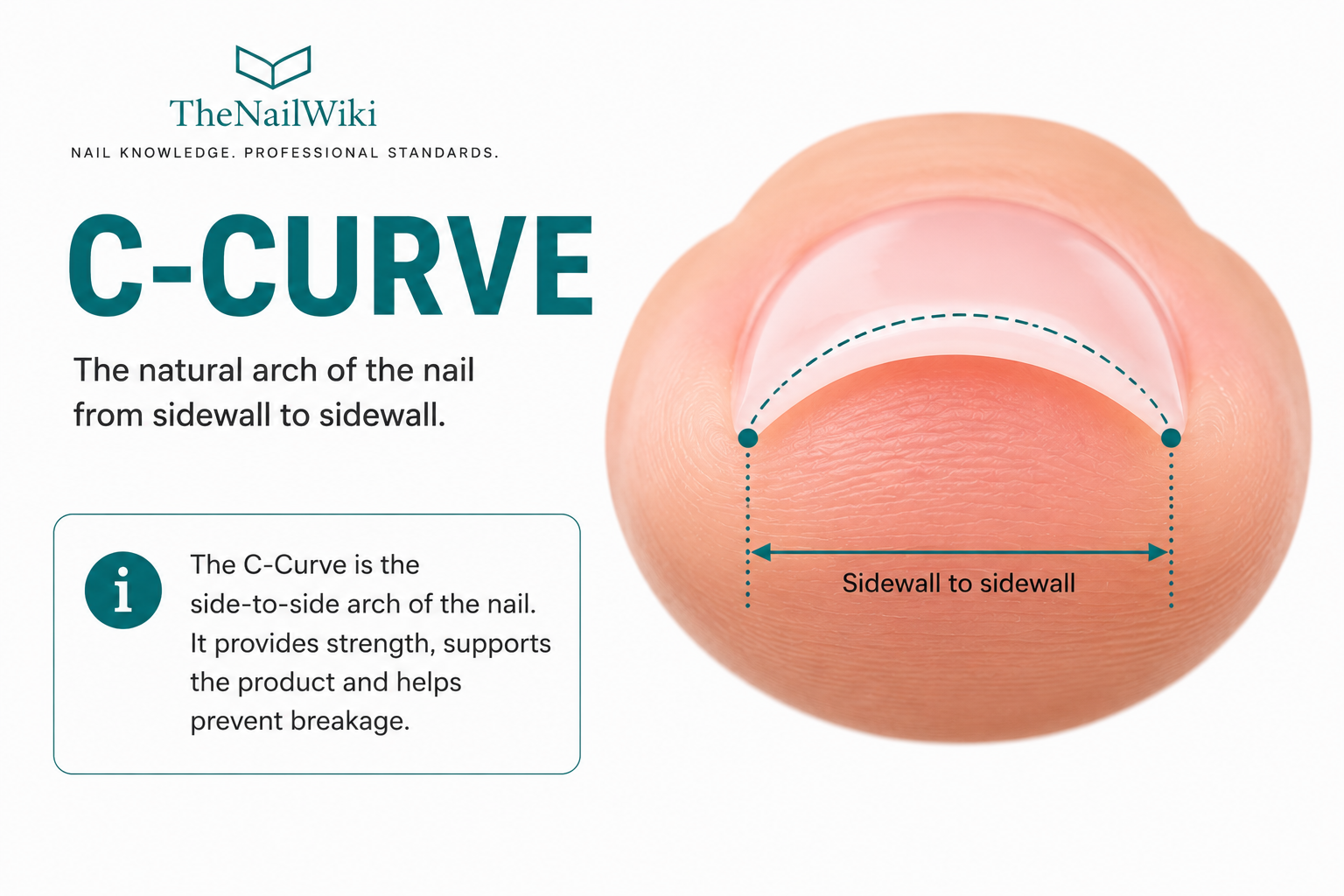
Quick Answer: The c-curve — also called the transverse arch — describes how much the nail plate curves from one lateral edge to the other when viewed from the free edge end-on. A nail with a pronounced c-curve forms a clear arc across its width; a flatter nail has a shallower curve or almost none. The c-curve influences how the nail handles lateral force and how enhancement product behaves on the nail. In enhancement work, the c-curve must be assessed and followed — it is a key part of the complete design, alongside the apex, the overall profile, and the product system being used.
Contents
What the C-Curve Is
The c-curve describes the transverse curvature of the nail plate — the degree to which it arches from one lateral edge to the other. The name comes from the shape the nail forms when viewed from the free edge end-on: a well-defined arch resembles a letter C. A flatter nail produces a much shallower curve or barely any departure from a straight line.
The c-curve is a separate concept from the nail apex. The apex describes the longitudinal profile — the highest point along the length of the nail when viewed from the side. The c-curve describes the transverse profile — how the nail curves across its width when viewed from the front. Together they describe the three-dimensional shape of the nail and the enhancement built on it.
The natural c-curve of a nail is shaped by the underlying nail bed and the nail matrix. The matrix produces the plate in the shape of the nail bed’s curvature, which is why the c-curve is largely inherited and cannot be permanently changed by product application alone.
How the C-Curve Affects Nail Behaviour
A curved surface can spread force across its arc in a way that a flat surface cannot. This is why the c-curve matters mechanically — when lateral force is applied to a curved nail, the arc distributes that force across its width and toward the lateral nail folds on each side. A flatter nail handles lateral force differently, with less distribution across the width. How much this matters in practice depends on the thickness of the plate, the length, the direction of force, and other individual characteristics.
The c-curve also affects how enhancement product sits on and adheres to the nail. Product applied to a curved surface and cured in that curve is in contact with the nail bed shape beneath it. A mismatch between the c-curve of the enhancement and the natural c-curve of the nail can create internal stress in the product, which may contribute to lifting or separation at the sidewalls over time.
It is worth noting that flat nails are not automatically weak or problematic. Many clients with flatter nail profiles have no particular difficulty with breakage or retention. The c-curve is one variable in the complete picture of how a nail performs, alongside plate thickness, length, flexibility, and the nature of the forces the nail experiences.
How the c-curve can influence nail performance
- Lateral force distribution — a curved surface spreads force across its arc rather than concentrating it at the centre
- Enhancement adhesion — product cured in the natural curve of the nail bed is better matched to the surface beneath it
- Sidewall behaviour — a mismatch between the enhancement c-curve and the natural nail can contribute to lifting at the edges
- Overall profile — the c-curve works alongside the apex and the longitudinal profile as part of the complete enhancement design
© TheNailWiki
C-Curve Variation on Natural Nails
The c-curve varies considerably between individuals, between different digits on the same hand, and even within the same digit over time. Thumb nails typically have a more pronounced c-curve; pinky nails are often flatter. This variation is normal and reflects the different nail bed shapes across the digits.
Certain nail characteristics can affect the c-curve in practice. Hooked nails — where the free edge curves sharply downward and inward — have an exaggerated transverse curvature that presents specific challenges in enhancement services, particularly regarding form fit and product distribution. Nails with very little natural c-curve need the form fitted carefully to match what is there rather than imposing a curve that the nail bed does not support.
Onycholysis — separation of the nail plate from the nail bed — can reduce the c-curve by allowing the lateral edges of the plate to flatten out once they are no longer held in position by the nail bed beneath. This is one reason that significant or long-standing onycholysis can visibly change the shape of the nail plate.
Assessing the C-Curve
The c-curve is assessed by holding the nail at eye level and viewing it from the free edge directly end-on. The technician observes how much the lateral edges of the plate drop away from the central highest point. A pronounced c-curve forms a clear arc; a flatter nail shows minimal departure from horizontal.
In professional practice, the c-curve is assessed before any enhancement service. It informs form selection, how the form must be seated, and how product should be placed to follow the natural curve of the nail. A severely hooked nail has specific considerations for enhancement services — certain systems, including BIAB, are not suitable for that nail type.
C-curve depth as a reference
In professional nail education, c-curve depth is sometimes described in relation to the proportion of a circle — how much of a full circular arc the nail’s transverse curvature represents. A typical salon enhancement often falls within a moderate range. Competition work, advanced shapes, or longer dramatic nails may involve a deeper curve to suit the design. These are general reference points used in training — they are not universal rules, and definitions vary between educators and training systems. The correct c-curve for any individual client is the one that follows their natural nail bed shape and suits the enhancement being built.
C-Curve in Enhancement Services
In enhancement work, the c-curve of the finished nail is shaped by a combination of factors: the natural c-curve of the client’s nail bed, the form selected and how it is seated, and how the product is placed and manipulated before curing. A form that fits the natural curve of the nail bed will guide the product into a curve that matches the nail beneath it. A form that does not fit correctly — sitting too flat or at the wrong angle — will produce a c-curve that does not follow the natural shape, creating a mismatch between the enhancement and the nail bed.
Dual forms and c-curve
In dual form and Sandwich Dual Form systems, the c-curve of the finished enhancement is determined by how the form moulds the product as it cures. The form must be selected and seated to match the individual nail. A form seated too loosely may allow the product to flatten; a form pressed too firmly against a deeply curved nail bed may produce a curve that is more pronounced than the natural nail supports. After the form is removed, the c-curve is set — filing can refine the surface and lateral edges, but the fundamental curve cannot be significantly changed at this stage without removing structural material from the sides.
C-curve and retention
An enhancement whose c-curve follows the natural curve of the nail bed is better matched to the surface beneath it. When the c-curve of the enhancement does not follow the nail bed — because the form was not fitted correctly, or the product shifted before curing — the resulting mismatch can create internal stress in the cured product. This may contribute to lifting at the sidewalls over time. Sidewall lifting can have several causes, including preparation, product compatibility, and curing, but c-curve fit is worth assessing as part of the diagnostic process.
Frequently Asked Questions
What is the c-curve on a nail?
The c-curve is the transverse arch of the nail plate — the degree to which it curves from one lateral edge to the other when viewed from the free edge end-on. A pronounced c-curve forms a clear arc across the width of the nail; a flatter nail has minimal curvature. The c-curve influences how the nail handles lateral force and how enhancement product sits and adheres to the natural nail surface.
Is the c-curve the same as the nail apex?
No — they describe different dimensions of the nail profile. The c-curve is the transverse arch — how the nail curves across its width, visible when viewed from the free edge. The apex is the longitudinal high point — the peak of the nail profile along its length, visible from the side. Both are part of the complete enhancement design and both should be assessed individually for each client.
Why does the c-curve matter in nail enhancement?
The c-curve affects how lateral force is distributed across the nail, and how well enhancement product matches the natural shape of the nail bed beneath it. A mismatch between the c-curve of the enhancement and the natural nail can create internal stress in the product, which may contribute to lifting or sidewall separation over time. Getting the c-curve right is part of designing an enhancement that performs well for the individual client.
Can the c-curve be changed?
The natural c-curve is determined by the nail bed shape and cannot be permanently altered. In enhancement work, product follows or slightly builds on the natural c-curve, but the enhancement should always respect what is there. Applying a curve that the nail bed does not support creates internal stress in the product and can contribute to lifting at the sidewalls.
What is the ideal c-curve for a nail enhancement?
There is no single ideal c-curve that applies to every nail. In professional education, c-curve depth is sometimes described in relation to how much of a circular arc the transverse curvature represents — with typical salon enhancements falling within a moderate range and more advanced or dramatic shapes going deeper. These are teaching references, not universal standards, and definitions vary between educators. The correct c-curve for any individual client is the one that follows their natural nail bed shape and suits the enhancement being built.
How does the c-curve affect enhancement lifting?
When the c-curve of the enhancement does not match the natural curve of the nail bed, the mismatch can create internal stress in the cured product, which may be released through lifting at the lateral edges. Correct form selection and seating — so that the product cures in a position that follows the client’s natural nail bed shape — helps reduce this risk. Sidewall lifting can also involve preparation, product compatibility, and curing, so all factors should be considered when assessing the cause.
Continue Your Professional Learning
Understanding that C-Curve and growth direction are independent characteristics explains why matching a form by width alone is never enough. If you would like to build the skill to assess and fit C-Curve accurately for each individual nail, continue your learning below.
🎓 Professional Training
The Ultimate Dual Forms — C-Curve assessment and form selection
New to Artistic Touch?
🎁 Free Mini Classes — Why Your Sandwich Dual Forms Are Not Working
Related Library Pages
Nail Science & Mechanics
- → Nail Apex
- → Stress Zone
Nail Anatomy
Nail Enhancement Systems
Professional Disclaimer
This page is provided for professional educational purposes. C-curve assessment and enhancement technique vary between clients, nail types, and product systems. Professional training is recommended before applying these principles in a salon environment. Always follow the product manufacturer’s guidelines for application and curing.
About the Author
Radina Ignatova
Professional Nail Expert | International Nail Educator
Radina Ignatova is a Professional Nail Expert since 2014, International Nail Educator, and Founder of TheNailWiki and Artistic Touch Nail Training Academy. She specialises in Russian Manicure, dual form systems, polygel, advanced e-file techniques, and nail safety protocols, and continues to work actively in salon practice, ensuring that all education reflects real client scenarios and current industry standards.
Her teaching philosophy is built on honest education — showing real salon challenges, real mistakes, and real performance testing rather than presenting only perfect demonstrations. This is how genuine technical competence is developed and how nail professionals become truly confident and capable.
Read full bio →© 2026 TheNailWiki. All rights reserved.