
Lateral Nail Folds: Anatomy, Function, and Salon Relevance
Author: Radina Ignatova, Professional Nail Expert & International Nail Educator | Last Updated: May 2026
Quick Answer: The lateral nail folds are the two ridges of skin running along the left and right sides of the nail plate from the base of the nail to the free edge. Together with the proximal nail fold at the base, they form the three-sided frame of skin that borders and supports the nail plate. They house the lateral nail grooves — the channels through which the edges of the nail plate grow — and play an important role in nail assessment for enhancement services.
Contents
Anatomy of the Lateral Nail Folds
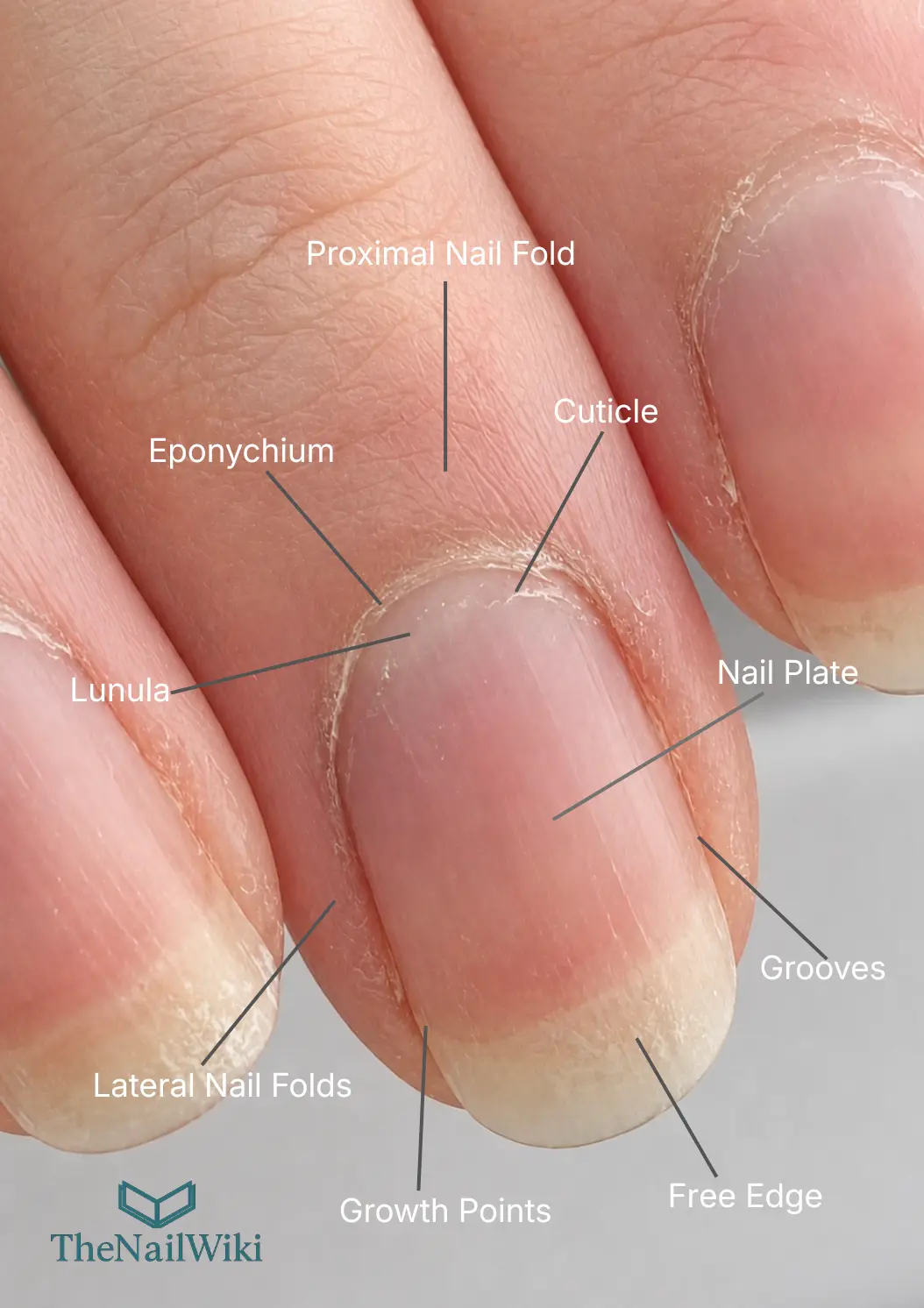
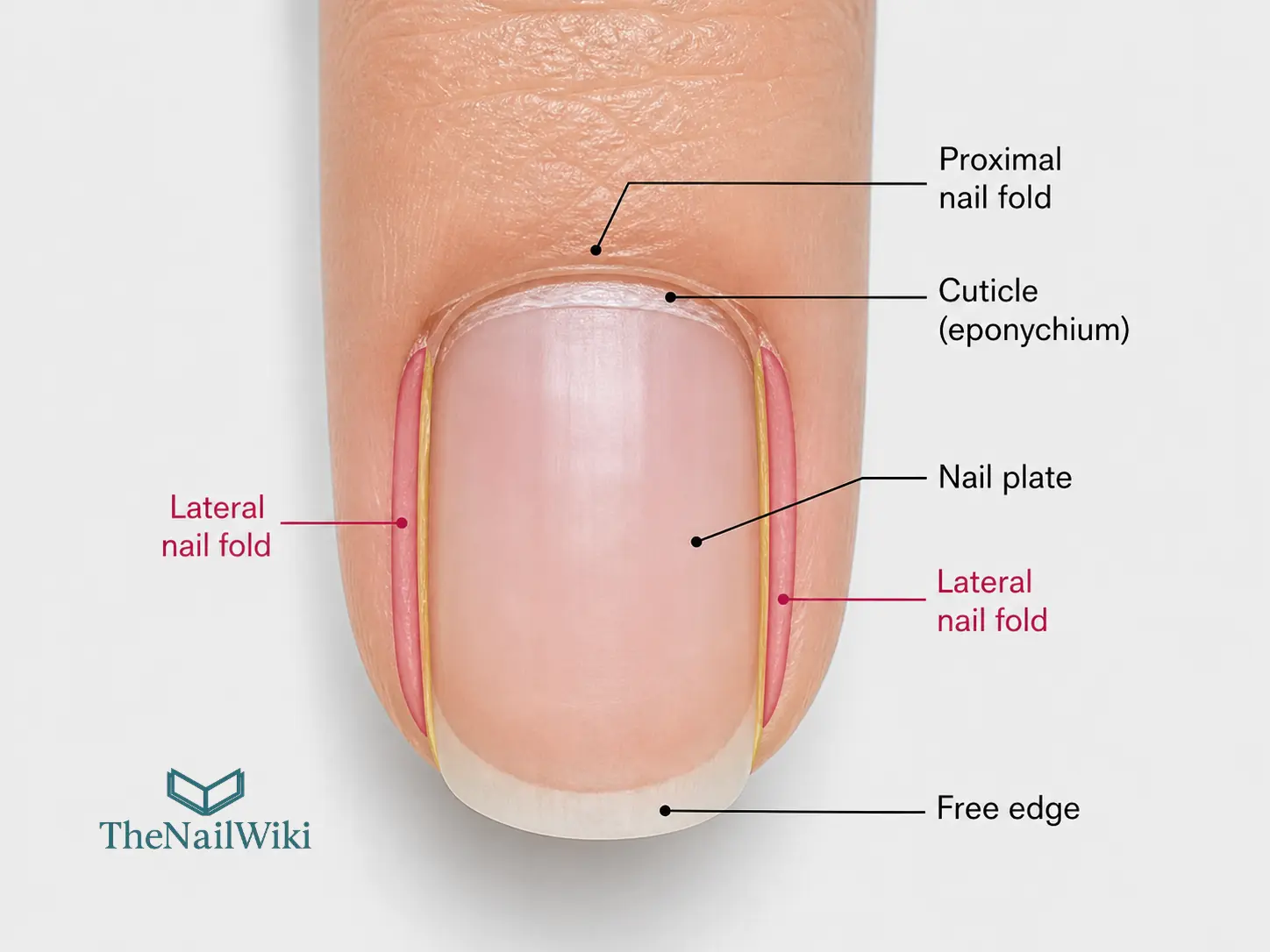
Each lateral nail fold overlaps the edge of the nail plate slightly, creating a raised border of skin on either side. Between the inner surface of each fold and the edge of the nail plate lies the lateral nail groove — a narrow channel through which the side edge of the nail plate grows as it advances forward. The fold and the groove are two distinct structures: the fold is the skin ridge itself, and the groove is the channel between the fold and the nail plate edge.
The lateral nail folds, the proximal nail fold, and the nail plate surface together form the visible anatomy of what most people simply call the nail — the plate bordered on three sides by soft tissue that holds it in place and supports its growth.
Function and Structural Role
Guiding nail plate growth
The lateral nail folds guide the edges of the nail plate as it grows forward, keeping the plate aligned within the nail unit. The lateral grooves between the folds and the nail plate edges act as tracks that constrain the plate’s lateral movement and direct it in a straight, forward path. Disruption of the lateral folds — through trauma, infection, or chronic pressure — can alter the direction of nail plate growth and contribute to conditions such as ingrown nails or curved growth patterns.
Protecting the nail plate edges
The slightly raised border of each lateral nail fold provides a measure of protection to the side edges of the nail plate from direct lateral impact. The fold absorbs some of the mechanical force that would otherwise be transmitted directly to the edge of the plate. This is particularly relevant at the stress zone of the nail — the area of the nail plate most susceptible to breakage — which overlaps with the region where the lateral folds provide their structural support.
Relevance to Professional Nail Services
Dual form and enhancement assessment
In dual form and Sandwich Dual Form services, the lateral nail folds are one of the primary assessment points when selecting a form. The form must fully cover the growth points — the areas where the nail plate meets the lateral folds — without compressing the folds or leaving gaps at the sidewalls. A form that is too narrow will compress the lateral folds, creating pressure that causes discomfort, uneven product distribution, and lifting at the sides. A form that is too wide will not seal correctly at the lateral folds, allowing product to spread unevenly.
Filing and shaping
When shaping the free edge of the nail with a nail file, the lateral nail folds define the natural width of the nail plate at each side. Shaping that removes too much from the sides of the free edge — narrowing it significantly — can undermine the structural support of the nail plate at the point where the lateral folds provide their guidance and protection, increasing the risk of side cracking and breakage.
Skin work in e-file and Russian manicure
In Russian manicure and e-file manicure, the skin at the lateral nail folds is worked on as part of the full cuticle and skin refinement process. Dead skin and callused skin at the fold can be gently refined with appropriate bits — primarily diamond bits at low speed. The lateral nail fold skin is thinner and more sensitive than the skin of the fingertip and requires lighter pressure and careful technique.
Product flooding at the lateral folds
Product that flows onto the lateral nail fold skin during gel or enhancement application and remains in contact while uncured is one of the pathways to contact sensitisation. Keeping product off all skin — including the lateral folds — throughout the service is both a quality and a safety standard.
Conditions Affecting the Lateral Nail Folds
Ingrown nail — onychocryptosis
When the edge of the nail plate grows into the lateral nail fold rather than along the lateral groove, the fold becomes inflamed, painful, and sometimes infected. This is one of the most common conditions affecting the lateral nail folds and is a contraindication to nail services in the acute phase. See: Ingrown Toenail →
Paronychia
Infection can occur at either lateral nail fold — typically presenting as redness, swelling, and tenderness along the side of the nail. As with proximal fold paronychia, acute infection is a contraindication to nail services in that area.
Callus and thickened skin
Thickened, hard skin at the lateral nail folds — particularly in clients who work with their hands or whose nails press frequently against adjacent fingers — is a common finding. This is manageable through gentle e-file work with appropriate bits in a professional nail service.
Frequently Asked Questions
What are the lateral nail folds?
The lateral nail folds are the two ridges of skin running along the left and right sides of the nail plate from the base of the nail to the free edge. They border the nail plate on each side, house the lateral grooves through which the nail plate edges grow, and form part of the three-sided skin frame surrounding the nail.
What is the difference between the lateral nail fold and the lateral nail groove?
The lateral nail fold is the raised ridge of skin running along the side of the nail. The lateral nail groove is the narrow channel between the inner surface of that fold and the edge of the nail plate — the track through which the nail plate edge grows. The fold is the structure; the groove is the space between the fold and the plate.
Why do lateral nail folds matter when choosing a dual form?
The dual form must cover the growth points — where the nail plate meets the lateral folds — without compressing the folds or leaving gaps. A form that is too narrow compresses the lateral folds and causes pressure, uneven product distribution, and side lifting. Correct form selection accounts for the width and curvature of the nail at the lateral folds, not just the overall width of the nail plate.
Can the lateral nail folds affect the c-curve?
Yes — the prominence of the lateral nail folds contributes to the transverse arch of the nail plate. Nails with more prominent lateral folds tend to have a deeper natural c-curve. Nails with lower, less defined folds tend to be flatter. This is one of the reasons c-curve depth varies between clients and must be assessed individually before enhancement services.
Professional training in nail anatomy and enhancement
Nail anatomy, form selection, enhancement assessment, and e-file technique are taught as part of structured professional courses at Artistic Touch Nail Training Academy.
Related Library Pages
Nail Anatomy
- → Nail Plate
- → Nail Matrix
- → Nail Bed
- → Eponychium and Cuticle
- → Proximal Nail Fold
- → Lateral Nail Grooves
- → Hyponychium
- → C-Curve (Transverse Arch)
Enhancement
Some linked pages are currently in development and will be published progressively.
Professional Disclaimer
The information on this page is provided for educational purposes and is intended to support the professional knowledge of nail technicians and nail educators. It does not constitute medical advice.
About the Author
Radina Ignatova
Professional Nail Expert since 2014 | International Nail Educator | Founder of TheNailWiki and Artistic Touch Nail Training Academy
Radina Ignatova is a Professional Nail Expert since 2014 and an International Nail Educator specialising in Russian Manicure, BIAB application, advanced e-file techniques, and nail safety protocols. Based in Dundee, Scotland, UK, she operates a professional salon whilst teaching nail technicians internationally through online courses.
Her teaching philosophy is centred on honest education — demonstrating real salon challenges, practical corrections and performance-based techniques rather than presenting only polished results.
Read full bio →© 2026 TheNailWiki — an independent nail education resource. Content is safety-led and professionally informed.