
The Sandwich Dual Form System: What It Is and How It Works
Author: Radina Ignatova, Professional Nail Expert & International Nail Educator | Last Updated: April 2026
Quick Answer: Sandwich dual forms are a two-part nail enhancement system using both a top and bottom mould to create a cleaner, smoother, and less filing-intensive extension compared to traditional single-mould dual forms. The product is placed between both parts of the mould, and the technician controls where the thickest concentration sits — deliberately placing it at the stress zone — before the form is pressed onto the nail. Dual forms control shape. They do not automatically control structure. Structure is what the technician creates.
Quick Summary
The Sandwich Dual Form System is a two-part nail enhancement mould — a top and a bottom — that works together to create a nail extension with a clean imprint on both surfaces, reducing the amount of filing required and giving the technician more control over product distribution and internal structure. It was developed to solve the hollow underside and guesswork of traditional single-mould dual form application.
The key difference from a standard dual form is the bottom mould. It is not suitable for every nail type, and correct assessment before application is part of the system.
Contents
- What Is a Dual Form?
- The Problem with Traditional Single-Mould Dual Forms
- Why the Sandwich System Was Developed
- What Makes the Sandwich System Different
- How It Works
- Shape vs Structure — Why This Matters
- Sandwich vs Traditional Dual Forms
- Nail Types and Suitability
- Preparation and Nail Health
- Who the System Is and Is Not Suitable For
- Common Mistakes
- Safe Use Summary
- Common Misconceptions
- Frequently Asked Questions
What Is a Dual Form?
A dual form is a clear, pre-shaped mould that fits over the natural nail and acts as both a shaping guide and a structure during the building process. Unlike traditional paper or foil nail forms — which attach beneath the free edge and require the technician to sculpt the enhancement entirely freehand — a dual form provides the shape ready-made. The technician places product inside or against the form, presses it onto the nail, cures it, and removes the form to reveal the finished shape.
Dual forms can be used with a range of products, most commonly builder gel systems. They come in a variety of sizes and curvatures to accommodate different nail widths and natural nail shapes. The correct fit is essential — a form that is too wide, too narrow, or incorrectly curved will produce an enhancement that does not sit properly on the nail plate, leading to premature lifting or structural weakness.
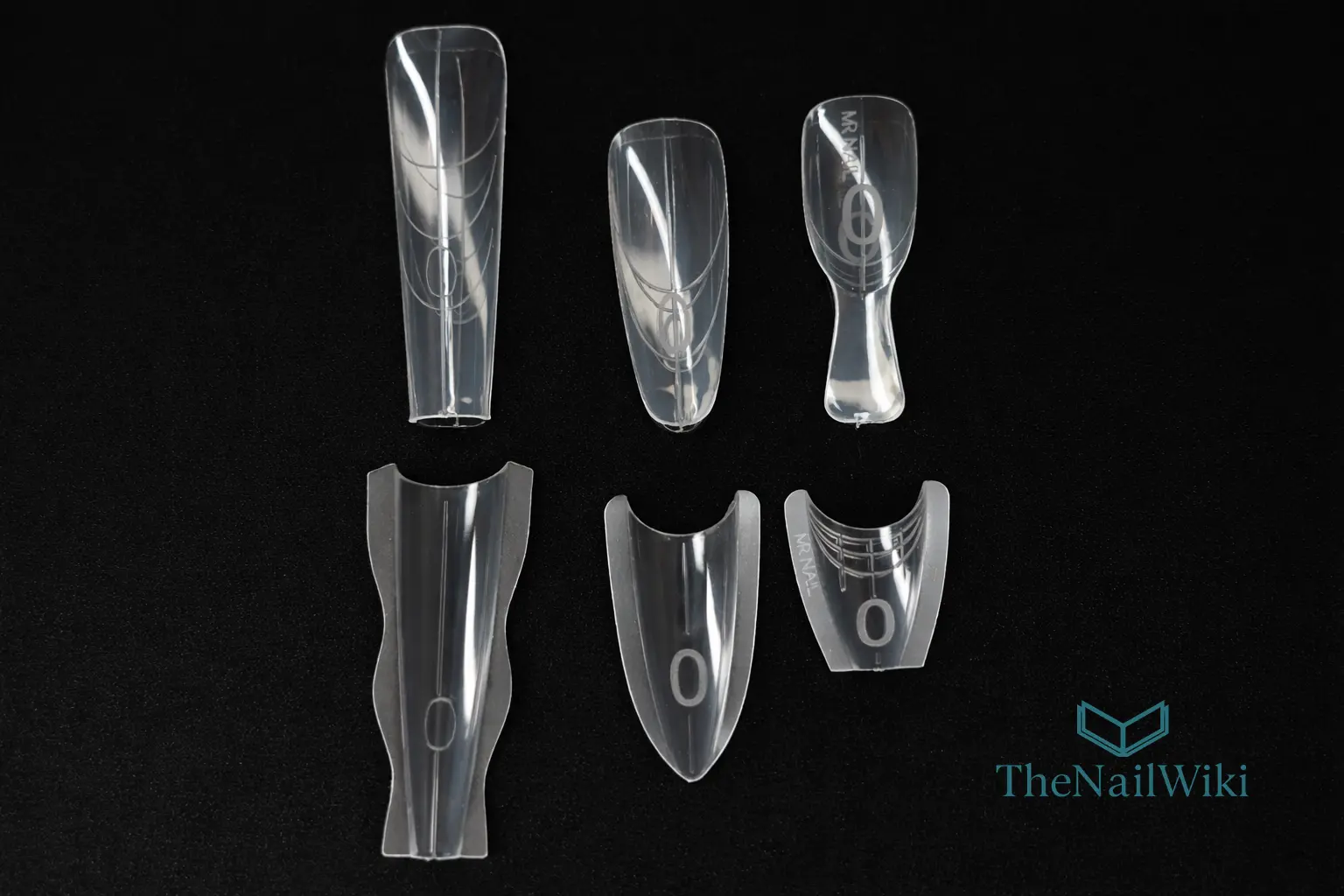
Not all dual forms are the same. Standard dual forms use a single mould — the top — to shape the upper surface of the enhancement. Sandwich dual forms add a second mould — the bottom — which simultaneously shapes the underside of the enhancement where it meets the nail plate. This two-part design is what defines the Sandwich Dual Form System and separates it from conventional dual form application.
© TheNailWiki
The Problem with Traditional Single-Mould Dual Forms
In standard dual form application, the technician places product into a single-mould form and presses it onto the nail. The top of the form shapes the upper surface of the enhancement. The underside — the surface that faces the nail plate — is left entirely to whatever the product does when it is pressed. There is no second mould to control it.
This creates predictable problems:
The hollow underside problem
When product is pressed down inside a single-mould form, it does not always make full contact with the nail plate across its entire surface. Air can become trapped between the product and the nail — invisible from the outside but creating weak points and reduced adhesion beneath. These hollow areas are a primary cause of lifting and are only discovered when the product starts to separate.
No control over the nail-facing surface
The underside of a single-mould dual form enhancement — the surface that bonds to the nail — is whatever shape the uncured product settles into when pressed. It may be smooth in places and uneven in others. It may have thin areas where product did not fully distribute. The technician has shaped the outside of the enhancement but has no control over the surface that actually determines adhesion and structural contact with the nail.
Filing as the primary correction tool
Because the internal structure and surface quality of a single-mould result are unpredictable, significant post-cure filing is often needed to achieve a clean, refined finish. Filing corrects surface imperfections — but it cannot reach or correct what is happening inside the cured product. Structural weaknesses, incorrect apex position, or uneven density within the enhancement remain regardless of how much filing is done on the outside.
Most failures happen before curing — not after. Once the product has set, the internal structure is locked in. Problems created during placement cannot be undone by filing, topping, or infilling. This is why what happens inside the form, before the nail is cured, determines the quality of everything that follows.
Why the Sandwich System Was Developed
The Sandwich Dual Form System was developed to solve the specific limitations of single-mould dual form application — in particular, the hollow underside, the lack of control over product distribution, and the dependence on post-cure filing to achieve a clean result.
The dual form as a concept already offered significant advantages over traditional paper forms — it removed the need for freehand sculpting and made a consistent shape accessible without years of manual technique development. The Sandwich system extended that principle further: not just shaping the outside, but also shaping and controlling the inside and underside of the enhancement simultaneously.
The specific problems the system was designed to solve:
- The hollow or uneven underside of traditional dual form results — replaced with a smooth, clean, fully formed nail-facing surface shaped by the bottom mould
- Unpredictable product distribution — replaced with deliberate placement, giving the technician control over where product concentrates before the mould is pressed
- Guesswork around the stress zone — replaced with intentional placement of the thickest product concentration at the point where the nail requires the most structural support
- Extensive post-cure filing — significantly reduced because the underside is already clean and shaped by the bottom mould, and the upper surface is shaped by the top mould
- Results that look shaped from the outside but have no controlled internal structure — replaced with an enhancement where both surfaces are intentionally formed
What Makes the Sandwich System Different
The defining difference between the Sandwich system and a standard dual form is the bottom mould — the second part of the two-part system that gives the method its name. The product is sandwiched between the top mould and the bottom mould. Both surfaces of the enhancement are shaped simultaneously when the form is pressed onto the nail.
The application itself works in the same way as a standard dual form — product is placed and the form is pressed onto the nail in one action. What is different is that the bottom mould creates a smooth, clean imprint on the underside of the enhancement — the surface that faces the nail plate — rather than leaving it to chance.
The key distinction in plain terms
- Standard dual form: one mould shapes the top. The underside is uncontrolled.
- Sandwich dual form: one mould shapes the top. A second mould shapes the underside.
- The product is still applied in one placement — it is not built up in separate layers.
- The technician deliberately places the thickest concentration of product at the stress zone before pressing.
- When the mould is pressed onto the nail, the product distributes between both moulds and both surfaces cure in a controlled form simultaneously.
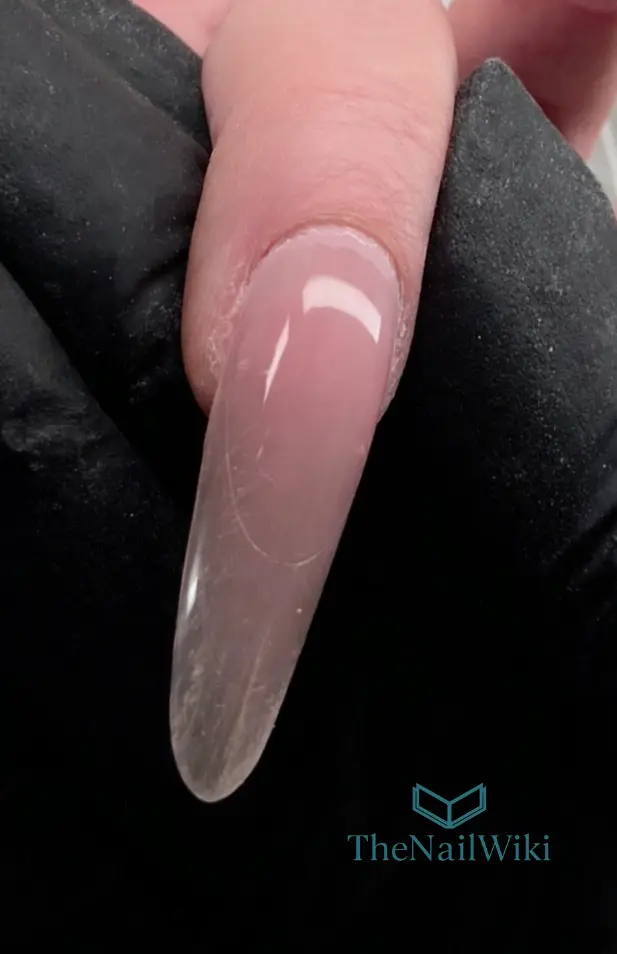
The result is a nail enhancement with a clean top surface, a clean nail-facing surface, controlled product distribution, and a deliberate stress zone — all achieved in one application, with significantly less filing required afterwards.
How It Works
The process is similar in pace to standard dual form application — product is placed, the form is pressed onto the nail, the product cures, and the form is removed. What the technician controls is the placement of the product before pressing, specifically where the thickest concentration sits.
Deliberate stress zone placement
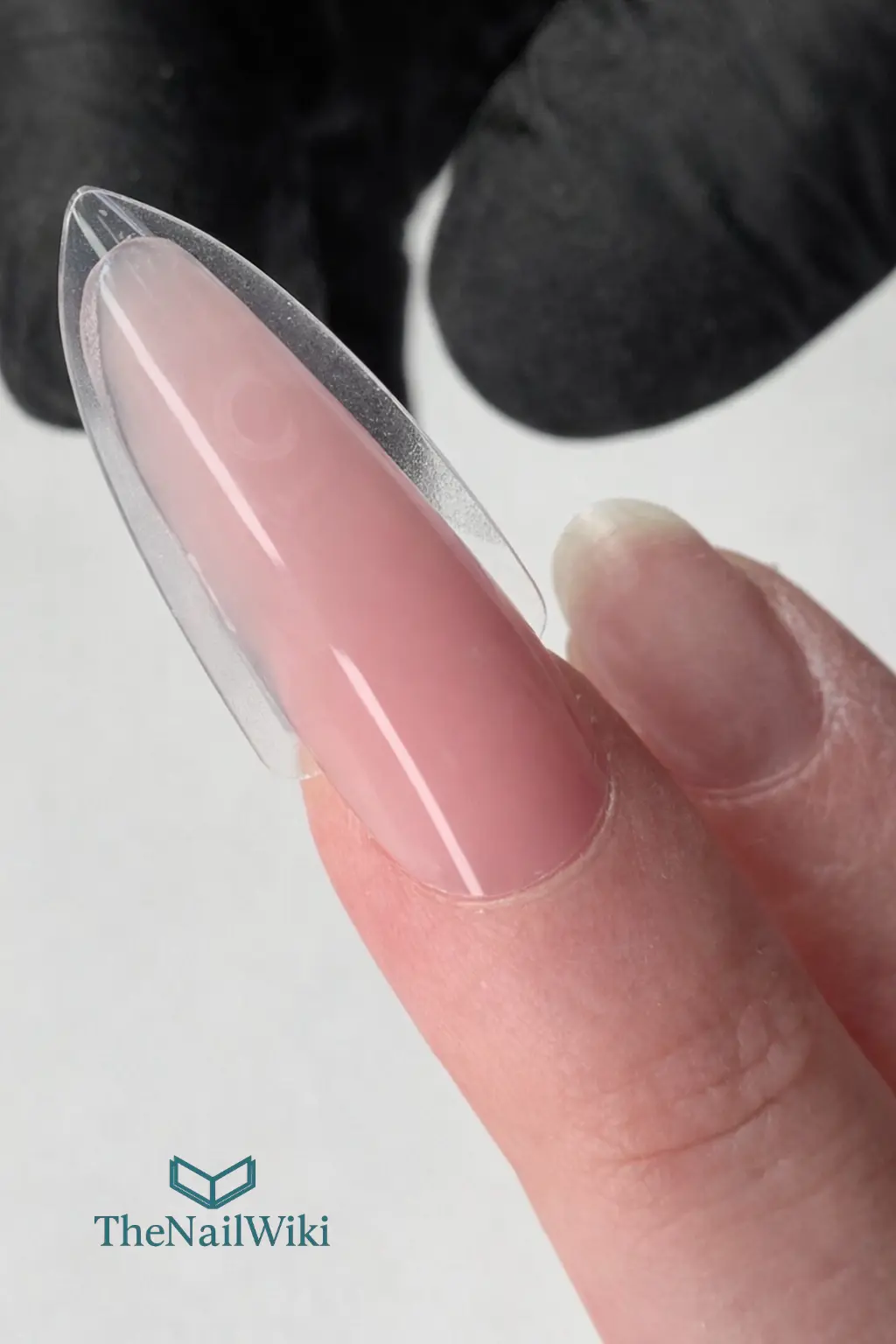
Before the form is pressed onto the nail, the technician places product with the thickest concentration at the stress zone — the area of the nail that experiences the most mechanical force during daily wear. When the mould is pressed on and the product distributes between both moulds, that concentration becomes the structural high point of the finished enhancement. This is the apex — and in the Sandwich system, it is placed where the nail actually needs it, not wherever the product happens to settle.
© TheNailWiki
The bottom mould forms the underside
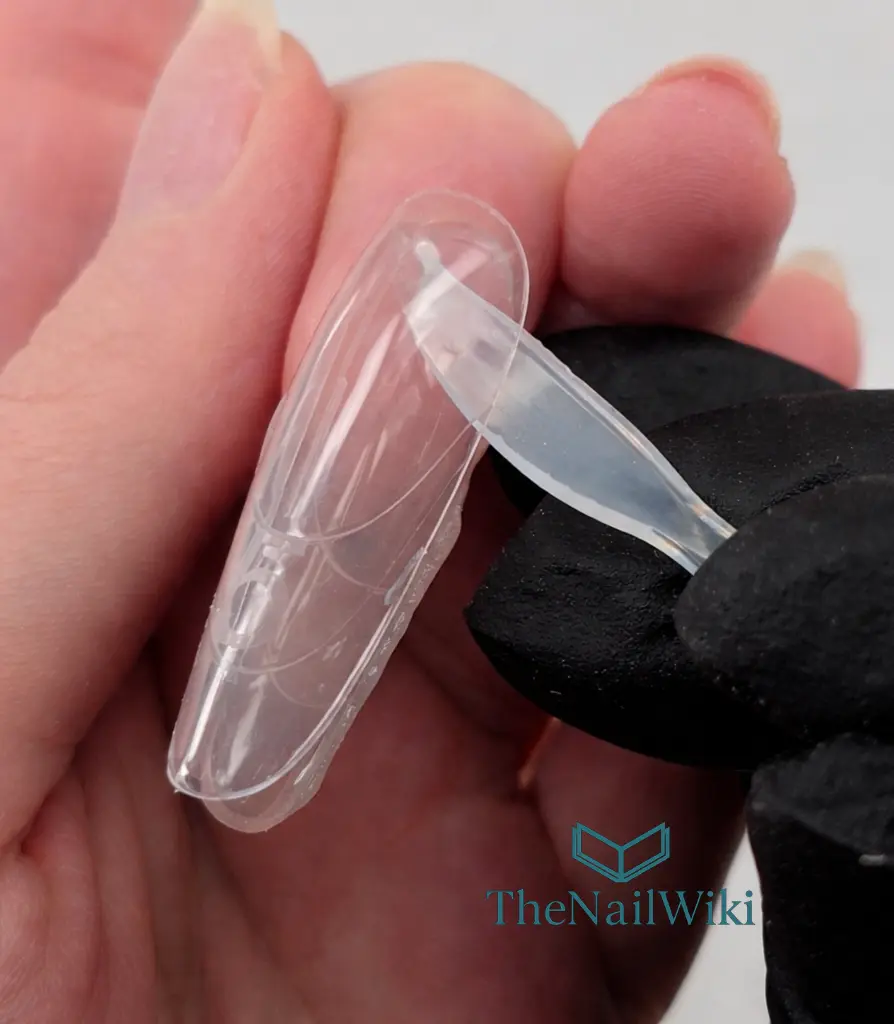
As the form is pressed down, the bottom mould shapes the underside of the enhancement — the surface that makes contact with the nail plate. This creates a smooth, even surface that bonds cleanly to the nail rather than the irregular underside that results from unconstrained product pressing. The top mould shapes the upper surface simultaneously. Both surfaces are formed in the same press.
Once cured, the structure is set
When the product cures inside the Sandwich mould, both surfaces and the internal distribution of product are locked in. The form is removed to reveal an enhancement that is clean on top, clean underneath, and structurally sound through the middle — ready to finish with minimal filing. Any structural decisions made during placement are permanent once the product has set. This is true of any enhancement system, and it is why what happens before curing matters more than anything done afterwards.
© TheNailWiki
Using the top mould alone
The top mould of a Sandwich system can be used alone as a standard single-mould dual form — but only by professionals who have a thorough understanding of both standard dual form application and the Sandwich system itself. Without that knowledge, the context of what the top mould is designed to work with — and what it is not designed to do on its own — is missing.
The Sandwich system is designed for a specific purpose. It works within certain nail types and within certain shapes. Using the top mould alone, on a nail that the full Sandwich system would not suit, does not make the top mould a substitute for a standard dual form. The two systems have different design intentions, and that distinction matters in practice.
Shape vs Structure — Why This Matters
Dual forms — of any kind — control shape. They do not automatically control structure. This is the most important distinction for any nail professional working with dual form systems to understand.
Shape is the external profile of the enhancement — the curve, the length, the width. A dual form provides this. Structure is the internal arrangement of the product — where it is thickest, where the apex sits, how it distributes across the nail plate, how well it bonds. Structure is what the technician creates. No mould — including the Sandwich system — creates structure automatically.
The Sandwich system gives the technician significantly more control over structure than a standard dual form by constraining both surfaces during curing. But that control only produces a better structural outcome when the product is placed deliberately — with the thickest concentration at the stress zone, and with awareness of how the product will distribute when the mould is pressed. Placing product randomly inside a Sandwich form and pressing it on produces a better surface finish than a standard dual form, but not necessarily a better internal structure.
Problems are created before the nail is even applied — not during filing, not during wear. Once cured, mistakes are locked in. Filing can refine a surface but cannot correct an apex in the wrong position, uneven density within the enhancement, or hollow areas where the product did not fully bond to the nail plate. The time to get the structure right is before pressing.
Sandwich vs Traditional Dual Forms
Professional training
The Sandwich Dual Form System — including product placement, stress zone control, apex positioning, and troubleshooting — is covered in the Sandwich Dual Forms online course at Artistic Touch Nail Training Academy.
© TheNailWiki
Nail Types and Suitability
Sandwich dual forms do not suit every nail type, and not all Sandwich dual forms are intended for the same purpose. Some are designed for longer extensions; others are better suited to overlay or shorter-length applications. Choosing the correct form for the client’s nail type, natural shape, and desired outcome is part of the application process — not an afterthought.
What works well
Sandwich dual forms work best on nail plates that are relatively flat to gently curved — where the natural curvature of the plate corresponds reasonably well to the curvature of the available form. When form and nail are well matched, the product distributes evenly between both moulds and the finished enhancement sits flush to the nail plate across its full width.
What requires careful assessment
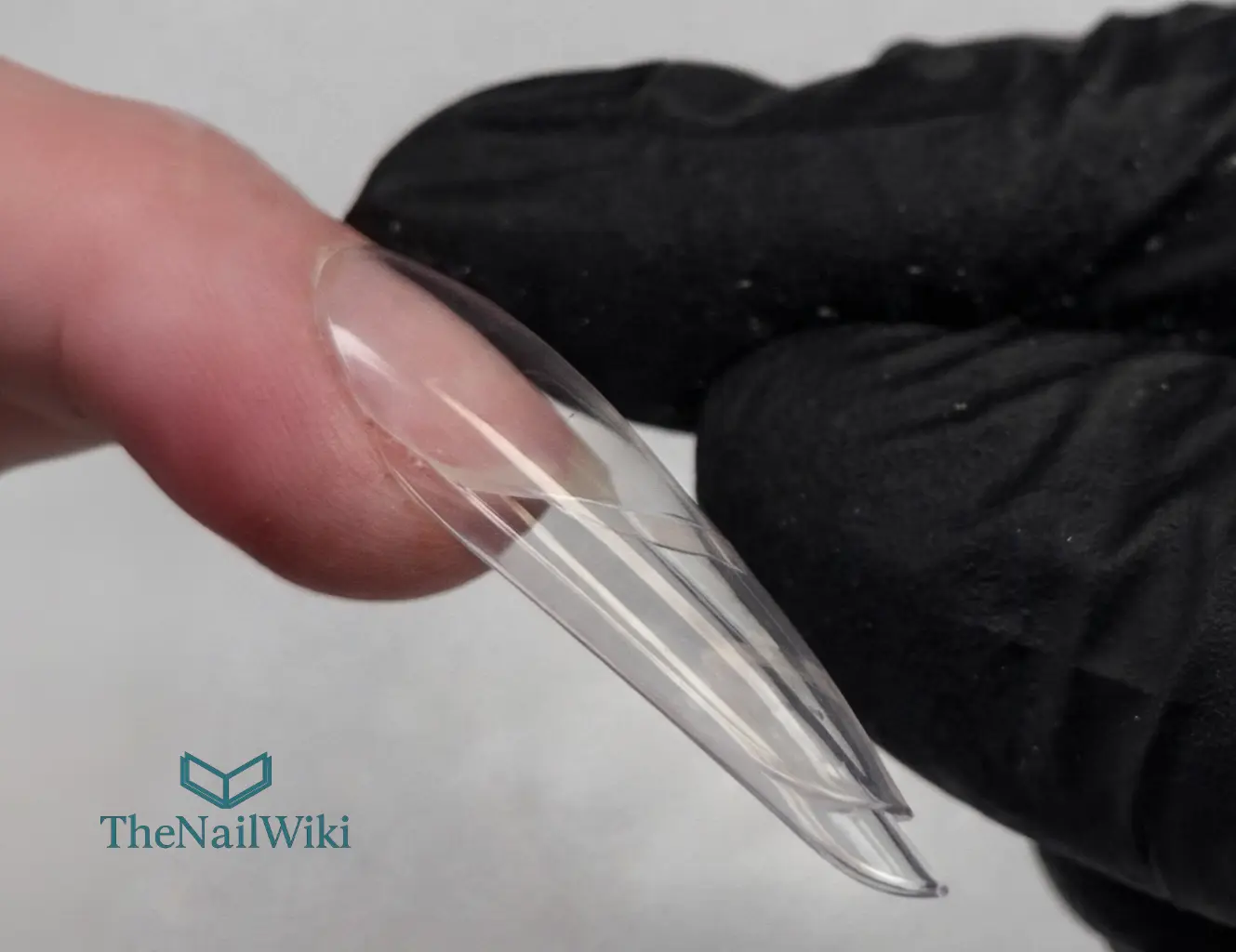
Nails with significant natural curvature — heavily arched nails, pinched nails, or a pronounced C-curve — present a challenge for any dual form application. If the curvature of the nail does not match the curvature of the form, the product cannot distribute correctly between both moulds. The result is uneven contact, potential hollow areas, and an enhancement that does not sit properly against the nail plate.
Severely hooked nails, very bitten nails with an altered nail bed shape, or nails where the free edge curves significantly downward may not be suitable for dual forms at all — an alternative such as traditional sculpting with a nail form may produce a better outcome for these clients.
Form fit is not just about width. A form must match the nail in both width and curvature. A form that is the correct width but the wrong curvature will not produce a correct result. If no available form matches the natural nail adequately in both dimensions, this should inform the service choice rather than be overridden.
© TheNailWiki
Preparation and Nail Health
The Sandwich system improves the quality and consistency of the enhancement — it does not compensate for incorrect nail preparation. The bottom mould creates a clean, shaped underside, but that underside still depends on making direct contact with a correctly prepared nail plate. Any residual cuticle on the plate surface, surface oil, or moisture will prevent that bond from forming, regardless of how well the product was placed inside the form.
Preparation includes complete removal of the true cuticle from the nail plate surface, appropriate surface dehydration, and correct use of primers or bonding agents where the product system requires them. Read more: The Eponychium and Cuticle →
Clients with certain nail conditions — including onycholysis, nail plate damage, or active skin conditions around the nail — may not be suitable candidates for dual form enhancements. A thorough nail consultation before every appointment is essential. Read more: Contraindications in Nail Services →
Who the System Is and Is Not Suitable For
For clients
The Sandwich Dual Form System is well-suited to clients who want nail enhancements that follow the natural contour of the nail — clean, refined results without excessive bulk. Because both surfaces are shaped by the mould simultaneously, the finished nail requires minimal filing and typically looks more natural than a standard dual form result.
It is particularly relevant for clients who have previously experienced lifting, cracking, or poor adhesion with dual form enhancements, as these problems are often linked to the hollow underside and uncontrolled product distribution that the Sandwich system addresses directly.
For nail technicians
For nail professionals, the Sandwich system provides a more consistent and repeatable result than single-mould dual form application. The controlled underside reduces variables that are otherwise left to chance, and the deliberate stress zone placement produces predictable structural outcomes when applied correctly. This means fewer callbacks for repairs, more confidence in the longevity of the service, and the ability to offer dual form enhancements as a premium service.
Who the system is not suitable for
- Technicians who do not yet understand basic nail anatomy and zone structure — the stress zone placement that defines the system requires this knowledge as a foundation
- Clients whose natural nail curvature does not match any available form in both width and curvature
- Nails that are actively damaged, lifting, or otherwise contraindicated for enhancement services
- Those expecting the system to produce professional results without understanding what they are doing and why — the mould shapes both surfaces, but the technician still controls where the product goes and how much
Common Mistakes
Selecting the form by width only
Both width and curvature must match the natural nail. A correctly wide but incorrectly curved form will not produce even contact across the nail plate, defeating the purpose of the controlled underside.
Not placing the thickest concentration at the stress zone
The stress zone placement is the technician’s primary structural decision. Placing product evenly throughout the form, or concentrating it in the wrong zone, produces an enhancement without a correctly positioned apex — and the structural advantage of the Sandwich system is largely lost.
Placing too much product near the cuticle zone
Excess product at the cuticle end creates bulk, risks skin contact with uncured gel, and produces a profile that does not taper correctly at the proximal zone.
Assuming the system compensates for poor preparation
The bottom mould creates a clean underside surface, but it cannot bond to a nail plate that has not been correctly prepared. Residual cuticle, surface oils, or moisture will still prevent adhesion.
Using the wrong product viscosity
Product that is too thin will self-level when the form is pressed, redistributing away from the stress zone. Product that is too thick may not make full contact with the bottom mould or nail plate. Working within the correct viscosity range for the system matters.
Relying on filing to fix structural decisions
Filing refines the surface after cure — it does not change what is inside the enhancement. An apex in the wrong position, uneven density, or hollow areas where the product did not fully bond are locked in once the product has set. Get the placement right before curing.
Safe Use Summary
- Prepare the natural nail fully before application — the system depends on direct plate-to-product contact across a correctly prepared surface
- Choose form fit by both width and curvature, not width alone
- Keep uncured product off the skin — skin contact with uncured gel chemistry carries sensitisation risk. See: Unsafe Sandwich Dual Form Placement — What to Avoid →
- Place the thickest product concentration at the stress zone deliberately, before pressing
- Do not rely on post-cure filing to fix structural errors — filing corrects surfaces, not internal architecture
- Reassess suitability if the nail is damaged, lifting, or contraindicated — the system does not make an unsuitable nail suitable for enhancement
Common Misconceptions
❌ “The Sandwich system means applying product in multiple layers”
The name refers to the product being sandwiched between two moulds — not to a layered application sequence. Product is still placed in one application, as with any dual form. The difference is that both sides of the enhancement are shaped simultaneously by the two-part mould.
❌ “The Sandwich system requires a different product”
The system is defined by the mould design, not the product. The same builder gel used in standard dual form application can be used — though product viscosity must be suitable for controlled placement.
❌ “Dual forms always produce a bulky, unnatural result”
This is a criticism of single-mould application with uncontrolled product distribution, not of dual forms as a tool. When both surfaces are shaped correctly and product is placed deliberately, the result can be indistinguishable from a well-sculpted traditional enhancement.
❌ “Dual forms are a beginner shortcut”
Dual forms remove the need for freehand sculpting — they do not remove the need for understanding nail structure, zone logic, and product behaviour. The Sandwich system in particular requires the technician to make deliberate structural decisions before pressing. It is a professional tool, not a workaround.
❌ “Filing after cure fixes everything”
Filing corrects the surface. It cannot correct what is inside the cured product. An incorrectly positioned apex, hollow areas, or uneven density within the enhancement are locked in once curing is complete. The surface can be made smooth — the structure cannot be changed.
Frequently Asked Questions
What is the difference between a dual form and a nail form?
A traditional nail form is a flat or slightly curved paper or foil template attached beneath the free edge of the natural nail, over which the technician sculpts the extension entirely freehand. A dual form is a pre-shaped clear mould that fits over the entire nail — both the natural plate and the extension area — and provides the shape without requiring freehand sculpting. Sandwich dual forms add a second mould that shapes the underside of the enhancement simultaneously.
Why does the stress zone placement matter?
The stress zone is the area of the nail that experiences the most mechanical force during daily wear. If the thickest part of the enhancement — the apex — sits above this zone, force is distributed through the body of the enhancement rather than concentrating at the attachment point. An apex in the wrong position leaves the nail’s weakest point unsupported, which is the most common cause of cracking and breakage.
Can the Sandwich system be used with any builder gel?
The system is defined by the mould, not the product — so in principle different builder gels can be used. In practice, product viscosity significantly affects how the product behaves when placed and pressed, and some products work more predictably within the system than others. Training covers product selection as part of the technique.
Is the Sandwich system suitable for short nails?
It depends on the form selected. Not all Sandwich dual forms are intended for the same application — some are designed for longer extensions and others for shorter lengths or overlays. Choosing the correct form for the intended outcome is part of the application process. When the right form is chosen for a shorter nail, the system can produce a strong, refined overlay enhancement.
Why do dual forms sometimes cause lifting?
In single-mould forms, lifting is most commonly caused by hollow areas where the product did not make full contact with the nail plate, or by incorrect preparation of the nail surface. The Sandwich system significantly reduces the hollow underside problem through the bottom mould — but preparation errors will still prevent correct adhesion regardless of the mould used.
Where can I learn the Sandwich Dual Form System professionally?
The Sandwich Dual Form System is taught in full — including placement technique, stress zone control, apex positioning, form selection, and troubleshooting — in the Sandwich Dual Forms online course at Artistic Touch Nail Training Academy.
Related Library Pages
Nail Anatomy
Products and Techniques
Professional Safety
- → Nail Patch Testing
- → Contact Sensitisation and Nail Allergies
- → Nail Consultation
- → Contraindications in Nail Services
Nail Conditions
Some linked pages are currently in development and will be published progressively.
Professional Disclaimer
The information on this page is provided for educational purposes and is intended to support the professional knowledge of nail technicians and nail educators. Nail enhancement application should only be performed by trained professionals. Any client with nail conditions, skin sensitivities, or relevant health concerns should be assessed by a qualified professional before any enhancement service is undertaken.
About the Author
Radina Ignatova
Professional Nail Expert since 2014 | International Nail Educator | Founder of TheNailWiki and Artistic Touch Nail Training Academy
Radina Ignatova is a Professional Nail Expert since 2014 and an International Nail Educator specialising in dual forms, gel systems, advanced nail structure, e-file techniques, and professional salon safety.
She founded TheNailWiki to provide clear, safety-led nail education accessible to everyone, and Artistic Touch Nail Training Academy to deliver structured professional online nail courses.
Her teaching philosophy is centred on honest education — demonstrating real salon challenges, practical corrections, and performance-based techniques rather than presenting only polished results.
Based in Scotland, UK, Radina contributes to advancing professional standards within the nail industry through structured educational resources and technical training.
Read full bio →About TheNailWiki
TheNailWiki is an independent educational platform dedicated to providing accurate, safety-led and professionally informed nail care information to professionals and enthusiasts worldwide. All content is created by qualified nail industry professionals and reviewed for technical accuracy.
For structured professional training, advanced masterclasses, and specialist technique courses, visit Artistic Touch Nail Training Academy.
This library page is published by TheNailWiki — an independent nail education resource maintained by nail industry professionals. Content is safety-led and professionally informed.