
Nail Apex: Enhancement Architecture, Structural Design and Product Placement
Author: Radina Ignatova – Nail Expert, International Nail Educator | Last Updated: July 2026
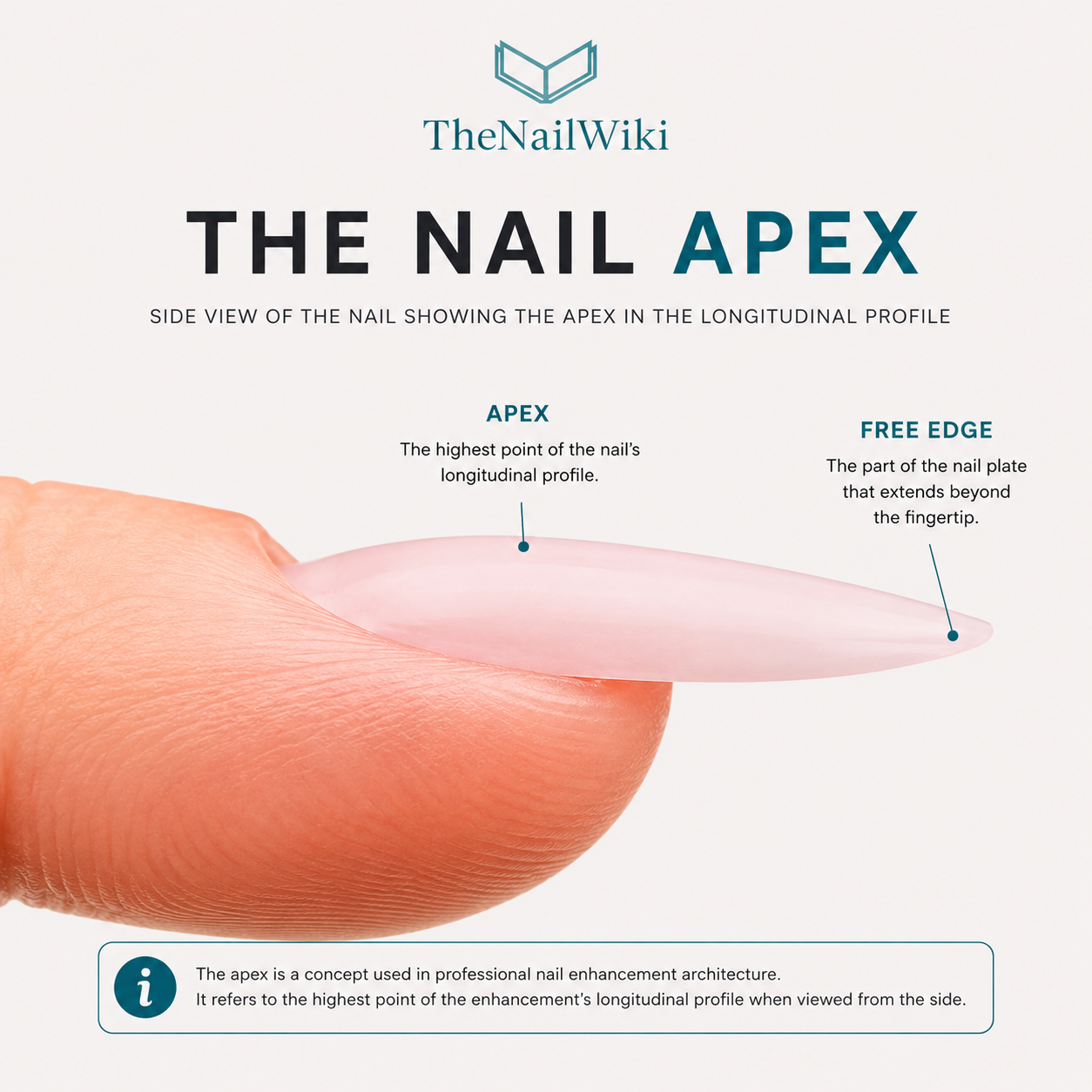
Quick Answer: In professional nail enhancement architecture, the apex is the highest point of the nail’s longitudinal profile when viewed from the side. It is created or reinforced with product to help the enhancement manage mechanical stress. Its exact position and prominence are not fixed: they depend on the natural nail, enhancement length, shape, product system and intended structure.
Contents
What the Nail Apex Is
The apex is primarily a professional nail enhancement term. It is the highest point of the longitudinal profile — the peak of the arch when the nail is viewed from the side. In enhancement work, it refers to the deliberate high point the technician creates or reinforces with product as part of the structural design.
The apex is not a separate anatomical structure in the way that the nail matrix, nail bed, or hyponychium are. It has no fixed anatomical position. Where it sits depends on the natural nail, the length and shape of the enhancement, and the product system being used.
Treating the apex as a design decision — rather than a fixed point — is what allows a technician to place product correctly for each individual client.
The Apex on a Natural Nail
Natural nail profiles vary considerably. Some nails are relatively flat along their length. Some are more arched. Some grow upward at the free edge; others curve downward. The c-curve — the curve across the width of the nail plate — also differs between individuals and between digits.
On a nail with a well-defined arch, there is a visible high point along the length of the plate — sometimes loosely called the natural apex. On flatter plates, this point is far less distinct or absent altogether. On hooked or ski-jump nails, the profile changes direction entirely, and the concept of a single apex high point does not apply.
The natural profile is shaped by the underlying nail bed and the growth direction produced by the nail matrix. Before building the enhancement, the technician must first assess the natural nail — the design must follow what is actually there, not assume a standard apex position.
Natural nail profile — what to assess before building
- The degree of longitudinal arch — is there a natural high point along the length of the plate?
- The c-curve — how much transverse curvature is present across the width?
- The growth direction — does the free edge grow upward, forward, or downward?
- The length of the natural nail bed relative to the planned enhancement length
- The overall nail shape — flat, arched, hooked, or ski-jump
© TheNailWiki
Structural Mechanics — How Enhancement Architecture Manages Load
The nail plate and any enhancement built on it are placed under stress during normal hand use — from typing, gripping, and impact at the free edge. How the enhancement is designed affects how that stress is spread. The apex is one part of that design — it works alongside product thickness, the c-curve, the overall length, and the properties of the product being used.
An arch spreads load more efficiently than a flat surface. Force applied to a curved surface travels along the curve rather than concentrating at one point. The apex contributes to this along the length of the nail. The c-curve contributes across the width. Both form part of the complete structure.
The apex alone does not determine how an enhancement performs. Preparation quality, product compatibility, curing, the condition of the natural nail, the client’s activities, and the overall product distribution all play a role. The apex is one part of the system, not the single controlling factor.
The Stress Zone and the Apex
The area of greatest stress in a nail enhancement is not a single fixed point. It shifts depending on nail length, shape, the natural nail, and the direction of force applied. On shorter nails, the highest stress area tends to sit closer to the nail bed. On longer enhancements, the extended free edge acts as a longer lever arm, shifting where stress concentrates.
The apex and the product distribution around it should support the areas under greatest stress for that specific client and length. The onychodermal band — the last zone of adhesion between the nail plate and nail bed — marks an important structural transition at the distal end of the nail bed, but it does not define a fixed apex position.
Signs that product distribution may be insufficient
- Recurring breakage at the same location along the nail — may indicate insufficient structure in that area
- Lifting that begins at a consistent point — may relate to product distribution, preparation, or c-curve mismatch
- Free edge that snaps under moderate pressure — may indicate insufficient product mass or an enhancement that is too thin overall
- Premature failure on active clients — often a combination of length, apex position, and overall product balance
Note: these patterns can also involve preparation, product compatibility, curing, natural nail flexibility, and client use. No single factor should be assumed to be the sole cause without full assessment.
The Apex in Enhancement Services
Building the apex is a deliberate decision — not an incidental result of applying product. The technician assesses the natural nail, the planned length and shape, and the product system, then designs the product placement accordingly. This applies across all enhancement systems: hard gel, BIAB, acrylic, polygel, and dual form systems all need a considered apex design to work structurally.
In dual form systems and Sandwich Dual Form Systems, the apex is shaped partly by the form and partly by where the technician concentrates product before pressing the form onto the nail. A well-fitted form guides the product toward the right high point — but the product placement inside the form determines whether the apex is built correctly. Too little product in the apex area will produce a flat result, regardless of how well the form fits.
American Apex and European Apex
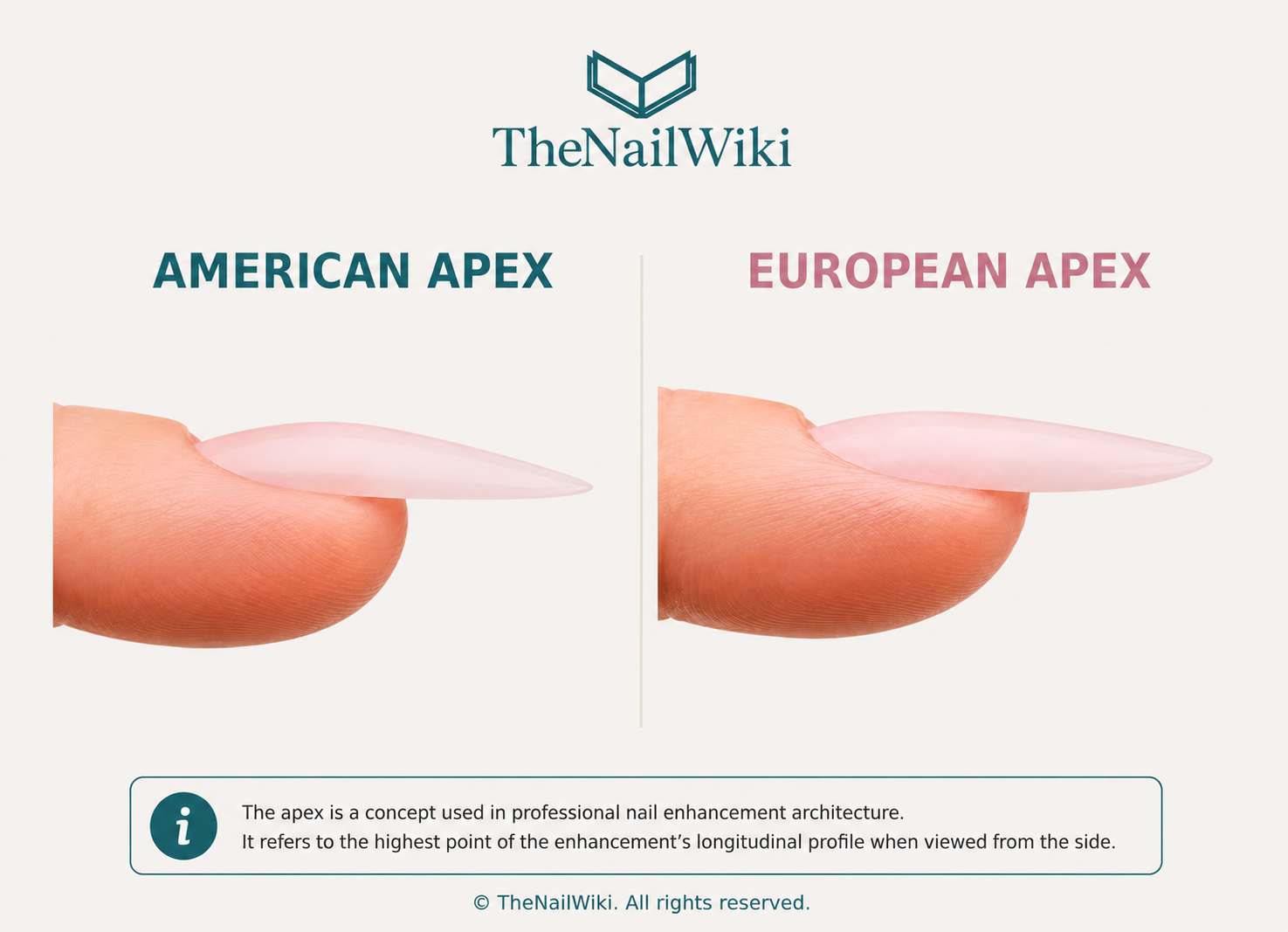
The terms “American apex” and “European apex” are professional nail-industry teaching terms — not anatomical classifications or scientifically defined categories. Their definitions vary between educators, countries, and training systems. Neither has one universally agreed meaning. Both describe different approaches to product distribution and nail profile design, and that is the most useful way to understand them.
© TheNailWiki
The American-style apex
As commonly described in professional education, the American-style apex has a more visibly pronounced high point in the upper profile. The rise toward the peak and the descent toward the free edge are more clearly defined. The product is concentrated in a distinct area, and the apex is easy to see when the nail is viewed from the side.
This is not inherently bulky, outdated, or incorrect. In certain product systems, lengths, and shapes, a more defined apex is the right technical choice. How it looks depends on the overall design, the product system, and the finished shape.
The European-style apex
As commonly described in professional education, the European-style apex produces a more elongated, integrated upper profile. The high point is less dome-like. Transitions through the body of the enhancement are more gradual. The overall profile tends to be slimmer, with the product spread across a broader area rather than concentrated at one obvious peak.
This approach is often discussed alongside the full nail design — the upper arch, lower arch, c-curve, sidewalls, and free edge — rather than treating the apex as an isolated feature. The enhancement is designed as a whole rather than built around a single point.
The European-style apex is not automatically stronger, safer, or technically superior. Its suitability depends on the same factors as any apex design: the natural nail, the product system, the length, and the finished shape.
Is one apex type better?
Neither style is universally correct. The right approach depends on the natural nail, the enhancement length, the finished shape, the product system, and how the client uses their hands. These factors determine what the apex should look like — not a preference for one teaching tradition over another.
The right question is not whether an apex is American or European — it is whether the complete design is right for the individual nail.
Apex position and nail length
The correct apex position changes with the nail and the enhancement. It is not fixed. As the free edge length increases, the high point and product distribution need to shift accordingly. There is no single correct location that applies to every nail and every length.
A common error on longer enhancements is placing the apex where it would suit a shorter nail — leaving the extended free edge without enough support where it is under greatest stress. The nail may look correct from above but will not have the product distribution it needs to perform.
Assessing the apex during the service
The apex is assessed by viewing the nail from the side — the profile view — while the product is still workable and again after curing. A well-designed apex produces a smooth arch from the base to the free edge, with the high point in the right position for the length and shape being built. If the profile is flat with no clear high point, the product distribution should be reconsidered before the service is completed.
After curing, the apex is refined by filing. This must be done carefully — filing through the apex removes the structural product it was built to provide. The aim is to smooth the transitions while preserving the high point, not to file the whole nail to an even thickness.
Frequently Asked Questions
What is the nail apex?
The apex is primarily a professional nail enhancement term. It is the highest point of the nail profile when viewed from the side — the high point that the technician creates or reinforces with product as part of the enhancement design. Its position is not fixed: it depends on the natural nail, the enhancement length and shape, the product system, and the needs of the individual client.
Where is the apex on a nail enhancement?
The apex position varies with the natural nail, the enhancement length, and the shape being built. There is no single correct location that applies to every nail. When viewed from the side, the apex is the highest point of the enhancement — and the technician determines where that sits based on an assessment of the individual nail.
Why does the apex matter in nail enhancements?
The apex helps manage stress across the nail. Combined with the right product distribution and c-curve, a well-designed apex helps the enhancement handle the pressures of daily hand use. It is one part of the structural design — how well it performs also depends on preparation, product compatibility, curing, the natural nail, and the client’s activities.
Does the apex position change with nail length?
Yes. The correct apex position changes with the nail and the enhancement. Longer enhancements need the high point and product distribution adapted to suit the extra length — the further the free edge extends, the more that product placement must account for the additional stress. Each nail and length must be assessed individually.
What happens when an enhancement has insufficient apex structure?
In salon practice, poor product distribution may be associated with recurring breakage at the same location, lifting that starts at a consistent point, or free edges that snap under moderate pressure. These issues can also involve preparation, product compatibility, curing, the natural nail, the length, and how the client uses their hands. No single factor should be assumed to be the sole cause without a full assessment.
What is a hidden apex?
A hidden apex is a nail-industry term for enhancement architecture where the structural volume is built into the nail without creating an obvious peak or dome in the finished upper profile. The apex is still present — the product is distributed through the complete design rather than concentrated at one visible high point. A hidden apex is not the same as a flat or under-built nail. The structure is there; it is simply less obvious from the side. The term is associated with some modern European and Eastern European nail methods, though definitions vary between educators and training systems.
What is the difference between an American apex and a European apex?
These are professional teaching terms, not anatomical classifications. Definitions vary between educators and training systems. As commonly described, the American-style apex has a more pronounced high point with clearer transitions in the upper profile. The European-style apex has a more elongated profile with the product spread across a broader area. Neither is universally superior — the right approach depends on the natural nail, the length, the product system, and the finished shape.
Is the apex the same as the c-curve?
No — they describe different dimensions of the nail arch. The c-curve is the transverse arch of the nail plate — how much the nail curves from one sidewall to the other when viewed end-on from the free edge. The apex is the longitudinal high point — the peak of the profile along the length of the nail when viewed from the side. Both are part of the enhancement’s structural architecture and both must be considered when designing and building an enhancement.
Continue Your Professional Learning
Understanding where the apex sits and why it must be assessed individually explains why copying one nail’s structure onto another so often fails. If you would like to build the skill to assess and construct apex position with confidence, continue your learning below.
🎓 Professional Training
The Ultimate Dual Forms — apex assessment and structural design
New to Artistic Touch?
🎁 Free Mini Classes — Why Your Sandwich Dual Forms Are Not Working
Related Library Pages
Nail Science & Mechanics
Nail Anatomy
Nail Enhancement Systems
Professional Disclaimer
This page is provided for professional educational purposes. Enhancement architecture varies between product systems, nail types, and individual client requirements. Professional training is recommended before applying these principles in a salon environment. Always follow the product manufacturer’s guidelines for application and curing.

About the Author
Radina Ignatova
Professional Nail Expert | International Nail Educator
Radina Ignatova is a Professional Nail Expert since 2014, International Nail Educator, and Founder of TheNailWiki and Artistic Touch Nail Training Academy. She specialises in Russian Manicure, dual form systems, polygel, advanced e-file techniques, and nail safety protocols, and continues to work actively in salon practice, ensuring that all education reflects real client scenarios and current industry standards.
Her teaching philosophy is built on honest education — showing real salon challenges, real mistakes, and real performance testing rather than presenting only perfect demonstrations. This is how genuine technical competence is developed and how nail professionals become truly confident and capable.
Read full bio →© 2026 TheNailWiki. All rights reserved.