
Nail Lamps: UV, LED, Hybrid and Flash Cure — A Complete Professional Guide
Author: Radina Ignatova, Professional Nail Expert & International Nail Educator | Last Updated: April 2026
Quick Answer: A nail curing lamp emits specific wavelengths of light that activate photoinitiators within gel nail products, triggering the chemical reaction that hardens them. There are three main lamp types — UV, LED, and hybrid UV/LED — plus the specialised flash cure lamp. Each type works differently, cures different products, and requires different considerations in professional use. Using the wrong lamp type, the wrong wattage, or insufficient curing time is one of the most common causes of product curing failure.
Quick Summary
Gel nail products — including gel polish, BIAB, builder gels, and base coats — contain photoinitiators that only react when exposed to specific wavelengths of light. Without the correct lamp, the product does not cure — it remains soft, sticky, and uncured regardless of how long it sits under the lamp.
UV lamps cure a broader range of products but require longer curing times. LED lamps cure faster but only work with LED-compatible products. Hybrid lamps emit both wavelength ranges and are the most versatile choice for professional use. Flash cure lamps serve a specific purpose in enhancement work and are covered on a separate page.
Contents
- How Nail Curing Works
- UV Lamps (Legacy Technology)
- LED Lamps — the Current Standard
- Hybrid UV/LED Lamps and Modern Features
- Wattage — Does It Matter?
- Lamp and Product Compatibility
- Curing Times
- Heat Spike During Curing
- Flash Cure Lamps
- Lamp Maintenance and Replacement
- What Clients Should Know
- Frequently Asked Questions
How Nail Curing Works
Gel nail products are composed of monomers and oligomers — liquid and semi-solid chemical units — combined with photoinitiators. When the photoinitiators are exposed to the correct wavelength of light, they become reactive and trigger a chain reaction called polymerisation — the monomers and oligomers link together into a solid polymer network. This is what transforms the gel from a soft, workable product into a hard, cured coating.
The key word is correct wavelength. Different photoinitiators respond to different wavelengths of light. UV lamps emit ultraviolet light at wavelengths typically around 365nm. LED lamps emit at narrower, higher-intensity wavelengths — typically around 365–405nm depending on the lamp. A product formulated with photoinitiators that respond to UV may not respond to LED wavelengths, and vice versa. This is the basis of lamp and product compatibility.
A product that is under-cured — not fully polymerised — is soft, flexible, and may remain tacky in an unusual way. More importantly, under-cured product contains free monomers that have not been incorporated into the polymer network. These free monomers are the primary source of sensitisation risk in gel nail services — they are chemically reactive and can penetrate skin that contacts the uncured product.
UV Lamps
UV lamps use fluorescent bulbs or tubes to emit ultraviolet light at broad wavelengths, typically around 365nm. They were the original curing technology in nail services and required two to three minutes per layer. UV lamps are now largely obsolete in professional settings — they have been replaced by LED technology across the industry. If you encounter a UV-only lamp, be aware that the fluorescent bulbs degrade gradually and lose intensity before they visibly stop working, meaning the lamp can appear functional while no longer delivering sufficient output to cure product correctly.
LED Lamps — the Current Standard
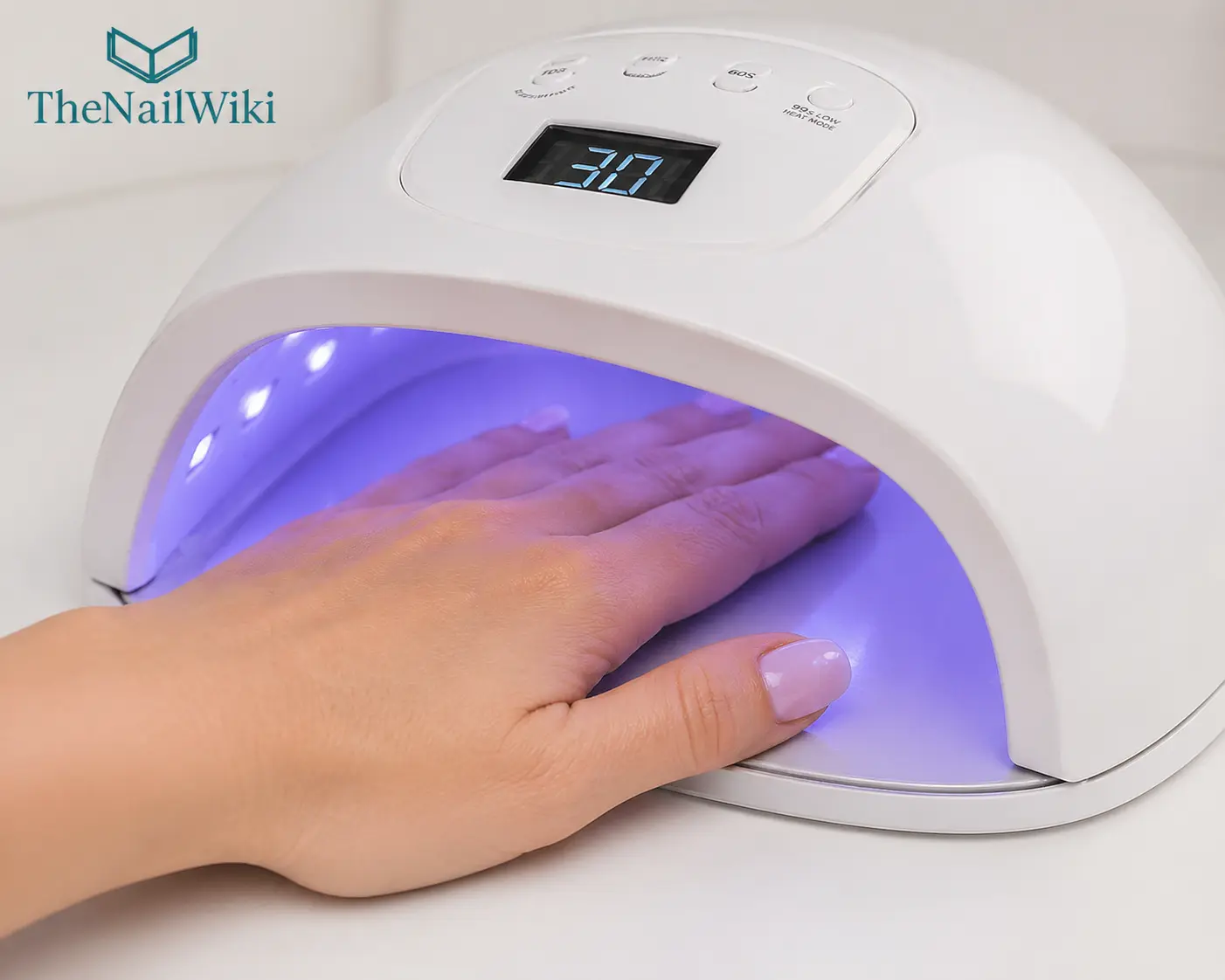
LED lamps are the current standard in professional nail services — and for good reason. They cure in 30 to 60 seconds per layer rather than two to three minutes, maintain consistent output over a long lifespan without bulb degradation, and are significantly more energy efficient than UV fluorescent technology. Virtually all modern nail products — gel polish, BIAB, builder gels, base coats — are formulated with photoinitiators designed for LED curing. UV-only products are increasingly rare and are associated with older gel systems that have largely been discontinued or reformulated.
© TheNailWiki
LED lamps use diodes emitting at specific wavelengths — typically 365nm, 405nm, or a combination of both. The concentrated, high-intensity output is what produces the fast curing time. LED diodes maintain their output intensity reliably over tens of thousands of hours of use — there is no silent degradation in the way UV bulbs degrade. A professional LED lamp that is working will be working consistently.
Hybrid UV/LED Lamps and Modern Features
Hybrid UV/LED lamps contain both UV fluorescent tubes and LED diodes, emitting across both wavelength ranges simultaneously. In practice, since almost all modern products are LED-compatible, the UV component of a hybrid lamp is rarely needed for current formulations. However, a hybrid lamp provides full backwards compatibility — useful for technicians who may occasionally work with older product systems or clients who bring their own older products.
Modern professional LED lamps have moved well beyond simple on/off curing. Features now standard or widely available in quality professional lamps include automatic sensor activation when the hand is placed inside, timer displays, multiple power settings, and — importantly — low heat modes designed to reduce heat spike for sensitive clients. When selecting a professional lamp, these features matter more in day-to-day practice than wattage alone.
AI-powered nail lamps
The most recent development in nail lamp technology is the AI-powered nail lamp. These lamps use built-in cameras and sensors to map the hand placed inside them, identifying the precise position of the nail plates and directing the curing light to hit only the nails — not the surrounding skin and soft tissue. For clients who find standard LED curing light uncomfortable, or for services where minimising any light exposure to the skin is a priority, AI-powered lamps represent a significant advance. This technology is relatively new and available from a small number of professional lamp manufacturers — it is worth watching as it becomes more widely available across the professional market.
Lamp type comparison at a glance
Wattage — Does It Matter?
Wattage is frequently used as a shorthand for lamp quality — higher wattage is often marketed as superior. The reality is more nuanced. Wattage measures the electrical power the lamp consumes, not the intensity of light delivered to the nail surface. A well-designed 36-watt LED lamp with efficiently positioned diodes can outperform a poorly designed 48-watt lamp with inefficient coverage.
What matters more than wattage alone is the irradiance — the light energy delivered per unit area at the nail surface — and whether that irradiance is sufficient for the products being cured. A 36-watt professional-grade LED lamp is typically adequate for all standard gel nail services. Higher wattage lamps (48W, 54W, 96W) can reduce curing times or handle thicker product layers, but they also increase the risk of heat spike — particularly on thin nail plates.
Always use the wattage recommended by the manufacturer of the specific product being cured. Curing times are formulated for a specific lamp type and wattage — using a higher wattage lamp and reducing curing time accordingly is not always safe or correct.
Lamp and Product Compatibility
The single most important rule in nail lamp use is that the lamp must be compatible with the product being cured. This means checking the manufacturer’s guidance for each product — not assuming that because one product cures correctly under a lamp, all products will.
Product labels and technical sheets specify whether the product is UV-compatible, LED-compatible, or both. Products labelled “UV/LED” or “dual cure” contain photoinitiators that respond to both wavelength ranges and can be cured under any lamp type. Products labelled “LED” only should not be assumed to cure correctly under a UV-only lamp.
Mixing product systems under one lamp carries risk. A hybrid lamp is the safest professional choice because it handles the full compatibility range. If using a single-type lamp (UV-only or LED-only), check every new product’s compatibility before use — do not assume compatibility because the products are from the same brand or the same colour range.
Curing Times
Curing times are specified by the product manufacturer for a particular lamp type and wattage. These times represent the minimum exposure required to achieve full polymerisation of the product layer at the specified lamp intensity. They are not guidelines — they are technical requirements.
Under-curing — not reaching the specified time — leaves free monomers in the product that have not been incorporated into the polymer network. These are a sensitisation risk and also contribute to soft, flexible product that lifts early. Over-curing — significantly exceeding the specified time — is generally less problematic but can affect the surface texture and inhibition layer of some products.
Factors that can reduce effective curing time in practice include: degraded UV bulbs, dark or heavily pigmented gel colours (which absorb more light), thick product application, and positioning of the hand within the lamp. Always ensure the nail plate is positioned as close to the lamp’s light source as possible and the hand is fully inside the lamp during curing.
Heat Spike During Curing
Heat spike — a brief, sharp burning sensation during the curing process — is a well-known experience in gel nail services. It is caused by the exothermic reaction of polymerisation: as the monomers and oligomers link together into a polymer network, they release heat. The faster the polymerisation occurs, the more intense the heat release.
Heat spike is more common with: higher wattage lamps, thicker product application, products applied too close to the surrounding skin, and clients with thin nail plates where there is less plate material between the product and the nail bed.
What to do when heat spike occurs
If you or a client experience a heat spike during curing — do not press the hand down onto the bottom of the lamp. The instinct to push the nails closer to the light source makes the heat worse, not better. Instead, remove the hand from the lamp, allow it to cool for a moment, and then place it back in to complete the curing cycle.
The curing cycle can be paused briefly — removing the hand for a few seconds to let the heat dissipate will not significantly affect the final cure provided the hand goes back in to complete the full time. What must be avoided is removing the hand entirely and not returning it — a heat spike that causes the session to be cut short leaves the product under-cured, which is both a structural failure and a sensitisation risk.
© TheNailWiki
Low heat mode
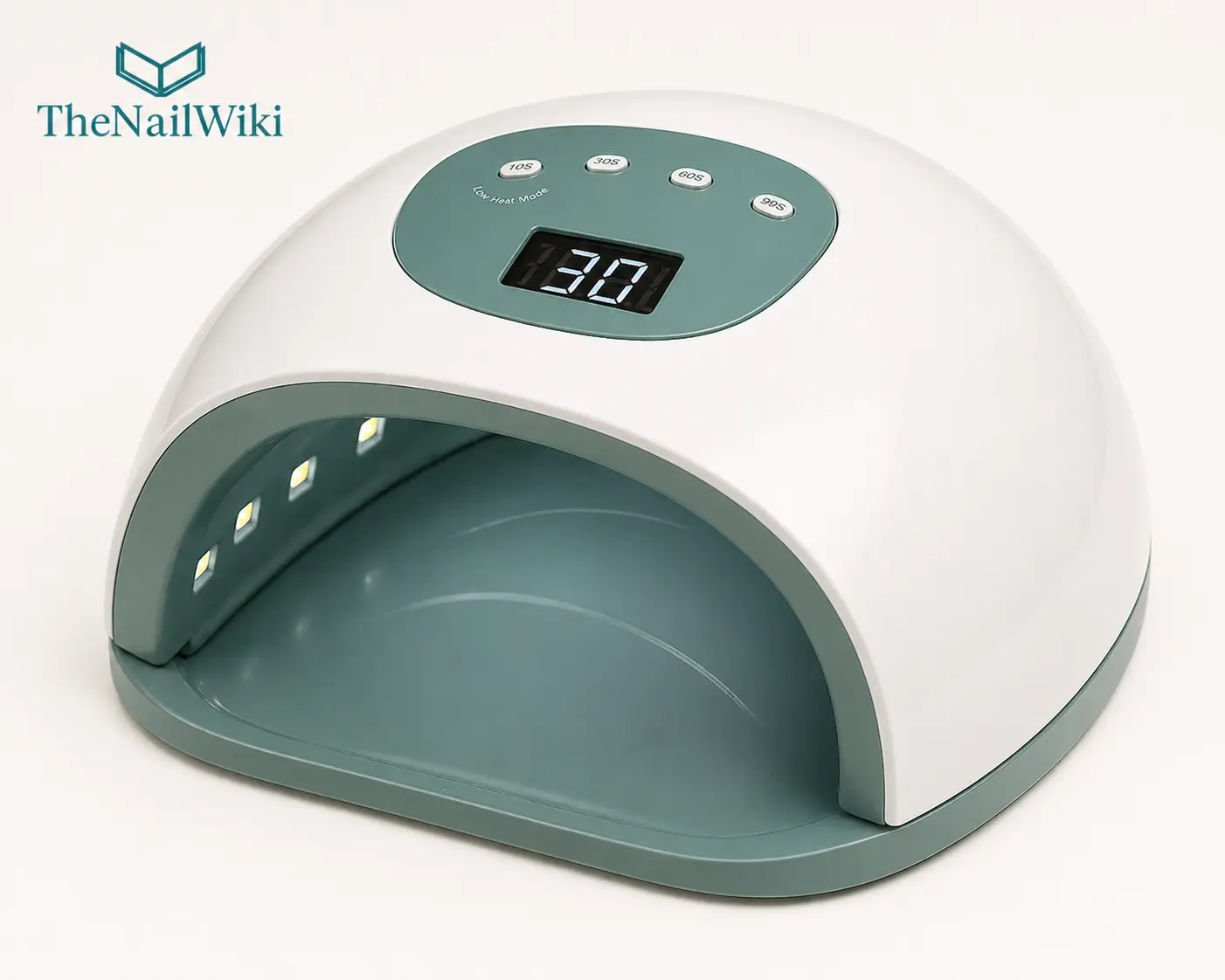
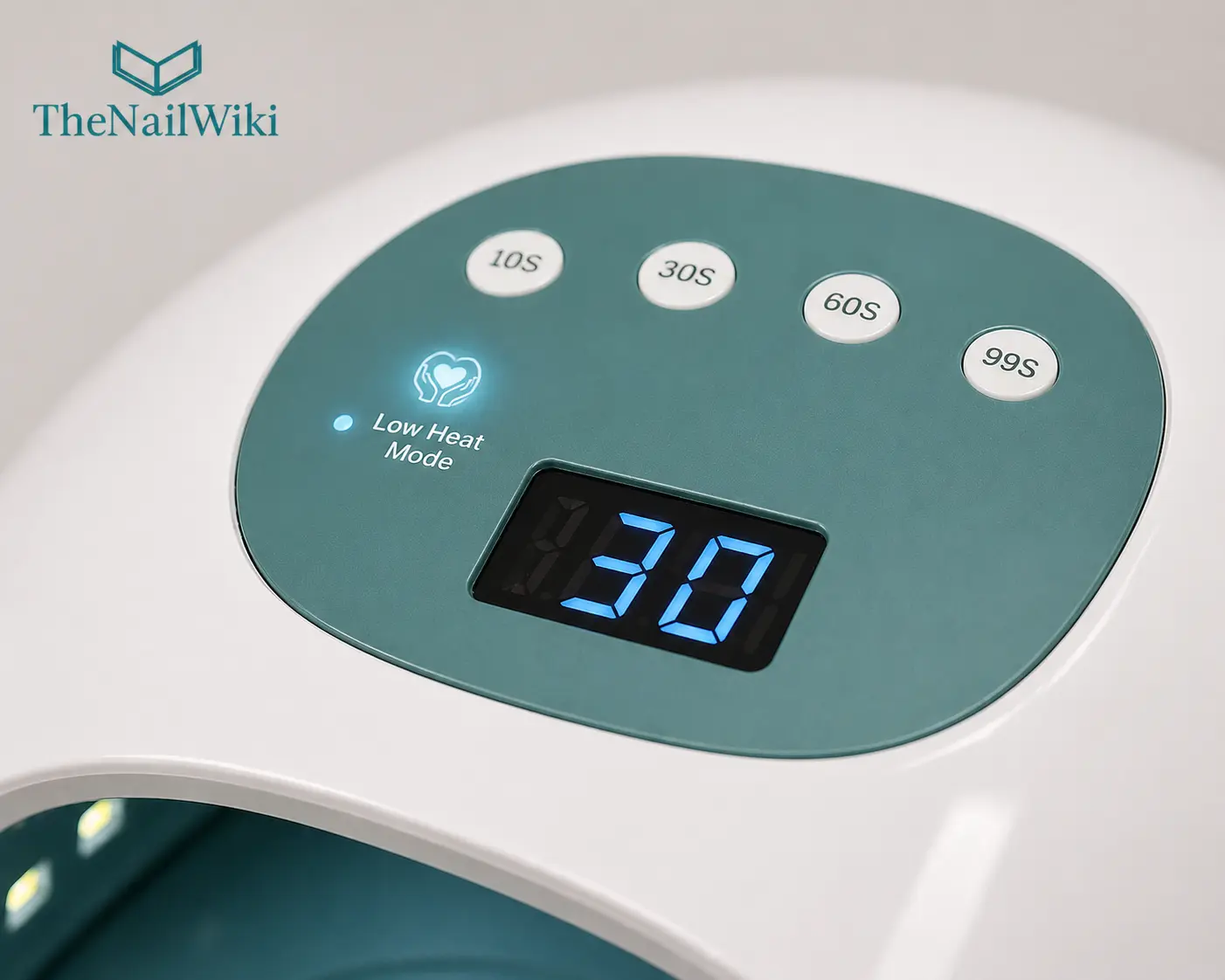
Many modern professional LED lamps include a low heat or gentle cure mode — often activated by a specific button or a longer initial press of the power button. In low heat mode the lamp cures at reduced intensity for a longer period rather than full intensity for a short burst. The total light energy delivered is the same — the product is fully cured — but the exothermic reaction occurs more gradually, releasing heat over a longer time frame rather than all at once. This significantly reduces or eliminates heat spike for sensitive clients without compromising cure quality.
If a client regularly experiences heat spike, switch to low heat mode before reducing product application thickness or making any other changes. It is the simplest and most effective adjustment — and it is built into most quality professional lamps precisely for this purpose. Check the manufacturer’s guidance for your specific lamp to confirm how to activate it and what the adjusted curing time is in that mode.
© TheNailWiki
Heat spike is not the same as lamp heat. The heat comes from the polymerisation reaction within the product itself, not from the lamp. A client who experiences heat spike under a high-wattage lamp may not experience it under a lower wattage lamp curing the same product — because the slower curing rate releases the same amount of heat over a longer period rather than all at once.
Flash Cure Lamps
A flash cure lamp is a compact, focused LED device — typically handheld or pen-shaped — that delivers a burst of curing light for just two to five seconds rather than a full curing cycle. It is not a standard nail lamp and cannot replace one. Its sole purpose is to briefly tack the surface of a product layer in enhancement work — holding it in position while the technician continues to shape and refine the product — before a full cure is completed in a standard lamp.
Flash curing is used primarily in sculpted enhancement services — structure building, apex placement, dual form work, and encapsulation. It is not part of gel polish or basic BIAB application. A flash-cured product still contains free uncured monomers throughout its interior and must always be followed by a full cure before the service is complete.
For the full guide to flash cure lamps — how they work, when to use them, correct technique, and what they must never be used for — see the dedicated page: Flash Cure Lamps →
Lamp Maintenance and Replacement
UV and hybrid lamps — replace bulbs regularly
UV fluorescent bulbs degrade gradually. They continue to emit visible light long after their UV output has dropped below the level needed for effective curing — a lamp that appears to be working normally may be significantly under-curing product. Replace UV bulbs every three to six months in regular professional use, or more frequently if the lamp is in constant daily use.
Keep the interior clean
Product debris, skin fragments, and dust accumulate on the interior surfaces and reflective walls of nail lamps. This buildup reduces the light reaching the nail surface and can harbour bacteria. Clean the interior of the lamp regularly with a lint-free wipe and IPA, taking care not to touch the bulbs or diodes directly.
When to replace the lamp entirely
Replace the lamp when: product consistently fails to cure correctly despite correct technique and fresh bulbs, the lamp shows physical damage to the casing or interior, or the lamp is more than three to four years old in daily professional use. A professional nail lamp is not a product to economise on — an under-curing lamp is a sensitisation risk and a service quality problem.
What Clients Should Know
Do not remove your hand from the lamp during curing
Removing the hand before the curing cycle is complete — even briefly — interrupts the polymerisation reaction and leaves the product partially uncured. Partially cured product contains free monomers that are a sensitisation risk. If a heat spike causes discomfort, tell the technician — do not remove your hand unilaterally.
Home lamps and professional lamps are not equivalent
Consumer nail lamps sold for home use vary enormously in quality, wattage, and output. A low-power home lamp may not deliver sufficient intensity to cure professional-grade products correctly — even if the curing time is extended. If purchasing gel products for home use, use the lamp recommended or sold by the same manufacturer and follow their curing times exactly.
Frequently Asked Questions
What is the difference between UV and LED nail lamps?
UV lamps are the legacy technology — fluorescent tubes with 2–3 minute curing times, now largely obsolete. LED lamps are the current industry standard — they cure all modern gel products in 30–60 seconds with a long, consistent lifespan. Virtually all modern nail products are formulated for LED curing. Hybrid lamps contain both and provide full backwards compatibility with older product systems.
Can I use any lamp with any gel product?
No — the lamp must be compatible with the product’s photoinitiators. Always check the manufacturer’s guidance for each product. Products labelled UV/LED or dual cure work with both lamp types. LED-only products require an LED or hybrid lamp. Using an incompatible lamp will result in under-cured product regardless of curing time.
Why does my nail burn under the lamp?
Heat spike is caused by the exothermic polymerisation reaction — the product releasing heat as it hardens, not the lamp itself. If heat spike occurs, do not press the hand onto the bottom of the lamp — remove it, allow it to cool briefly, then place it back in to complete the cycle. Do not abandon the cure entirely. To prevent heat spike, apply thinner product layers, use low heat mode if the lamp has one, and check the wattage is appropriate for the product.
How often should I replace UV lamp bulbs?
Every three to six months in regular professional use, regardless of whether the bulbs still appear to be working. UV bulbs lose intensity before they visibly fail — a lamp that looks functional may be under-curing product. In daily professional use, err towards three months.
Is a higher wattage lamp always better?
Not necessarily. Higher wattage can reduce curing times and handle thicker products but also increases heat spike risk, particularly on thin nail plates. The most important factor is using the wattage recommended by the product manufacturer for the specific product being cured. A well-designed 36-watt professional lamp is adequate for most gel nail services.
What is a flash cure lamp?
A flash cure lamp is a specialised tool used in enhancement work to briefly set the surface of a product layer — typically builder gel or acrylic gel — without fully curing it, allowing further shaping before final cure. It is not a replacement for a standard nail lamp and serves a specific technical purpose in sculpted enhancement services. See: Flash Cure Lamps →
Professional training in nail systems and equipment
Lamp selection, product compatibility, curing protocols, and troubleshooting are covered as part of the structured training courses at Artistic Touch Nail Training Academy.
Related Library Pages
Product Systems
Specialised Lamps
Ingredients & Chemistry
Troubleshooting
Some linked pages are currently in development and will be published progressively.
Professional Disclaimer
The information on this page is provided for educational purposes and is intended to support the professional knowledge of nail technicians and nail educators. Nail services should only be performed by trained professionals.
This library page is published by TheNailWiki — an independent nail education resource. Content is safety-led and professionally informed.