
Nail Primers — Acid vs Acid-Free: What They Do and When to Use Them
Author: Radina Ignatova, Professional Nail Expert & International Nail Educator | Last Updated: April 2026
Quick Answer: A nail primer is a preparation product applied to the nail plate after dehydration and before the first product layer. Its purpose is to chemically improve the bond between the nail plate surface and the product applied over it. There are two main types: acid primers, which etch the nail plate surface to create a mechanical bond, and acid-free primers, which work through chemical attraction without etching. They are not interchangeable. Acid primer must never be used with gel polish under any circumstances. If product still lifts despite correct primer use, the issue is with the preparation sequence — not with the primer or the product.
Quick Summary
Nail primers exist because some product systems require a stronger initial bond to the nail plate than dehydration alone can provide. Acid primers etch the nail plate surface using methacrylic acid, creating microscopic irregularities for the product to grip. Acid-free primers use bifunctional molecules — typically HEMA or HEMA-free alternatives — to create a chemical bridge between the nail plate and the product without any etching.
Primer is not required for all services. Gel polish never requires primer of any type. Persistent lifting after primer use is a preparation issue — not a product failure. Understanding which primer is appropriate for which system, how to apply it correctly, and what it can and cannot fix is a fundamental part of professional nail plate preparation.
Contents
- What a Nail Primer Is
- Primer vs Base Coat — the Key Difference
- Acid Primers — How They Work and When They Are Used
- Acid-Free Primers — How They Work and When They Are Used
- Acid vs Acid-Free — Side by Side
- When Is Primer Actually Needed?
- How to Apply Primer Correctly
- Where Primer Sits in the Preparation Sequence
- If Product Still Lifts — It Is the Preparation, Not the Product
- Safety — Acid Primer Risks and Correct Handling
- Primer and Sensitisation Risk
- Common Mistakes
- Frequently Asked Questions
What a Nail Primer Is
A nail primer is a preparation product applied to the nail plate after dehydration and before the first product layer. Its purpose is to improve the initial adhesion between the nail plate surface and the coating or enhancement product applied over it — either by chemically etching the surface or by acting as a molecular bridge between the nail and the product.
Primers are not a universal requirement. Some product systems — particularly gel polish and most builder gel and BIAB systems — are formulated to bond adequately to a correctly prepared nail plate without primer. Others, particularly acrylic systems and some hard gel systems, require primer to achieve reliable adhesion. Always follow the manufacturer’s specific preparation guidance for each product system.
The word “primer” is sometimes used loosely to describe any preparation product — including dehydrators and bonding base coats. In professional nail services, primer has a specific meaning: a product applied between the dehydrator and the first product layer, whose primary function is adhesion improvement.
Primer vs Base Coat — the Key Difference
Primer and base coat are frequently confused — particularly in home nail care. They are different products with different functions and different positions in the preparation sequence.
A base coat is the first curable product layer — it is part of the coating itself and is cured under a lamp. A primer is not cured. It is applied, allowed to dry or settle, and the base coat is applied over it. They cannot replace each other.
Acid Primers — How They Work and When They Are Used
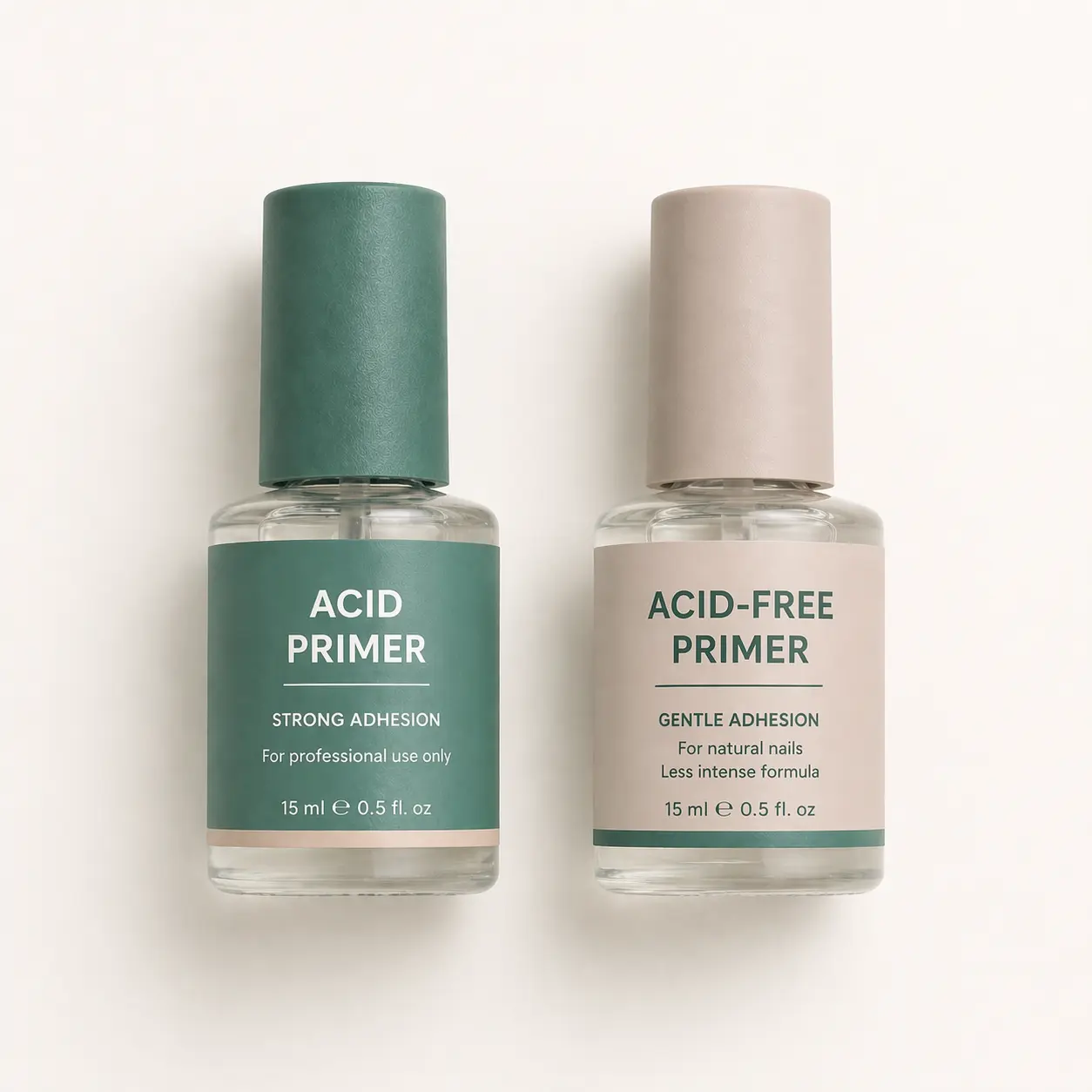
Acid primers contain methacrylic acid as their active ingredient, typically at concentrations between 20% and 100%. They work by temporarily etching the nail plate surface — the acid reacts with the keratin proteins within the nail plate, slightly roughening and chemically modifying the surface to create a more receptive bonding substrate for the product applied over it.
This etching action is why acid primers have historically been standard for acrylic systems, where the product must bond to the nail plate through a wet application process without UV or LED curing at the point of initial contact.
What acid primer does to the nail plate structure
The etching action of methacrylic acid does not stop at the surface. Acid destroys the disulfide bonds within the keratin structure of the nail plate — the chemical links between sulphur-containing amino acids that give the nail plate its strength, rigidity, and resilience. When these bonds are broken, the sulphur content of the nail plate decreases and the keratin structure is weakened. Research into occupational chemical exposure in nail services has confirmed that acidic agents cause measurable reductions in sulphur-rich proteins within the nail plate, leading to a nail that becomes progressively more brittle and fragile with repeated exposure.
Methacrylic acid is a significantly stronger acid than the acidic compounds sometimes found in base coat formulations. Where an acidic base coat causes cumulative, gradual disulfide bond damage over months of repeated services, acid primer causes more intense and immediate damage at the point of contact — at concentration, every single time it is applied. This is one of the strongest arguments for the professional nail industry’s ongoing shift away from acid primers and towards acid-free alternatives. The adhesion improvement acid primer provides comes at a direct cost to the long-term structural integrity of the nail plate beneath it.
When acid primer is used
Acid primer is primarily associated with acrylic (liquid and powder) systems. In rare cases it is also specified for certain hard gel or builder gel systems — but this must always be confirmed directly from the manufacturer’s documentation before use.
⚠️ Acid primer must never be used with gel polish
Acid primer is chemically incompatible with gel polish systems. It can cause curing failure, disrupt the gel’s chemistry, and produce an aggressive reaction between the methacrylic acid and the gel formulation. If a technician is experiencing lifting with gel polish, the answer is never acid primer — it is a review of the preparation sequence.
⚠️ Acid primer must never be used after its expiry date
Methacrylic acid can degrade and change in chemical behaviour after expiry in ways that are not visible to the eye. Expired acid primer carries increased and unpredictable risk. Check the expiry date before every use. Dispose of expired product correctly and replace it — never use it regardless of how it looks.
Acid-Free Primers — How They Work and When They Are Used
Acid-free primers do not etch the nail plate. Instead, they contain bifunctional molecules with two reactive ends that bond to the nail plate on one side and to the product applied over them on the other — creating a chemical bridge without a corrosive etching action.
The most commonly used compound in acid-free nail primers is HEMA (hydroxyethyl methacrylate). Many modern formulations are moving towards HEMA-free alternatives due to sensitisation concerns. HEMA-free primers use alternative bifunctional monomers with a lower sensitisation risk profile.
What acid-free primer looks like after application
Not all acid-free primers behave the same way after application. Some dry to a completely clear, matte finish. Others remain shiny. Some are intentionally formulated to leave a tacky layer — this tackiness allows the next product layer to bond to the primer surface immediately and securely. A shiny or tacky finish does not mean the primer has not worked. Always follow the manufacturer’s guidance on how their primer should appear when ready for the next step.
When acid-free primer is used
Acid-free primers are appropriate for builder gel, BIAB, dual form systems, most acrylic systems that have moved away from methacrylic acid, and as a targeted addition to the preparation sequence for clients with persistently oily nail plates or those who are persistent lifters despite correct preparation.
HEMA-free primers
HEMA is one of the most common causes of contact sensitisation in nail services. Once sensitised, a client or technician may react to any product containing HEMA permanently. For clients with known HEMA sensitivity, or as a precautionary approach, HEMA-free formulations are the safer choice. HEMA may also appear as 2-hydroxyethyl methacrylate on ingredient labels.
Acid vs Acid-Free — Side by Side
© TheNailWiki
When Is Primer Actually Needed?
Primer is not a universal preparation step. Whether it is required depends entirely on the product system in use. Always follow the specific manufacturer protocol — not a generic assumption about what primers do.
Services where primer is used
Acrylic (liquid and powder) systems — acid primer or acid-free
Traditional acrylic systems use acid primer as standard. Many modern acrylic brands have moved to acid-free alternatives. Always check the manufacturer’s protocol — newer formulations may not require methacrylic acid primer at all.
Some builder gel and hard gel systems — acid-free; acid in rare cases only
Some hard gel and builder gel systems specify an acid-free primer in their protocol. In rare cases a manufacturer may specify acid primer — this must be confirmed directly from the product’s technical documentation, never assumed.
Dual form systems — acid-free primer
Dual form systems — including the Sandwich Dual Form System — use acid-free primer where primer is required. Acid primer is not appropriate for dual form application.
Persistent lifters and oily nail plates — acid-free primer
For clients with naturally oily nail plates or those who consistently experience product lifting despite correct preparation, an acid-free primer can be added to the sequence to improve bond consistency — but only after reviewing and confirming the preparation sequence is fully correct first.
Services where primer is not used
Gel polish — no primer of any type
Gel polish is formulated to bond without primer when preparation is correct. Neither acid primer nor acid-free primer should be used with gel polish systems. A bonding base coat is sometimes used — this is a different product that forms part of the coating, not a preparation primer.
Adding primer when the system does not require it does not improve adhesion — it can compromise it. Applying primer from one product system over a product from a different system introduces chemical incompatibilities. Always follow the manufacturer’s specific preparation protocol.
How to Apply Primer Correctly
Primer application technique is as important as primer selection. These rules apply to both acid and acid-free primer.
Use the brush that comes with the bottle
Primer must be applied with the dedicated brush supplied with the product — not a separate brush from another product. The supplied brush is sized specifically for the correct application of that primer. Using a different brush risks applying too much product, cross-contaminating products, or uneven application.
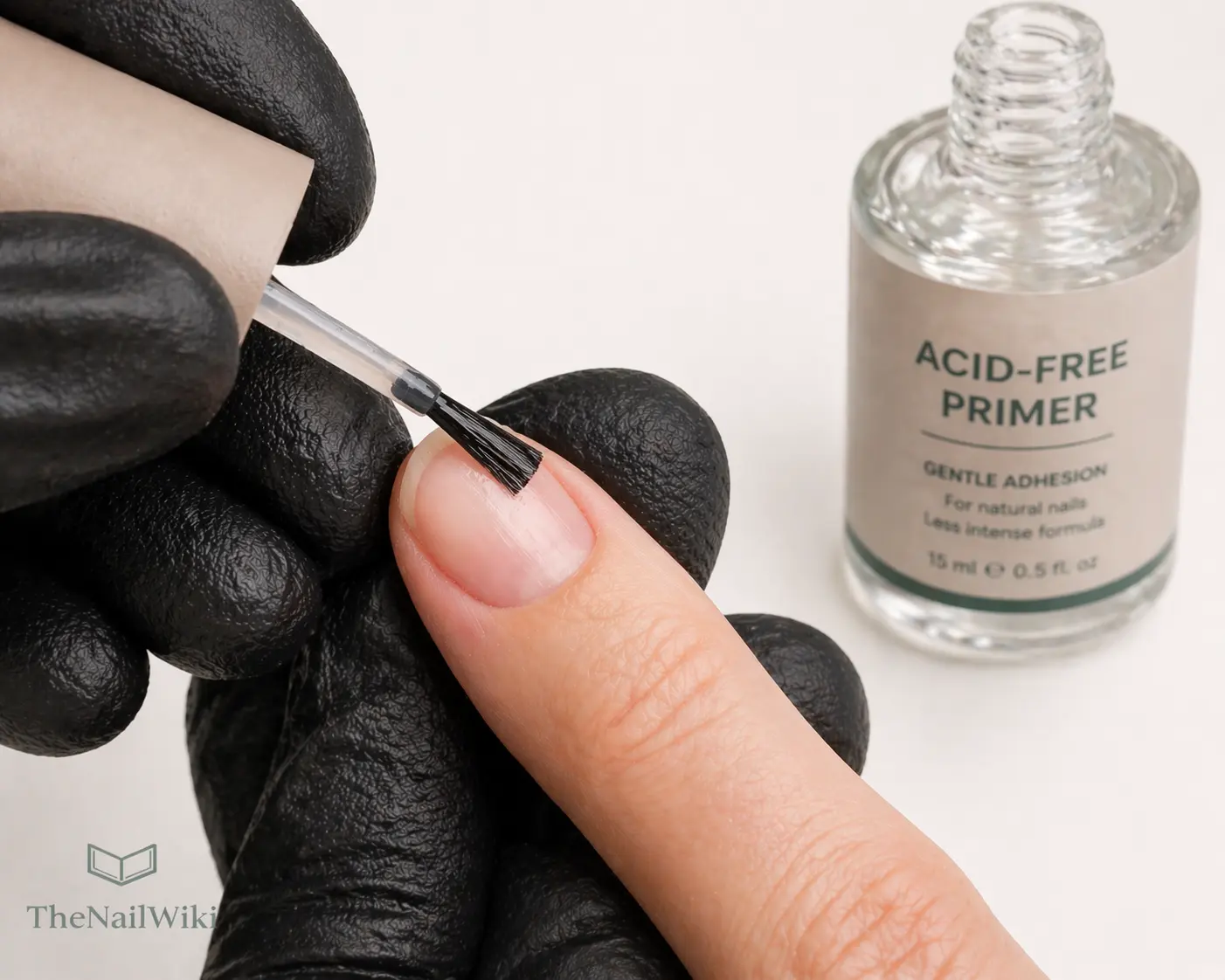
Apply with an almost dry brush — never oversaturate
The brush should carry the absolute minimum amount of product to cover the nail plate — the tip of the brush barely loaded, not dripping. Primer applied from an oversaturated brush floods the nail plate, runs onto the surrounding skin, and significantly increases both chemical burn risk (acid primer) and sensitisation risk (acid-free primer). More primer does not mean better adhesion — it means greater risk with no additional benefit.
© TheNailWiki
⚠️ Primer must never touch the skin
Neither acid nor acid-free primer should contact the surrounding skin, cuticle area, or lateral folds at any point. For acid primer this is a chemical burn risk — immediate and serious. For acid-free primer this is a sensitisation risk — cumulative and permanent. Apply primer to the nail plate only, staying well clear of all surrounding skin. If primer contacts the skin, remove it immediately with a dry lint-free wipe.
Allow to dry fully before applying product
Acid primer turns white when applied and becomes transparent again when dry and ready. Do not apply product while it still appears white. Acid-free primers vary — some dry clear and matte, some remain shiny, some leave a deliberate tacky layer. Follow the manufacturer’s guidance for the specific product. Apply product as soon as the primer is ready — do not leave a long gap between primer and the first product layer.
Where Primer Sits in the Preparation Sequence
Full preparation sequence with primer
- Cuticle work
- Buffing — 240-grit buffer
- Cleansing — Radina Double Cleanse Method or IPA on lint-free wipe
- Dehydrator — allow to evaporate fully
- Primer — almost dry brush, nail plate only, allow to dry fully
- Base coat — first product layer, cured under lamp
If Product Still Lifts — It Is the Preparation, Not the Product
When product lifts consistently despite primer being used, the instinct is often to blame the primer or the product. In the vast majority of cases the issue is with the preparation sequence — not with the primer itself and not with the product.
Primer can only perform its function on a correctly prepared nail plate. If the cleansing step was incomplete, if the dehydrator was not applied or did not evaporate fully, if the nail was touched after dehydration, or if dead cuticle was left on the plate — primer applied over any of these will not compensate. The primer bonds to whatever surface it contacts. If that surface is contaminated, the primer bonds poorly and the product lifts.
Before adding primer to the sequence — review these first
- Is all dead cuticle being fully removed from the nail plate surface?
- Is the Radina Double Cleanse Method being used, or IPA alone?
- Is the dehydrator being applied and left to evaporate fully — not wiped away?
- Is the nail plate being touched after dehydration before product is applied?
- Is the client applying hand cream, oils, or sanitiser gel before appointments?
- Is product being applied promptly after dehydration — not several minutes later?
If all of the above are correct and lifting persists, adding an acid-free primer is a reasonable next step for persistent lifting clients. But primer is not a fix for incomplete preparation — it enhances a sequence that is already correct. See also: Product Lifting Issues →
Safety — Acid Primer Risks and Correct Handling
Methacrylic acid is corrosive — it causes chemical burns on skin contact, is damaging to the eyes, and produces vapour that should not be inhaled. Acid primer must be handled as a professional corrosive chemical.
Never use after expiry date
Acid primer must never be used after its expiry date. Expired methacrylic acid can degrade unpredictably. Check the expiry date before every use. Dispose of expired product correctly.
Work in a ventilated area
Acid primer produces vapour that should not be inhaled. A nail dust extractor provides some protection but is not a substitute for adequate room ventilation.
Store correctly
Store in a cool, dark location away from heat sources and direct sunlight. Keep the cap tightly closed when not in use. Refer to the product’s safety data sheet (SDS) for specific storage requirements.
Never use on broken or damaged skin
Acid primer must not be used where there is any broken skin, open cuticle, or damage around the nail. Check for any contraindications affecting skin integrity before proceeding.
Primer and Sensitisation Risk
Both acid and acid-free primers carry sensitisation risk. Once sensitisation occurs it is permanent. For acid primer the primary concern is methacrylic acid. For acid-free primers HEMA is the most significant risk. For a full explanation see: Contact Sensitisation & Nail Allergies →
Sensitisation risk is reduced by using the minimum necessary amount, avoiding any skin contact, ensuring adequate ventilation, and following the manufacturer’s recommended protocol.
Acid primer is chemically incompatible with gel polish. It can cause curing failure and product failure. If gel polish is lifting, the answer is to review preparation — not to add acid primer. Using too much primer floods the nail plate and runs onto the surrounding skin. It does not improve adhesion. Apply with an almost dry brush — a barely loaded tip. More primer means greater risk, not better adhesion. Primer must go onto a fully dehydrated nail plate. Applying it before dehydration means the primer is working over residual moisture. The sequence is always: cleanse → dehydrate → prime. Acid primer must never be used after its expiry date. The chemical behaviour of methacrylic acid can change after expiry in ways that increase risk. Check expiry dates before every use. Adding primer to a service where the manufacturer does not specify it can compromise the product’s chemistry. Primer is system-specific — always follow manufacturer guidance. A primer is applied before the base coat and is not cured. A base coat is the first curable product layer. They cannot replace each other. Most gel systems — including gel polish and the majority of builder gel and BIAB systems — do not require primer when preparation is correct. Gel polish specifically should never have primer applied before it. Some gel brands include a bonding base as part of their system — this is a combination product forming part of the coating, not a preparation primer. Acid primers contain methacrylic acid and etch the nail plate to create a mechanical bond — corrosive with significant chemical burn risk. Acid-free primers contain bifunctional monomers creating a chemical bridge without etching — safer but carry sensitisation risk particularly with HEMA-containing formulations. No. A primer is applied before the base coat and is not cured under a lamp. A base coat is the first curable product layer applied after primer where required, and cured under UV or LED. They occupy different positions in the sequence and cannot replace each other. Persistent lifting despite primer is almost always a preparation issue. Review the full sequence: is all dead cuticle removed, is the Radina Double Cleanse Method or thorough IPA cleansing being used, is the dehydrator applied and left to evaporate fully, is the nail touched after dehydration? Primer cannot compensate for incomplete preparation — it can only enhance a sequence that is already correct. Some acid-free primers are intentionally formulated to leave a tacky layer — this tackiness allows the next product layer to bond to the primer surface immediately and securely. It is not a sign that the primer has not worked. Other primers dry to a clear or shiny finish. Always follow the manufacturer’s guidance for the specific product. No — acid primer must never be used after its expiry date regardless of how it looks. Methacrylic acid can degrade in ways that are not visible to the eye, increasing chemical risk unpredictably. Check the expiry date before every use and replace expired product. Primer selection, preparation sequencing, and product-specific application protocols are covered as part of the structured training courses at Artistic Touch Nail Training Academy. Preparation Sequence Ingredients & Safety Nail Types & Adhesion Enhancement Systems Some linked pages are currently in development and will be published progressively. The information on this page is provided for educational purposes and is intended to support the professional knowledge of nail technicians and nail educators. Nail services should only be performed by trained professionals. Any client with nail conditions, skin sensitivities, or relevant health concerns should be assessed by a qualified professional before any nail service is undertaken. Radina Ignatova Professional Nail Expert since 2014 | International Nail Educator | Founder of TheNailWiki and Artistic Touch Nail Training Academy Radina Ignatova is a Professional Nail Expert since 2014 and an International Nail Educator specialising in advanced nail preparation, BIAB, dual form systems, e-file techniques, and professional salon safety. Based in Scotland, UK, she teaches nail technicians internationally through structured online courses. Her teaching philosophy is centred on honest education — demonstrating real salon challenges, practical corrections, and performance-based technique rather than presenting only polished results. TheNailWiki is an independent educational platform dedicated to providing accurate, safety-led and professionally informed nail care information to professionals and enthusiasts worldwide. For structured professional training, advanced masterclasses, and specialist technique courses, visit Artistic Touch Nail Training Academy. This library page is published by TheNailWiki — an independent nail education resource maintained by nail industry professionals. Content is safety-led and professionally informed.Common Mistakes
Using acid primer with gel polish
Oversaturating the nail with primer
Applying primer before dehydration
Using expired acid primer
Using primer when the system does not require it
Confusing primer with base coat
Frequently Asked Questions
Do I need primer for gel nails?
What is the difference between acid and acid-free primer?
Is primer the same as base coat?
My nails keep lifting even with primer — what should I do?
Why does my acid-free primer look tacky after drying?
Can I use an old bottle of acid primer if it still looks fine?
Professional training in nail preparation
Related Library Pages
Professional Disclaimer
About the Author
About TheNailWiki