
Nail Psoriasis: Signs, Nail Bed Changes and Professional Considerations
Author: Radina Ignatova, Professional Nail Expert & International Nail Educator | Last Updated: March 2026
Quick Summary
Nail psoriasis is the involvement of the nail unit in psoriasis — a chronic inflammatory skin condition. It is estimated that up to 90% of people with psoriasis will experience nail changes at some point, and in some individuals the nails are affected without any visible skin involvement at all.
Nail psoriasis is not contagious. It is not a contraindication in itself for nail services in all cases — but it does require careful assessment, honest communication with the client, and a thorough understanding of the specific nail changes present before any service is provided.
Contents
What Is Nail Psoriasis?
Psoriasis is a chronic autoimmune inflammatory condition in which skin cells turn over at an accelerated rate, producing characteristic plaques of thickened, scaly skin. When this inflammatory process affects the nail unit, it produces a range of distinctive nail changes depending on which part of the nail is involved.
The nail unit can be affected in two primary areas: the nail matrix — which produces the nail plate — and the nail bed — which sits beneath the plate. Psoriatic inflammation in each location produces different visible changes, and both may be present simultaneously.
Nail psoriasis is also associated with psoriatic arthritis — an inflammatory joint condition that affects a significant proportion of people with psoriasis. The presence of nail psoriasis is considered a risk factor for psoriatic arthritis development, which is one reason appropriate referral matters beyond the nail itself.
Important: Nail psoriasis is not contagious. It cannot be passed from client to client or from client to professional. It should not be treated as an infection risk in the salon environment.
Signs from Matrix Involvement
When psoriatic inflammation affects the nail matrix, it disrupts the production of the nail plate, producing changes that are visible in the plate structure itself.
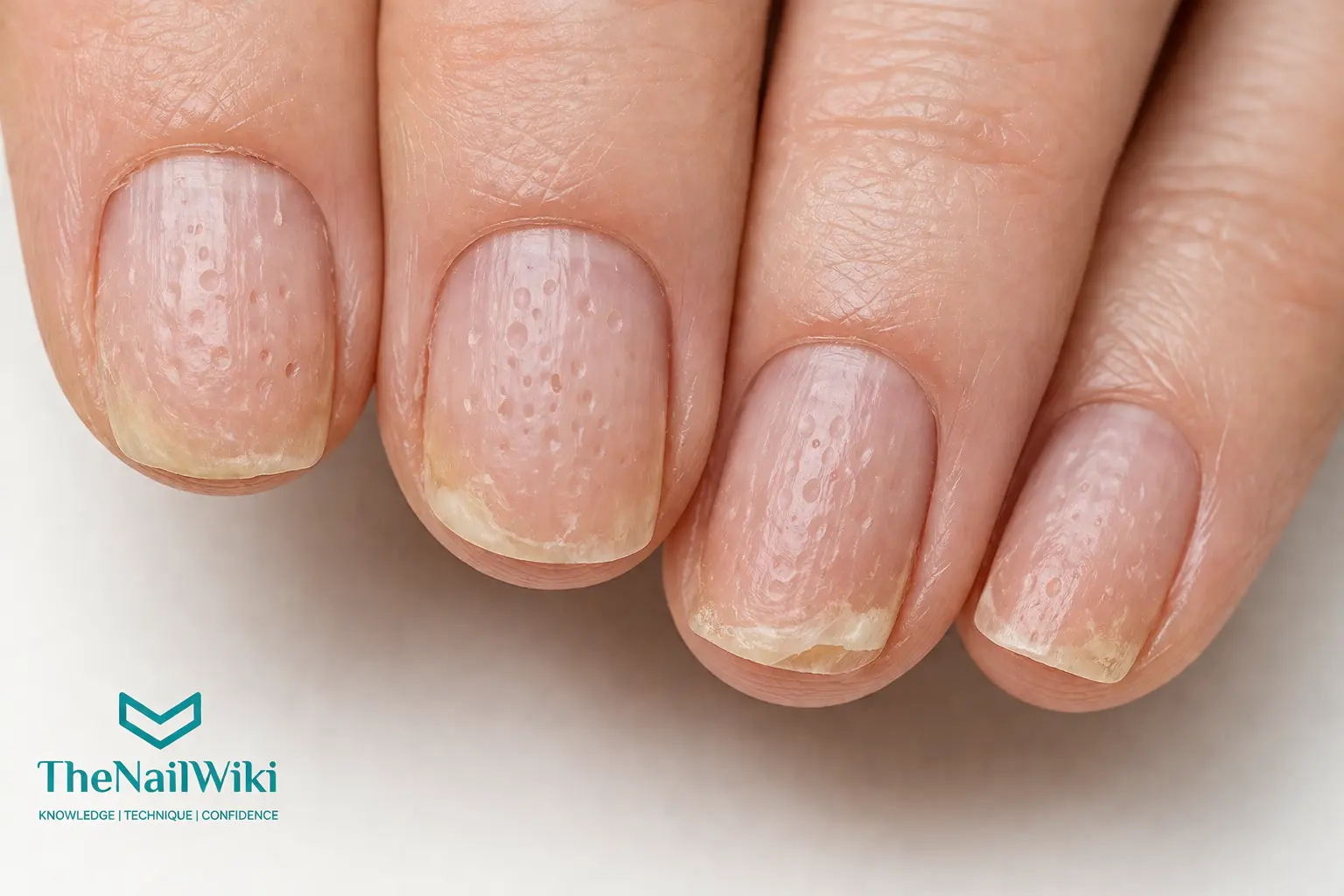
Nail pitting
Small, discrete depressions on the surface of the nail plate — like pinpricks or puncture marks — are the most characteristic sign of matrix involvement in nail psoriasis. They result from areas of the matrix producing a cluster of defective cells that fall away from the surface of the plate as it grows forward. Pitting in psoriasis is typically deeper and more irregularly distributed than the shallow, uniform pitting sometimes seen in alopecia areata. Read more about nail pitting →
© TheNailWiki
Leukonychia and crumbling
Psoriatic matrix involvement can produce areas of white discolouration within the plate (leukonychia) and, in more severe cases, structural weakening of the plate causing it to crumble or become friable. This reflects the disorganised keratin production occurring in the affected matrix zone.
Beau’s lines
Horizontal ridges or grooves running across the plate — known as Beau’s lines — can occur during periods of significant psoriatic flare affecting the matrix. They represent a temporary disruption of normal plate production. Read more about Beau’s lines →
Signs from Nail Bed Involvement
Psoriatic inflammation affecting the nail bed produces changes that are visible through the translucent plate as colour changes and structural alterations beneath it.
Salmon patch (oil drop sign)
The salmon patch — also called the oil drop sign — is one of the most characteristic signs of nail bed psoriasis. It appears as a well-defined area of orange-yellow discolouration visible through the plate, typically in the mid-nail or free edge area. It resembles a drop of oil beneath the plate and is caused by localised inflammation and altered keratin production in the nail bed beneath.
Onycholysis with a red or pink border
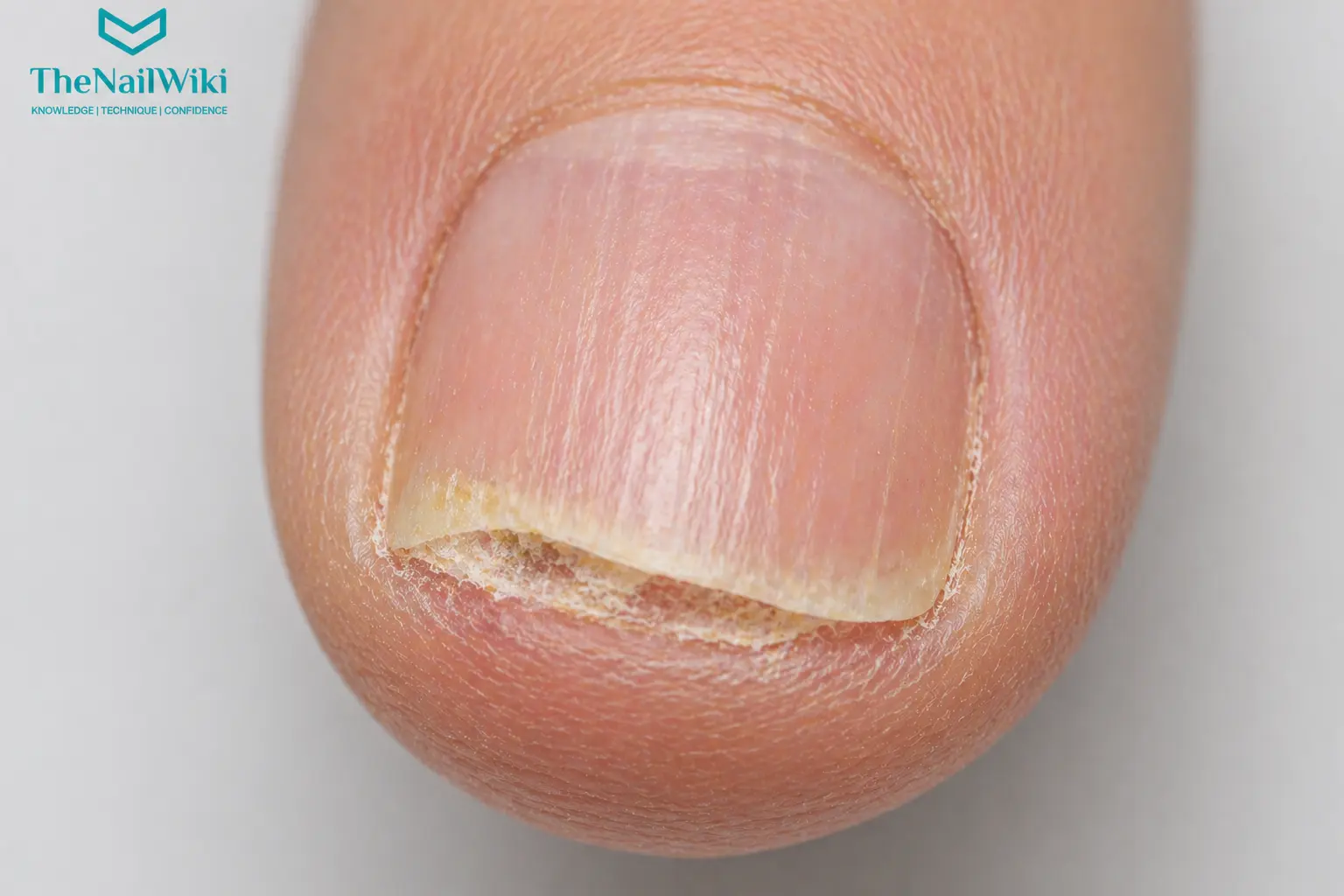
Psoriatic onycholysis — separation of the plate from the bed — is common and has a distinctive feature that helps differentiate it from mechanically caused onycholysis: a red or pink band at the proximal border of the separation. This erythematous border reflects the active inflammatory process at the advancing edge of the separation and is considered a hallmark of psoriatic nail bed involvement.
Subungual hyperkeratosis
Psoriasis in the nail bed causes an accelerated turnover of the nail bed epithelium, producing an accumulation of scale beneath the plate — a condition called subungual hyperkeratosis. This scale build-up lifts the plate from below, causing it to appear thickened and sometimes to separate. In severe cases, the nail plate may be substantially raised or the entire nail may loosen.
Splinter haemorrhages
Fine, dark linear streaks running parallel to the length of the nail — splinter haemorrhages — can occur in nail psoriasis due to the fragility of the nail bed capillaries in an inflamed environment. While splinter haemorrhages have many causes, their presence alongside other psoriatic signs supports the overall picture.
Working with Clients Who Have Nail Psoriasis
Nail psoriasis is not an automatic contraindication for all nail services, but it does require individual assessment and a clear conversation with the client about what is and is not advisable given the specific state of their nails at that appointment.
The Koebner phenomenon
In psoriasis, trauma to the skin or nail can trigger new psoriatic lesions at the site of injury — a response known as the Koebner phenomenon (or isomorphic response). This means that aggressive nail preparation, filing, cuticle work, or any technique that creates mechanical stress on a nail unit already affected by psoriasis risks triggering or worsening a psoriatic flare at that site. Gentle technique is not optional with these clients — it is a clinical requirement.
Sensitive cuticle area — high bleeding risk
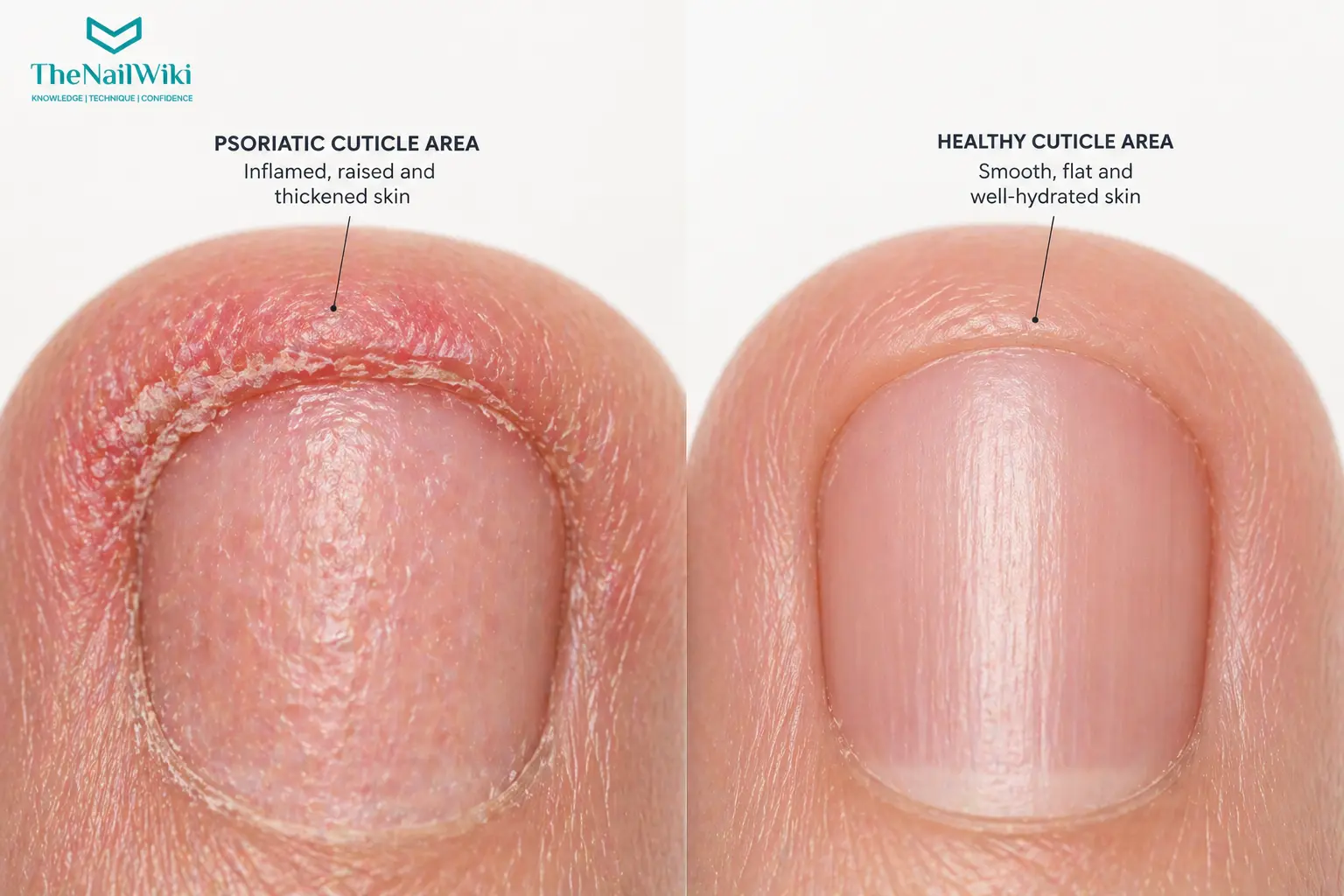
In clients with nail psoriasis, the eponychium and surrounding cuticle area is frequently inflamed, fragile, and significantly more prone to bleeding than in a healthy nail. The psoriatic process affects not just the nail plate but the entire nail unit — the skin surrounding the nail is often thinner, more sensitive, and reacts more readily to any mechanical contact.
Any cuticle work on a client with nail psoriasis must be approached with extreme caution. Standard cuticle technique that would be appropriate on a healthy nail — even gentle e-file work at low speed — can cause bleeding at the cuticle area in a psoriatic nail unit. Bleeding at the cuticle line not only causes discomfort and distress to the client but also activates the Koebner response, increasing the risk of a new psoriatic lesion forming precisely at the site of trauma.
⚠️ Cuticle work on psoriatic nails
- Approach all cuticle work with minimal pressure — less than you would normally use
- Use the gentlest tool and the lowest speed — a soft cuticle pusher before any e-file consideration
- If the skin at the cuticle line is visibly inflamed, raised, or bleeding at the start of the appointment — do not perform cuticle work at this visit
- If bleeding occurs during the service — stop immediately, apply gentle pressure, and do not continue in that area
- Any bleeding at the cuticle area must be documented in the client record and discussed at the next appointment
- Consider whether the service should be adapted or postponed if the nail unit is in an active flare
© TheNailWiki
Onycholysis and product
If psoriatic onycholysis is present, product should not be applied over the separation zone. The separated area is vulnerable, the exposed nail bed is fragile, and sealing product over it creates a risk of secondary bacterial colonisation. Additionally, product chemistry contact with an already-inflamed nail bed may exacerbate the condition.
Subungual scale
Attempting to remove subungual hyperkeratosis mechanically — by using a tool to clean beneath the plate — should be avoided. This can cause bleeding, pain, and trauma that may trigger the Koebner response. If scale build-up beneath the plate is significant, this is better managed by the client’s dermatologist.
© TheNailWiki
Documentation and communication
Nail psoriasis should be noted in the client’s nail consultation record. Any worsening of signs between appointments, or any new signs appearing on nails not previously affected, should be documented and the client encouraged to discuss these changes with their dermatologist or GP. The nail professional’s role is to observe, document, adapt technique, and refer — not to diagnose or treat.
When to Refer
- A client presents with nail changes consistent with psoriasis but has no known diagnosis — particularly if multiple nails are affected or changes are progressing
- Existing psoriatic nail changes are worsening significantly or spreading to new nails
- The client reports joint pain, swelling, or stiffness alongside nail changes — potential signs of psoriatic arthritis
- Secondary infection is suspected — particularly if warmth, pus, or rapidly increasing separation is present
- Any nail change that does not fit a clear explanation and is progressing over time
Common Misconceptions
❌ “Nail psoriasis is contagious”
Psoriasis is an autoimmune condition — it cannot be passed from person to person. There is no infection risk to the nail professional or to other clients. Treating a client with nail psoriasis as if they pose a hygiene risk is both medically incorrect and professionally inappropriate.
❌ “Psoriatic onycholysis looks the same as any other onycholysis”
The distinctive red or pink border at the proximal edge of psoriatic onycholysis helps differentiate it from mechanically caused separation. Recognising this sign matters because the management approach and referral considerations differ from those for straightforwardly mechanical onycholysis.
❌ “Clients with nail psoriasis cannot have nail services”
This is not a universal rule. Whether a nail service is appropriate depends on the specific state of the nails, the techniques used, and the individual client’s medical history and current treatment. Blanket refusal is not necessary or appropriate in all cases — informed assessment and gentle technique allow many clients with nail psoriasis to receive safe, adapted services.
Frequently Asked Questions
How common is nail psoriasis?
Nail involvement is extremely common in psoriasis — research suggests that up to 90% of people with cutaneous psoriasis will experience nail changes at some point in their lifetime. Nail psoriasis without any visible skin plaques also occurs, making the nail changes potentially the first or only presentation a nail professional may see.
Can nail psoriasis be cured?
Psoriasis is a chronic condition with no cure, but it can be managed. Treatments range from topical therapies applied to the nail unit to systemic medications and biological agents. Nail signs often improve with effective treatment of the underlying psoriasis. Management is the responsibility of a dermatologist, not a nail professional.
Can nail professionals use an e-file on nails with psoriasis?
E-file use on psoriatic nails requires significant caution. Given the Koebner phenomenon — where trauma triggers new psoriatic lesions — any mechanical work on the nail surface carries a risk of exacerbating the condition. If e-file use is considered, it should be extremely gentle, avoiding the nail plate surface in areas of pitting or crumbling, and avoiding any work near separated zones or the nail bed.
How does nail psoriasis differ from fungal nail infection?
Both conditions can cause nail thickening, discolouration, and onycholysis. Key distinguishing features of nail psoriasis include: nail pitting, the salmon patch or oil drop sign, the characteristic red border on onycholysis, and known psoriasis elsewhere on the body or a personal or family history of the condition. Definitive differentiation requires clinical assessment and, in some cases, laboratory testing — this is not within the scope of a nail professional to determine.
Related Library Pages
Nail Conditions
- → Onycholysis
- → Nail Pitting
- → Beau’s Lines
- → Leukonychia
- → Onychomycosis (Fungal Nail Infection)
- → Lichen Planus
Nail Anatomy
Some linked pages are currently in development and will be published progressively.
Professional Disclaimer
The information on this page is provided for educational purposes and is intended to support the professional knowledge of nail technicians and nail educators. It does not constitute medical advice and must not be used to diagnose or treat nail psoriasis. Any client presenting with unexplained or progressive nail changes should be referred to a qualified medical professional for assessment.
About the Author
Radina Ignatova
Professional Nail Expert since 2014 | International Nail Educator | Founder of TheNailWiki and Artistic Touch Nail Training Academy
Radina Ignatova is a Professional Nail Expert since 2014 and an International Nail Educator specialising in dual forms, gel systems, polygel application, advanced nail structure, E-File techniques and professional salon safety.
She founded TheNailWiki to provide clear, safety-led nail education accessible to everyone, and Artistic Touch Nail Training Academy to deliver structured professional online nail courses.
Her teaching philosophy is centred on honest education — demonstrating real salon challenges, practical corrections and performance-based techniques rather than presenting only polished results.
Based in Scotland, UK, Radina contributes to advancing professional standards within the nail industry through structured educational resources and technical training.
Read full bio →About TheNailWiki
TheNailWiki is an independent educational platform dedicated to providing accurate, safety-led and professionally informed nail care information to professionals and enthusiasts worldwide. All content is created by qualified nail industry professionals and reviewed for technical accuracy.
For structured professional training, advanced masterclasses, and specialist technique courses, visit Artistic Touch Nail Training Academy.
This library page is published by TheNailWiki — an independent nail education resource maintained by nail industry professionals. Content is safety-led and professionally informed.