
Keratinisation Process: How the Nail Plate Is Formed
Author: Radina Ignatova – Nail Expert, International Nail Educator | Last Updated: July 2026
Quick Answer: Keratinisation is the process by which living cells produced in the nail matrix are progressively transformed into the hard, compacted structure of the nail plate. As cells move away from the matrix, they lose their nucleus and internal organelles, flatten, and fill with keratin protein until they are no longer living tissue. This is why the finished nail plate has no capacity for biological repair — it is not living tissue, and any existing damage must grow out rather than heal. New nail plate is only ever produced by the matrix; the nail plate itself cannot regenerate.
Contents
What Keratinisation Means
Keratinisation is the process by which a living cell is transformed into a hardened, protein-filled structure with no remaining biological activity. The nail plate belongs to the same family of structures as hair — both are ectodermal appendages produced through progressive keratinisation. The difference is in the finished shape: the nail plate grows as a continuous flat sheet, while hair grows as a strand.
The word describes a transformation, not a single event. A cell does not become “keratinised” instantly — it passes through a sequence of changes over time, moving from a living, functioning cell to a flattened, hardened unit called an onychocyte, which is the building block of the finished nail plate.
Where Keratinisation Happens
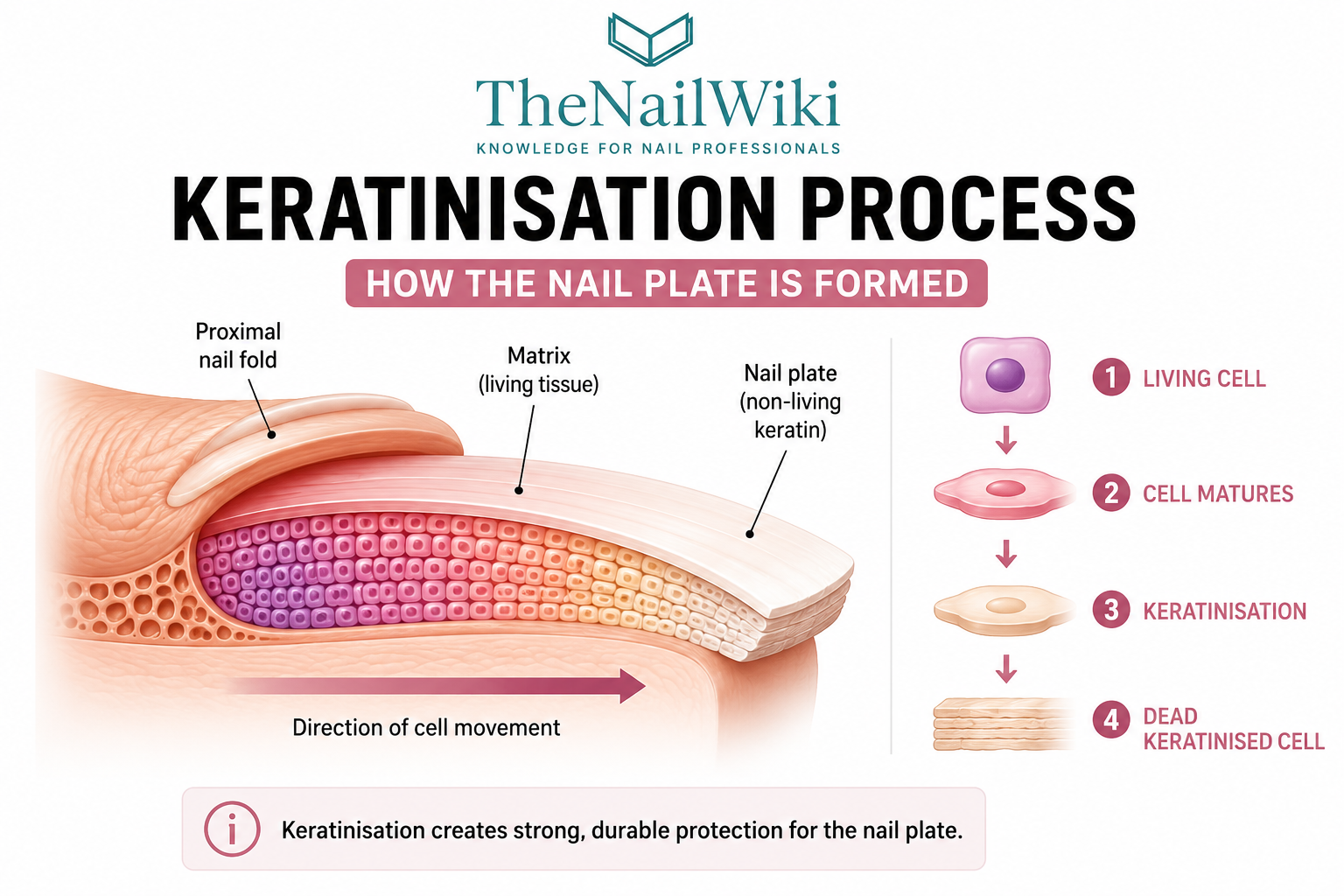
Keratinisation begins in the nail matrix — the living, actively dividing tissue at the base of the nail unit, supplied with blood and nerve endings. Every cell that will eventually form part of the nail plate starts its life here as a living, nucleated cell.
This distinction matters: the matrix itself is living tissue throughout a person’s life, but what it produces is not. As new cells are formed in the matrix and pushed forward by the cells dividing behind them, keratinisation begins and continues along the length of the nail bed. By the time a cell reaches the free edge, the process is complete — which is also why the free edge is the hardest, most fully keratinised, and driest part of the nail plate.
The Cellular Journey — From Living Cell to Hardened Nail Plate
The transformation from living matrix cell to hardened nail plate happens in overlapping stages rather than sharp, distinct steps. Understanding the sequence explains why the process only moves in one direction.
- Living, dividing cell — within the matrix, the cell is nucleated, contains a full set of internal organelles, and is actively producing proteins
- Loss of the nucleus and organelles — as the cell is pushed away from the matrix by ongoing division behind it, it progressively breaks down and loses its nucleus and internal structures
- Flattening and keratin filling — the cell flattens and fills with keratin intermediate filaments, replacing the cellular machinery that has been lost
- Cross-linking and hardening — the keratin proteins are locked together by disulphide bonds between sulphur-rich amino acids, which is what gives the finished structure its rigidity and resistance to deformation
- Fully keratinised onychocyte — the cell is now a flattened, hardened, non-living structural unit, held to its neighbours by a thin intercellular cement layer
© TheNailWiki
This is the same underlying chemistry that gives hair its strength — a high sulphur content, densely cross-linked, produces a tough and resilient material. Once a cell has completed this transformation, none of the steps can be reversed. There is no stage at which a fully keratinised cell can regain a nucleus, resume internal activity, or return to a living state.
Why the Finished Nail Plate Cannot Repair Itself
Repair, in a biological sense, requires living cellular activity — protein synthesis, cell division, and the coordinated processes that living tissue uses to replace damaged material with new material in the same location. Skin can do this because it remains living tissue throughout. The finished nail plate cannot, because by the time it is visible, every cell within it has already lost the nucleus and organelles that this kind of activity depends on.
This is why the nail plate has no capacity to repair itself once damage has occurred. A thinned, split, or otherwise damaged section of nail plate remains part of that plate — it does not thicken, reseal, or restore itself in place. The only way the appearance changes is through continued growth, as the damaged section moves forward and is eventually replaced by newly keratinised nail plate reaching the same position.
Producing New Nail Is Not the Same as Repairing Existing Nail
These two ideas are often conflated in client conversations, but they describe entirely different processes. Producing new nail is something the matrix does continuously, for as long as it remains healthy — it is an ongoing, ordinary biological function, not a response to damage. Repairing existing nail plate is not something that happens at all, in the sense of restoring already-keratinised tissue to its previous state.
When a client’s nails “improve” after a period of good aftercare, what has usually happened is that new, well-formed nail plate has been produced and has grown forward, while the previously damaged section has grown out past the free edge and been trimmed or filed away. Nothing about the old, damaged section was repaired — it was replaced by new material produced from the matrix, on the same ongoing schedule the matrix always follows.
Frequently Asked Questions
What is keratinisation?
Keratinisation is the process by which a living cell produced in the nail matrix is transformed into a hardened, protein-filled structure with no remaining biological activity. The cell loses its nucleus and internal organelles, flattens, and fills with cross-linked keratin protein, becoming a building block of the finished nail plate.
Where does keratinisation happen?
Keratinisation begins in the nail matrix and continues as the cell moves forward along the nail bed. By the time the cell reaches the free edge, the process is complete, which is why the free edge is the hardest and most fully keratinised part of the nail plate.
Why can’t nail plate damage heal?
Healing requires living cellular activity, and the finished nail plate is not living tissue — every cell within it has already lost the nucleus and organelles that this activity depends on. Damage cannot be repaired in place; the affected section must grow out and be replaced by new nail plate produced at the matrix.
Is the nail plate alive?
No. The nail plate itself is an inert, keratinised structure with no biological activity. The tissues that produce and support it — the nail matrix and nail bed — are living, but once a cell has completed keratinisation and become part of the visible nail plate, it is no longer living tissue.
What is the difference between producing new nail and repairing existing nail?
Producing new nail is an ongoing biological function of the matrix, unrelated to damage. Repairing existing nail plate does not happen in the sense of restoring already-keratinised tissue — improvement in appearance comes from new nail plate growing forward and replacing the damaged section, not from the damaged section itself being fixed.
Why does the free edge feel different from nail near the cuticle?
The free edge has completed the full keratinisation process and has also had the longest time away from the nail bed’s moisture supply, making it harder, denser, and drier than nail plate closer to the cuticle, where keratinisation is still comparatively recent.
Continue Your Professional Learning
Understanding how the nail plate is formed helps explain why existing nail damage cannot repair itself and why correct technique should always respect the biology of the natural nail. If you would like to see how this scientific knowledge is applied in professional nail services, continue your learning below.
🎓 Professional Training
New to Artistic Touch?
🎁 Free Mini Classes — Explore free professional nail education
Professional Disclaimer
This page is provided for professional educational purposes. It describes the general biological process of nail plate formation and is not a diagnostic resource. Persistent or unexplained changes in nail growth or appearance should be assessed by a qualified medical professional.
About the Author
Radina Ignatova
Professional Nail Expert | International Nail Educator
Radina Ignatova is a Professional Nail Expert since 2014, International Nail Educator, and Founder of TheNailWiki and Artistic Touch Nail Training Academy. She specialises in Russian Manicure, dual form systems, polygel, advanced e-file techniques, and nail safety protocols, and continues to work actively in salon practice, ensuring that all education reflects real client scenarios and current industry standards.
Her teaching philosophy is built on honest education — showing real salon challenges, real mistakes, and real performance testing rather than presenting only perfect demonstrations. This is how genuine technical competence is developed and how nail professionals become truly confident and capable.
Read full bio →© 2026 TheNailWiki. All rights reserved.