
Nail Growth Cycle: How Fingernails Grow and Replace Themselves
Author: Radina Ignatova – Nail Expert, International Nail Educator | Last Updated: July 2026
Quick Answer: Fingernails grow as new nail plate material is produced in the nail matrix and moves forwards over the nail bed towards the free edge. Adult fingernails grow at an average rate of roughly 3 millimetres per month, although the rate varies between people, fingers and circumstances. Complete replacement of a fingernail commonly takes around four to six months. This is why damage, discolouration and other changes may remain visible for months while the affected area grows towards the free edge.
Contents
How the Nail Grows
The nail matrix — the specialised tissue located beneath the proximal nail fold at the base of the nail — is the main tissue responsible for producing the nail plate. Cells within the matrix divide and differentiate as new nail plate material is formed. As this material develops, the cells become increasingly keratinised and compacted into the hard, densely packed structure that forms the nail plate.
The nail plate moves forwards over the nail bed. The nail bed is living tissue beneath the plate and has its own blood supply. It supports the overlying plate and contributes to its close attachment as the plate advances. The lunula is the pale crescent visible at the base of some nails, most prominently on the thumb. It is the visible portion of the nail matrix showing through the plate, and it is not equally visible on every nail.
In nail education, “growth cycle” is commonly used to describe the continuous process from nail plate formation in the matrix to the point where that section reaches the free edge. Unlike hair, the nail does not normally pass through the same distinct growth and resting phases, and the rate of production is not fixed — it fluctuates with age, health, nutrition, season and other individual factors.
The nail growth process in summary
- Cells within the matrix divide and differentiate as new nail plate material forms
- The developing nail plate becomes increasingly keratinised and compacted
- The nail plate advances across the nail bed toward the free edge
- The nail bed supports the overlying plate and contributes to its close attachment
- The lunula is the visible portion of the nail matrix, most prominent on the thumb
- Growth is continuous — there is no resting phase as there is in hair growth
Growth Rate — Averages and Variation
Adult fingernails grow at an average rate of around 3 millimetres per month. Individual growth rates vary — between people, between fingers on the same hand, with age, after illness or injury and under other physiological influences. At an average rate, a full nail plate — from the point of production at the matrix to the free edge — takes roughly four to six months to travel the full length of the nail bed. This means that a change or damage occurring at the nail matrix will not be visible at the free edge for several months.
Toenails generally grow more slowly than fingernails and take considerably longer to replace completely — often a year or more. This slower growth rate is relevant in conditions affecting the toenails and in recovery from toenail damage or infection.
Growth rate also varies between digits, and commonly cited patterns — such as the middle finger growing faster than the thumb or little finger — are general observations rather than universal rules.
Different nails grow at different rates
- Different people have different average growth rates
- Different fingers on the same person may grow at different rates
- An individual’s own growth rate can change over time — with age, health or circumstances
- Maintenance timing should be based on the individual nail and client, not one fixed universal number
Growth rate is an individual characteristic, not a fixed salon timetable.
What Affects Nail Growth Rate
Nail growth rate is influenced by several factors, some of which can be affected by lifestyle and health, and some of which are largely fixed individual characteristics.
Factors that can influence growth rate
- Age — growth rate may be faster in younger adults and can slow progressively with age
- Season and temperature — some research has reported seasonal variation in growth rate, although the effect is not identical for everyone
- Nutrition — severe nutritional deficiencies can affect nail quality and growth rate; moderate dietary variation in healthy individuals has a less clear effect, and slow-growing nails alone do not prove a nutritional deficiency
- Health and systemic conditions — certain medical conditions and medications can be associated with slower or altered nail growth
- Trauma and illness — significant illness or physical trauma may temporarily slow nail growth, and can sometimes produce a visible transverse line or groove in the plate as a record of the disruption
Damage, Recovery and the Growth Cycle
Understanding the growth cycle is essential for understanding how nail damage appears and recovers. For changes that formed within the nail plate during production, their position may provide a rough indication of when the disruption occurred. As the plate grows, these changes move towards the free edge. This principle does not apply equally to every nail condition or visible change.
This can be useful in professional nail assessment and client communication. When onycholysis occurs — separation of the nail plate from the nail bed — the already separated section of nail plate does not reattach to the nail bed. If the cause is resolved and new growth remains attached, the detached area may gradually move towards the free edge as the nail grows. The time required depends on the location and extent of the separation. The same growth-forward principle applies to discolouration, surface changes and structural irregularities that originated at the matrix level.
When the matrix itself is damaged — through trauma, infection or inappropriate product exposure — the resulting change in the nail plate grows forward over the following months. If the matrix is temporarily affected, later nail growth may return towards its previous appearance as the cause resolves. Permanent matrix damage or scarring can produce persistent changes in the nail plate.
In professional nail practice, realistic client communication about recovery timelines depends on understanding the growth cycle. A client whose nails have been damaged by over-filing or trauma needs to understand that significant nail plate damage may take weeks or months to grow out, depending on where the affected area is located. Changes close to the base of the visible nail take longer to reach the free edge than changes already near the tip.
How Long Does Nail Plate Damage Take to Grow Out?
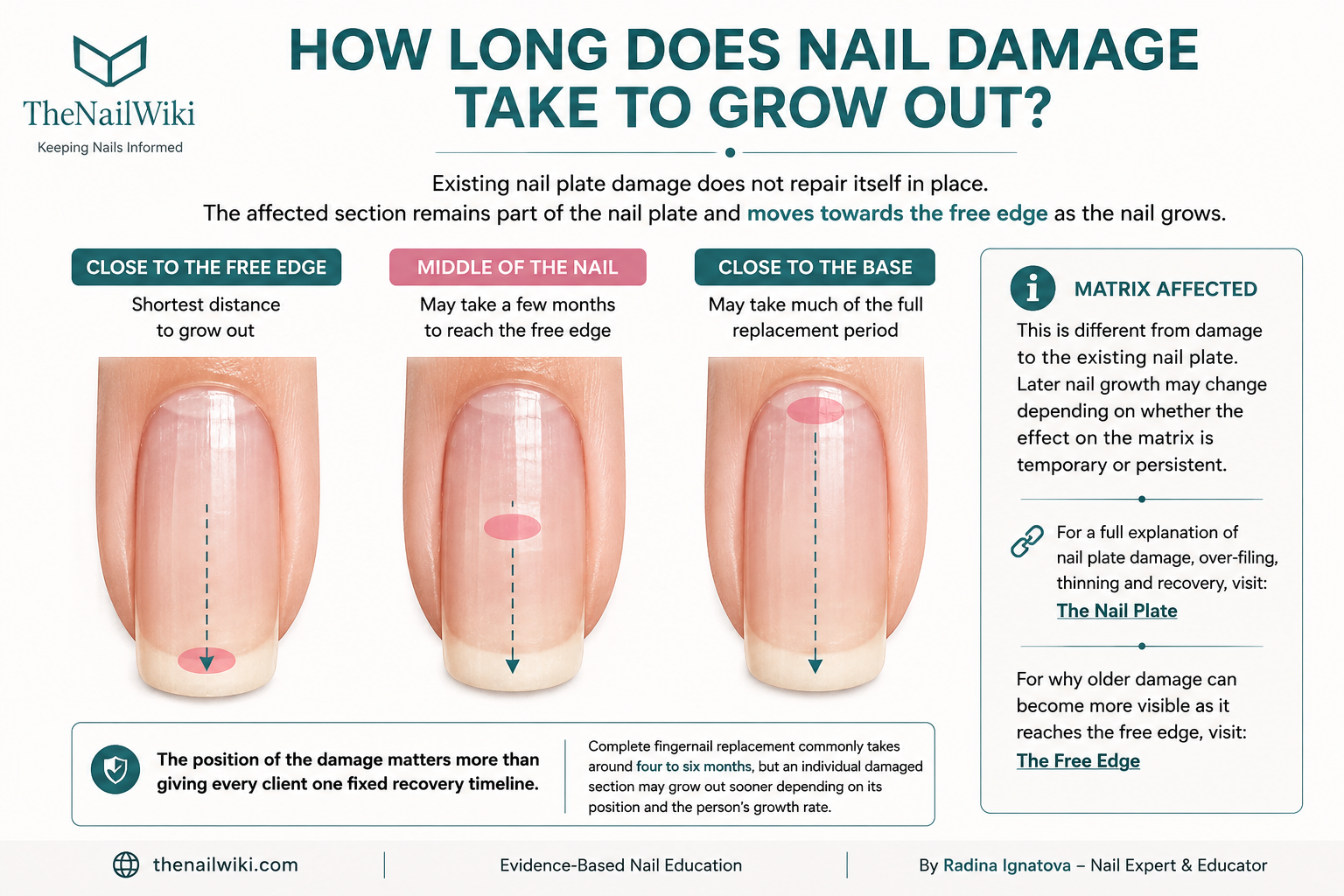
Existing nail plate damage does not repair itself in place. The affected section remains part of the nail plate and moves towards the free edge as the nail grows.
How long it takes to disappear depends mainly on where the affected section is located. Damage already close to the free edge may be removed relatively soon. Damage in the middle of the visible nail has further to travel. Damage close to the base of the visible nail may take several months to reach the free edge.
This is why there is no single recovery time for visible nail plate damage. Complete fingernail replacement commonly takes around four to six months, but an individual damaged section may grow out sooner depending on its position and the person’s growth rate.
Where the damage sits determines how long it takes to grow out
- Close to the free edge — shortest distance to grow out
- Middle of the visible nail — may take a few months to reach the free edge
- Close to the base of the visible nail — may take much of the full replacement period
- Matrix affected — this is different from damage to the existing nail plate; later nail growth may change depending on whether the effect on the matrix is temporary or persistent
© TheNailWiki
The position of the damage matters more than giving every client one fixed recovery timeline.
The Growth Cycle in Professional Nail Practice
The growth cycle informs professional nail practice in several direct ways. Nail growth is one factor that influences maintenance timing. As the natural nail grows, the visible regrowth area increases and the relationship between the enhancement and the growing nail changes. Depending on the service, length, product system and individual growth rate, maintenance or rebalancing may be needed — commonly every two to four weeks, though this is a common service interval rather than a fixed biological requirement.
The growth cycle also determines how long it takes for the effects of a service — whether positive or negative — to become fully visible. A section of nail plate thinned by over-filing remains part of that plate and moves forwards as the nail grows. It does not become thick again. The visible damage disappears only after the affected section reaches the free edge and is safely removed. Understanding this prevents unnecessary concern from both the technician and the client, and allows for more realistic advice about when the affected section may grow out and when the outcome of new growth can be assessed.
As an enhancement grows out, its original product distribution moves forwards with the nail. The free edge may become longer and the enhancement may no longer have the same proportions it had when first applied. This is why maintenance is not only about filling the visible regrowth area; the complete structure may need reassessment. Growth rate is also a separate characteristic from growth direction — how quickly a nail grows says nothing about the angle or path it grows in, and both are assessed independently.
Frequently Asked Questions
How fast do nails grow?
Adult fingernails grow at an average rate of around 3 millimetres per month, though this varies between individuals, between digits and with age, health and other circumstances. Toenails generally grow more slowly than fingernails and take considerably longer to replace completely. A full fingernail replacement takes approximately four to six months.
Where does nail growth come from?
The nail matrix is the main tissue responsible for producing the nail plate. It is specialised tissue beneath the proximal nail fold at the base of the nail. The nail bed supports the overlying plate as it advances. Injury or disease affecting the matrix can alter later nail plate growth, and permanent matrix damage may cause persistent changes.
How long does it take for a damaged nail to recover?
The time depends on where the affected area is located. Damage close to the free edge may grow out relatively quickly, while damage near the base of the visible nail can take several months to reach the free edge. If the matrix was affected, the final outcome may not be clear until substantial new growth has appeared.
Do nails have a resting phase like hair?
Nails do not normally have the same distinct growth and resting phases as hair. Nail plate production is generally continuous, although illness, injury or other significant physiological disruption can temporarily slow or interrupt growth. This may later become visible as a transverse change in the nail plate, depending on the cause and severity.
What slows down nail growth?
Nail growth rate varies naturally and may change with age. Illness, injury, some medications and other physiological factors can also slow or interrupt growth. Severe nutritional deficiency may affect nail growth and quality, but slow-growing nails alone do not prove a nutritional deficiency.
Continue Your Professional Learning
Understanding how the nail plate is continuously produced and replaced explains why damage takes months to grow out and why maintenance timing should follow the individual nail. If you would like to see how this understanding translates into real client communication and service planning, continue your learning below.
🎓 Professional Training
New to Artistic Touch?
🎁 Free Mini Classes — Explore free professional nail education
Related Library Pages
Nail Science & Mechanics
Nail Anatomy
- → Nail Matrix
- → Nail Plate
- → Nail Bed
- → Lunula
- → Proximal Nail Fold
- → Free Edge
Conditions
Professional Disclaimer
This page is provided for professional educational purposes. Nail growth rates and recovery timelines vary between individuals. Persistent changes in nail appearance or growth should be assessed by a qualified medical professional.

About the Author
Radina Ignatova
Professional Nail Expert | International Nail Educator
Radina Ignatova is a Professional Nail Expert since 2014, International Nail Educator, and Founder of TheNailWiki and Artistic Touch Nail Training Academy. She specialises in Russian Manicure, dual form systems, polygel, advanced e-file techniques, and nail safety protocols, and continues to work actively in salon practice, ensuring that all education reflects real client scenarios and current industry standards.
Her teaching philosophy is built on honest education — showing real salon challenges, real mistakes, and real performance testing rather than presenting only perfect demonstrations. This is how genuine technical competence is developed and how nail professionals become truly confident and capable.
Read full bio →© 2026 TheNailWiki. All rights reserved.