
Nail Material Science: How Nails and Enhancement Products Behave Under Force
Author: Radina Ignatova – Nail Expert, International Nail Educator | Last Updated: July 2026
Quick Answer: Nail material science examines how the nail plate and enhancement materials respond when force is applied. A material may deform temporarily and recover, remain permanently deformed, or fracture. Elasticity, plasticity, and brittleness help describe these different responses, but real nail and enhancement behaviour also depends on factors such as thickness, shape, hydration, product formulation, curing, architecture, length, and the type of force applied.
Contents
What Nail Material Science Covers
Nail material science applies material-behaviour concepts to the nail plate and to materials used in nail enhancements. It helps describe what happens when these materials are bent, compressed, stretched, or otherwise loaded. The same force does not produce the same response in every material. Some materials deform and recover, some retain a changed shape, and some fracture with relatively little visible deformation.
Material behaviour cannot be judged from the material name alone. The response also depends on the amount, direction, speed, and duration of the force, as well as the material’s thickness and shape. A brief impact and a lower force acting repeatedly or for a long time may produce different outcomes.
The nail plate is a biological material — a keratinised structure produced by the nail matrix — and it does not behave like a simple engineering material. Its behaviour under force is influenced by its hydration level, thickness, layered structure, and individual characteristics. Enhancement products introduce additional materials — gels, acrylics, polygels — each with their own distinct physical properties that interact with the natural nail beneath.
Three material properties are particularly relevant to nail practice: elasticity, plasticity, and brittleness. Understanding what each one means — and how natural nails and different products express these properties — informs better decisions about product selection, enhancement architecture, and client suitability.
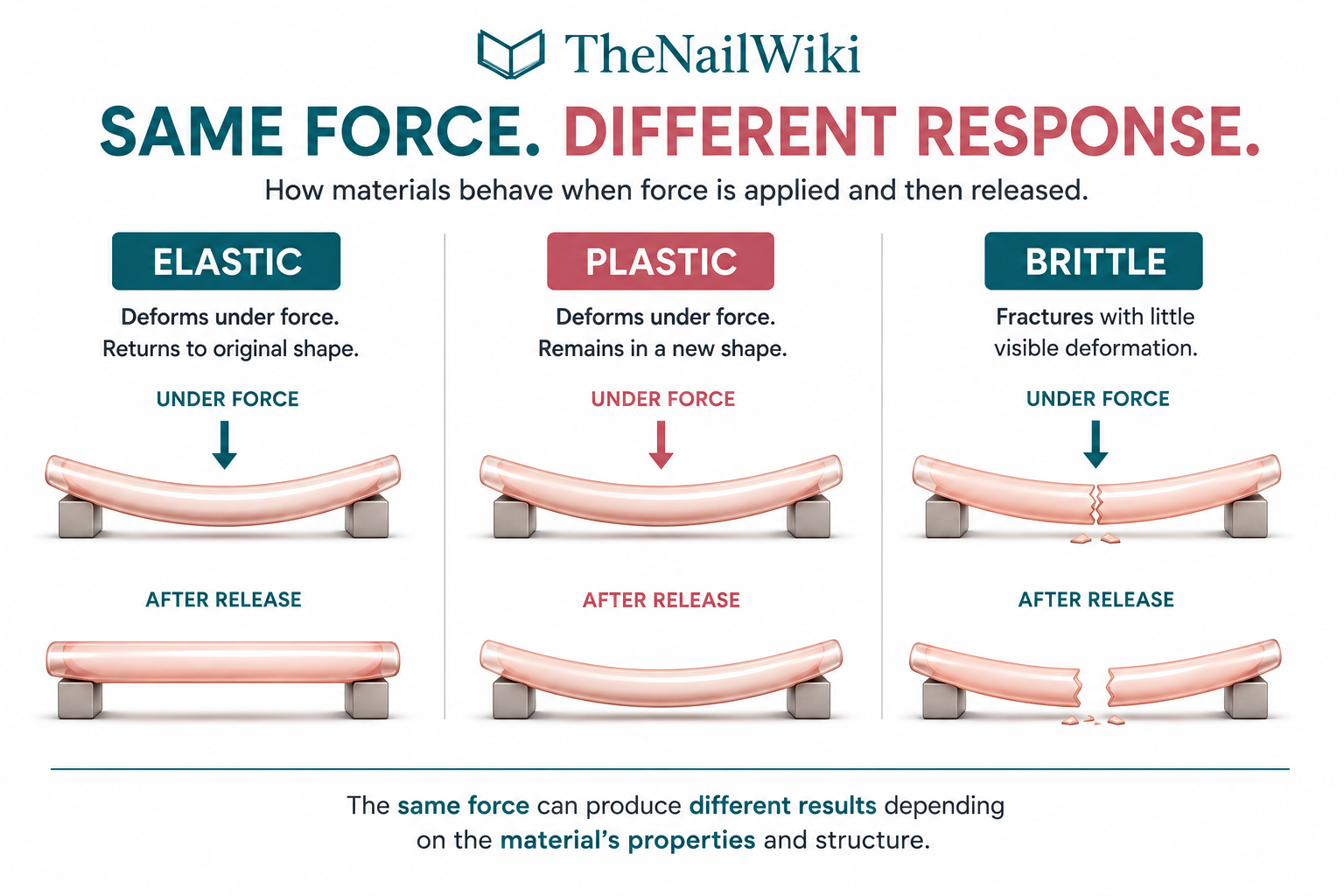
These terms do not mean the same thing
- Hardness — resistance to local surface indentation or scratching
- Stiffness — resistance to deformation under load
- Elasticity — reversible deformation
- Plasticity — permanent deformation
- Brittleness — fracture with relatively little deformation beforehand
A material can be hard without being identical in stiffness or brittleness to another hard material. These properties should not be used as interchangeable words.
© TheNailWiki
Elasticity — Flex and Recovery
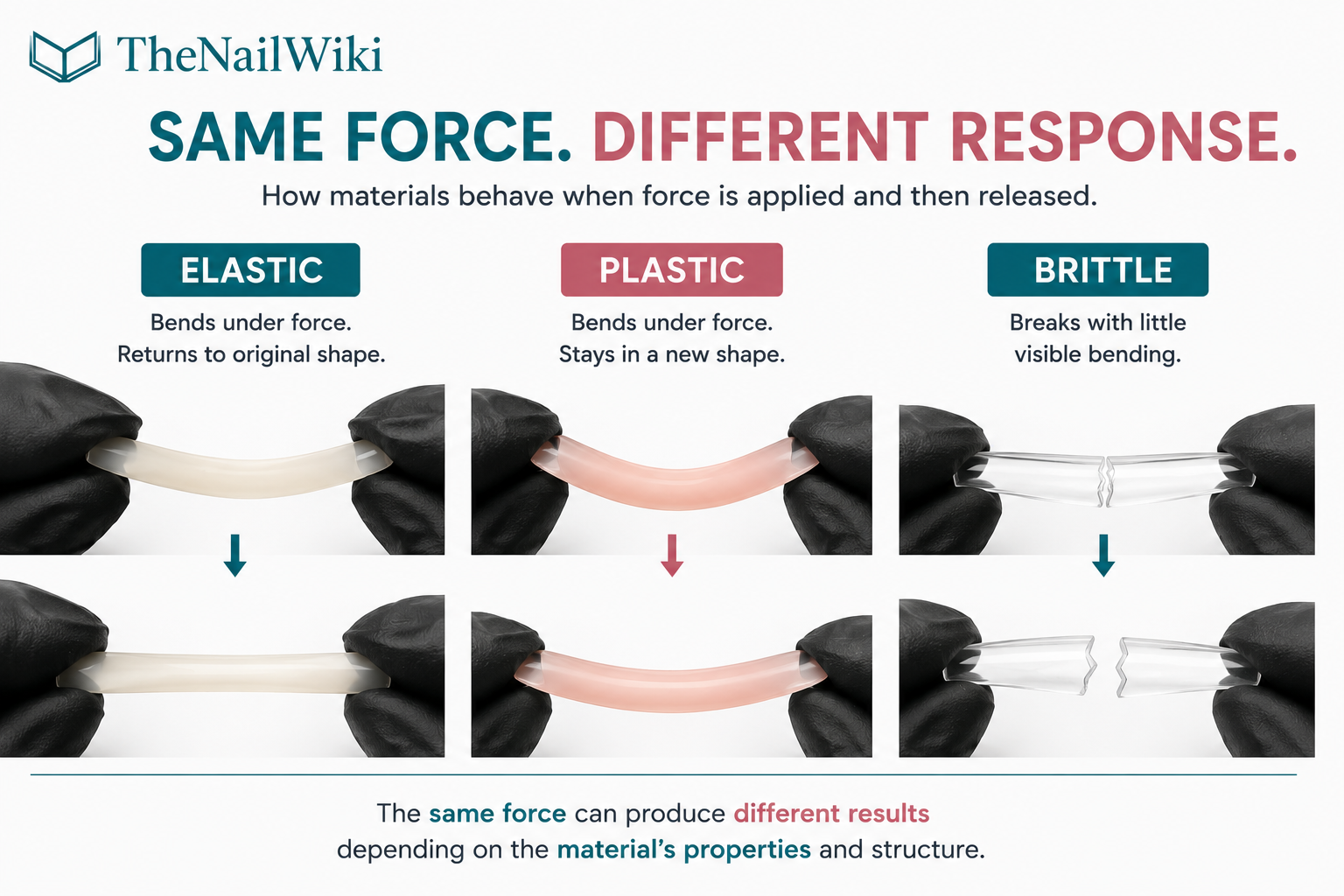
Elasticity describes reversible deformation. When force is applied, the material changes shape to some degree. If it remains within its recoverable range, it returns towards its original shape after the force is removed. The degree of elasticity varies: some materials are highly elastic and return almost perfectly to their original shape; others have limited elasticity and show some permanent change even after small forces.
In nail practice, “flexible” is often used informally for products that visibly bend more easily. Flexibility and elasticity are related concepts, but they are not identical — a material can undergo elastic deformation without appearing highly flexible.
Natural nail plates have some degree of elasticity — they can flex slightly under force, particularly when hydrated. A nail plate with limited capacity for deformation may respond differently to impact from one that bends more readily. Whether it cracks, bends, or remains unchanged also depends on its thickness, condition, shape, and the force applied.
In enhancement products, elasticity is one of the properties to be aware of. A more elastic product — sometimes described in professional practice as a softer or more flexible product — deforms temporarily under the applied load rather than immediately fracturing. This is particularly relevant as the natural nail grows and the enhancement flexes slightly with daily use.
Elasticity in nail practice
- Nail plates and cured enhancement products differ in how much they deform under a given load
- Greater visible flexibility does not automatically mean better performance
- A product can be relatively flexible and still provide useful support
- Product behaviour depends on formulation, thickness, curing, and the complete enhancement design
- No single level of elasticity is correct for every nail or service
Plasticity — Permanent Deformation
Plasticity describes permanent deformation that remains after the applied force is removed. In contrast with elastic deformation, the material does not fully return to its previous shape.
For a finished nail enhancement, permanent deformation would mean that the cured material has changed shape rather than fully recovering or fracturing. Whether this occurs depends on the material, the load, the duration of loading, and the structure of the enhancement. A visible change in enhancement shape over time does not by itself prove plastic deformation — natural nail growth, architecture moving forwards with growth, damage, and changes in the relationship between the enhancement and the growing nail must also be considered.
In natural nails, plasticity is less commonly discussed as a distinct concept. A separate but related characteristic is growth direction, which describes the path new nail plate takes as it is produced — this is a biological growth pattern rather than deformation of existing nail plate, and the two should not be conflated.
Brittleness — Sudden Fracture
© TheNailWiki
Brittleness describes a tendency to fracture with relatively little deformation beforehand. A brittle response is different from a material bending substantially or remaining permanently deformed before failure.
Water content can influence the mechanical behaviour of the nail plate. Changes in hydration may alter how readily the plate bends and how it responds to force. However, visible brittleness or splitting should not be attributed to dehydration alone. Persistent or unexplained changes in natural nails can have many causes and should not be diagnosed from material behaviour alone.
Cured enhancement products vary considerably between formulations. Products within the same broad category may differ in hardness, rigidity, flexibility, and fracture behaviour. Product category alone does not establish how a specific cured material will behave. Fracture location cannot be predicted from brittleness alone — the outcome also depends on enhancement architecture, length, thickness, existing damage, and where and how force is applied.
A fracture may show limited deformation beforehand
- The material appears to fracture rather than bend substantially
- Failure occurs with little visible permanent deformation
- Repeated fractures may suggest that material behaviour is one factor to assess
Fracture appearance alone cannot identify the cause. Architecture, thickness, length, product condition, curing, previous damage, and the force involved must also be assessed.
Material Behaviour in the Natural Nail
The natural nail plate expresses all three material behaviours to varying degrees, and the balance between them shifts depending on the nail’s condition. Water content is one factor among several that can influence this balance.
The nail plate is a layered keratinised structure rather than a single uniform sheet. Its thickness, internal organisation, water content, and condition can all influence how it behaves under force. Splitting between layers of the nail plate is described as onychoschizia. It can have multiple contributing factors and should not be attributed to one cause from appearance alone.
The material properties of individual clients’ nails vary considerably. Some clients have naturally more flexible nails; others have thicker, more rigid plates. These differences are one part of how a nail responds to enhancement products, alongside product selection and architectural design for that client.
Material Properties in Enhancement Products
The natural nail and the cured enhancement form a combined structure during wear. Their behaviour cannot be understood from either material in isolation. Product formulation, application thickness, curing, adhesion, nail condition, enhancement architecture, length, and client use can all influence performance.
A difference in flexibility between the natural nail and enhancement may be relevant in some situations, but it does not by itself prove why lifting or fracture occurred. Failure should be diagnosed from the complete service rather than attributed automatically to a product being “too hard” or “too flexible”.
Natural nail characteristics are one part of product selection, but they should not be used as a one-step matching rule. The intended service, length, architecture, product instructions, curing requirements, previous performance, and the individual nail all matter.
In BIAB and gel overlay services, the material properties of the specific product formula matter as much as the application technique. Products sold under the same broad category can behave differently after curing because formulations vary. Terms such as BIAB, builder gel, hard gel, or acrylic do not by themselves describe every relevant material property. Technicians should learn the behaviour and manufacturer requirements of the specific system they use.
Material Distribution Matters More Than Overall Thickness
The amount of product alone does not determine how well an enhancement manages force. What matters is how the material is distributed — and that is a question of enhancement architecture, not overall thickness.
A thin enhancement can perform well when the material is distributed correctly. A thick enhancement can still perform poorly when product is added without purpose — adding more material across the whole nail does not automatically create better support or longer wear.
The same cured material can therefore behave differently depending on how it is distributed, not simply how much of it is used. How to distribute material appropriately for a given nail is covered on the Nail Architecture page.
Key takeaway
Strength does not come from making the whole nail thick. It comes from creating the correct structure with purposeful material distribution.
Material properties and enhancement architecture
Material properties and enhancement architecture should be considered together, but one cannot compensate automatically for the other. The same product can behave differently depending on the architecture it is built into, and a visually similar architecture may perform differently when created with different materials.
This is why technicians should not diagnose a failure from product category, hardness, or flexibility alone. The complete enhancement, natural nail, service history, and failure pattern must be assessed together. Thin does not mean weak. Thick does not mean strong. Structure determines how effectively the enhancement manages force.
Frequently Asked Questions
What is elasticity in nail science?
Elasticity describes reversible deformation. When force is applied, a material changes shape to some degree. If it remains within its recoverable range, it returns towards its original shape after the force is removed. In nail practice, this concept can be applied to both the nail plate and cured enhancement materials.
What does brittleness mean for nails?
Brittleness describes a tendency to fracture with relatively little deformation beforehand. It does not identify why a nail or enhancement broke. Material formulation, thickness, architecture, previous damage, and the force involved must also be considered.
What is plasticity in nail products?
Plasticity describes permanent deformation that remains after force is removed. In a finished enhancement, this would mean that the cured material has changed shape rather than fully recovering or fracturing. A visible change in enhancement shape does not by itself prove plastic deformation, because nail growth, damage, and other factors may also alter the appearance over time.
Why do nail material properties matter for product selection?
Cured enhancement products vary in elasticity, rigidity, and brittleness, and these properties can be relevant to how an enhancement performs. However, a difference in hardness or flexibility between a product and the natural nail does not by itself prove why lifting or fracture occurred. Product selection should consider the intended service, architecture, length, and manufacturer guidance alongside the individual nail, rather than following a single matching rule.
How does hydration affect nail material behaviour?
Water content can influence the mechanical behaviour of the natural nail plate, affecting how readily it bends and responds to force. However, visible brittleness or splitting should not be attributed to dehydration alone, since persistent or unexplained changes in natural nails can have many contributing factors.
Continue Your Professional Learning
Understanding that thickness alone does not predict strength changes how you evaluate both natural nails and enhancement products. If you would like to build the skill to select and apply products based on genuine material behaviour, continue your learning below.
🎓 Professional Training
The Ultimate Dual Forms — product selection and material behaviour
New to Artistic Touch?
🎁 Free Mini Classes — Why Your Sandwich Dual Forms Are Not Working
Related Library Pages
Nail Science & Mechanics
Nail Anatomy
- → Nail Plate
- → Nail Matrix
- → Free Edge
Nail Enhancement Systems
Professional Disclaimer
This page is provided for professional educational purposes. Material properties of nail products vary between manufacturers and formulations. Professional training and manufacturer guidance should inform product selection and application technique.

About the Author
Radina Ignatova
Professional Nail Expert | International Nail Educator
Radina Ignatova is a Professional Nail Expert since 2014, International Nail Educator, and Founder of TheNailWiki and Artistic Touch Nail Training Academy. She specialises in Russian Manicure, dual form systems, polygel, advanced e-file techniques, and nail safety protocols, and continues to work actively in salon practice, ensuring that all education reflects real client scenarios and current industry standards.
Her teaching philosophy is built on honest education — showing real salon challenges, real mistakes, and real performance testing rather than presenting only perfect demonstrations. This is how genuine technical competence is developed and how nail professionals become truly confident and capable.
Read full bio →© 2026 TheNailWiki. All rights reserved.