
Nail Architecture: Structure and Product Distribution in Nail Enhancements
Author: Radina Ignatova – Nail Expert, International Nail Educator | Last Updated: July 2026
Quick Answer: Nail architecture is how a technician plans and builds the complete structure of an enhancement, rather than treating it as a set of separate steps. It applies to any hard or builder-based product system — BIAB, builder gel, polygel, or acrylic — and to overlays just as much as full built extensions. Profile, curvature, product distribution, sidewalls, free edge, length, and shape all have to work together, because the finished nail behaves as one structure. On a natural nail, that structure comes from how the nail grew. On an enhancement, the technician has to plan it. No single feature decides whether the build is right — the whole picture does, and it looks different on every nail and every product system.
Contents
- What Nail Architecture Means
- Natural Nail Characteristics vs Enhancement Architecture
- Nail Architecture Is Three-Dimensional
- The Elements of Nail Architecture
- Product Distribution
- Architecture Changes With Length and Shape
- Assessing the Natural Nail First
- Architecture in Enhancement Work
- Overgrown Nail Architecture
- How Nail Architecture Is Assessed
- Why Architecture Matters in Professional Practice
- Frequently Asked Questions
What Nail Architecture Means
In professional practice, this way of thinking runs through every stage of a service — from the initial assessment of the natural nail, through product placement and curing, to filing and refinement. A profile is not built, then a c-curve considered separately, then the free edge finished in isolation. Each decision affects the others, so all of them are made with the complete structure in mind throughout the service, not only at the end of it.
On a natural nail, this structure is simply the result of how the nail grew, and the technician works with what is there. On an enhancement, the same structure has to be actively planned and built rather than assessed afterwards — which is why architectural thinking becomes a deliberate professional skill in enhancement work specifically.
Natural Nail Characteristics vs Enhancement Architecture
Before designing an enhancement, the technician must assess the natural nail. This assessment is the starting point — not a template to copy, but information that informs every architectural decision that follows.
Natural nail characteristics to assess
- Longitudinal growth direction — forward, upward (ski-jump), downward (hooked), or laterally deviated
- Transverse curvature — how the nail arches across its width
- Width — across the nail bed and at the free edge
- Thickness — of the natural nail plate
- Flexibility — how the natural nail responds to force
- Asymmetry — whether the nail is consistent in shape across its width and length
- Existing damage or changes — thinning, onycholysis, surface irregularity
Enhancement architecture involves deliberate decisions about
- Longitudinal profile — the shape of the enhancement from the side
- Product distribution — where material is placed and how it is balanced across the length
- Apex — where relevant to the system and the nail
- Transverse shape — the c-curve of the finished enhancement
- Sidewalls — their direction, taper, and how they relate to the natural nail
- Lower arch — the underside profile of the free edge or extension
- Free edge — its length, thickness, and shape
- Finished length and shape
The natural nail influences the plan, but the enhancement is not simply a copy of the natural nail. The technician assesses what is naturally present, then plans the enhancement around the individual nail, product system, and intended result.
Nail Architecture Is Three-Dimensional
An enhancement exists in three dimensions and must be assessed from multiple views. Each view reveals different information. A nail can look correct from one angle and still have problems that are only visible from another.
What each view reveals
- Side view — longitudinal profile, growth direction, product distribution along the length, and the position and prominence of the apex where present
- Top view — width, outline shape, sidewall direction, symmetry, and whether the enhancement follows or deviates from the natural nail
- End-on view (from the free edge) — transverse curvature, free-edge thickness, and the overall balance of the c-curve
- Underside view where relevant — lower arch, any excess product, and the construction of the free edge from beneath
This is directly relevant to dual form selection. A dual form may appear to fit correctly by width when viewed from above, but the transverse curvature or longitudinal profile may not match the natural nail. Selecting a dual form by width alone — without checking the other views — is one of the most common reasons for a poor architectural result. The form must be assessed for fit in all relevant dimensions before use.
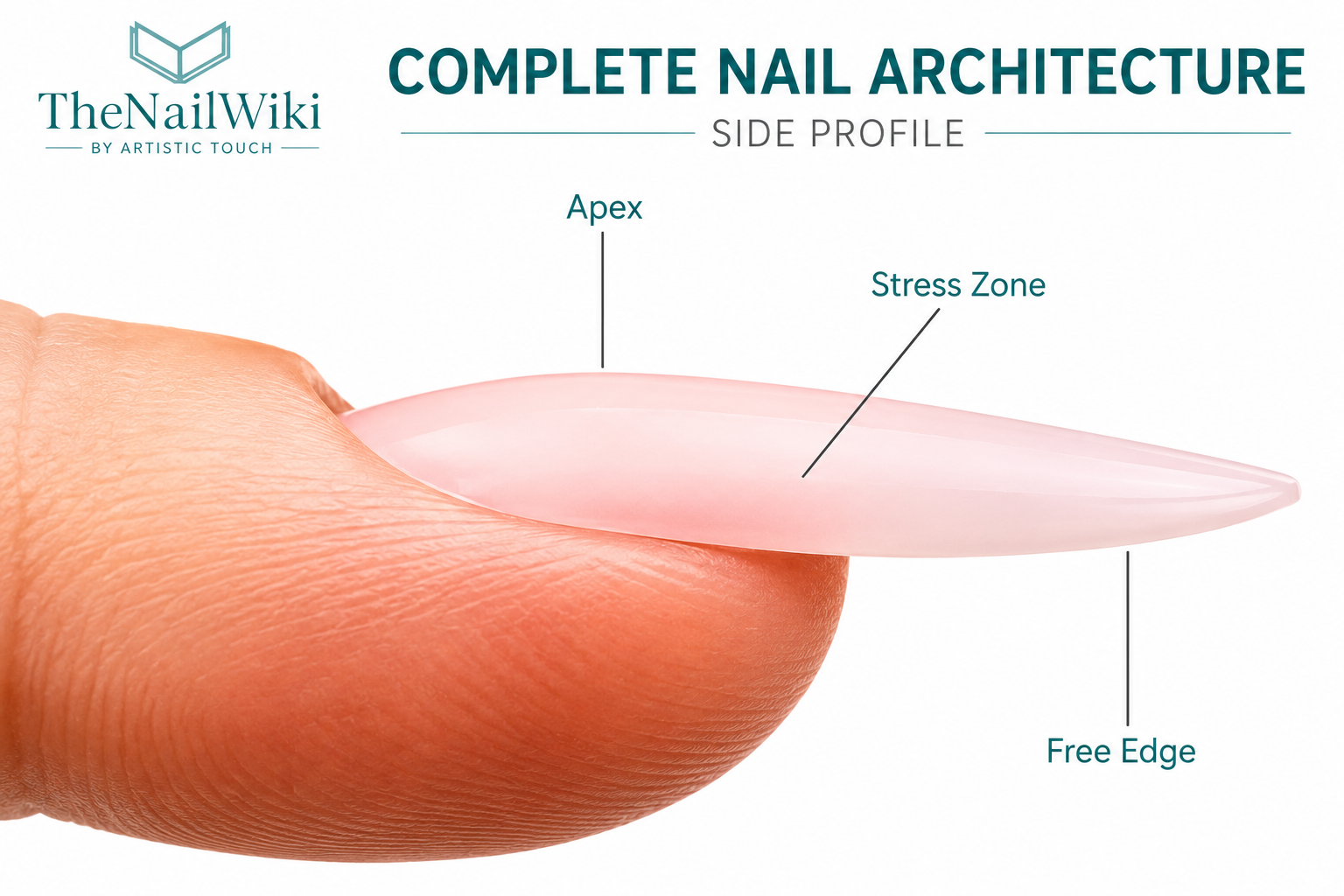
© TheNailWiki
The Elements of Nail Architecture
Several elements contribute to the architecture of a nail enhancement. Each influences the others — changing one element affects the overall structure.
Key architectural elements
- Upper arch — longitudinal profile — the shape of the enhancement when viewed from the side, from the cuticle zone to the free edge tip
- Lower arch — the underside profile of the free edge or extension — its shape contributes to the overall constructed form, particularly on longer enhancements
- Apex — an enhancement-architecture concept referring to the area of greatest built structure or elevation in the longitudinal profile, depending on the system, nail, length, and shape. Not every natural nail has an apex in this professional sense
- C-curve — transverse arch — the curvature of the enhancement across its width from one lateral edge to the other, assessed from the end-on view
- Sidewalls — the lateral edges of the enhancement. Their direction, taper, and outline contribute to the overall shape and how the enhancement relates to the natural nail at the sides. Sidewalls are distinct from the anatomical lateral nail folds and lateral nail grooves
- Product distribution and thickness — where product is placed and how it varies across the enhancement. This is one of the most important architectural decisions. See the dedicated section below
- Free edge — its length, thickness, shape, and how these relate to the overall proportions of the enhancement
- Length — the total enhancement length, which affects every other architectural decision
- Finished shape — the outline of the free edge, which cannot be considered in isolation from the three-dimensional structure behind it
Product distribution deserves particular attention on this list, since where the product sits along the length affects nearly every other element here — the c-curve, the apex, the sidewalls, and the finished shape. It is covered in detail in the next section.
Product Distribution
Product distribution is one of the most important architectural concepts and deserves specific attention. It describes where product is placed across the enhancement and how thickness varies from the cuticle zone to the free edge tip.
Equal thickness everywhere is not the goal. More product does not automatically produce a better or stronger enhancement. Thinner does not automatically mean better architecture. Excess bulk can exist even when important areas have insufficient structure. The question is not only how much product is present, but where it is placed.
The appropriate distribution depends on the natural nail, the length, the shape, the product system, the material properties of the product, and the construction method being used. A short overlay requires different distribution from a long extension. A square nail may need different lateral planning than an almond or stiletto. A more flexible gel may be distributed differently from a harder, more rigid system.
Good product distribution is not visible as a single feature when the nail is viewed from above. It is something the technician plans before and during application, and assesses from the side view and end-on view as the enhancement is built.
Architecture Changes With Length and Shape
A short overlay, a medium-length enhancement, and a long extension do not require the same architecture. As length increases, the complete design must be reconsidered — not just one element shifted or increased. The technician may need to reconsider the longitudinal profile, the product distribution across the length, the sidewall direction, the free-edge construction, and the overall proportions of the enhancement.
Shape changes the architectural requirements too. A square free edge, an almond, a coffin, and a stiletto are not simply different outlines applied to the same underlying structure. Each shape has different lateral construction, different free-edge thickness requirements, and different proportional demands. Treating shape as only a free-edge outline change — while leaving the underlying architecture identical — is a common limitation in enhancement work.
There are no fixed percentages or universal placement rules for apex position, c-curve depth, or product thickness at any given length. The appropriate architecture is always specific to the individual nail, the product system, the intended shape, and the client’s needs.
Assessing the Natural Nail First
Natural nails vary considerably. Their growth direction, transverse curvature, thickness, flexibility, width, and condition are all individual — and all relevant to how an enhancement should be designed. No natural nail type is superior to another. A flat, thin, or very flexible natural nail is not inferior architecture — it is a set of characteristics that must be assessed and accounted for in the design.
A client with a pronounced natural transverse curvature needs different form selection and product placement than a client whose nails are naturally flat. A client with an upward growth direction (ski-jump) needs a different approach to form positioning than a client whose nails grow broadly forward. These differences determine which product systems are appropriate, how forms must be fitted and seated, and what the enhancement design needs to achieve.
The natural nail is the starting point. The enhancement is designed around it — not applied on top of it without regard for what is there.
Architecture in Enhancement Work
In professional enhancement work, architectural decisions begin with the natural nail assessment and continue through every stage of the service — from product system and form selection, through product placement and curing, to filing and refinement. Each decision can influence the finished structure.
Poor or unsuitable architecture can contribute to cracking, breakage, unwanted flexing, excess bulk, or other performance problems. These outcomes are not caused by architecture alone — preparation, adhesion, product compatibility, curing, client use, and impact all play a role. Architecture is one of the factors a technician assesses when diagnosing a problem.
How architecture is influenced in different systems
Architecture may be influenced by the natural nail, the product system, the form or tip used, form fit and positioning, product placement, the properties of the product, curing behaviour, filing and refinement, and the intended length and shape. No single stage determines the architecture on its own.
In dual form and Sandwich Dual Form systems, the shape of the form strongly influences the starting architecture. Selection, fit, product placement, positioning, and refinement all contribute to the final result. In freehand-built systems — BIAB, builder gel, polygel, and acrylic — the technician makes more direct decisions about every architectural element through application technique. This applies whether the result is an overlay or a built extension. The natural nail, product behaviour, and curing still influence the outcome, even with this greater control. The build differs between systems, but the underlying job stays the same: plan the structure, keep it balanced, and place the product exactly where it needs to be.
Enhancement failure and architecture
When an enhancement shows cracking, breakage, or lifting, the failure pattern can provide clues — but it does not prove one cause. Potential contributing factors include architecture, product distribution, preparation, adhesion, contamination, product compatibility, curing, impact, repeated daily use, service age, and the condition of the natural nail. Architecture is one factor to investigate alongside the others, not a diagnosis by itself.
Overgrown Nail Architecture
Even a well-constructed enhancement changes as the natural nail grows. Understanding how architecture changes during the wear period is an important part of nail science and maintenance planning.
As the nail grows, the original product distribution moves forward with the nail plate. The gap between the enhancement product and the proximal nail fold increases. The free edge becomes longer relative to the product that was applied. The relationship between the attached nail and the extension changes — and the area of the nail experiencing the greatest mechanical demand may shift. An enhancement that was well proportioned when freshly balanced may no longer have the same structural balance after several weeks of growth.
This applies to overlays, BIAB services, gel enhancements, polygel enhancements, and full extensions. As overgrowth increases, the demands on the structure increase. This is one reason why regular maintenance — infilling, rebalancing, or reapplication — is not simply cosmetic. It is part of maintaining appropriate architecture over the wear period. See: Stress Zone.
In professional practice, three weeks is generally the point at which a standard infill or removal should take place — beyond this, structural balance and stress distribution become harder to maintain safely. Russian Manicure services can often be extended to four to six weeks, since the closer, more precise cuticle work involved typically leaves a smaller gap for overgrowth to affect. This is not a fixed rule: the appropriate interval still depends on the individual client’s growth rate, nail condition, and lifestyle, and should be assessed on a client-by-client basis rather than applied universally.
When assessing an enhancement, the technician should note how much it has grown since the last service. An enhancement that is significantly overgrown may show problems that were not present when it was freshly applied — and these problems may resolve with rebalancing rather than indicating a fundamental application error.
How Nail Architecture Is Assessed
Assessing nail architecture is not a rigid checklist with universal pass or fail rules. It is a professional skill that involves viewing the nail from multiple angles, comparing what is present with what is appropriate for the individual nail and service, and considering how the enhancement has changed since it was applied.
What to consider when assessing architecture
- View from the side — longitudinal profile, growth direction, product distribution
- View from above — width, shape, sidewall direction, symmetry
- View from the free edge end-on — transverse curvature, free-edge thickness and balance
- Underside view where relevant — lower arch and free-edge construction
- Length and shape — are they appropriate for the natural nail and the product system?
- Product distribution — where is the material? Where is it thin or thick relative to what the service requires?
- How the enhancement compares to the individual natural nail
- The product system and construction method used
- How much the enhancement has grown since it was last applied or rebalanced
Architectural assessment is relevant at every stage — before the service, during application, after curing, and during any follow-up consultation. An enhancement that was appropriate at application may need reassessment as it grows out.
Why Architecture Matters in Professional Practice
The concept of nail architecture matters because it shifts the focus of enhancement work from appearance to structure. A nail can look correct — smooth surface, clean edges, defined shape — and still have unsuitable architecture for that particular nail and length. Surface finish alone does not reveal whether the complete three-dimensional structure is appropriate.
Architecture is also the framework that connects the other nail science concepts covered in this library. The apex is an enhancement-architecture concept — a deliberate part of the longitudinal profile design. The c-curve is the transverse shape, relevant to both natural nails and enhancements. The stress zone is a mechanical concept describing where an enhancement experiences the greatest demand during use — relevant to understanding how architecture changes as an enhancement grows out. Understanding each of these individually is useful. Understanding how they relate to the complete architecture is what allows consistently informed enhancement decisions across different clients, lengths, shapes, and systems.
Frequently Asked Questions
What is nail architecture?
Nail architecture describes the complete three-dimensional structure of a nail enhancement — including the longitudinal profile, transverse curvature, product distribution, sidewalls, lower arch, free edge, length, and finished shape. These elements work together and must be planned around the individual natural nail, the product system, and the service. There is no single architecture that is correct for every nail.
Is nail architecture the same as nail shape?
No. Nail shape refers to the outline of the free edge — square, oval, almond, stiletto, and so on. Nail architecture refers to the complete three-dimensional structure, including the profile from the side, the curvature across the width, the product distribution along the length, and how all these elements work together. Two nails with the same shape can have very different architecture.
Is nail architecture the same as the apex?
No — the apex is one element within the architecture. It refers to the area of greatest built structure or elevation in the longitudinal profile, depending on the system, nail, length, and shape. Architecture describes the complete structure across all dimensions. Judging an enhancement’s architecture by the apex alone does not give a complete picture.
Does nail architecture only apply to nail extensions?
No. The same planning applies whatever hard or builder-based product is used — BIAB, builder gel, polygel, or acrylic — and whether the service is an overlay on the natural nail or a full built extension. What changes between them is the construction method and how much free edge, if any, is being built. What does not change is the need to plan the structure and place the product correctly.
Does every nail need the same architecture?
No. The appropriate architecture depends on the individual natural nail, the enhancement length, the finished shape, the product system, the material properties, and the client’s activities. What is correct on one nail may be unsuitable on another. There is no universal architecture that applies to every client and every service.
Can a nail be thick and still have poor architecture?
Yes. Thickness alone does not determine whether the architecture is appropriate. A nail can have excess product in some areas and insufficient structure in others while appearing thick overall. Good architecture is about where product is placed relative to the length, shape, and natural nail — not simply about how much product is present.
Why does nail architecture change as an enhancement grows out?
As the natural nail grows, the product that was applied moves forward with it. The free edge becomes longer, the gap between the product and the proximal nail fold increases, and the structural balance of the enhancement changes. An enhancement that was well proportioned when freshly applied may no longer have the same balance after several weeks of growth, which is one reason why regular maintenance and rebalancing matter beyond cosmetic appearance.
Can poor architecture contribute to enhancement failure?
Poor or unsuitable architecture can contribute to cracking, breakage, unwanted flexing, or excess bulk. However, enhancement failure involves several interacting factors — preparation, adhesion, product compatibility, curing, impact, client use, and service age all play a role. A failure pattern is evidence to investigate, not a diagnosis. Architecture is one factor to assess alongside the others.
How is nail architecture assessed?
Architecture is assessed from multiple views: the side view reveals the longitudinal profile and product distribution; the top view shows width, shape, and symmetry; the end-on view shows the transverse curvature and free-edge balance; the underside view where relevant shows the lower arch and free-edge construction. The technician also considers the length, shape, product system, construction method, and how much the enhancement has grown since it was last applied or rebalanced.
Continue Your Professional Learning
Understanding that architecture is about structure and product distribution — not simply how much product is applied — changes how you approach every enhancement service. If you would like to build this skill in full, continue your learning below.
🎓 Professional Training
The Ultimate Dual Forms — plan and construct complete enhancement architecture
New to Artistic Touch?
🎁 Free Mini Classes — Why Your Sandwich Dual Forms Are Not Working
Related Library Pages
Nail Science & Mechanics
- → Nail Apex
- → C-Curve — Transverse Arch
- → Stress Zone
- → Nail Material Science
- → Nail Growth Direction
Nail Anatomy
Nail Enhancement Systems
Professional Disclaimer
This page is provided for professional educational purposes. Enhancement architecture varies between product systems, nail types, lengths, and individual clients. Professional training is recommended before applying these principles in a salon environment.

About the Author
Radina Ignatova
Professional Nail Expert | International Nail Educator
Radina Ignatova is a Professional Nail Expert since 2014, International Nail Educator, and Founder of TheNailWiki and Artistic Touch Nail Training Academy. She specialises in Russian Manicure, dual form systems, polygel, advanced e-file techniques, and nail safety protocols, and continues to work actively in salon practice, ensuring that all education reflects real client scenarios and current industry standards.
Her teaching philosophy is built on honest education — showing real salon challenges, real mistakes, and real performance testing rather than presenting only perfect demonstrations. This is how genuine technical competence is developed and how nail professionals become truly confident and capable.
Read full bio →© 2026 TheNailWiki. All rights reserved.