
E-File Machine: What It Is, How It Works, and How to Choose One
Author: Radina Ignatova, Professional Nail Expert & International Nail Educator | Last Updated: April 2026
Quick Answer: An e-file machine — also called a nail drill or electric file — is a motorised handpiece used in professional nail services to perform cuticle work, surface preparation, product removal, and nail shaping with precision and control that manual filing cannot achieve. It is the core tool in e-file manicure and Russian manicure services. The machine itself is only one part of the equation — the result depends equally on the bit attached to it, the speed used, and the technique of the person operating it.
Quick Summary
An e-file machine converts electrical power into controlled rotational movement — the handpiece spins an attached bit at a speed set by the technician, measured in RPM (revolutions per minute). The technician controls the speed, direction of rotation, and pressure. The bit determines what the machine does to the nail surface — different bit types, grits, and shapes perform different functions.
A professional e-file machine is not a high speed tool operated with aggressive pressure. Correct professional technique uses low to moderate speeds with minimal pressure — the bit does the work, not the force applied. Understanding what the machine can and cannot do, and how to select appropriate settings for each task, is fundamental to safe and effective e-file practice.
Contents
- A Brief History of the E-File
- What an E-File Machine Is
- How It Works — RPM, Torque and Rotation
- Types of E-File Machine
- What to Look for When Choosing a Professional Machine
- Speed Settings — What RPM to Use for Each Task
- Heat Generation and How to Manage It
- Maintenance and Hygiene
- E-File Bits — What Attaches to the Machine
- Common Mistakes
- Frequently Asked Questions
A Brief History of the E-File
The e-file did not arrive fully formed in the nail industry. It evolved over decades from unrelated fields — and understanding that history gives useful context for why the machine works the way it does, and why professional-grade tools are built the way they are.
Key milestones
1950s
Early rotary discs and drum tools begin appearing for nail smoothing — largely unsuccessful due to extreme heat generation and nail damage. The concept existed; the technology was not yet refined enough.
1974
The first official patent for a dedicated electric nail file is filed — U.S. Patent 3,916,921 by Roger Pesola. His device used a solenoid-powered reciprocating motion to reduce the physical effort of manual filing and could run on batteries or mains power. This is the first documented purpose-built electric nail file.
1984
KUPA Inc. is founded by Robert Upshaw and Kito Ochi — the first company to commercially develop and produce an electric nail file specifically for the professional nail industry. KUPA continues to operate as a professional nail equipment manufacturer today: kupa.com → Before KUPA, nail technicians working with early rotary tools were largely adapting equipment from other industries — including Dremel tools — which were not designed for the precision and sensitivity required in nail work. KUPA adapted rotary technology from the dental industry and built it into a portable, high-torque tool suited to professional nail technique. This is the point at which the professional e-file as we know it today effectively began.
Dental origins
The modern e-file is a direct descendant of the dental drill. High-torque rotary technology from dentistry — developed to handle hard materials precisely and safely — was adapted for nail care. The crossover makes technical sense: both applications require precision rotation at variable speeds, minimal vibration, and consistent power under resistance.
Early 2000s onwards
The transition to the slim, adjustable rotary handpieces used in professional nail services today occurs through the early 2000s. Machines become more refined, quieter, lower in vibration, and more precisely controllable. The professional e-file market grows significantly alongside the expansion of Russian manicure and e-file manicure techniques from Eastern Europe into global nail education.
Fun facts
- The first recorded attempt at mechanical nail filing dates to the 1950s — over 70 years before today’s professional machines
- Roger Pesola’s 1974 patent predates the founding of the first dedicated professional nail e-file company by a decade
- The professional nail e-file shares its engineering ancestry with the dental drill — both rely on high-torque rotary motor technology adapted for precision work on hard surfaces
- Before purpose-built nail e-files were available, some nail technicians adapted Dremel tools — general-purpose rotary tools designed for craft and DIY work, not for skin or nail tissue
- The history of the e-file page covers this in more detail: History of Nail Technology →
What an E-File Machine Is
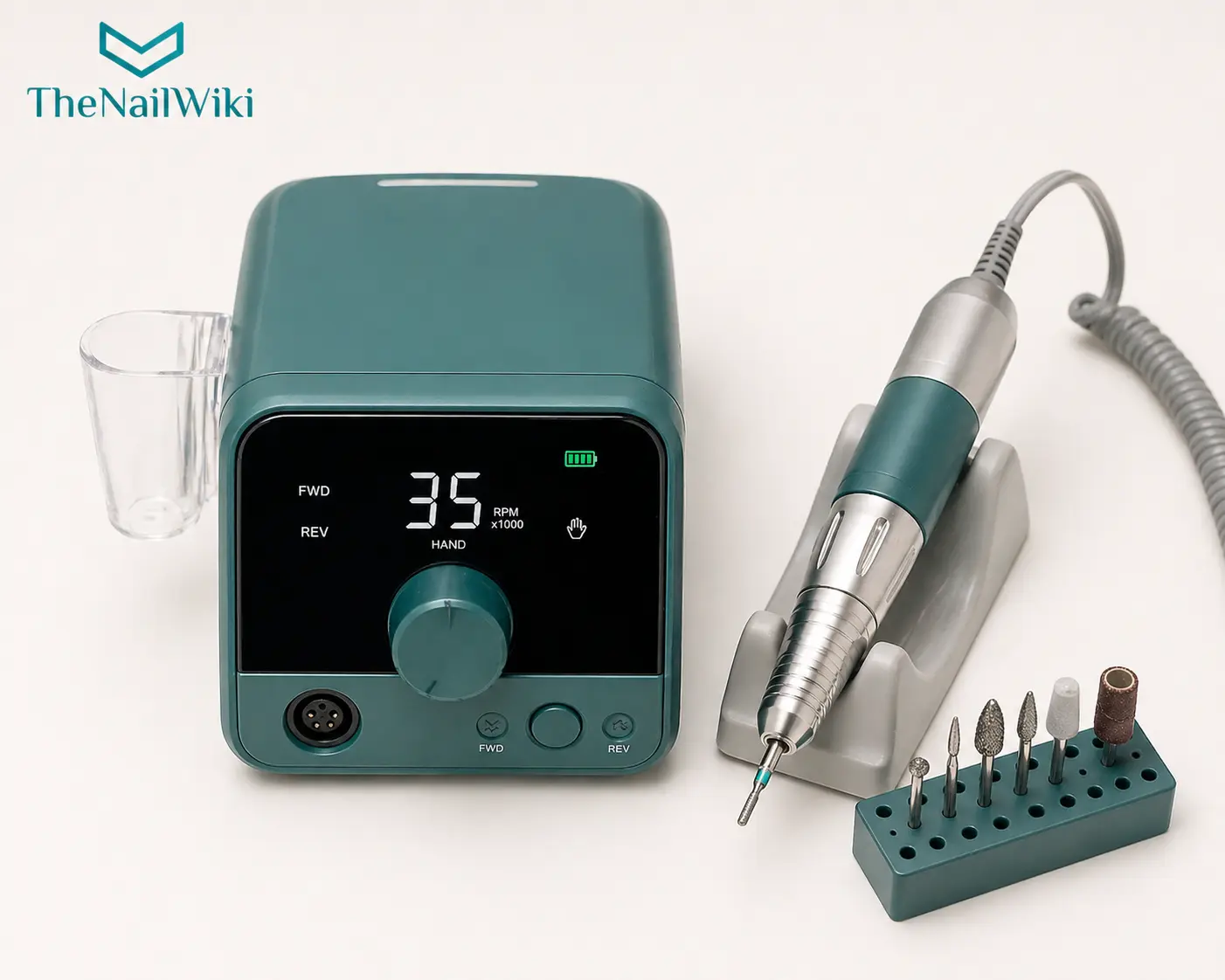
An e-file machine — also referred to as a nail drill, electric file, or nail e-file — is a motorised professional tool used to perform precision work on the nail plate, surrounding skin, and nail products. It consists of a control unit (the body of the machine containing the motor and controls) and a handpiece — a slim, pen-like device that holds the interchangeable bits and transmits the rotational movement from the motor to the bit tip.
The machine does not perform any specific function on its own — it spins. The function is determined by the bit attached to it. A cuticle bit performs cuticle work. A carbide bit shapes and refines product. A sanding band removes product. Changing the bit changes what the machine does entirely. This is why understanding e-file bits is inseparable from understanding the machine itself.
© TheNailWiki
E-file machines are used across a range of professional nail services — e-file manicure, Russian manicure, product application preparation, enhancement shaping and refinement, and product removal. They are professional tools requiring proper training before use — incorrect technique causes damage to the nail plate and surrounding tissue that can be difficult or impossible to reverse.
How It Works — RPM, Torque and Rotation
RPM — revolutions per minute
RPM measures how many complete rotations the bit makes per minute. Professional e-file machines typically operate between 3,000 and 35,000 RPM, with the technician selecting the appropriate speed for each task. Lower RPM settings are used for delicate work — cuticle area, thin nail plates, sensitive skin. Higher RPM settings are used for faster product removal or shaping of harder products such as acrylic or hard gel.
A common mistake is assuming that higher RPM means better or faster results. Excessive RPM for the task generates heat, removes material too aggressively, and increases the risk of damaging the nail plate or surrounding tissue. The correct RPM is the lowest speed that achieves the result safely — not the highest speed the machine is capable of.
Torque
Torque is the rotational force the motor produces — how much power the bit maintains under resistance. A machine with high torque will maintain its speed consistently even when the bit is pressed against a harder surface. A machine with low torque will slow down or stall when resistance increases, which can cause the bit to drag or grab rather than cut cleanly.
For professional work — particularly on harder products such as acrylic or hard gel — consistent torque is more important than maximum RPM. A machine that maintains steady, smooth rotation under pressure produces better and safer results than one that delivers high maximum RPM but drops significantly under load.
Same RPM — not the same machine
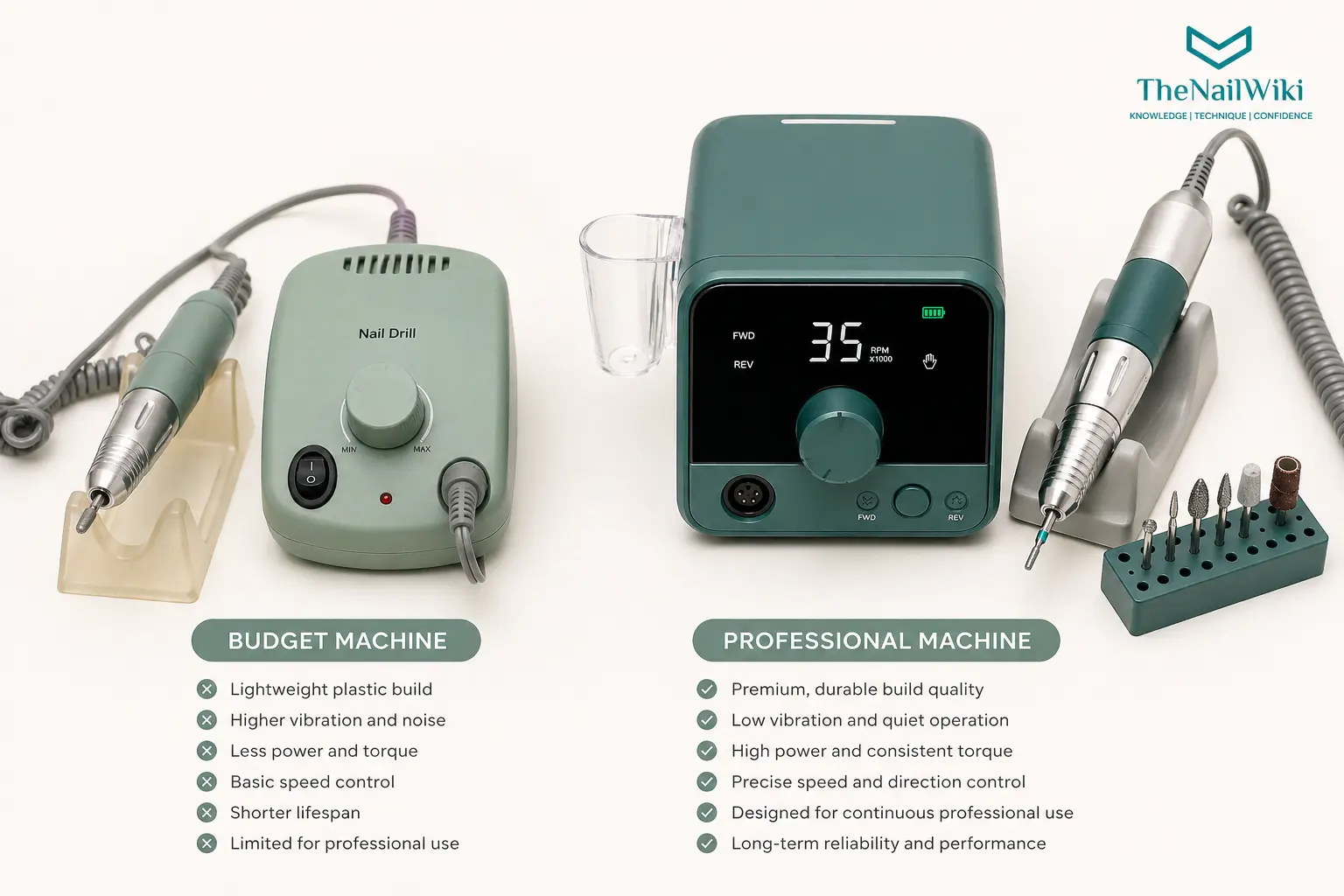
A budget machine rated at 30,000 RPM and a high-end professional machine rated at 30,000 RPM are not equivalent. The RPM figure describes how fast the motor spins when it is running freely with no load. It says nothing about how much power the machine maintains when the bit meets resistance.
The real-world difference shows up the moment the bit contacts nail product or tissue. A high-torque professional machine holds its speed consistently under that resistance — the bit continues cutting at the set RPM regardless of what it is working on. A low-torque budget machine drops speed the moment resistance is applied — the motor slows, the bit grabs or drags rather than cutting cleanly, and the technician compensates by pressing harder, which generates more heat and reduces control. This is why motor quality, torque rating, and how a machine performs under load matter far more than the maximum RPM figure printed on the box.
© TheNailWiki
Forward and reverse rotation
All professional e-file machines offer both forward (clockwise) and reverse (counter-clockwise) rotation. The direction of rotation determines which way the bit’s cutting edges are oriented relative to the direction of travel across the nail surface — and therefore how the bit cuts.
For right-handed technicians, forward rotation is typically used when working from right to left, and reverse when working from left to right — or vice versa depending on the bit type and the specific technique. The correct rotation direction for each task is part of the technique training for e-file work and varies by bit type and the area being worked on. Using the wrong rotation direction for the movement being made pushes material into the tissue rather than away from it — a common cause of trauma to the eponychium and surrounding skin.
Types of E-File Machine
Corded machines
Corded e-file machines connect to a power unit via a cable. They offer consistent power delivery, typically support higher torque and a wider RPM range, and are the standard choice for professional salon use. The control unit sits on the workstation and the handpiece is connected by a flexible cord. Most professional-grade machines used in serious e-file and Russian manicure work are corded.
Cordless machines
Cordless e-file machines are battery-powered and offer freedom of movement without a cable. They are useful for mobile technicians or as a secondary tool. The trade-off is battery life, lower maximum torque compared to most corded machines, and the need to recharge between uses. For full-time professional salon use with demanding services such as Russian manicure, a corded machine is generally the more reliable choice.
Desktop vs portable units
Desktop units have a separate control unit that sits on the nail station with a handpiece on a stand or holder. Portable units integrate the controls into a smaller, handheld form factor. Desktop units typically offer more precise speed control and a wider operating range. Portable units are more compact and suited to mobile work. For a dedicated nail station, a desktop unit is the professional standard.
What to Look for When Choosing a Professional Machine
Consistent torque at working speed
The machine should maintain smooth, consistent rotation under the resistance of working on actual product or tissue — not just spin freely at high speed with nothing attached. A machine that drops speed or stutters under light resistance will produce uneven results and make technique harder to control.
Low vibration handpiece
Handpiece vibration is one of the most important factors in e-file work — a vibrating handpiece makes precise control at the cuticle area much harder and causes fatigue in the technician’s hand over the course of a working day. A quality professional machine should run quietly and smoothly with minimal handpiece vibration at all speeds.
Precise, gradual speed control
The speed control dial or slider should allow precise, gradual adjustment — not just a few fixed settings. The ability to set exactly 8,000 RPM versus 12,000 RPM matters when working in different areas of the nail and with different bit types. Machines with only a few preset speed steps limit technical precision.
Forward and reverse rotation with easy switching
The machine must offer both rotation directions with a clear, accessible switch that can be changed during the service without interrupting workflow. Some machines have the direction switch on the handpiece itself — the most convenient placement for professional use.
Compatibility with standard bit shank sizes
Professional e-file bits come in two standard shank diameters — 3/32 inch (2.35mm), which is the most common professional standard, and 1/8 inch (3.17mm) used in some dental and podiatry applications. Confirm the handpiece accepts 3/32 inch bits before purchasing, as this is the standard across the vast majority of professional nail e-file bits.
Low heat generation at working speeds
Both the handpiece and the bit will generate some heat during use. A quality machine generates minimal handpiece heat even during sustained use. Excessive handpiece heat is a sign of poor motor quality or inadequate cooling. Bit heat is managed through speed selection, technique, and bit condition — see the heat section below.
Speed Settings — What RPM to Use for Each Task
Speed selection is one of the most important aspects of safe e-file technique. The following are general professional guidelines — always cross-reference with the specific bit type in use and adjust based on what you observe during the service.
These are starting points, not fixed rules. The appropriate speed depends on the specific bit in use, the product or tissue being worked on, the client’s nail sensitivity, and the technician’s technique. Always start lower and increase only if needed. If heat is felt — by you or the client — reduce speed immediately.
Heat Generation and How to Manage It
Heat generated during e-file work comes from friction between the bit and the surface being worked on. All bits generate some heat — the amount depends on the speed, the pressure applied, the condition of the bit, and the material being worked on. Managing heat is one of the most important safety considerations in e-file technique.
How to reduce heat generation
- Use the correct speed — higher RPM than needed for the task generates unnecessary friction and heat
- Keep the bit moving — holding the bit stationary in one spot concentrates heat at a single point. Continuous movement distributes friction across a larger area
- Use minimal pressure — pressing the bit into the surface creates more friction. The weight of the handpiece alone should be close to sufficient — the bit does the work
- Replace worn bits — a dull or worn bit creates more friction than a sharp one. Bits should be replaced when they no longer cut cleanly
- Work in passes, not sustained contact — brief, controlled passes across the surface allow both the bit and the nail to dissipate heat between passes
If the client feels heat — stop immediately
Any sensation of heat or burning reported by the client during e-file work must be acted on immediately — lift the bit from the surface, allow the area to cool, and reassess. Continuing to work through heat complaints damages the nail plate and surrounding tissue. Reduce speed, check the bit condition, and reduce pressure before continuing.
Maintenance and Hygiene
Handpiece care
Standard handpiece care between clients requires wiping the exterior with a lint-free wipe dampened with IPA or an appropriate disinfectant — never immersing the handpiece in liquid, as this damages the internal mechanism. Remove the bit before cleaning. Check the connection point for debris or product buildup and clean carefully with a dry brush.
Some professional handpieces are specifically manufactured as autoclavable — designed and validated to withstand repeated autoclave sterilisation cycles without damage to the internal components. If your handpiece is confirmed autoclavable by the manufacturer, autoclaving between clients provides the highest level of decontamination. This must be confirmed from the manufacturer’s technical specification — not all handpieces can be autoclaved and autoclaving a non-autoclavable handpiece will destroy it. Always check the documentation that came with the machine and follow the manufacturer’s stated decontamination protocol exactly.
Bit hygiene
Metal bits — carbide, ceramic, diamond — must be both sanitised and sterilised between every client. Sanitisation reduces the microbial load on the surface. Sterilisation eliminates all microorganisms including bacterial spores. Both steps are required — sanitising alone is not sterilisation and does not meet the professional standard for reusable tools that contact skin and nail tissue. Autoclave sterilisation is the gold standard. Approved chemical sterilisation is an acceptable alternative where autoclave is not available. Sanding bands are single-use and must be discarded after each client without exception. For the full bit hygiene protocol see: E-File Bits →
Machine servicing
Professional e-file machines used in daily practice benefit from periodic servicing — checking the motor, handpiece connection, cord integrity, and speed calibration. If the machine begins to vibrate more than usual, produces unusual sounds, runs hotter than normal, or the speed feels inconsistent, have it serviced or replaced. A malfunctioning machine is a safety risk.
E-File Bits — What Attaches to the Machine
The bit is what determines the function of the e-file — the machine only provides the rotation. Understanding bit types, grits, shapes, and appropriate use is as important as understanding the machine itself. See the full guide: E-File Bits →
The four main e-file bit material types
- Carbide bits — precision cutting used exclusively on hard nail products for shaping, refining, and bulk removal
- Ceramic bits — abrasive, lower heat generation, used on hard nail products — not on skin or natural nail
- Diamond bits — the most widely used in Russian and e-file manicure, used for all skin work and exfoliation
- Silicone bits — used for skin polishing in Russian manicure and e-file manicure finishing — not for nail plate shine
- Mandrel bits and sanding bands — disposable bands for product removal, natural nail prep with caution, and pedicure callus work
Common Mistakes
Running too high a speed for the task
High RPM is not better RPM. Excessive speed for delicate work — particularly cuticle area and natural nail surface — generates heat, removes material too aggressively, and reduces control. Always start at a lower speed and increase only if needed.
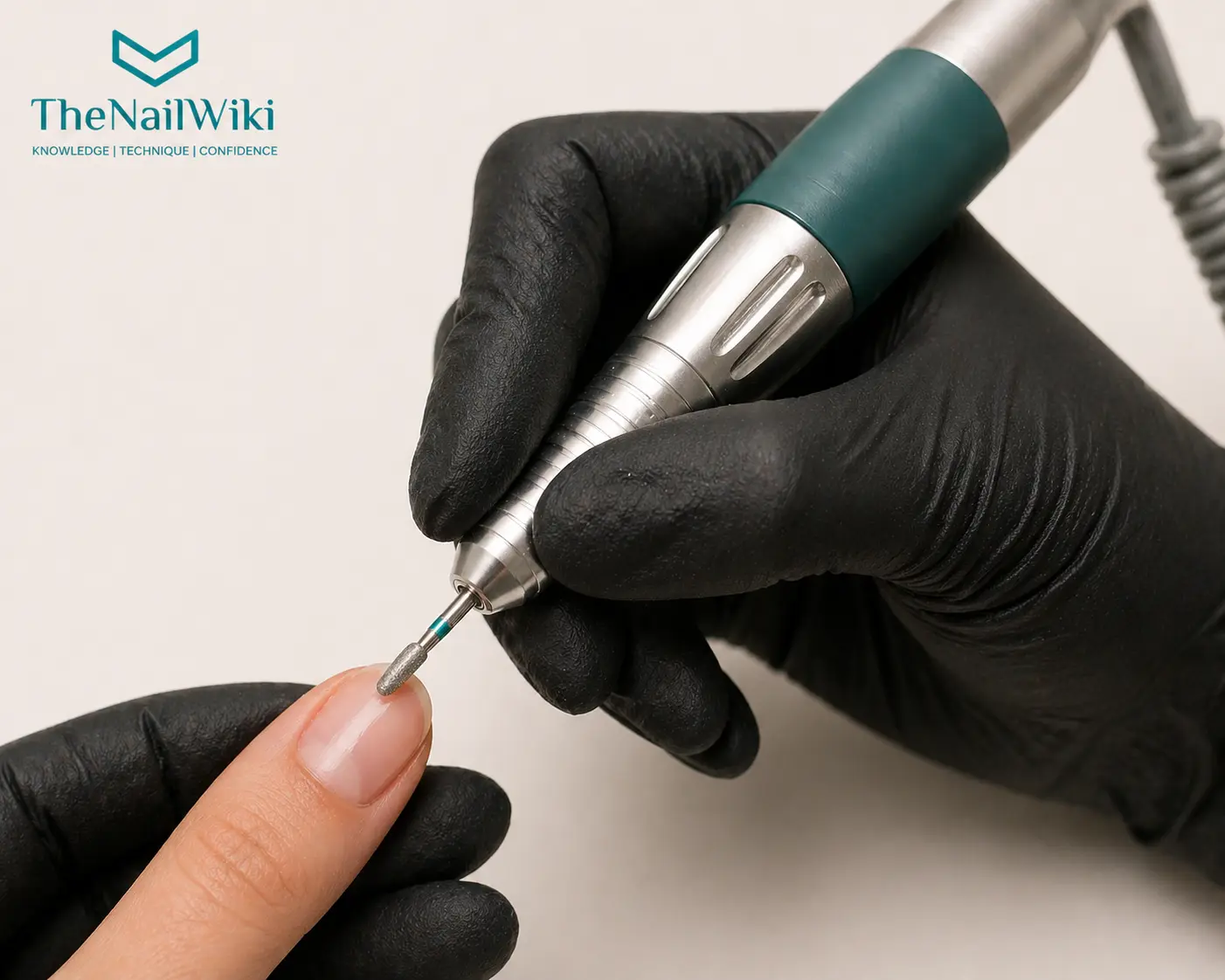
Applying pressure with the handpiece
The bit does the work — pressure from the technician’s hand should be minimal. Pressing the bit into the surface increases friction, heat, and the risk of removing too much material. Hold the handpiece lightly and let the bit contact the surface with its own weight.
© TheNailWiki
Using the wrong rotation direction
Using the wrong rotation direction for the movement being made pushes debris and material towards the skin rather than away from it. This is a common cause of trauma to the eponychium and lateral folds during cuticle work. Rotation direction is a fundamental part of e-file technique training.
Holding the bit stationary in one spot
Keeping the bit in one position concentrates heat and abrasive action at a single point, creating grooves, thin spots, or burns. Always keep the bit moving in continuous, controlled passes.
Using the e-file without proper training
An e-file machine operated without proper training causes damage that can be permanent — thinned nail plates, scarring around the cuticle area, and nerve damage in severe cases. E-file technique must be learned through structured professional training before being used on clients. Watching social media videos is not a substitute for proper hands-on training.
Frequently Asked Questions
What is the difference between an e-file and a nail drill?
There is no meaningful difference — both terms refer to the same type of motorised rotary tool used in professional nail services. E-file is the term more commonly used in the European nail industry and in professional training. Nail drill is the more commonly used term in the United States. They are the same tool.
What RPM should I use for cuticle work?
Cuticle work is typically performed between 5,000 and 12,000 RPM depending on the bit type and the specific technique being used. Lower speeds give more control and reduce the risk of heat and trauma to the delicate tissue around the nail. Start lower than you think you need and increase only if necessary.
Why does the e-file get hot during use?
Heat is generated by friction between the bit and the surface being worked on. It increases with higher speed, greater pressure, worn bits, and sustained contact in one spot. Reduce heat by using the correct speed for the task, applying minimal pressure, keeping the bit moving, and replacing worn bits promptly.
Can I use any bit with any e-file machine?
Most professional e-file machines accept the standard 3/32 inch (2.35mm) shank size used by the vast majority of professional nail bits. Confirm your machine accepts this shank size before purchasing bits. Some machines use a 1/8 inch shank — these are less common in nail services and more associated with dental or podiatry tools.
Do I need professional training to use an e-file?
Yes — without exception. An e-file operated without proper training causes damage that can be irreversible, including permanently thinned nail plates and scarring to the cuticle area. E-file technique must be learned through structured, hands-on professional training before being used on any client. Courses in e-file manicure and Russian manicure are available at Artistic Touch Nail Training Academy.
Professional training in e-file technique
E-file manicure and Russian manicure training — including machine settings, bit selection, rotation direction, speed protocols, and safe cuticle work technique — are covered in full at Artistic Touch Nail Training Academy.
Related Library Pages
E-File Bits
- → E-File Bits — Complete Guide
- → Carbide Bits
- → Ceramic Bits
- → Diamond Bits
- → Mandrel Bits & Sanding Bands
Services
Preparation
Some linked pages are currently in development and will be published progressively.
Professional Disclaimer
The information on this page is provided for educational purposes and is intended to support the professional knowledge of nail technicians and nail educators. E-file services should only be performed by trained professionals. Improper use of an e-file machine can cause permanent damage to the nail plate and surrounding tissue.
About the Author
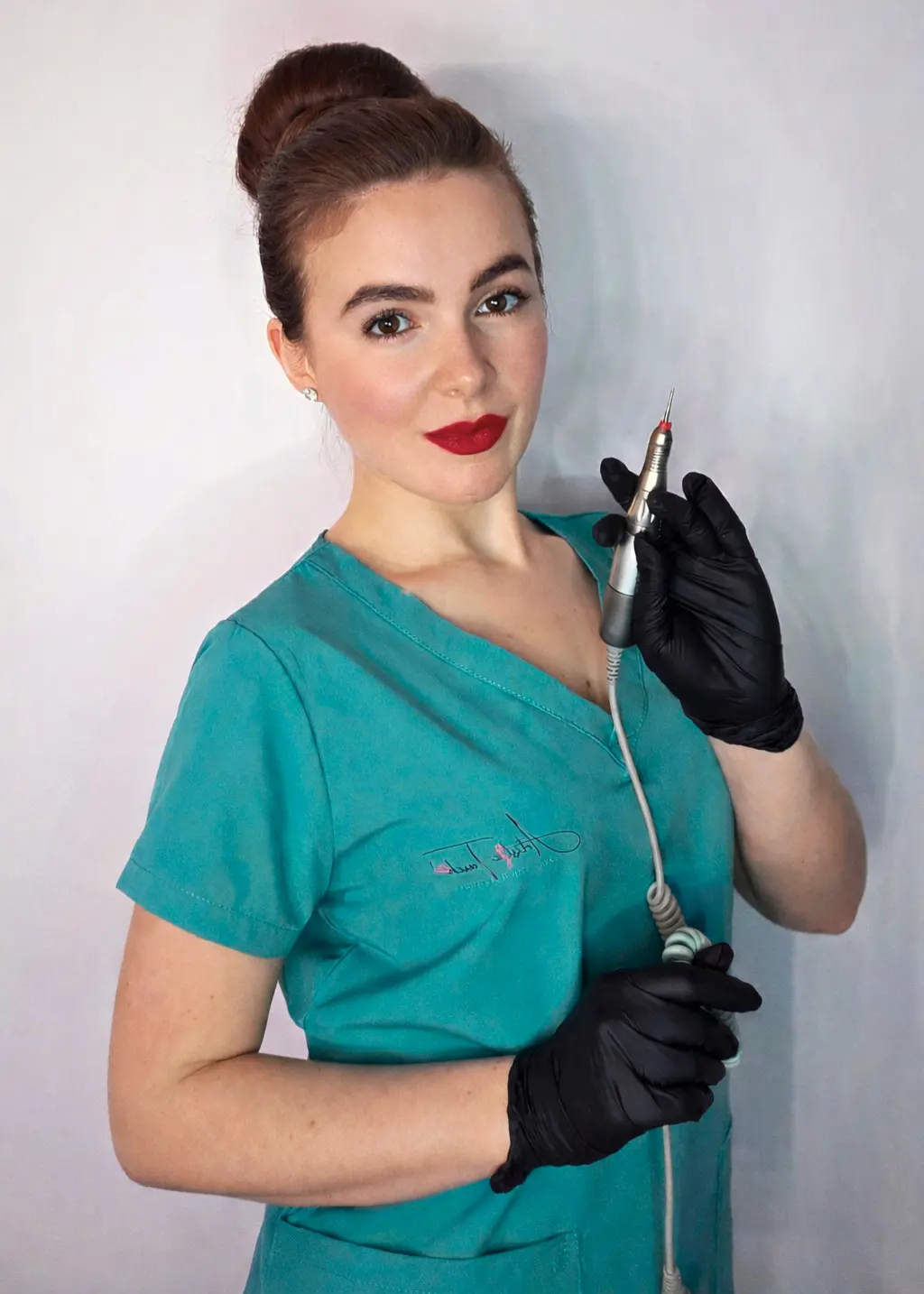
Radina Ignatova
Professional Nail Expert since 2014 | International Nail Educator | Founder of TheNailWiki and Artistic Touch Nail Training Academy
Radina Ignatova is a Professional Nail Expert since 2014 and an International Nail Educator specialising in advanced nail preparation, BIAB, dual form systems, e-file techniques, and professional salon safety. Based in Scotland, UK, she teaches nail technicians internationally through structured online courses.
Read full bio →About TheNailWiki
TheNailWiki is an independent educational platform dedicated to providing accurate, safety-led and professionally informed nail care information to professionals and enthusiasts worldwide.
For structured professional training visit Artistic Touch Nail Training Academy.
This library page is published by TheNailWiki — an independent nail education resource. Content is safety-led and professionally informed.