
The Eponychium and Cuticle: What They Are and Why the Distinction Matters
Author: Radina Ignatova, Professional Nail Expert & International Nail Educator | Last Updated: March 2026
Quick Summary
The eponychium and the cuticle are two distinct structures at the base of the nail that are among the most routinely confused terms in the nail industry. They are not the same thing. They have different compositions, different functions, and — critically — different implications when it comes to professional nail work.
Understanding the difference between these structures, and between both of them and the proximal nail fold they sit alongside, is a foundational piece of professional nail anatomy knowledge. It directly affects how nail preparation is performed, what is safe to remove or manipulate, and how to explain these structures accurately to clients and fellow professionals.
Contents
Three Structures, Not One
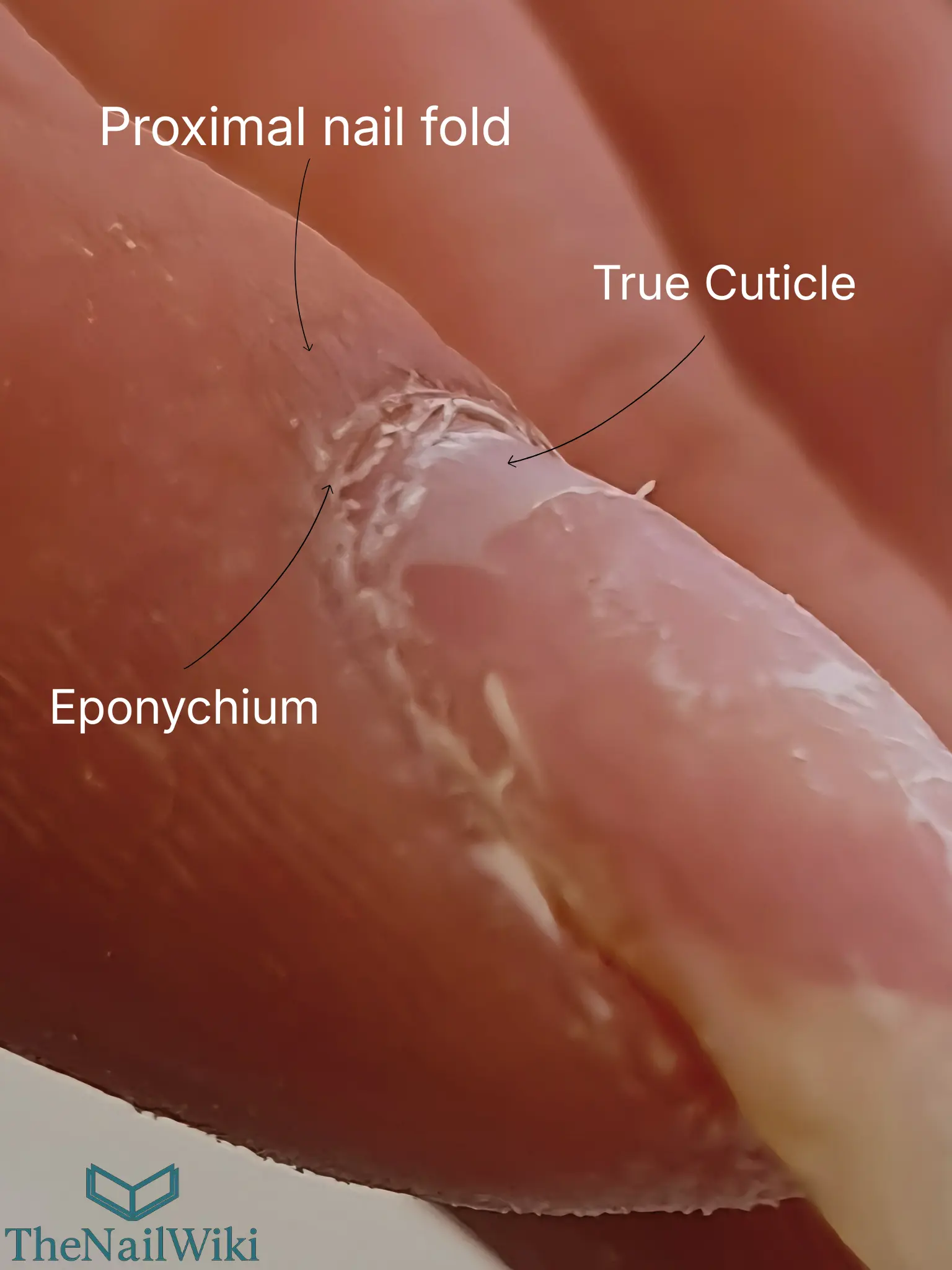
At the base of the nail, where the nail plate emerges from beneath the skin fold, there are three distinct structures that occupy a very small area and are routinely referred to interchangeably in everyday nail industry language. In practice, the word “cuticle” is used to describe all of them — which is where the confusion originates.
The three structures are:
The Proximal Nail Fold
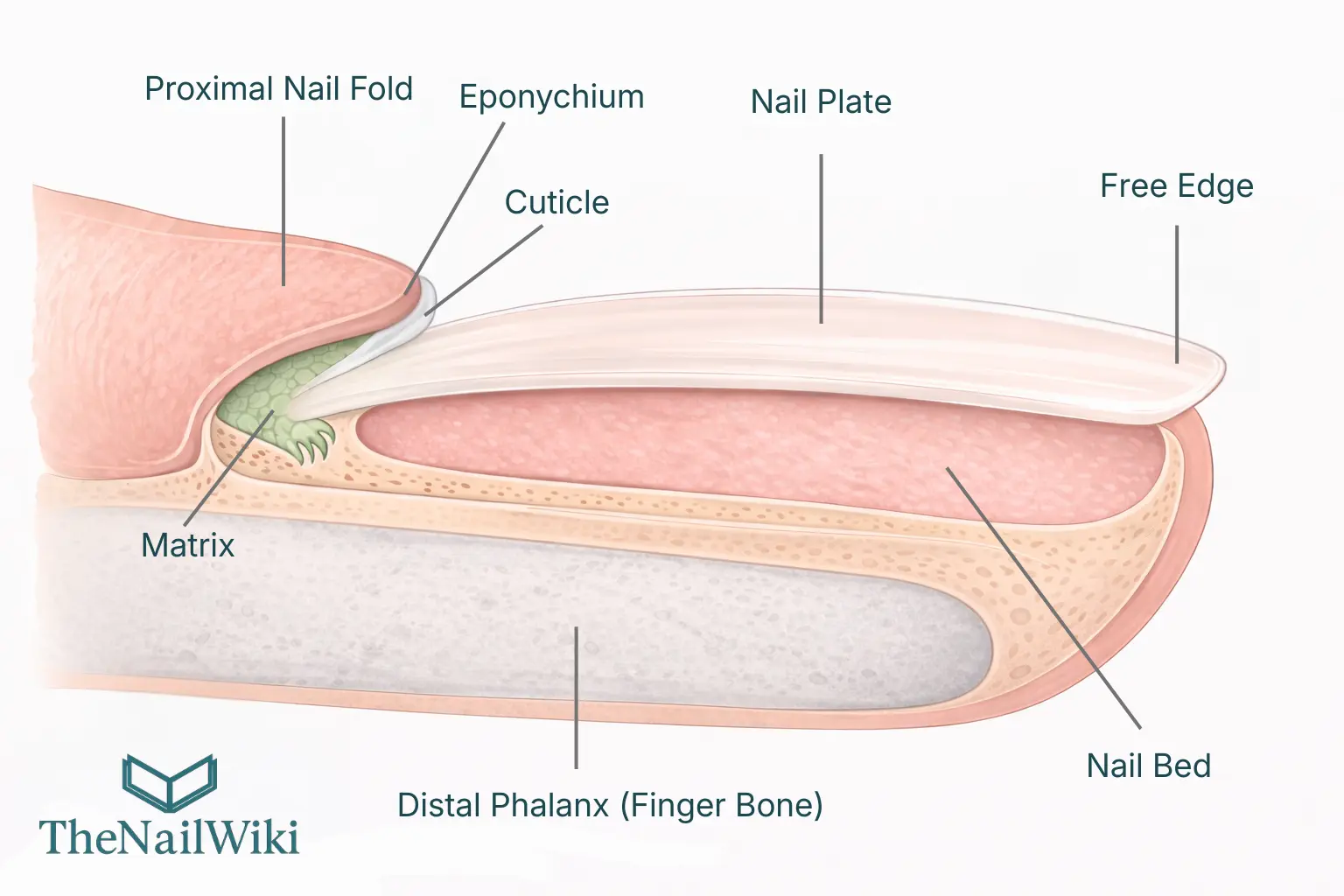
The proximal nail fold is the visible fold of skin at the base of the nail. It is the skin that overlaps the nail plate — the soft tissue you can see sitting above the nail at the base of each finger. It is made of ordinary skin: living epidermis and dermis, with a blood supply and nerve endings.
The proximal nail fold serves a protective function — it forms a physical barrier over the nail matrix beneath, shielding the matrix from trauma, pathogens, and environmental exposure. Because the matrix is the structure that produces the nail plate, any damage to the proximal nail fold that disrupts the matrix beneath it can affect nail growth.
The proximal nail fold is living tissue and must not be cut in routine nail preparation. Cutting or aggressively pushing back the proximal nail fold risks bleeding, infection, and — because the matrix lies directly beneath — potential permanent disruption of nail plate production.
The Eponychium
The eponychium is the living skin at the very lower edge of the proximal nail fold — the point where the fold’s underside meets the surface of the nail plate. It is a continuation of the proximal nail fold skin, not a separate organ, but it occupies a specific and important position in the nail unit.
The eponychium forms a seal between the proximal nail fold and the nail plate. This seal is the body’s barrier against pathogens and debris entering the space beneath the fold where the nail matrix is located. When this seal is intact, it protects the matrix from external contamination. When it is broken — through cutting, aggressive pushing, or chronic mechanical disruption — that barrier is compromised and infection risk increases.
The eponychium is living tissue with a blood supply and nerve endings. Understanding its anatomy — what it is, what it seals, and what lies beneath it — is what allows a professional to work on it with skill and intention rather than without awareness of what they are doing. Informed professionals make better decisions about technique, tools, and the results they deliver to clients.
In European nail techniques and Russian manicure, working on the eponychium is standard, accepted, and expected practice. When a professional understands the anatomy of this zone thoroughly, they can work on it with precision — knowing exactly what they are doing and why. How a professional chooses to approach the eponychium in their practice is their own informed decision to make.
In professional nail education, the eponychium is sometimes referred to informally as the “living cuticle” — a term that helps distinguish it from the true cuticle (which is non-living) but is not standard anatomical terminology. The correct term is simply: the eponychium. Read more about how the eponychium is worked on in advanced practice: Russian Manicure →
The True Cuticle
The true cuticle — sometimes called the cuticle proper or the nail cuticle — is a thin layer of non-living, keratinised tissue that is shed from the underside of the proximal nail fold onto the surface of the nail plate. As the nail plate grows forward from the matrix and emerges from beneath the fold, it carries this layer of shed tissue with it, deposited onto the plate surface at the point where it exits from under the fold.
The true cuticle is translucent and thin. On nails that have not been recently prepared, it appears as the slightly whitish, slightly ragged film that adheres to the nail plate just beyond the base of the fold — it is the tissue that peels away when the nail plate is soaked and gently worked. It has no nerve supply and no blood supply. It is shed, non-living tissue.
It is worth noting that on many clients the true cuticle is almost invisible — particularly to a beginner or an untrained eye. It appears as a faint, barely-there film on the plate surface rather than a clearly defined layer. This is one of the reasons that manual preparation frequently leaves cuticle residue behind even when the technician believes the nail plate is clean. What appears to be a prepared nail may still have a thin layer of non-living cuticle tissue adhered to the plate surface — and product applied over it will not bond to the plate directly, increasing the risk of proximal lifting.
What the true cuticle actually does
The true cuticle forms a secondary seal between the underside of the proximal nail fold and the nail plate surface. As the plate grows forward, this seal of non-living tissue moves with it, closing off the narrow gap at the fold-to-plate junction and preventing the entry of debris and pathogens into the space beneath the fold. It is a passive, structural barrier — but a functional one.
Because the true cuticle is non-living tissue adhered to the plate surface, it can be safely removed from the nail plate during professional preparation without causing bleeding or damage to living structures — provided the removal is confined to the non-living tissue on the plate surface and does not extend to the living eponychium at the fold edge.
In practice, the true cuticle is what is removed during a professional manicure cuticle treatment. The problem arises when the term “cuticle removal” is applied loosely to include the eponychium — because removing living tissue is a fundamentally different action with fundamentally different risks.
Why the Distinction Matters in Practice
The distinction between the eponychium and the true cuticle is not academic — it has direct consequences for how preparation is performed, what risks are created, and how professionals communicate with clients and with each other.
In nail preparation
The true cuticle — non-living tissue on the plate surface — can be removed as part of professional preparation. Its removal is appropriate because it represents a dead cell layer adhered to the nail plate that, if left in place, prevents nail product from bonding directly to the plate and can lift product prematurely. Removing it improves adhesion without risk to living tissue.
How a professional approaches the eponychium during preparation is a matter of their training, technique, and the service they are delivering. Understanding what the eponychium is — and what lies beneath it — is what allows that work to be performed with skill and intention.
In professional terminology
Using correct terminology in client records, within a salon team, and in any educational context matters for professional credibility and for accurate communication. Describing a procedure as “cuticle removal” when the true cuticle is being removed is accurate. Using the same term when the living eponychium is being cut describes a different — and riskier — action with the same words. Precision in terminology reflects precision in practice.
Skin Contact and Sensitisation Risk
Sensitisation is an immune response that develops through repeated skin exposure to certain chemicals — in the nail industry, this primarily concerns acrylate chemistry found in gel and acrylic systems. Once sensitised, the immune system treats the chemical as a threat and subsequent exposures trigger an allergic reaction. This reaction is irreversible. It is worth noting that Russian manicure and European dry manicure techniques have been practised for decades with no widespread sensitisation problems — the preparation technique itself is not the issue.
The sensitisation risk in nail services comes specifically from uncured or partially cured acrylate product making repeated contact with living skin — not from e-file preparation work on the eponychium. A correctly prepared nail where product is applied cleanly, cured fully, and kept off the living skin of the proximal fold does not present the same risk as product that is habitually flooded onto the surrounding skin and left to cure in contact with it.
No-contact placement — a product safety protocol
Keeping nail product off the living skin of the proximal fold is a sensitisation risk reduction measure that applies to product application — not to preparation technique. A small, consistent gap between the product edge and the skin prevents uncured acrylate chemistry from being deposited onto skin that can absorb it. This applies to gel polish, builder gel, acrylic, and any other acrylate-based system, regardless of the preparation method used.
Thorough removal of the true cuticle from the nail plate surface before product application is also relevant here — not because the cuticle itself creates sensitisation risk, but because residual cuticle on the plate can cause product to lift at the proximal edge and migrate onto the surrounding skin during wear. Clean preparation supports clean application. Read more: Contact Sensitisation and Nail Allergies →
Professional Nail Preparation at the Cuticle Zone
The goal of professional preparation at the proximal nail fold area is to remove the true cuticle from the nail plate surface and achieve a clean, defined nail plate boundary. There are two main approaches — wet preparation and dry e-file preparation — and both are legitimate professional methods. They differ significantly in the quality of result they can deliver.
Wet preparation (traditional manicure)
In wet preparation, a cuticle remover product is applied or the fingertips are soaked to soften the tissue at the proximal zone. The true cuticle, once softened, is loosened from the plate surface using a cuticle pusher or orange stick and excess tissue at the fold edge is nipped away with cuticle nippers. This is a widely used and accepted method across the industry.
The limitation of manual wet preparation is that the true cuticle — often near-invisible even on a prepared nail — is rarely removed completely. A thin film of non-living cuticle tissue almost always remains adhered to the plate surface after manual preparation, whether the professional is aware of it or not. Product applied over this residue cannot bond to the plate directly, and this is a primary contributor to proximal lifting in gel and enhancement services.
Dry preparation (e-file / Russian manicure)
In dry e-file preparation — the method used in Russian manicure and European dry manicure technique — the true cuticle is removed from the plate surface using a fine, appropriate bit at a controlled speed and angle, without water or soaking. Because the e-file works mechanically on the plate surface rather than relying on softening and manual removal, it removes the true cuticle far more completely than manual methods can achieve — including the near-invisible residue that wet preparation leaves behind.
In European nail techniques, working on the eponychium with an e-file is a standard and accepted part of advanced preparation. The eponychium is opened and pushed back first to expose the proximal zone fully, the true cuticle is then removed from the nail plate surface, and the eponychium itself can then be fully exfoliated — as can the surrounding skin around the entire nail perimeter. This level of exfoliation and refinement is simply not achievable with manual preparation, and it is one of the results clients notice most immediately. When performed by a trained professional with correct technique, it produces a level of precision and cleanliness at the proximal zone — and a corresponding improvement in product adhesion and longevity — that manual preparation simply cannot match.
Both preparation methods are valid professional choices, and every professional can decide how they want to work. The difference is in the standard of result achievable — and the premium that standard can command. Manual wet preparation cannot deliver the same depth of cuticle removal, the same precision at the proximal zone, or the same product longevity as e-file dry preparation. A professional working with manual prep alone is not in a position to deliver — or charge for — the same quality of service as one working with a correctly used e-file. E-file dry manicure and Russian manicure technique represent the direction the nail industry is moving, and the gap in results speaks for itself.
Read more: E-File Manicure → | Russian Manicure →
Professional training
Both wet and dry preparation techniques — including the anatomy underpinning each — are covered in professional masterclasses at Artistic Touch Nail Training Academy.
Common Misconceptions
❌ “The cuticle and the eponychium are the same thing”
They are not. The cuticle is non-living tissue shed onto the nail plate surface. The eponychium is the living skin at the lower edge of the proximal nail fold. They sit adjacent to each other and are often treated as a single zone during nail preparation — but they are anatomically and functionally distinct, and treating them as identical has practical safety implications.
❌ “Cutting the eponychium is always wrong”
This is not an accurate position. In European nail techniques and Russian manicure, working on the eponychium is standard professional practice. The difference between good work and poor work in this zone is anatomy knowledge, correct tools, and trained technique — not avoidance. A professional who understands the structures they are working on can make informed decisions about how to approach the proximal zone in their own practice.
❌ “The proximal nail fold is the cuticle”
The proximal nail fold is the visible skin fold at the base of the nail. The cuticle is the non-living tissue on the plate surface that is shed from the underside of that fold. The fold itself is not the cuticle — it is the structure from which the cuticle originates.
❌ “Cuticle oil nourishes the cuticle”
The true cuticle is non-living tissue — it cannot be nourished because it has no biological activity. Cuticle oil applied to the proximal nail fold area benefits the living skin of the eponychium and the proximal fold, keeping it supple and reducing dryness and splitting. It also benefits the nail plate itself. The marketing term “cuticle oil” is widely used, but what the oil actually conditions is the living skin and the plate — not the non-living cuticle tissue.
Frequently Asked Questions
What is the cuticle actually made of?
The true cuticle is a thin layer of keratinised, non-living epithelial cells shed from the underside of the proximal nail fold. It has no blood supply and no nerve supply — it is the same type of tissue as dead skin cells shed from the surface of normal skin.
Is it safe to remove the cuticle?
Removing the true cuticle — the non-living tissue on the nail plate surface — is safe and is standard professional practice. The risk arises when the procedure extends beyond the non-living tissue into the living eponychium. Correct technique keeps preparation confined to the non-living tissue on the plate surface.
Why does the cuticle grow back after removal?
The true cuticle is continuously produced by the underside of the proximal nail fold as the nail plate grows forward beneath it. Removing it does not prevent further production — it simply removes the accumulated non-living tissue already deposited onto the plate surface. New cuticle tissue is deposited continuously as the nail grows.
What happens if the eponychium is damaged?
Damaging the eponychium breaks the seal between the proximal nail fold and the nail plate surface. This opens a route for bacteria and fungi to enter the space beneath the fold where the nail matrix is located. Repeated damage can lead to infection, inflammation, and potentially disrupt normal nail plate production if the matrix is affected.
Why does gel product lift at the base of the nail?
Proximal lifting — product lifting at the cuticle end of the nail — is frequently caused by residual true cuticle on the nail plate surface that was not fully removed during preparation. Product cannot bond to non-living cuticle tissue in the same way it bonds to the nail plate itself — the cuticle acts as a barrier between product and plate, and as it gradually separates from the plate during normal wear, it carries the product with it. Thorough removal of the true cuticle from the plate surface is the primary prevention for this type of lifting.
Should cuticle oil be applied before or after nail product?
Cuticle oil should always be applied after nail product — never before. Any oil or moisture on the nail plate surface before product application will compromise adhesion. Applied after the service is complete, cuticle oil benefits the living skin of the proximal fold and eponychium and improves the flexibility and condition of the nail plate. Regular use between appointments supports the overall health of the nail unit.
Related Library Pages
Nail Anatomy
- → The Nail Matrix
- → The Nail Plate
- → The Nail Bed
- → The Lateral Nail Folds
- → The Hyponychium
- → The Lunula
Professional Safety
Techniques
Some linked pages are currently in development and will be published progressively.
Professional Disclaimer
The information on this page is provided for educational purposes and is intended to support the professional knowledge of nail technicians and nail educators. Any client presenting with signs of infection, inflammation, or structural nail changes should be referred to a qualified medical professional for assessment.
About the Author
Radina Ignatova
Professional Nail Expert since 2014 | International Nail Educator | Founder of TheNailWiki and Artistic Touch Nail Training Academy
Radina Ignatova is a Professional Nail Expert since 2014 and an International Nail Educator specialising in dual forms, gel systems, polygel application, advanced nail structure, E-File techniques and professional salon safety.
She founded TheNailWiki to provide clear, safety-led nail education accessible to everyone, and Artistic Touch Nail Training Academy to deliver structured professional online nail courses.
Her teaching philosophy is centred on honest education — demonstrating real salon challenges, practical corrections and performance-based techniques rather than presenting only polished results.
Based in Scotland, UK, Radina contributes to advancing professional standards within the nail industry through structured educational resources and technical training.
Read full bio →About TheNailWiki
TheNailWiki is an independent educational platform dedicated to providing accurate, safety-led and professionally informed nail care information to professionals and enthusiasts worldwide. All content is created by qualified nail industry professionals and reviewed for technical accuracy.
For structured professional training, advanced masterclasses, and specialist technique courses, visit Artistic Touch Nail Training Academy.
This library page is published by TheNailWiki — an independent nail education resource maintained by nail industry professionals. Content is safety-led and professionally informed.