
E-File Bits: A Complete Professional Guide to Nail Drill Bits
Author: Radina Ignatova, Professional Nail Expert & International Nail Educator | Last Updated: April 2026
Quick Answer: An e-file bit is the interchangeable attachment that fits into the handpiece of an e-file machine and determines what the machine actually does to the nail surface. The machine provides the rotation — the bit determines the function. There are four main material categories used in professional nail services: carbide, ceramic, diamond, and mandrel bits with sanding bands. Each has a different mechanism, different applications, and different hygiene requirements. Choosing the correct bit for each task is as important as choosing the correct speed.
Quick Summary
Bits are not interchangeable across tasks. A bit designed for cuticle work used on hard acrylic product will not perform effectively and may cause heat. A removal bit used on the natural nail surface will cause damage. Understanding which bit type, grit, and shape is appropriate for each task — and in which direction to rotate it — is the technical foundation of safe e-file practice.
Bit hygiene is non-negotiable. Reusable metal bits must be sterilised between every client. Sanding bands are single-use and must be discarded after each client without exception. Using unsterilised bits or reusing disposable bands is a cross-contamination risk and a serious professional and legal failing.
Contents
How E-File Bits Work
An e-file bit attaches to the handpiece via a standard shank — the cylindrical shaft that slides into the handpiece chuck and is secured by the chuck mechanism. The vast majority of professional nail e-file bits use a 3/32 inch (2.35mm) shank diameter, which is the professional nail industry standard.
When the machine runs, the bit rotates. The active surface of the bit — whether that is cutting edges on a carbide bit, an abrasive coating on a diamond or ceramic bit, or an abrasive band on a mandrel — contacts the nail surface or product and removes material through cutting or abrasion. The rate of material removal is determined by the bit type, the grit, the speed (RPM), and the pressure applied.
Rotation direction matters. Because bits have directional cutting surfaces, the direction of rotation relative to the direction of movement across the nail determines whether the bit cuts cleanly and pushes debris away from tissue, or grabs and pushes material into the skin. Correct rotation direction for each task is part of e-file technique training — it is not something that can be determined by looking at the bit alone.
© TheNailWiki
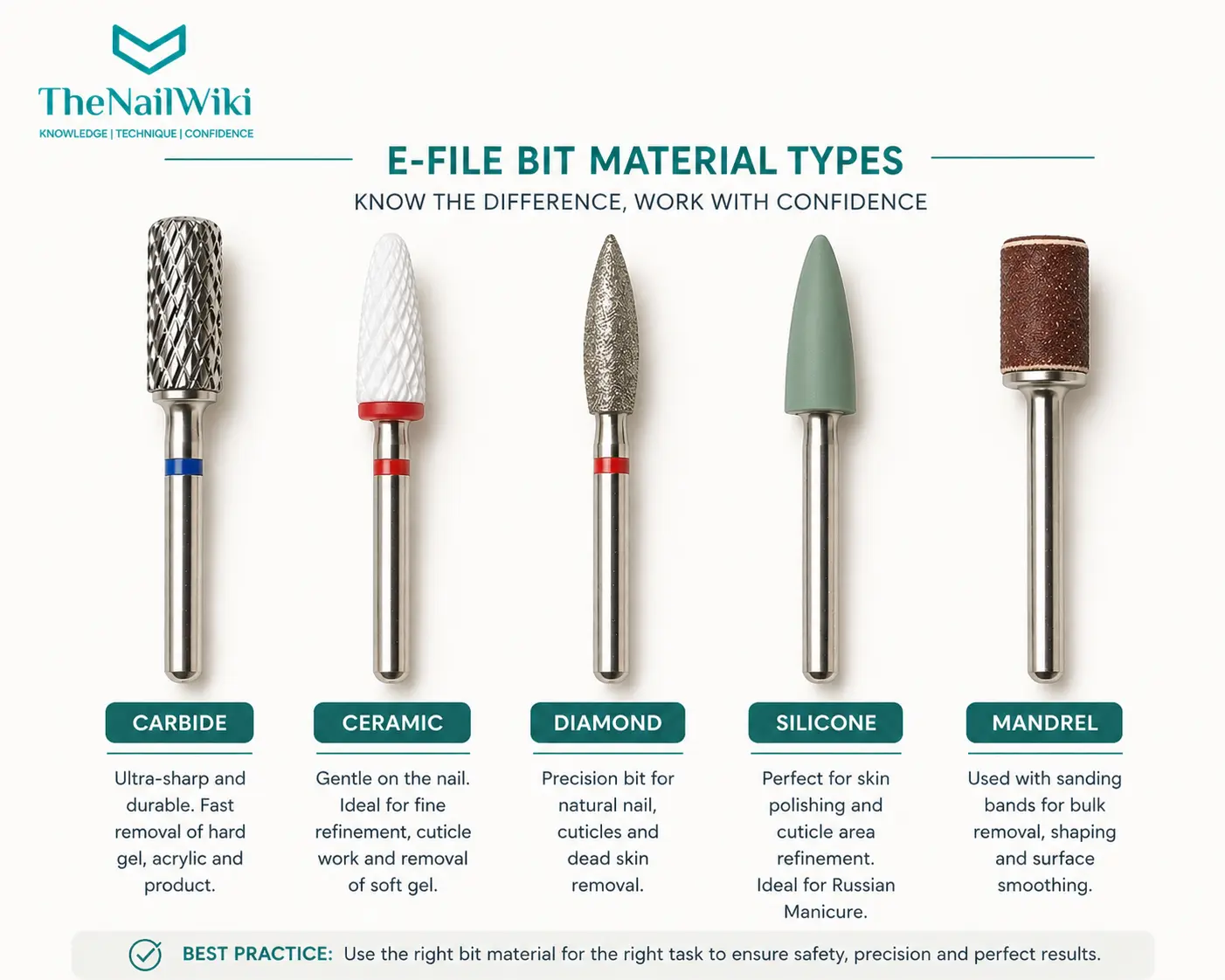
Carbide Bits
Carbide bits are precision cutting tools machined from tungsten carbide — an extremely hard metallic compound. They have precisely cut flutes (grooves) along their surface that act as cutting edges. When rotated at the correct speed and direction, carbide bits cut cleanly and efficiently through hard nail products, removing material in controlled chips rather than abrading it.
Carbide bits are used exclusively on top of hard nail products — gels, acrylics, builder gels, and enhancements — for shaping, refining, and bulk removal. They are never used directly on the natural nail surface or on skin. The aggressive cutting action of a carbide bit on natural nail plate or skin causes irreversible damage. The flute count and cut angle determine how aggressively the bit cuts — coarser cuts for bulk product removal, finer cuts for surface refinement and finishing on product.
Carbide bits generate less heat than abrasive bits because the cutting action is efficient. They must be kept clean and free of debris buildup in the flutes — clogged flutes reduce cutting efficiency and increase heat generation.
For the complete guide to carbide bits — flute counts, cut angles, shapes, and specific applications: Carbide Bits →
Ceramic Bits
Ceramic bits have an abrasive ceramic coating rather than machined cutting edges. The ceramic material is significantly harder than most nail products but produces less friction heat than carbide when working on product surfaces — making ceramic bits a popular choice for clients with heat-sensitive nails or for services where heat management is a priority.
Ceramic bits work through abrasion rather than cutting — they wear material away gradually rather than removing it in chips. Like carbide bits, ceramic bits are used exclusively on top of hard nail products — gels, acrylics, and builder gels — for product shaping, refinement, and removal. They are never used directly on the natural nail surface or on skin. The lower heat generation compared to carbide makes them the preferred choice for heat-sensitive clients when working on product.
The ceramic coating wears over time and ceramic bits lose effectiveness as the abrasive surface degrades. Ceramic bits are replaced when worn — they cannot be resharpened.
For the complete guide to ceramic bits — abrasive grades, shapes, uses, and how they compare to carbide: Ceramic Bits →
Diamond Bits
Diamond bits are coated with industrial diamond particles bonded to the metal shank — diamond being the hardest known material, making these bits exceptionally durable abrasive tools. They work through abrasion and are the most widely used bit type in Russian manicure and e-file manicure services — the tool of choice for all skin work around the nail.
Diamond bits are used for skin exfoliation, smoothing the skin of the lateral folds and surrounding area, softening the skin at the base of the nail, gentle cuticle area work, and general skin refinement throughout the manicure service. Fine-grit diamond bits used at the correct low speed on skin produce a smooth, refined finish that is the hallmark of professional Russian and e-file manicure results. They are not used for product removal — carbide bits or sanding bands are appropriate for that purpose.
Diamond bits come in a wide range of grits. For professional nail and e-file manicure services, fine and ultra-fine grits are the most relevant. Coarser grits are used in podiatry and foot care for callus work. The grit colour coding system — described in the grit section below — is particularly important for diamond bits given the range available.
For the complete guide to diamond bits — grits, shapes, and skin versus product applications: Diamond Bits →
Silicone Bits
Silicone bits are the gentlest e-file bit type — they do not cut and do not abrade in the way that carbide, ceramic, or diamond bits do. Made from flexible medical-grade silicone, they work by buffing and polishing the surface they contact rather than removing material.
In professional nail services, silicone bits are used primarily for skin polishing — smoothing and refining the skin around the nail as part of a Russian manicure or e-file manicure finishing sequence. They are excellent for polishing the cuticle area and surrounding skin to a clean, refined finish after diamond bit work — they do not leave the skin dry or rough and the silicone flexibility means they follow the contours of the skin rather than sitting rigidly against it.
Silicone bits are also used for working cuticle oil into the skin during finishing. They are not used on the natural nail plate to create shine — that is achieved through buffing with appropriate nail buffers, not through e-file work. Used at low speed on skin, silicone bits produce a smooth, polished skin finish that is a hallmark of a well-executed Russian manicure result.
Silicone bits must still be sanitised and sterilised between clients in the same way as all other reusable metal-shanked bits.
For the complete guide to silicone bits — shapes, applications, and how they compare to diamond bits for skin work: Silicone Bits →
Mandrel Bits & Sanding Bands
A mandrel bit is a reusable cylindrical metal shank that holds a disposable sanding band — a small abrasive sleeve that slides over the mandrel and is secured in place for use. The sanding band is the working surface; the mandrel is simply the carrier that attaches it to the handpiece.
Sanding bands are available in different grits and are used for product removal, natural nail surface preparation with caution, and pedicure work including callus exfoliation. Coarse bands remove bulk product quickly during enhancement removal. Medium bands refine the surface after bulk removal. Fine bands are used for gentler tasks — including careful natural nail surface preparation and gentle skin exfoliation in pedicure services. When used on the natural nail or skin, minimal pressure and the correct speed are essential — sanding bands on natural nail without proper technique causes thinning and damage.
⚠️ Sanding bands are single-use — no exceptions
A sanding band used on one client must be discarded immediately after that service. It must never be used on another client, cleaned and reused, or sterilised for reuse. The porous abrasive surface of a sanding band cannot be adequately sterilised and reuse is a direct cross-contamination risk. The mandrel itself is reusable and must be sterilised between clients. A fresh sanding band for every client, every time — without exception.
For the complete guide to mandrel bits and sanding bands — sizes, grits, fitting, and correct use: Mandrel Bits & Sanding Bands →
Bit Shapes and What They Are Used For
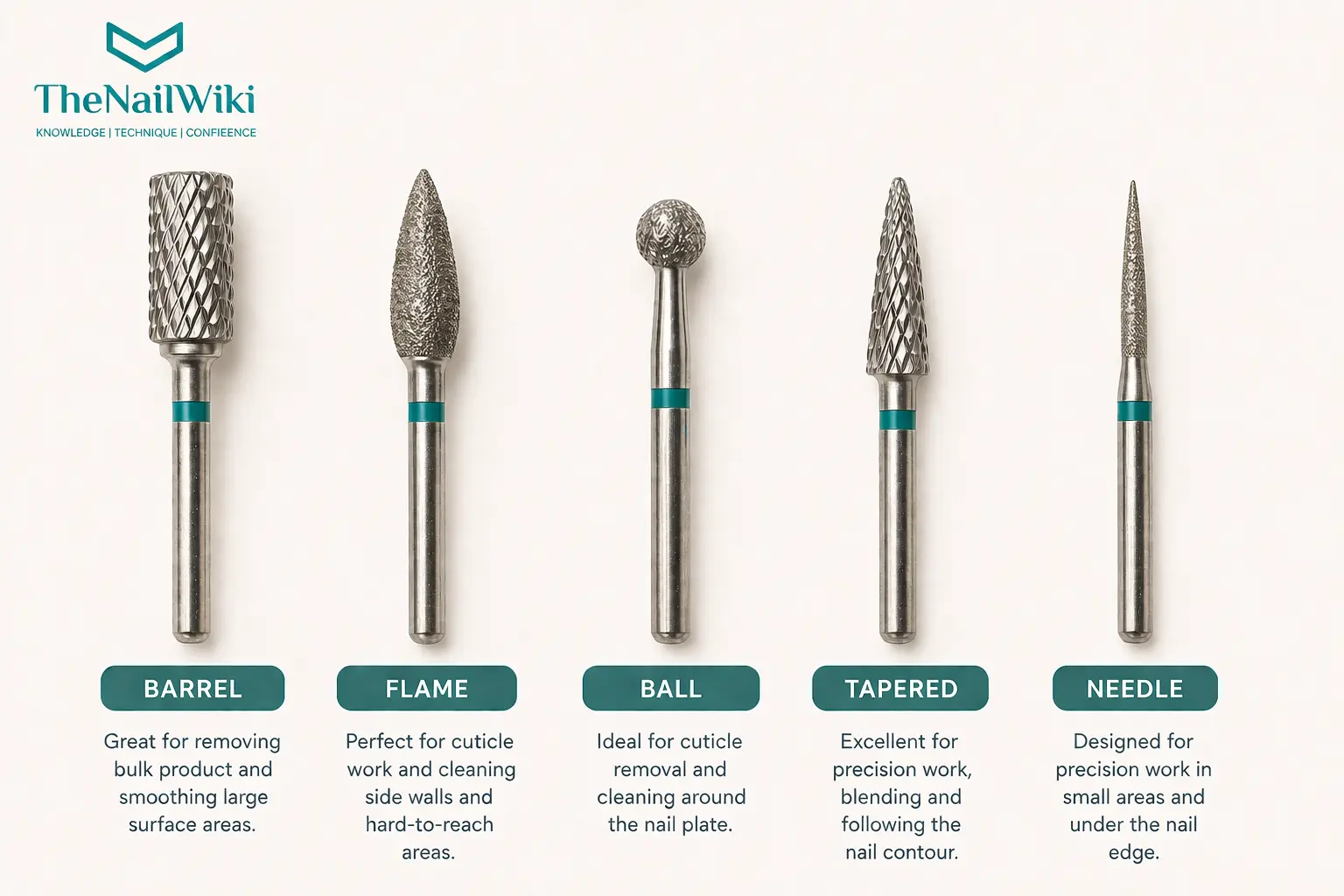
Bit shape determines which areas of the nail and surrounding skin the bit can reach and how it makes contact with the surface. The same material (carbide, ceramic, diamond) is available in multiple shapes — each suited to a different application.
© TheNailWiki
Grit — Coarse, Medium and Fine
Grit refers to how aggressively a bit removes material — the coarser the grit, the more material removed per pass. In e-file bits, grit is particularly relevant for diamond bits and sanding bands. For carbide and ceramic bits it is used more loosely, referring to the cut density or flute count rather than a standardised grit number.
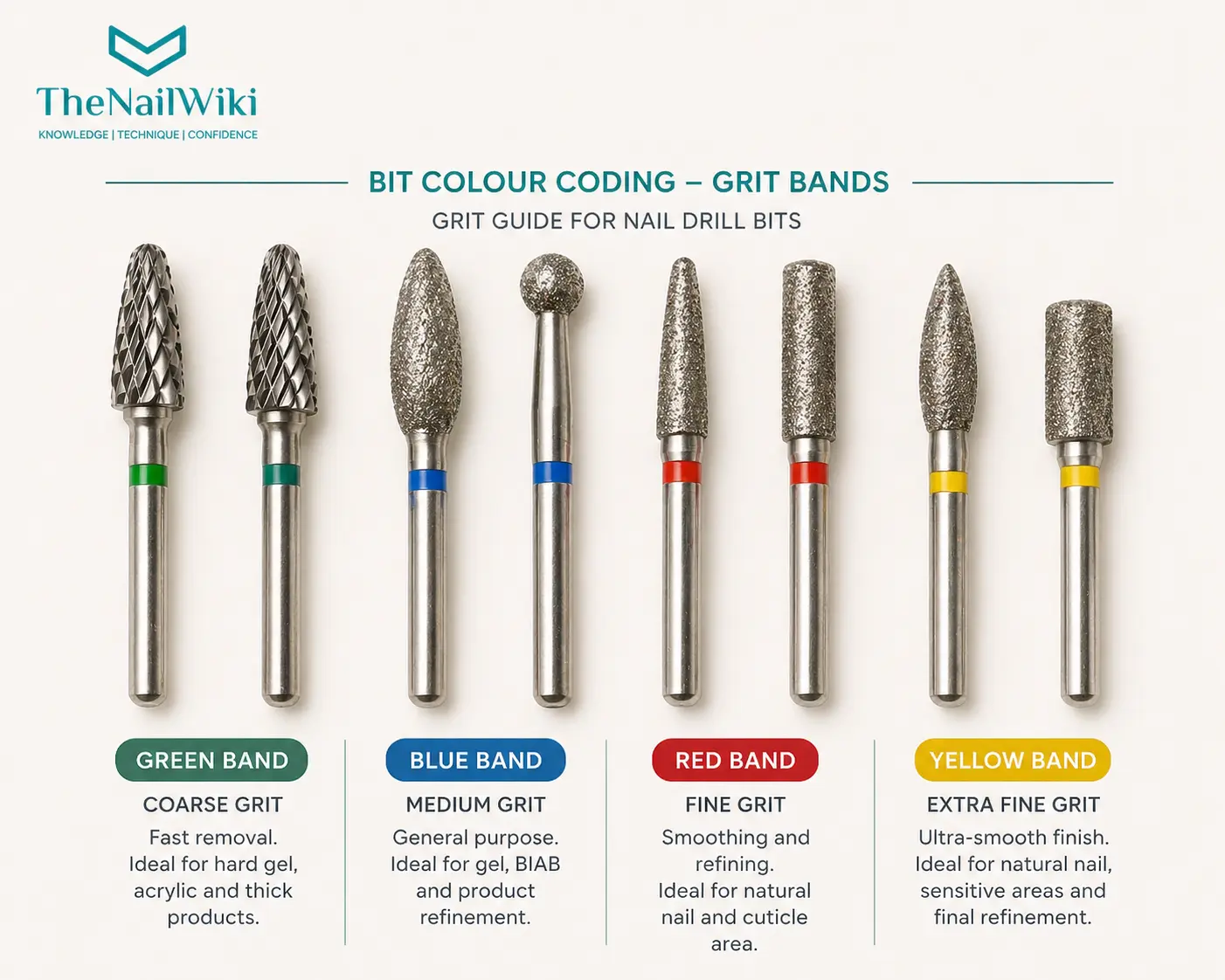
Colour coding — the industry standard for identifying grit
Most professional e-file bit manufacturers use a colour band on the bit shank to indicate the grit level. This system is widely used across the industry and allows quick visual identification during a service. The main colours and what they represent:
- Green — Coarse: Heavy-duty bulk removal of hard gel or acrylic. Never used on natural nail or skin
- Blue — Medium: Versatile — general shaping and refining of enhancements and hard products
- Red — Fine: Detailed work, surface smoothing on product, and cautious natural nail preparation
- Yellow — Extra Fine: Final finishing, gentle surface polishing, and very delicate skin work
Other colour variations exist — purple, combinations of blue and red, white, and others — depending on the manufacturer. These typically represent intermediate grits or manufacturer-specific categories. The four colours above are the most widely used standard. Always check the specific manufacturer’s grit guide for the bit range in use, as colour coding can vary between brands.
© TheNailWiki
Bit Hygiene and Sterilisation
Bit hygiene is one of the most critical safety responsibilities in e-file work. Bits contact the client’s nail plate, skin, and sometimes soft tissue — any cross-contamination between clients carries risk of transmitting bacterial, fungal, or viral infections.
Metal bits — carbide, ceramic, diamond
Reusable metal bits must go through a full decontamination process between every client — no exceptions. The three required stages are:
- Manual cleaning — remove all visible debris, product residue, skin particles, and dust from the bit surface. For carbide bits, clean the flutes thoroughly using a dedicated bit-cleaning brush under running water. An ultrasonic cleaner is highly effective at dislodging debris from flutes and surface textures and is the professional standard for thorough pre-sterilisation cleaning. This step must be done before any chemical or heat sterilisation — debris protects microorganisms from sterilisation agents.
- Sanitisation — reduces the microbial load on the surface. This is not the same as sterilisation and does not meet the full professional standard on its own.
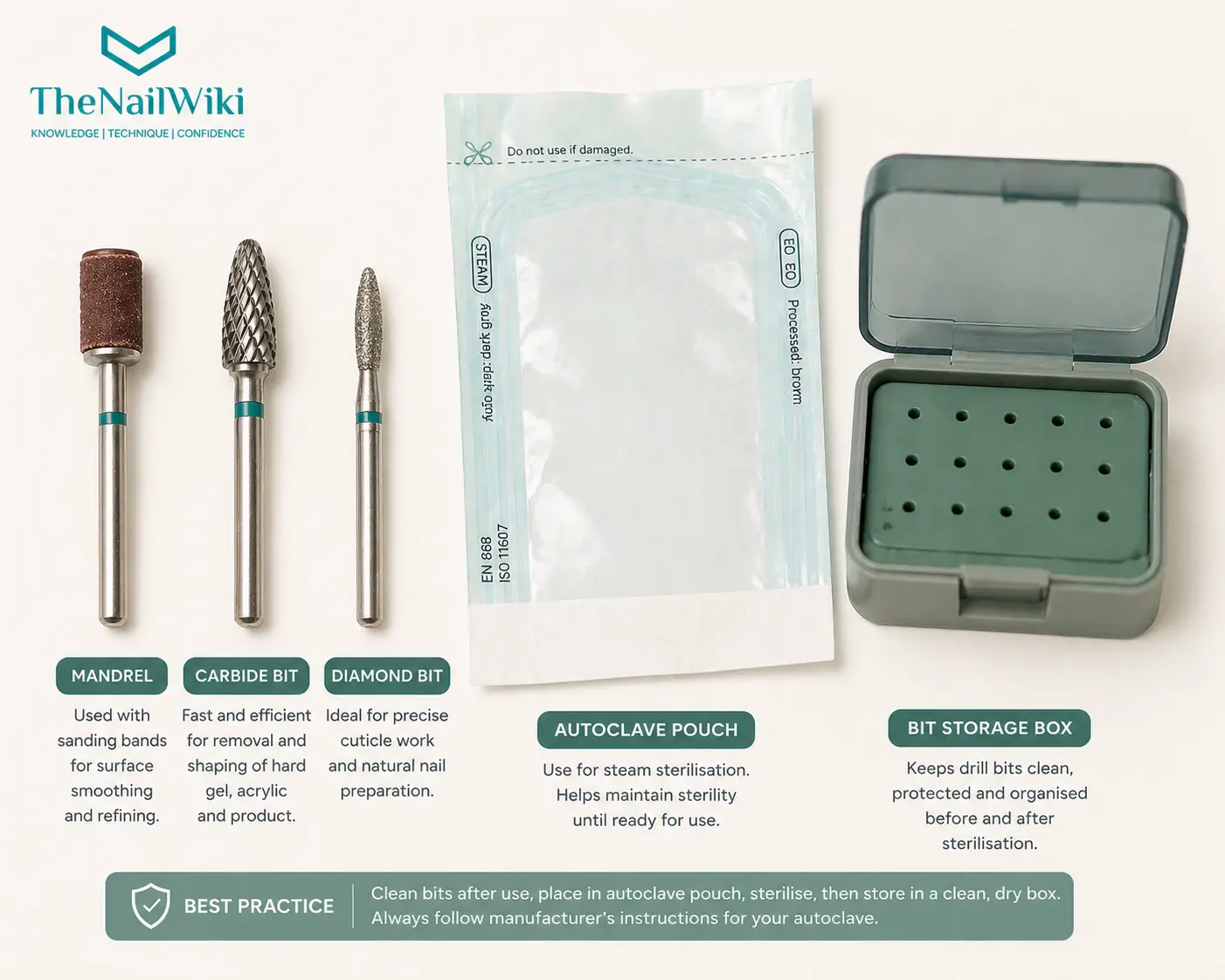
- Sterilisation — eliminates all microorganisms including bacterial spores. Autoclave sterilisation or a validated heat steriliser is the gold standard. Approved hospital-grade chemical sterilisation is an acceptable alternative where heat sterilisation is not available. Disposable sterilisation pouches can be used for individual bit storage after autoclaving, protecting them from recontamination until the next use.
Storage after sterilisation
Sterilised bits must be stored in a way that prevents recontamination before use. Options include sealed autoclave pouches (each bit individually pouched), a clean closed container or drawer dedicated to sterilised tools, or a covered bit holder that protects the bits from environmental exposure. Bits left loose on the workstation or in an open container after sterilisation are no longer considered sterile.
© TheNailWiki
Sanding bands — single use only
Sanding bands are porous, fibrous, disposable items. They cannot be adequately cleaned or sterilised. They must be used once and discarded — this is not a recommendation, it is a hygiene and professional standard. Using a sanding band on more than one client is a cross-contamination risk regardless of any cleaning or disinfection attempted between uses.
Every client — every time — fresh sanding band. This applies without exception. If a sanding band has been fitted to the mandrel and any contact has been made with it — even brief contact with a surface — it is used. Replace it before the next client.
Choosing the Right Bit for Each Task
These are professional starting points — specific bit selections vary by product system, client nail type, and individual technique. Always cross-reference with your training and the guidance relevant to your specific service protocol.
Frequently Asked Questions
What is the difference between carbide, ceramic and diamond bits?
Carbide and ceramic bits are used exclusively on top of hard nail products — gels, acrylics, enhancements — for shaping, refining, and removal. They must never be used on skin or natural nail. Diamond bits are used for skin work — exfoliation, cuticle area, smoothing the skin around the nail. Diamond bits are the most widely used in Russian manicure and e-file manicure services. Each type has specific applications and they are not interchangeable.
Can sanding bands be cleaned and reused?
No — sanding bands are single-use disposable items. They cannot be adequately cleaned or sterilised and must be discarded after use on one client. Reusing a sanding band is a cross-contamination risk regardless of any cleaning attempted. The mandrel itself is reusable and must be sterilised between clients.
How do I clean carbide bits between clients?
Remove visible debris from the flutes using a dedicated bit-cleaning brush under running water or in an ultrasonic cleaner. Follow with disinfection and autoclave sterilisation or an approved chemical sterilisation process. The bit must go through all three stages — cleaning, disinfection, and sterilisation — not just one.
Why does rotation direction matter?
E-file bits have directional cutting surfaces. The correct rotation direction relative to the direction of movement ensures the bit cuts cleanly and pushes debris away from the skin. The wrong rotation direction pushes material towards and into the tissue, causing trauma to the eponychium and surrounding skin. Rotation direction is a fundamental part of e-file technique training.
How do I know when a bit needs replacing?
A bit that needs replacing will feel less effective — it takes more passes to achieve the same result, generates more heat than usual, or catches and drags rather than cutting cleanly. Carbide bits with clogged or damaged flutes, ceramic bits with worn coating, and diamond bits with degraded abrasive surface should all be replaced. Never continue using a worn bit by increasing speed or pressure — replace it.
Professional training in e-file technique
Bit selection, speed protocols, rotation direction, and safe e-file technique are covered in full at Artistic Touch Nail Training Academy.
Related Library Pages
Bit Types — Full Guides
Equipment
Services
Safety
Some linked pages are currently in development and will be published progressively.
Professional Disclaimer
The information on this page is provided for educational purposes and is intended to support the professional knowledge of nail technicians and nail educators. E-file services should only be performed by trained professionals. Improper use of e-file bits can cause permanent damage to the nail plate and surrounding tissue.

About the Author
Radina Ignatova
Professional Nail Expert since 2014 | International Nail Educator | Founder of TheNailWiki and Artistic Touch Nail Training Academy
Radina Ignatova is a Professional Nail Expert since 2014 and an International Nail Educator specialising in advanced nail preparation, BIAB, dual form systems, e-file techniques, and professional salon safety. Based in Scotland, UK, she teaches nail technicians internationally through structured online courses.
Read full bio →About TheNailWiki
TheNailWiki is an independent educational platform dedicated to providing accurate, safety-led and professionally informed nail care information to professionals and enthusiasts worldwide.
For structured professional training visit Artistic Touch Nail Training Academy.
This library page is published by TheNailWiki — an independent nail education resource. Content is safety-led and professionally informed.