
Nail Porosity: Permeability of the Nail Plate
Author: Radina Ignatova – Nail Expert, International Nail Educator | Last Updated: July 2026
Quick Answer: Porosity describes how readily water, solvents, and oils can move through the nail plate. It does not mean the plate contains visible holes — it is a property of the keratin structure itself, which is a poor barrier to many substances compared with skin. This is why nails are not waterproof, despite feeling solid: water, acetone, and other solvents pass through the plate constantly, at a rate that depends on the plate’s condition. Porosity is not fixed — damage, over-filing, and dehydration all increase how readily substances move through the plate, which has direct practical consequences for hydration, product removal, and nail preparation.
Contents
- What Porosity Actually Means
- Porosity Is Not Visible
- How Movement Happens: Diffusion
- Water Movement Through the Nail Plate
- Solvent Movement — Acetone and Beyond
- Oil Movement
- Cuticle Oil and Nail Porosity
- Why Porosity Varies
- The Effect of Damage and Over-Filing
- Practical Implications: Adhesion, Removal, and Preparation
- Frequently Asked Questions
What Porosity Actually Means
In materials science, porosity and permeability are closely related but not identical. Porosity describes the structure, while permeability describes how easily substances move through it. In nail science, the term “porosity” is commonly used to describe this overall behaviour — structure and movement together — rather than being applied with strict technical separation.
Porosity is a term borrowed from materials science, and in the context of the nail plate it describes how readily substances can pass through its structure. This is easy to misunderstand as meaning the plate contains visible holes or channels — it does not. Porosity in this sense is a property of the keratin structure itself, arising from how the protein network is organised at a molecular level, not from any visible gaps.
The practical consequence is straightforward, even if the mechanism is not: the nail plate is not a sealed, waterproof barrier. Despite feeling solid and impermeable to the touch, it constantly allows water and other small molecules to pass through it in both directions, at a rate that depends on the plate’s condition and what it is currently exposed to.
Porosity Is Not Visible
A common assumption in professional practice is that a “porous” nail must have microscopic holes, tunnels, or cracks running through it — something that could, in principle, be seen under enough magnification. This is not what porosity means in the nail plate. There are no holes, no tunnels, and no cracks involved in normal porosity.
What actually varies is the molecular organisation of the keratin structure itself — how tightly the protein network is packed and cross-linked. This organisation creates transport pathways at a molecular scale, allowing small molecules like water to move between and through the structure. None of this is visible, even under a microscope in the way a physical hole would be; it is a property of the material, not a feature of its visible surface.
Common Misconception
“Porous nails contain holes.” This is not accurate. Porosity is a property of the keratin structure’s molecular organisation, not a description of physical holes, tunnels, or cracks. A highly porous nail plate can look and feel completely smooth and intact.
How Movement Happens: Diffusion
Water and solvents move through the nail plate primarily by diffusion — moving from areas of higher concentration to areas of lower concentration until a balance is reached. This is why a nail plate exposed to a humid environment gradually absorbs moisture, and why a plate exposed to dry air gradually loses it: the movement follows the concentration difference between the plate and its surroundings.
Water Movement Through the Nail Plate
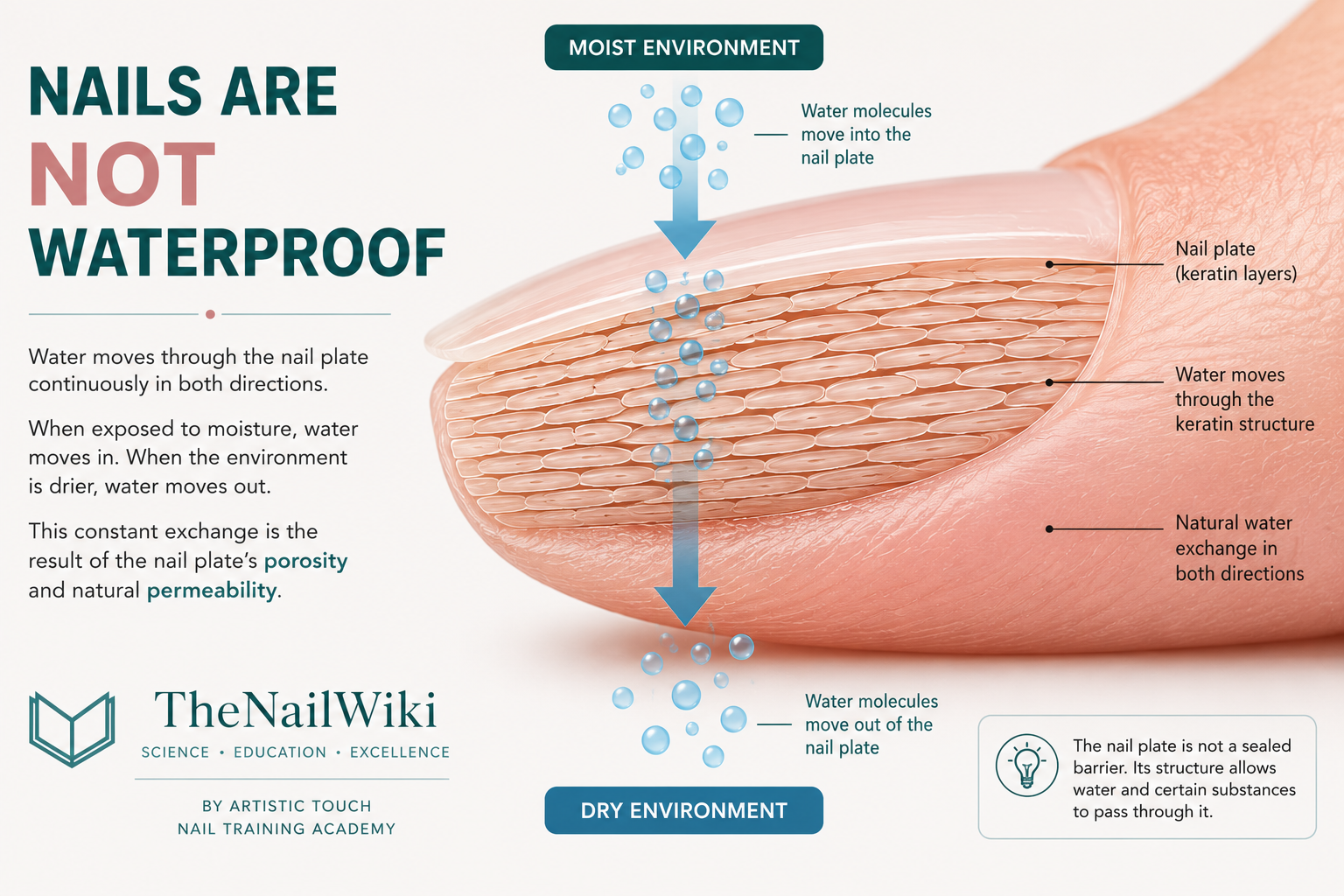
Water moves through the nail plate continuously, in both directions. It moves in when the plate is exposed to a moist environment, and it moves out when the surrounding air is dry — which is why nail plate hydration is not a stable, fixed state but something that shifts throughout the day depending on activity and environment.
© TheNailWiki
This constant exchange is a direct expression of porosity. A more porous plate exchanges water more readily in both directions; a less porous plate holds a more stable water content over time. This connects directly to the hydration behaviour described on the Nail Composition page — porosity is the mechanism that makes that hydration variation possible in the first place.
Solvent Movement — Acetone and Beyond
Because the nail plate’s barrier is keratin-based rather than lipid-based, solvents such as acetone penetrate it more readily than they penetrate skin, where a lipid-rich outer layer provides more resistance. This is the same underlying porosity at work — the plate simply does not resist small solvent molecules the way a lipid barrier would.
Repeated solvent exposure is not without consequence. It can progressively affect the plate’s internal composition over time, contributing to the dryness and brittleness some clients associate with frequent polish removal — a relationship covered in more detail on the Nail Plate page. The key point for this page is that this happens because the plate is porous to solvents in the first place, not because of any flaw or damage.
Oil Movement
Oils move through the nail plate more slowly than water or small solvent molecules, but they are not blocked entirely. Several factors explain why. Oil molecules are typically larger than water or acetone molecules, which makes them slower to move through the same molecular pathways. Oils are also non-polar, whereas the keratin structure and the water pathways within it are more polar in nature — this mismatch limits how readily oil interacts with and moves through that structure, in the same way oil and water resist mixing. The result is that oils tend to interact more with the surface of the keratin than pass efficiently through it.
This is part of the reasoning behind cuticle and nail oils applied around the nail unit — some penetration into the surrounding tissue and plate surface is possible, though the degree of meaningful penetration into the deeper structure of the plate itself is more limited than for water or acetone.
This is a useful distinction for setting realistic client expectations: an oil applied to the nail is not passing through the plate in the same way water or acetone does, and its main practical value is more often at the surface and surrounding skin than as a deep structural treatment.
Cuticle Oil and Nail Porosity
Cuticle oils interact with the nail plate differently from water. Water moves relatively readily through the keratin structure, whereas oils generally penetrate more slowly because of their chemical properties. Regular application of an appropriate cuticle oil can help maintain flexibility and reduce brittleness by supporting the nail’s moisture balance, but it does not make the nail waterproof or permanently alter its porosity.
Why Porosity Varies
Porosity is not identical from client to client, or even from nail to nail on the same person. It is influenced by the plate’s overall condition, its layered structure, its current hydration level, and its history of exposure to solvents, chemicals, and mechanical stress. A well-maintained, undamaged plate generally has more consistent, predictable porosity than one that has experienced repeated damage.
The Effect of Damage and Over-Filing
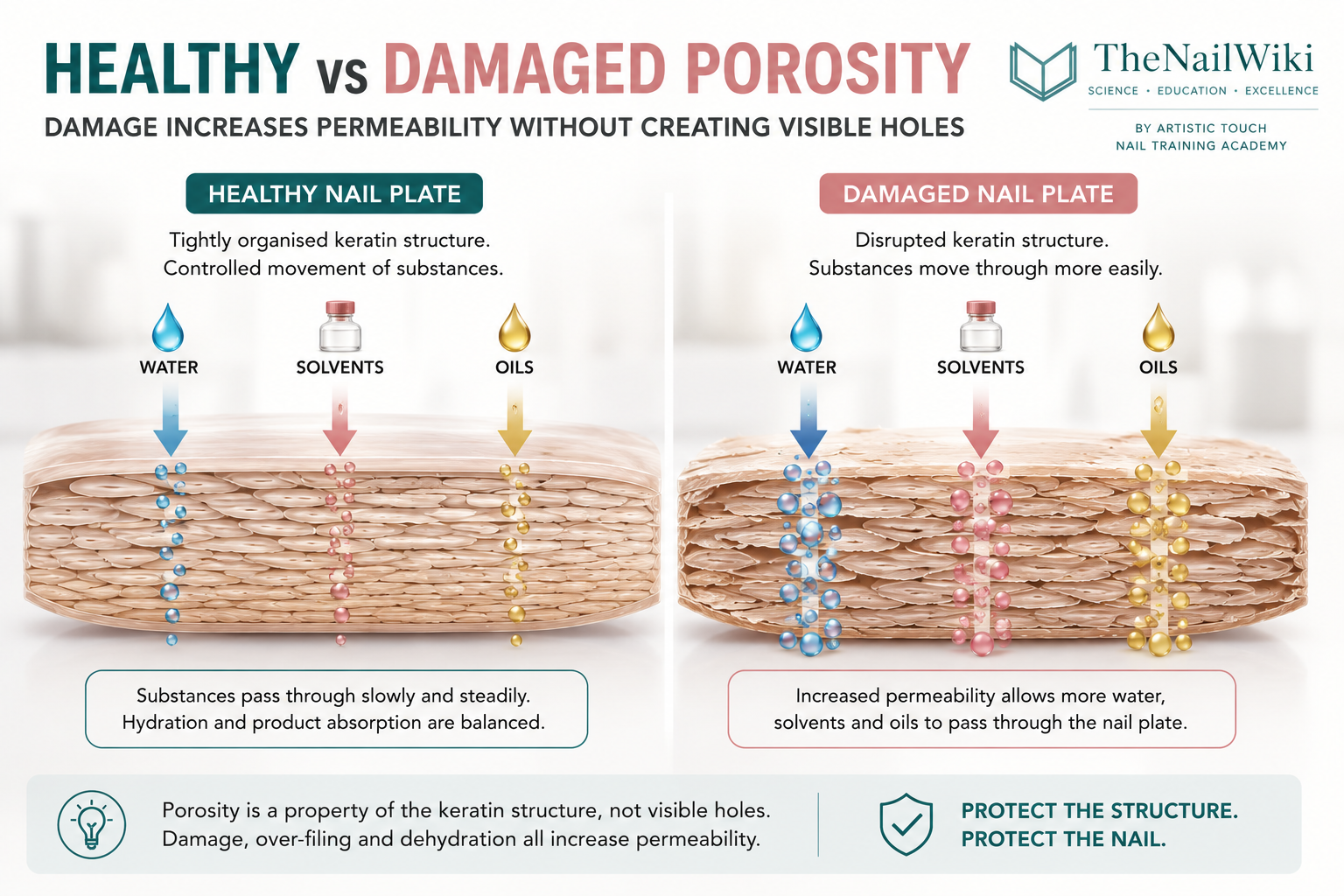
Damage does not just weaken a nail plate mechanically — it also changes its porosity. A plate that has been over-filed, chemically stressed, or otherwise compromised typically becomes more porous, not less. This means damaged nail plates often behave differently to hydration, product, and solvent exposure than healthy ones, which is part of why the same aftercare advice does not always produce the same result for every client.
© TheNailWiki
This is a genuinely useful clinical distinction: increased porosity after damage is not a sign that something new is wrong, but a direct, expected consequence of the structural change that has already occurred.
Practical Implications: Adhesion, Removal, and Preparation
Porosity has direct relevance to several parts of professional nail practice, not just as background biology. During nail plate preparation, the plate’s porosity affects how readily a dehydrator or primer can interact with the surface — a drier, more receptive surface generally supports better product adhesion than one that is still holding excess moisture.
During product removal, porosity is part of why soak-off times vary between clients and even between nails on the same client — a more porous plate allows solvent to reach the product-plate interface more readily. And because damage increases porosity, a client with a history of over-filing or repeated chemical exposure may need different handling during preparation and removal than a client with an undamaged, less porous plate.
One point is worth stating directly: increased porosity does not automatically mean poor adhesion, and it does not automatically mean better adhesion either. A common assumption is that “more porous equals better adhesion” — this is not true. Adhesion depends on many factors working together, including surface preparation, product chemistry, and technique, not on porosity as a single determining variable.
Frequently Asked Questions
What does nail porosity mean?
Nail porosity describes how readily water, solvents, and other substances can move through the nail plate’s keratin structure. It is not about visible holes — it is a property of the plate’s molecular structure.
Are nails waterproof?
No. Despite feeling solid, nails are not waterproof. Water moves through the nail plate continuously in both directions, depending on the surrounding environment and the plate’s condition.
Why does acetone penetrate nails so easily?
The nail plate’s barrier is keratin-based rather than lipid-based, unlike skin. This means solvents such as acetone penetrate the plate more readily than they penetrate skin, where a lipid-rich barrier provides more resistance.
Does over-filing change how a nail behaves?
Yes. Damage such as over-filing typically increases a nail plate’s porosity, meaning it becomes more responsive to hydration, product, and solvent exposure than an undamaged plate. This is an expected consequence of the structural change, not a separate problem.
Why does porosity matter for nail preparation and product removal?
Porosity affects how readily a dehydrator or primer can interact with the nail surface during preparation, and how quickly solvent can reach the product-plate interface during removal. This is part of why preparation and soak-off times can vary between clients.
Does porosity mean the nail has holes?
No. Porosity is a property of the keratin structure’s molecular organisation. There are no visible holes, tunnels, or cracks involved in normal porosity.
Can porosity return to normal?
It depends on what caused the change. An existing section of damaged nail plate cannot repair itself and will retain altered porosity until it grows out. New nail growth will generally have normal porosity, provided the matrix producing it has not itself been affected.
Does acetone permanently increase porosity?
Acetone exposure can affect the existing nail plate’s composition and porosity for as long as that section of plate remains. Because the plate cannot repair itself, any change persists in that section until it grows out — new nail plate produced afterwards is not permanently altered.
Continue Your Professional Learning
Understanding that porosity is a structural property, not visible holes, explains why damaged nails respond differently to hydration, product, and solvent exposure. If you would like to see exactly how this plays out in preparation and retention, continue your learning below.
🎓 Professional Training
New to Artistic Touch?
🎁 Free Mini Classes — The 3 BIAB Mistakes Causing 90% of Lifting Issues
Related Library Pages
Nail Anatomy
Nail Science & Mechanics
- → Nail Composition
- → Nail Plate Layers
- → Nail Thickness & Density
- → Keratinisation Process
- → Onychocytes
- → Nail Hydration & Water Content
- → Nail Adhesion Surface
Nail Prep & Application Tools
Professional Disclaimer
This page is provided for professional educational purposes and describes the general permeability properties of the nail plate. It is not a diagnostic resource. Persistent or unexplained nail changes should be assessed by a qualified medical professional.
About the Author
Radina Ignatova
Professional Nail Expert | International Nail Educator
Radina Ignatova is a Professional Nail Expert since 2014, International Nail Educator, and Founder of TheNailWiki and Artistic Touch Nail Training Academy. She specialises in Russian Manicure, dual form systems, polygel, advanced e-file techniques, and nail safety protocols, and continues to work actively in salon practice, ensuring that all education reflects real client scenarios and current industry standards.
Her teaching philosophy is built on honest education — showing real salon challenges, real mistakes, and real performance testing rather than presenting only perfect demonstrations. This is how genuine technical competence is developed and how nail professionals become truly confident and capable.
Read full bio →© 2026 TheNailWiki. All rights reserved.