
Nail Composition: What the Nail Plate Is Actually Made Of
Author: Radina Ignatova – Nail Expert, International Nail Educator | Last Updated: July 2026
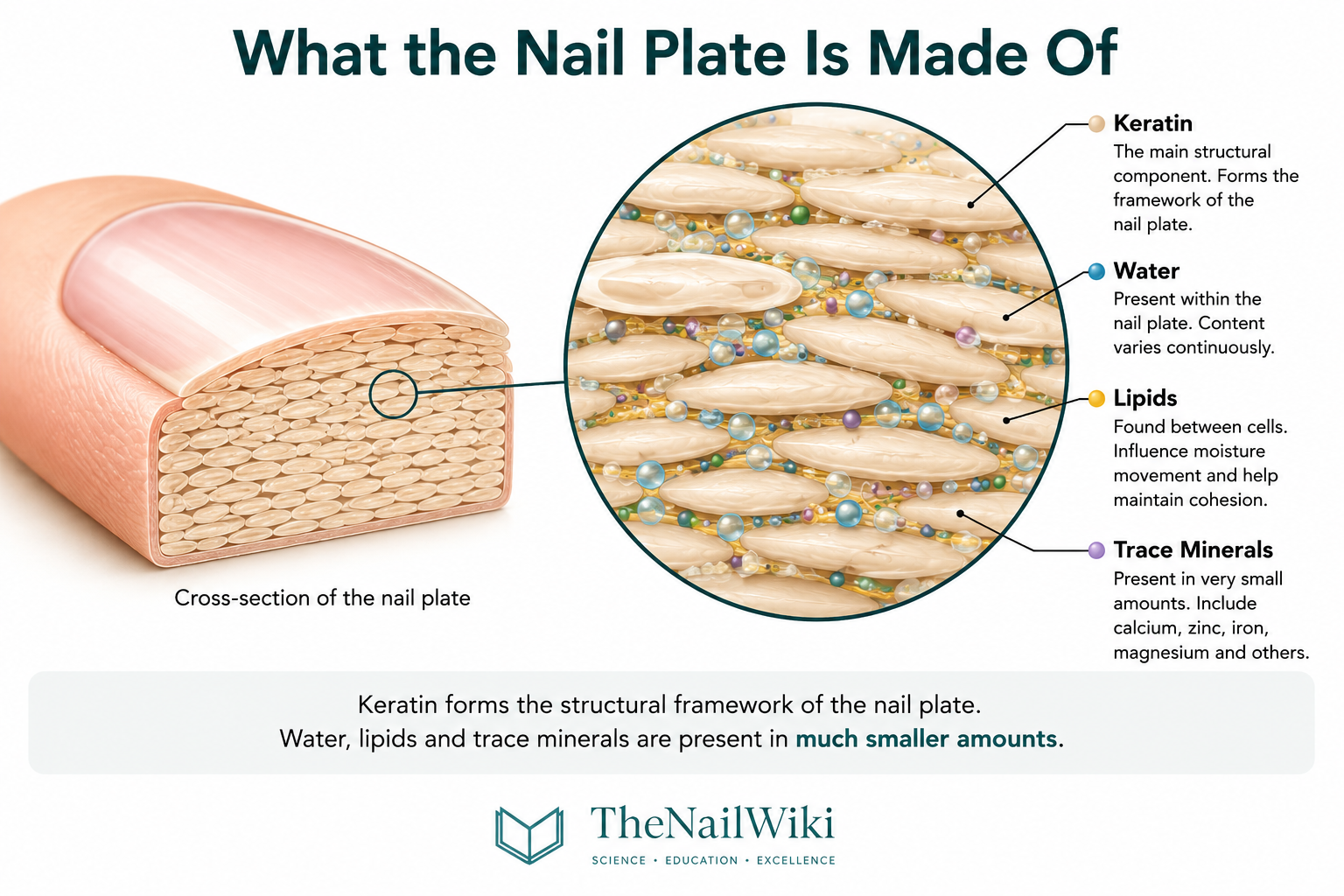
Quick Answer: The nail plate is made almost entirely of hard keratin — a family of structural proteins, not a single substance — built from amino acids and locked together by disulphide bonds. The remainder is a small, variable amount of water, a very small amount of lipid, and trace amounts of minerals. Keratin, not calcium or other minerals, is what gives the nail plate its structural strength. Composition explains what the nail plate is built from, but it does not, on its own, predict how a particular nail will behave — that depends on structure, hydration, and individual variation as much as on chemical makeup.
Contents
© TheNailWiki
Keratin: A Family of Proteins, Not One Substance
Keratin is often referred to as though it were a single material, but it is more accurate to describe it as a family of structural proteins. Different types of keratin are produced in different tissues throughout the body — skin, hair, and nails all rely on keratin, but not the same keratin. The nail plate is built specifically from hard α-keratin, the same category of dense, tightly structured keratin found in hair, which is notably different from the softer keratin found in skin.
This keratin is produced by keratinocytes — the cells responsible for keratin production — during the process described in detail on the Keratinisation Process page. Once this process is complete and the resulting onychocytes have become part of the visible nail plate, the keratin within them is no longer part of a living, active cell — it exists purely as structural material. This is why the nail plate can be described as built from keratin without being, itself, a living tissue.
Keratin forms the structural framework of the nail plate in the most literal sense: nearly everything else about how the plate behaves — its rigidity, its resistance to bending, its response to filing — traces back to how this keratin framework is built and held together.
Where Keratin Comes From: Amino Acids
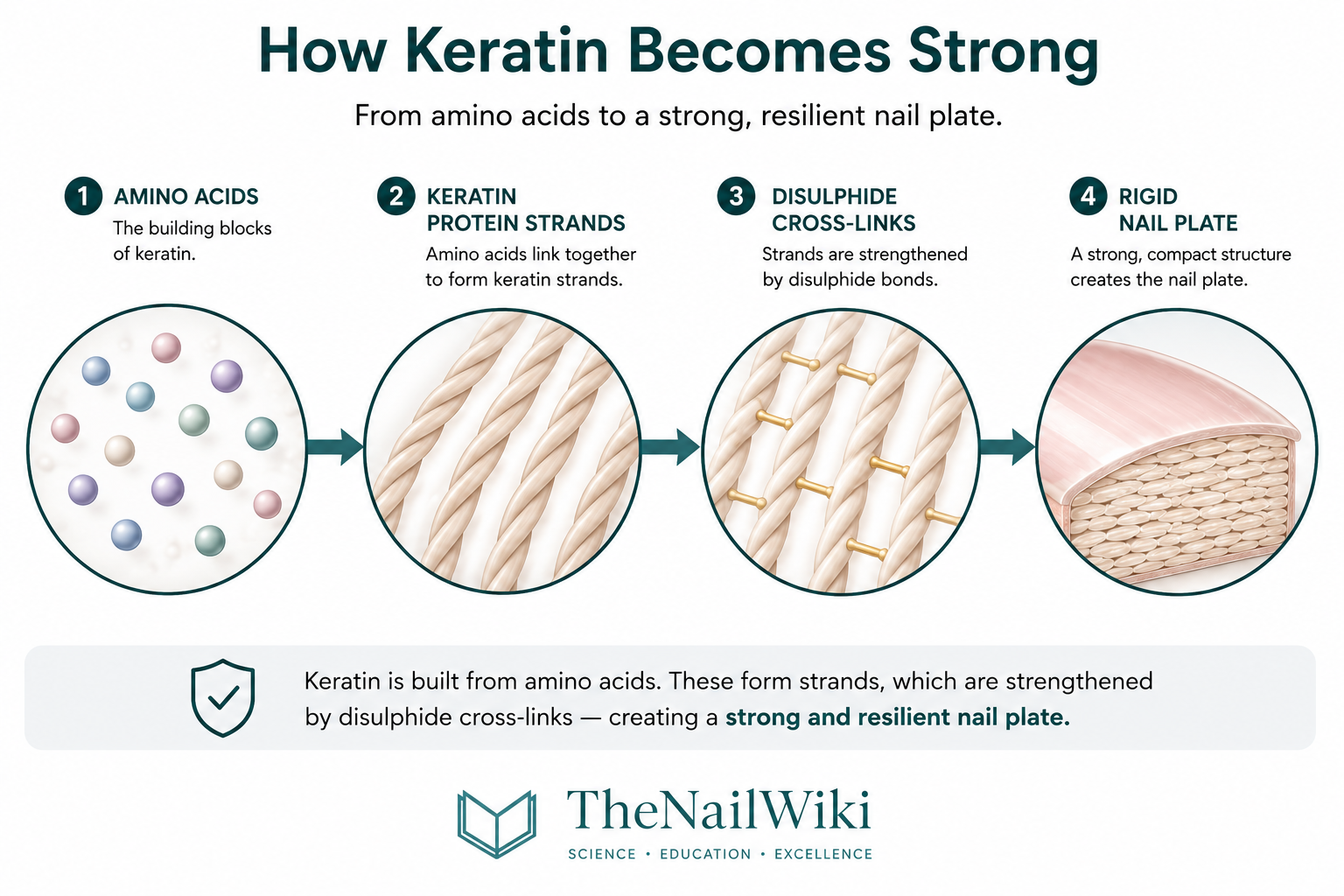
Keratin itself is not a starting material — it is built from smaller building blocks called amino acids, assembled into long protein chains. A technician does not need a chemistry background to understand this, but knowing where keratin comes from helps explain why the nail plate behaves the way it does.
A small number of amino acids matter most to this structure. Cysteine is the most significant, because of what it makes possible structurally — this is covered in the next section. Methionine, glycine, and serine are also present in meaningful quantities and contribute to the overall protein structure. None of these amino acids are unique to nails; what matters is how they are assembled and, in cysteine’s case, how they connect to one another once assembled.
Disulphide Bonds and Structural Rigidity
Cysteine contains sulphur, and this single detail is central to why the nail plate is rigid rather than soft. Where two cysteine units end up positioned near each other within the keratin structure, their sulphur atoms can form a chemical bond with one another — a disulphide bond. These bonds act as cross-links, joining separate sections of keratin protein together rather than leaving them as loose, independent strands.
The more densely these cross-links occur, the more rigid and resistant to deformation the resulting structure becomes. This is the same underlying mechanism responsible for hair’s strength, and it is the primary reason the nail plate resists bending and stretching far more effectively than tissues without this level of cross-linking.
© TheNailWiki
Water Content and Hydration
Water is not a fixed, static component of the nail plate — it moves continuously into and out of the plate, influenced by the surrounding environment, exposure to water or solvents, and individual factors. The exact water content varies considerably between individuals and circumstances; the specific ranges are covered on the Nail Plate page.
This continuous movement matters because hydration level temporarily changes how the nail plate behaves under force. Increased hydration is generally associated with increased flexibility, while dehydration is generally associated with reduced flexibility. These are general tendencies rather than fixed rules, and the practical implications for how nails and enhancement materials respond to force are explored further on the Nail Material Science page.
Lipids
Lipids make up only a small proportion of the nail plate’s overall composition — far less than in skin, where a lipid-rich outer barrier plays a much larger structural role. Within the nail plate, lipids are located between the cells rather than within them, sitting alongside the intercellular material that holds onychocytes together.
Despite the small proportion involved, this lipid content still has a measurable job to do. It influences how moisture moves through the plate, and it contributes to cohesion between neighbouring cells — helping the layered structure hold together as a unit rather than as loosely stacked material.
Trace Minerals
Trace amounts of minerals — including calcium, zinc, iron, and magnesium — can be detected within nail tissue. Their presence is well documented and not in dispute. What matters is what that presence does and does not mean.
Detecting a mineral within a tissue is not the same as that mineral being responsible for the tissue’s structural properties. In the nail plate, these minerals are present in quantities far too small to account for its hardness or rigidity — that structural role belongs to the keratin framework and its disulphide cross-linking, described above.
Common Misconceptions
A number of persistent beliefs about nail composition do not hold up against what the nail plate is actually made of and how it actually behaves.
- “Nails are made from calcium.” Calcium is present only in trace amounts. The nail plate is built almost entirely from keratin, not calcium
- “Mineral supplements automatically make nails stronger.” There is no reliable evidence that increasing mineral intake alone makes nails measurably harder or stronger in people without an underlying deficiency
- “Thick nails are automatically stronger.” Thickness alone does not determine strength — how the material is structured matters as much as how much of it there is, as explored further on the Nail Plate Layers page
- “Nails are simply dead skin.” The nail plate and skin are both keratinised structures, but they are distinct tissues built from different keratin types and produced by different processes — the nail plate is not skin
- “Protein-containing nail products replace natural keratin.” Topical products sit on or around the existing nail plate; they do not chemically integrate into or replace the keratin structure the matrix has already produced
This distinction matters for how technicians discuss nail health with clients. A client asking whether a supplement or protein-enriched product will make their nails stronger is really asking a question about structure and keratin condition, not about composition alone — and the honest answer is usually more nuanced than a single ingredient can address.
Composition vs Structure
Composition and structure answer two different questions, and conflating them is one of the most common sources of confusion in nail education. Composition answers: what is the nail made of? Structure answers: how are those materials organised?
Two nails can have almost identical chemical composition — similar keratin content, similar water content, similar trace minerals — and still behave very differently in practice. The difference comes down to factors that composition alone does not capture: thickness, architecture, hydration at a given moment, growth direction, porosity, and how the plate’s layers are organised.
This is why two clients can be told, correctly, that their nails are “made of the same thing” and still need entirely different approaches to product selection and service planning. Composition is the starting material; structure is what determines how that material actually performs.
Composition Is Not the Whole Story
Knowing what the nail plate is made of explains a great deal, but it does not, by itself, predict how a specific nail will behave under force. Composition alone cannot predict flexibility, brittleness, resistance to cracking, or how well a nail will support an enhancement — those outcomes depend on multiple interacting factors working together, not on chemical makeup in isolation. This is explored in more depth on the Nail Material Science page, which covers how nails and enhancement materials actually respond when force is applied.
In other words, composition tells you what a nail is built from. It does not, on its own, tell you how strong that particular nail will be — structure and condition matter just as much.
Key Facts
- Keratin is the primary structural component of the nail plate
- Hard α-keratin — the same category found in hair — forms the nail plate
- Keratin is built from amino acids, with cysteine playing the key structural role
- Disulphide bonds between cysteine units cross-link keratin proteins, producing rigidity
- Water content varies continuously and temporarily affects flexibility
- Lipids make up only a small proportion of the plate but influence moisture movement and cell cohesion
- Trace minerals are present but are not responsible for nail hardness
- Composition describes what the nail is made from, not how it behaves
Frequently Asked Questions
What is the nail plate made of?
The nail plate is made almost entirely of hard keratin protein, built from amino acids and cross-linked by disulphide bonds, with a small, variable amount of water, a very small amount of lipid, and trace amounts of minerals.
Is keratin one single substance?
No. Keratin is a family of structural proteins. The nail plate is built from hard α-keratin, the same category found in hair, which is distinct from the softer keratin found in skin.
What are disulphide bonds and why do they matter?
Disulphide bonds are chemical bonds that form between sulphur atoms in cysteine, an amino acid within the keratin structure. These bonds cross-link separate sections of keratin protein together, and the density of this cross-linking is a major reason the nail plate is rigid and resistant to deformation.
Does calcium make nails harder?
No. Calcium is present in nail tissue only in trace amounts and is not the source of the nail plate’s hardness. Hardness comes from the density and cross-linking of the keratin structure, not from mineral content.
Will taking mineral supplements make nails stronger?
There is no reliable evidence that increasing mineral intake alone makes nails measurably harder or stronger in people without an underlying deficiency. Nail strength depends primarily on keratin structure, hydration, and condition rather than mineral content.
What is the difference between composition and structure?
Composition describes what the nail plate is made of — its chemical makeup. Structure describes how those materials are organised — thickness, architecture, layering, and hydration. Two nails can share almost identical composition and still behave very differently because of structural differences.
Does knowing a nail’s composition tell you how strong it is?
Not on its own. Composition explains what a nail is built from, but thickness, layered structure, hydration, and individual variation all influence how a specific nail actually behaves under force.
Continue Your Professional Learning
Understanding that keratin, not calcium or minerals, gives the nail plate its strength changes how you talk to clients about nail health and supplements. If you would like to see how this composition knowledge informs product selection in practice, continue your learning below.
🎓 Professional Training
New to Artistic Touch?
🎁 Free Mini Classes — Explore free professional nail education
Related Library Pages
Nail Anatomy
Nail Science & Mechanics
Professional Disclaimer
This page is provided for professional educational purposes and describes the general chemical composition of the nail plate. It is not medical or nutritional advice. Persistent or unexplained nail changes should be assessed by a qualified medical professional.
About the Author
Radina Ignatova
Professional Nail Expert | International Nail Educator
Radina Ignatova is a Professional Nail Expert since 2014, International Nail Educator, and Founder of TheNailWiki and Artistic Touch Nail Training Academy. She specialises in Russian Manicure, dual form systems, polygel, advanced e-file techniques, and nail safety protocols, and continues to work actively in salon practice, ensuring that all education reflects real client scenarios and current industry standards.
Her teaching philosophy is built on honest education — showing real salon challenges, real mistakes, and real performance testing rather than presenting only perfect demonstrations. This is how genuine technical competence is developed and how nail professionals become truly confident and capable.
Read full bio →© 2026 TheNailWiki. All rights reserved.