
Nail Hydration & Water Content: State vs Capacity
Author: Radina Ignatova – Nail Expert, International Nail Educator | Last Updated: July 2026
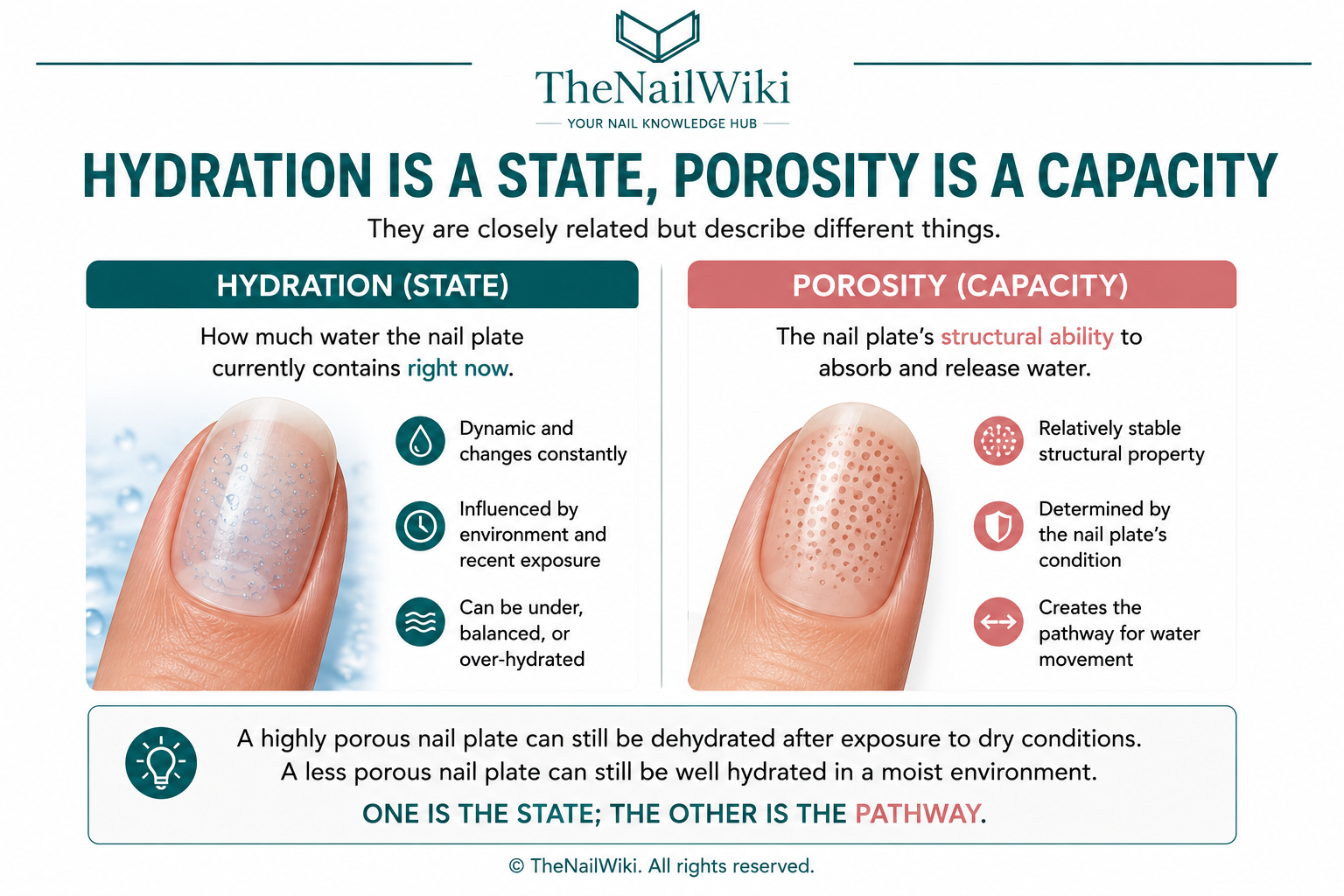
Quick Answer: Hydration describes how much water the nail plate currently contains — its present water content at a given moment. This is different from porosity, which describes the plate’s structural capacity to exchange water in the first place. A nail can have high porosity and still be well hydrated or poorly hydrated depending on its recent environment — porosity is the pathway, hydration is the current state travelling through it. Both under-hydration and over-hydration affect the nail plate, and neither extreme is desirable: a dehydrated plate becomes more brittle, while a plate exposed to prolonged excess moisture can swell and weaken temporarily.
Hydration Is a State, Porosity Is a Capacity
These two terms are closely related and frequently discussed together, but they answer different questions. Porosity describes how readily water and other substances can move through the nail plate’s structure — it is a relatively stable property of the plate itself, changing mainly in response to damage or structural change. Hydration describes something more immediate: how much water the plate actually contains right now, which shifts constantly depending on environment and recent exposure.
A useful way to hold these apart: porosity is the pathway a substance can travel through; hydration is where the water currently sits along that journey. A highly porous nail plate can still be dehydrated if it has recently been exposed to dry conditions, and a less porous plate can still be reasonably hydrated if the surrounding environment has been consistently moist.
Under-Hydration
When the nail plate’s water content drops below its typical range, the plate generally becomes less flexible and more prone to brittle fracture — the relationship between hydration and material behaviour is covered in more detail on the Nail Material Science page. Common contributors include repeated exposure to solvents such as acetone, dry environments, and frequent hand-washing without replenishing moisture afterwards.
Under-hydration is not usually a permanent change to the nail plate itself — because water moves in both directions through the plate, restoring a more typical environment generally allows hydration to normalise. This is different from structural damage, which does not reverse in the same way.
Over-Hydration and Prolonged Wet Exposure
Under-hydration receives most of the attention in nail care conversations, but excess water exposure carries its own consequences. Prolonged or repeated soaking — frequent dishwashing, extended bathing, or occupations involving constant wet work — can cause the nail plate to temporarily swell and soften as it absorbs more water than its structure typically holds.
A swollen, over-hydrated nail plate is not simply “extra flexible” in a beneficial sense — it is temporarily weaker and more vulnerable to mechanical damage while in this state. Repeated cycling between over-hydrated and dehydrated states, rather than either extreme alone, is often what produces the most visible cumulative damage, including the layer separation described as onychoschizia. This is why occupational wet work is a recognised contributor to nail plate deterioration independent of any chemical exposure involved. It is also part of why the industry has increasingly moved toward dry manicure techniques, such as the dry Russian manicure method, which avoids a water soak altogether and removes this source of repeated wet exposure from the service itself.
© TheNailWiki
Common Misconception
“Nails should stay as dry as possible.” This is not accurate. Dry enough for product application does not mean healthy all the time — that is a temporary, deliberate adjustment for a specific purpose, not a permanent target. Permanent dehydration is undesirable, but so is excess water exposure. The goal is balance, not maximum dryness.
Why Hydration Varies
Hydration is influenced by environmental humidity, occupation and hand-washing frequency, climate and season, and individual porosity — a more porous plate exchanges water with its environment more readily in both directions, meaning its hydration level can shift more quickly than a less porous plate’s. Two clients in the same environment can therefore show different hydration levels simply because their underlying porosity differs.
Cuticle Oil and Hydration
Cuticle oils do not simply “replace lost water”. Instead, they help support the nail’s moisture balance by reducing excessive water loss and improving flexibility. Certain oils, particularly jojoba oil, are commonly discussed in nail care because their molecular structure allows them to diffuse into the nail plate more readily than many heavier oils, moving through the keratin structure differently from water — the mechanics of this are covered on the Nail Porosity page. Their primary role, however, is still to support moisture balance and the condition of the nail plate and surrounding skin, rather than permanently changing hydration or porosity.
Practical Relevance for Nail Services
Hydration level at the time of a service is relevant to nail plate preparation. A plate carrying excess surface moisture is deliberately dehydrated before product application, because a well-prepared, appropriately dry surface generally supports better adhesion than one still holding residual water. This is a deliberate, temporary adjustment to hydration state — it is not the same as permanently altering the plate’s porosity, which remains a separate, more stable property. This is why nail technicians intentionally remove temporary surface moisture immediately before product application but encourage long-term hydration between appointments.
Ongoing hydration maintenance between services is a matter of supporting the nail’s general moisture balance rather than chasing a single “correct” water content — since hydration naturally fluctuates with environment, the realistic goal is avoiding prolonged extremes in either direction rather than maintaining one fixed state.
In Summary
Hydration describes the nail’s current water content. Porosity describes its capacity to exchange water. One is the state; the other is the pathway. Keeping this distinction clear is what allows a technician to interpret a nail’s hydration accurately, rather than treating every case of dryness or excess softness as the same underlying problem.
Frequently Asked Questions
What is the difference between nail hydration and nail porosity?
Porosity describes the nail plate’s structural capacity to exchange water and other substances. Hydration describes how much water the plate currently contains at a given moment. Porosity is relatively stable; hydration shifts constantly with environment and exposure.
Can nails be over-hydrated?
Yes. Prolonged or repeated exposure to water — frequent dishwashing, extended bathing, or occupational wet work — can cause the nail plate to temporarily swell and soften, leaving it more vulnerable to mechanical damage while in that state.
Is dehydration or over-hydration more damaging?
Neither extreme alone is ideal, but repeated cycling between over-hydrated and dehydrated states is often more damaging than either extreme sustained on its own, contributing to layer separation over time.
Does dehydrating the nail before a service damage it?
No. Deliberately reducing surface moisture during preparation is a temporary adjustment to the plate’s current hydration state, intended to support product adhesion. It does not permanently alter the plate’s underlying porosity or structure.
Why do two clients in the same environment have different hydration levels?
Individual porosity differs between people. A more porous nail plate exchanges water with its environment more readily, so its hydration level can shift more quickly than a less porous plate’s, even under identical conditions.
Does cuticle oil hydrate the nail?
Not directly in the same way water does. Cuticle oil supports moisture balance, improves flexibility, and reduces excessive water loss, helping maintain the condition of the nail plate rather than simply adding water.
Can drinking more water hydrate the nails?
Staying well hydrated supports overall health, but nail hydration is influenced far more by local environmental exposure than daily water intake alone.
Continue Your Professional Learning
Understanding the difference between hydration and porosity explains why the same aftercare advice does not work the same way for every client. If you would like to apply this understanding to genuinely informed aftercare, continue your learning below.
🎓 Professional Training
New to Artistic Touch?
🎁 Free Mini Classes — Explore free professional nail education
Related Library Pages
Nail Anatomy
Nail Science & Mechanics
- → Nail Porosity
- → Nail Composition
- → Nail Material Science
- → Nail Flexibility
- → Nail Thickness & Density
Nail Prep & Application Tools
Professional Disclaimer
This page is provided for professional educational purposes and describes general nail plate hydration behaviour. It is not a diagnostic resource. Persistent or unexplained nail changes should be assessed by a qualified medical professional.
About the Author
Radina Ignatova
Professional Nail Expert | International Nail Educator
Radina Ignatova is a Professional Nail Expert since 2014, International Nail Educator, and Founder of TheNailWiki and Artistic Touch Nail Training Academy. She specialises in Russian Manicure, dual form systems, polygel, advanced e-file techniques, and nail safety protocols, and continues to work actively in salon practice, ensuring that all education reflects real client scenarios and current industry standards.
Her teaching philosophy is built on honest education — showing real salon challenges, real mistakes, and real performance testing rather than presenting only perfect demonstrations. This is how genuine technical competence is developed and how nail professionals become truly confident and capable.
Read full bio →© 2026 TheNailWiki. All rights reserved.