
Nail Flexibility: What Determines How a Nail Bends
Author: Radina Ignatova – Nail Expert, International Nail Educator | Last Updated: July 2026
Quick Answer: Flexibility is the everyday, observable term for how readily a nail plate bends under gentle pressure. It is closely related to elasticity — the technical material property covered on the Nail Material Science page — but the two are not identical: elasticity specifically describes whether a material returns to its original shape after bending, while flexibility simply describes how easily it bends in the first place. A natural nail’s flexibility is shaped by a combination of hydration, thickness, density, and individual variation, and it changes throughout the day as those factors shift.
Contents
Flexibility vs Elasticity
These two words are often used as though they mean the same thing, but they answer slightly different questions. Elasticity is the technical property that describes reversible deformation — whether a material returns towards its original shape once force is removed, as explained in detail on the Nail Material Science page. Flexibility, in everyday professional use, simply describes how readily something bends when pressure is applied — it is what a technician observes directly, without necessarily testing whether the nail then returns to its original position.
In practice, a nail can appear flexible without being highly elastic in the technical sense — it might bend easily but not fully recover its original shape, which would indicate some degree of permanent deformation rather than true elastic behaviour. This distinction matters more for assessment than it might first appear: observing flexibility alone does not confirm that a nail is behaving elastically.
Why Flexibility Is Not Always a Problem
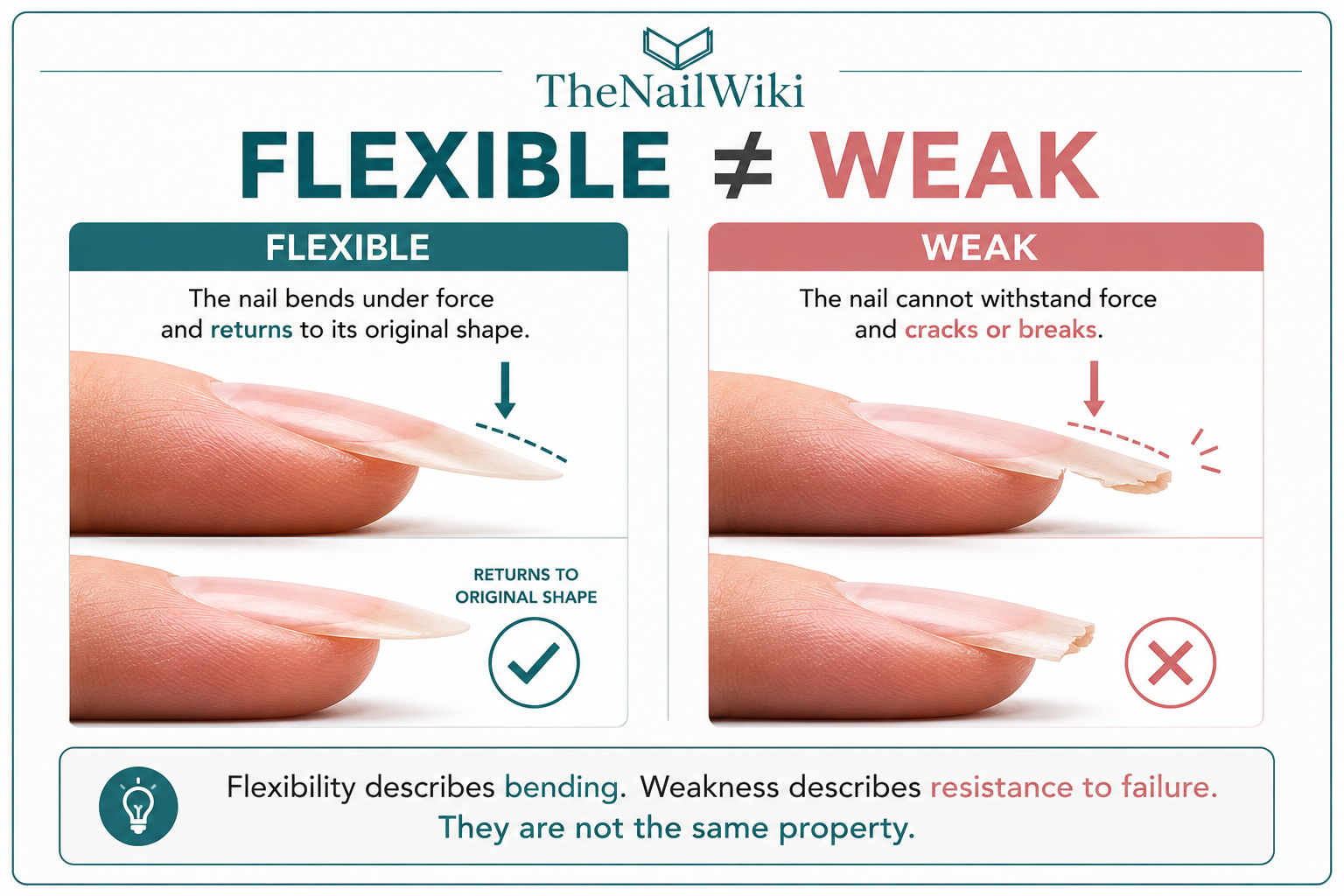
A common assumption in professional practice is that flexible automatically means weak. This is not accurate. Flexibility is a natural property of the nail plate, not a defect — every nail bends to some degree, and a certain amount of give under everyday pressure is entirely normal.
Flexibility only becomes something to actively consider when it is combined with other factors: the enhancement type being applied, the intended length, the client’s lifestyle and hand use, and the natural nail’s overall condition. A naturally flexible nail is not, by itself, a problem to be corrected — it is simply one characteristic to factor into the service plan alongside everything else.
© TheNailWiki
Flexibility Changes Along the Nail
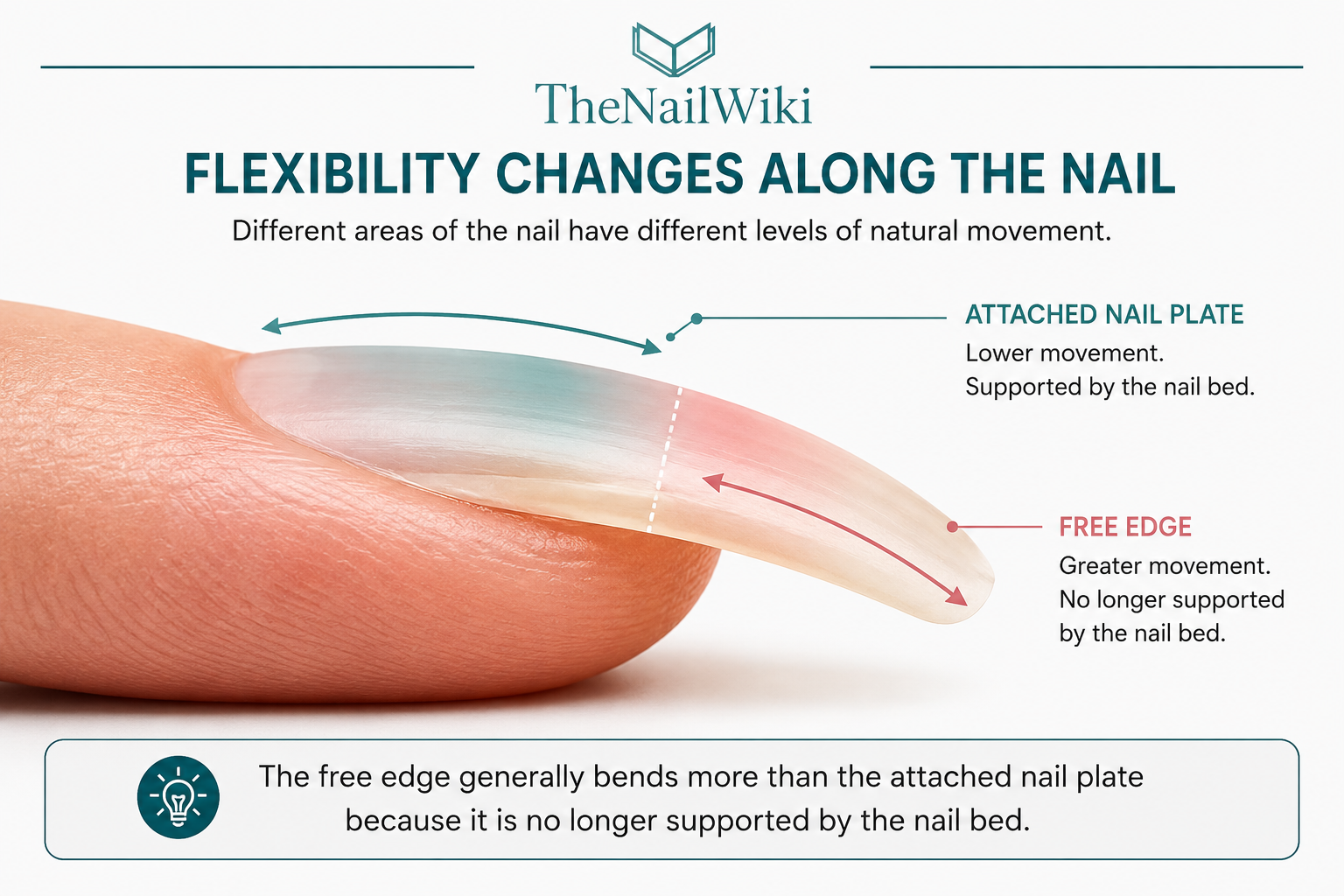
Flexibility is not uniform across the whole nail plate. The free edge generally feels more flexible than the portion of the plate still attached to the nail bed, since the attached nail is supported from beneath and cannot bend as freely. This underlying support influences how much give the technician actually feels when applying pressure.
Because of this difference, technicians usually assess flexibility specifically at the free edge rather than across the whole nail — it is the part most representative of the plate’s own material properties, without the nail bed’s support masking the result.
© TheNailWiki
What Determines a Natural Nail’s Flexibility
A natural nail’s flexibility is not a single fixed characteristic — it results from several factors acting together, and it can shift for the same client from one day to the next.
- Hydration — a well-hydrated plate is generally more flexible than a dehydrated one, covered in detail on the Nail Hydration & Water Content page
- Thickness — a thinner plate generally bends more readily than a thicker one, though thickness alone does not determine flexibility, as explored on the Nail Thickness & Density page
- Density — how tightly the internal keratin structure is cross-linked affects how much a given thickness resists bending
- Individual variation — some clients naturally have more flexible nails than others, independent of any of the above being unusual or problematic
- Age — flexibility may change gradually over a lifetime, generally alongside broader changes in nail composition, hydration, and growth characteristics as a person ages
Because several of these factors shift day to day, particularly hydration, a client’s nail flexibility observed at one appointment is not necessarily a fixed, permanent characteristic — it is a snapshot influenced by recent conditions as much as by underlying structure. Flexibility is neither good nor bad. It is simply one of the natural mechanical properties of the nail plate that technicians learn to recognise and interpret during professional assessment.
Assessing Flexibility During Consultation
Flexibility is usually assessed informally, through gentle observation rather than any specialised tool. A technician might note how readily the free edge bends under light pressure, or how the nail responds during filing. What matters is that this observation is treated as one data point among several, not as a standalone verdict on the nail’s overall condition.
Assessing flexibility helps technicians understand how the natural nail may respond to everyday mechanical forces. It forms one part of the overall assessment and should always be considered alongside thickness and density, hydration, and the client’s intended service.
A very flexible-feeling nail is not automatically fragile, and a rigid-feeling nail is not automatically strong — the broader relationship between flexibility, thickness, and density is covered on the Nail Thickness & Density page. Flexibility observed at consultation should be considered alongside the client’s hydration at that moment, their history of damage, and the intended service, rather than used in isolation to predict how a nail or enhancement will perform.
Common Misconception
“Flexible nails are always weak.” This is not accurate. Flexibility and strength are related but separate characteristics — a flexible nail can still have good density and structural integrity, and a rigid nail is not automatically stronger. Flexibility alone does not determine how well a nail performs under force.
Frequently Asked Questions
Is nail flexibility the same as elasticity?
No. Elasticity is the technical property describing whether a material returns to its original shape after bending. Flexibility describes how readily something bends in the first place. A nail can bend easily without fully returning to its original shape.
What makes a nail more flexible?
Hydration, thickness, density, and individual variation all contribute. A well-hydrated, thinner, less densely structured nail generally bends more readily than a dehydrated, thicker, more densely structured one.
Does nail flexibility change throughout the day?
Yes. Because hydration is one of the main influences on flexibility and hydration shifts constantly with environment and activity, a nail’s flexibility is not a fixed, permanent characteristic.
Is a very flexible nail automatically weaker?
Not automatically. Flexibility alone does not determine strength — density and overall structure matter just as much. A flexible nail is not necessarily fragile, and a rigid nail is not necessarily strong.
How is nail flexibility assessed during a consultation?
Usually through gentle observation, such as noting how readily the free edge bends under light pressure. This should be considered alongside hydration, damage history, and the intended service, rather than used alone to predict performance.
Can flexibility be permanently changed?
Flexibility can change temporarily through hydration and through the presence of an enhancement over the natural nail, and it can change naturally over time through growth and individual biology. It is not instantly or permanently changed by applying a product.
Does flexibility affect enhancement choice?
Flexibility is one of several factors technicians consider alongside length, structure, lifestyle, and the intended service when planning an enhancement — it is not used in isolation to choose a product or system.
Continue Your Professional Learning
Understanding that flexibility and elasticity are not the same thing changes how you interpret what you feel during a consultation. If you would like to apply this distinction to more accurate client assessment, continue your learning below.
🎓 Professional Training
New to Artistic Touch?
🎁 Free Mini Classes — Explore free professional nail education
Related Library Pages
Nail Anatomy
Nail Science & Mechanics
Professional Disclaimer
This page is provided for professional educational purposes and describes general nail plate flexibility. It is not a diagnostic resource. Persistent or unexplained nail changes should be assessed by a qualified medical professional.

About the Author
Radina Ignatova
Professional Nail Expert | International Nail Educator
Radina Ignatova is a Professional Nail Expert since 2014, International Nail Educator, and Founder of TheNailWiki and Artistic Touch Nail Training Academy. She specialises in Russian Manicure, dual form systems, polygel, advanced e-file techniques, and nail safety protocols, and continues to work actively in salon practice, ensuring that all education reflects real client scenarios and current industry standards.
Her teaching philosophy is built on honest education — showing real salon challenges, real mistakes, and real performance testing rather than presenting only perfect demonstrations. This is how genuine technical competence is developed and how nail professionals become truly confident and capable.
Read full bio →© 2026 TheNailWiki. All rights reserved.