
Base Coats for Nails: Types, Functions, and When to Use Each
Author: Radina Ignatova, Professional Nail Expert & International Nail Educator | Last Updated: April 2026
Quick Answer: A base coat is the first curable product layer applied to the nail plate after all preparation steps are complete. It creates the foundation that every subsequent product layer bonds to — it is not optional, and it is not interchangeable with a primer. Different base coat formulations serve different purposes — standard adhesion, rubber or flex base for problem nail types, bonding base for improved grip, and colour base for pigmented coverage. Choosing the correct base coat for the nail type and product system in use is one of the most impactful decisions in any nail service.
Quick Summary
The base coat is the first product layer cured under a lamp — it sits between the preparation steps and the colour or enhancement layers. It must bond to the nail plate surface below and provide a receptive surface for the product applied over it. Everything that follows in the service depends on how well the base coat has adhered.
Base coats are not universal. A standard base coat may work well for most clients but produce consistent lifting on clients with oily nail plates, thin nail plates, or damaged nail plates. Understanding what different base coat formulations do — and why the correct choice matters — is as important as any other step in nail plate preparation.
Contents
What a Base Coat Is
A base coat is the first curable product layer in any gel nail service. It is applied directly onto the prepared nail plate — after cleansing, dehydration, and primer where required — and cured under a UV or LED lamp before any further product layers are applied. It forms the foundation of the entire service: every colour layer, enhancement layer, and top coat that follows bonds to the base coat rather than directly to the nail.
The base coat performs two functions simultaneously. On the underside it must bond firmly to the nail plate surface. On the top side it must provide a receptive, compatible surface for the next product layer applied over it. A base coat that fails at either function — bonding to the nail below or accepting product above — compromises the entire service.
Base coats are also used in traditional nail polish services, though in that context they are not cured under a lamp — they air-dry and serve primarily to protect the nail plate from staining and to provide grip for the polish. This page focuses on gel base coats used with UV or LED curing systems, as these are the base coats most relevant to professional nail services.
Base Coat vs Primer — Not the Same Thing
Base coat and primer are two of the most frequently confused products in nail services — particularly in home nail care where the two terms are sometimes used interchangeably. They are completely different products that perform different functions at different points in the preparation sequence.
A primer is applied before the base coat, is not cured, and works by either etching the nail plate surface or creating a molecular bridge between the nail and the product. The base coat is applied after the primer — it is the first product layer that is cured. They perform sequential, complementary functions and neither can substitute for the other.
Types of Base Coat
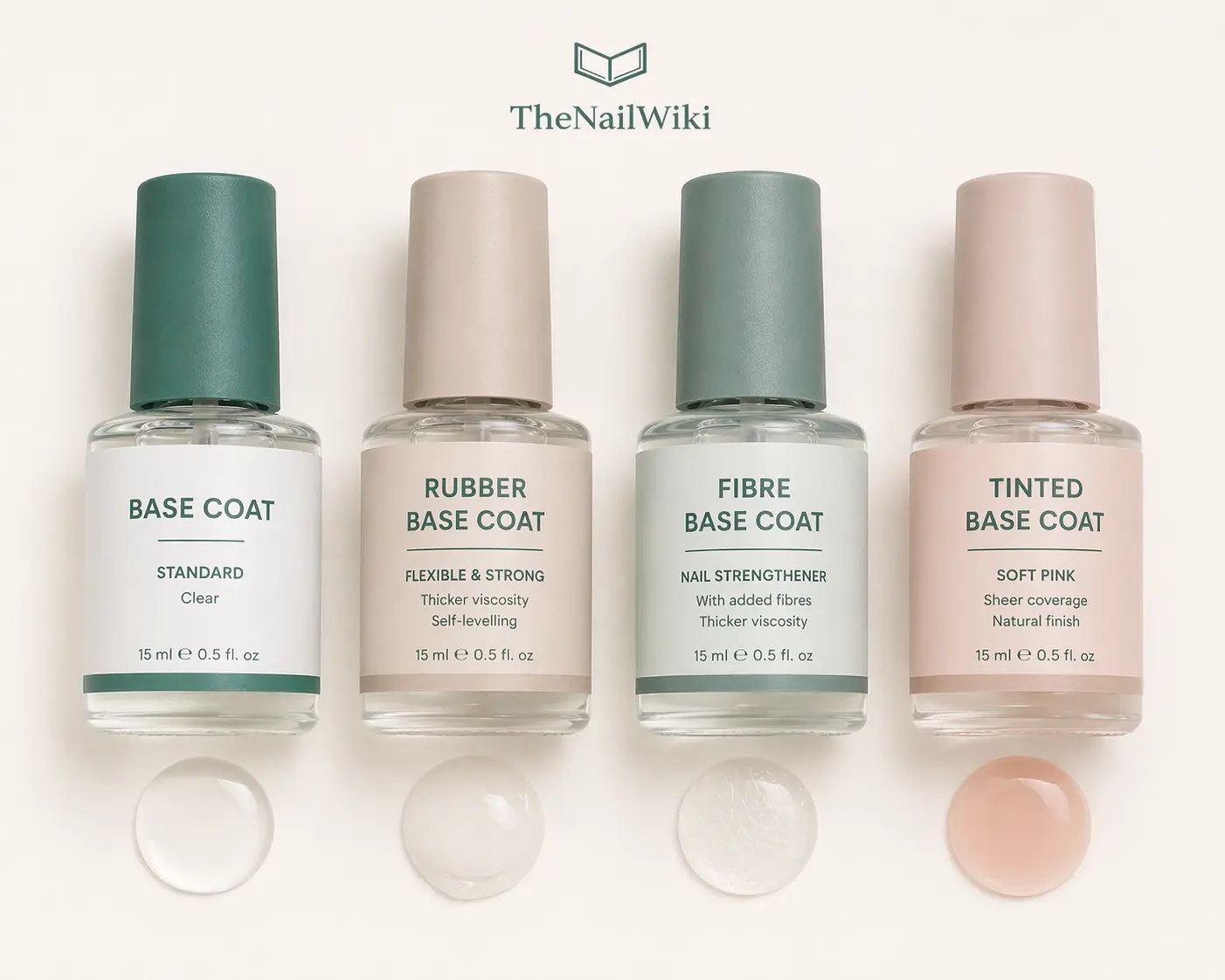
Not all base coats are the same formulation. Different types are designed to address different adhesion challenges and nail types. Understanding the differences allows a technician to select the most appropriate base coat for each client rather than using a single product for every service regardless of outcome.
The most important quality in any base coat — flexibility
The single most important property to look for in a gel base coat — regardless of type or brand — is flexibility. The natural nail plate is not rigid. It flexes slightly with every movement of the hand and finger, every impact, and every contact with surfaces throughout the day. A base coat that is too rigid cannot accommodate this movement — it resists, and the point of resistance becomes the point of lifting or cracking.
A flexible, elastic base coat absorbs this mechanical shock. Rather than fighting the nail’s natural movement, it moves with it — which is why a quality flexible base coat performs better across all nail types, not just problem nails. When selecting a base coat for your practice, prioritise flexibility and elasticity above all other marketing claims. A flexible base coat that is correctly applied and sits on a correctly prepared nail plate is the foundation of a durable, consistent service.
In professional practice, it is entirely possible to work with a single universal flexible gel base coat that performs reliably across all nail types — rather than maintaining a different base coat for every situation. Manufacturers will often suggest that multiple specialised bases are needed; the reality is that a genuinely flexible, well-formulated base coat handles the full range of nail types when applied correctly and on top of thorough preparation.
Standard base coat
A standard gel base coat is formulated to bond to a correctly prepared nail plate and provide a compatible surface for gel colour or top coat. When it is flexible in formulation — as a good standard base coat should be — it works reliably across most nail types. It is the starting point for any gel service including gel polish and BIAB.
Rubber base coat
A rubber base coat is a thick, flexible UV/LED gel used as a foundation layer — particularly suited to strengthening weak, brittle, or damaged nail plates. Its elastic, rubbery texture after curing means it moves with the nail plate rather than resisting it — absorbing mechanical shock that would otherwise create the stress points that cause lifting, cracking, or edge separation.
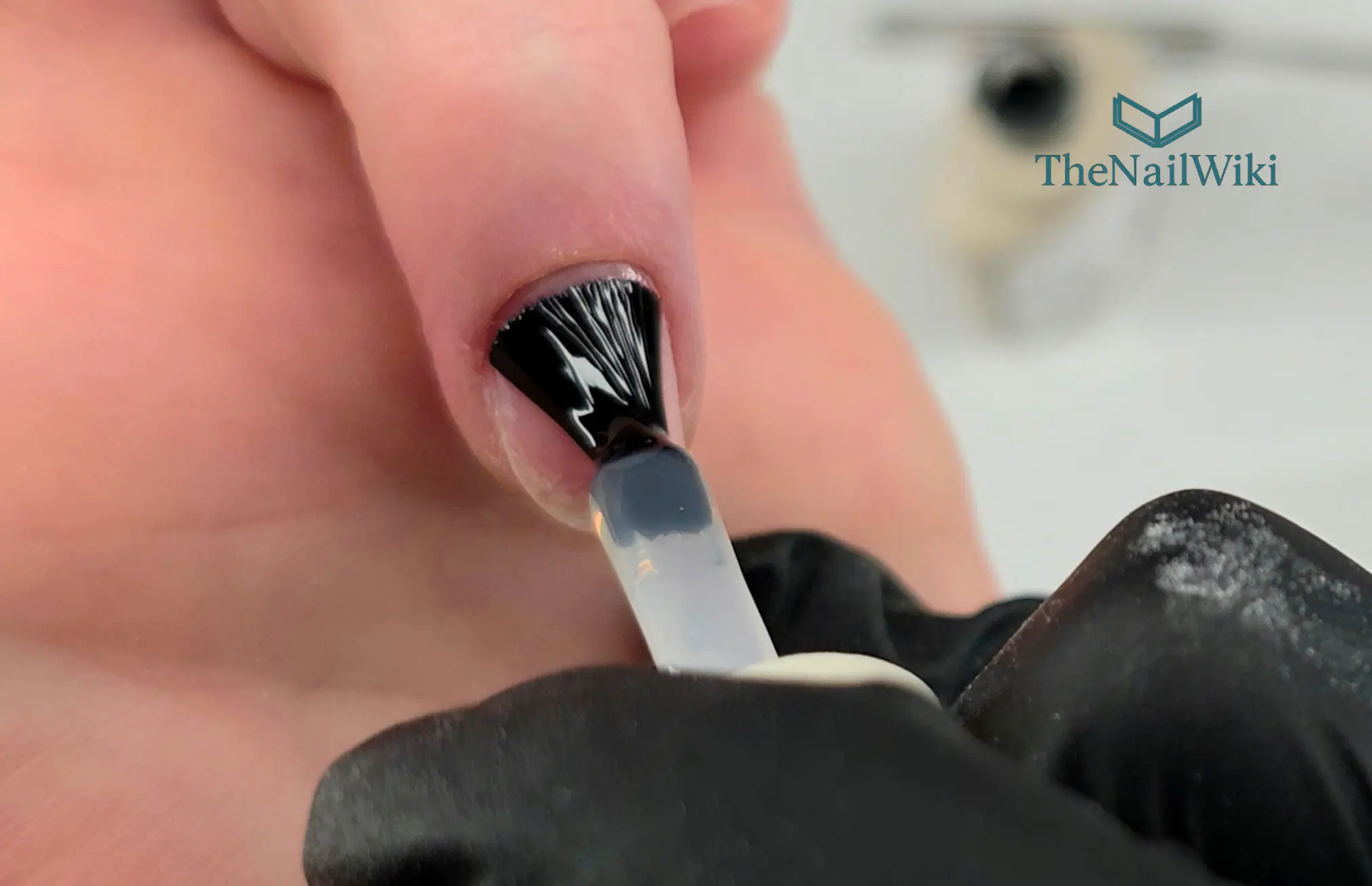
Despite being available in thicker consistencies than standard base coats, rubber base must still be applied in a thin, even layer. The correct application technique is to use small rubbing motions across the nail plate — working the product into the surface and ensuring full, even coverage including the edges — rather than brushing it on in a single stroke. This rubbing action helps the base key into the nail plate surface and prevents air pockets or uneven thickness.
© TheNailWiki
Rubber base coats are available in clear and in a range of sheer nudes and coverage tones, and some can be worn as a standalone finish without colour gel over the top. Note that standard and bonding base coats can also be flexible depending on the specific formulation — the rubber label refers to a particular texture and consistency rather than flexibility being exclusive to this type.
© TheNailWiki
Bonding base coat
A bonding base coat combines the adhesion-enhancing function of a primer with the structural function of a base coat in a single curable layer. It contains bifunctional molecules — similar to those in an acid-free primer — that bond to the nail plate on one side and to the product above on the other. Bonding base coats can also be flexible in formulation depending on the manufacturer — flexibility is not exclusive to rubber base coats.
Modern base coat formulations — including bonding bases — have become increasingly sophisticated. Some now contain additional active ingredients beyond the core bonding compounds: keratin proteins, calcium, vitamins, or conditioning agents that support nail plate health beneath the coating. These additions do not replace preparation or affect adhesion in a clinically measurable way — but they reflect the direction professional nail chemistry is moving, away from purely functional products and towards formulations that also consider nail plate condition during the wear period.
Many bonding base coats contain HEMA or similar bifunctional monomers. HEMA-free alternatives are available and are a safer choice for clients with known sensitisation concerns.
Colour base coat
A colour base coat — sometimes called a peel-off base, camouflage base, or cover base — contains pigment, typically in sheer nudes, pinks, or whites. It serves as both a base coat and a first colour layer simultaneously, reducing the number of product layers needed in the service. Colour base coats are popular for creating clean, natural-looking finishes with fewer steps — and some thick, self-levelling versions are used specifically as a base for nail art where a smooth, even canvas is needed.
Peel-off base coat
A peel-off base coat is formulated to allow the entire coating to be removed by peeling rather than soaking in acetone. It achieves this by bonding to the nail plate less firmly than a standard base coat — which means the coating peels away cleanly, but also means it does not provide the same level of adhesion or longevity as a standard base. Peel-off base coats are popular for nail art services where the client wants to change the design frequently. They are not appropriate for clients who want maximum wear time or for enhancement systems that require strong adhesion.
Peel-off base coats deliberately weaken adhesion. This makes them unsuitable for clients who regularly have their nails caught, pulled, or exposed to mechanical stress — peeling can take nail plate layers with it if the coating is pulled off rather than peeled correctly. Use only where the client understands the trade-off between removability and durability.
Acidity in base coats — what it does to the nail plate
Some base coat formulations contain acidic compounds as part of their adhesion chemistry. While acidity can improve initial grip on the nail plate surface, it comes with a consequence that is not always communicated clearly — acid degrades the nail plate’s internal structure over time.
The nail plate is held together primarily by disulfide bonds — the chemical links between sulphur-containing amino acids within the keratin structure. These disulfide bonds are what give the nail plate its strength, rigidity, and resilience. Acidic compounds break down these disulfide bonds, reducing the sulphur content within the nail plate and progressively weakening the keratin structure. The result — with repeated exposure — is a nail plate that becomes increasingly brittle, fragile, and prone to splitting.
This is not a theoretical concern. Research into occupational chemical exposure in nail services has confirmed that acidic agents destroy disulfide bonds in nail keratin, leading to measurable reductions in sulphur-rich proteins within the nail plate. For professional nail technicians applying base coats to the same clients repeatedly over months and years, the cumulative effect of an acidic base coat is worth understanding. A product that produces good short-term adhesion through acidity may be quietly weakening the nail plate beneath it over the long term — which often presents as progressively thinner, more brittle nails in clients who wear continuous gel coatings.
The same mechanism applies to acid primer — only more aggressively. Methacrylic acid is a significantly stronger acid than any acidic compound found in a base coat formulation. The disulfide bond destruction it causes is more intense and more immediate at the nail plate surface — which is one of the strongest arguments for the professional nail industry’s ongoing shift away from acid primers entirely. An acidic base coat damages slowly and cumulatively; acid primer damages at concentration, at every application.
What to look for
Check the ingredient list of any base coat for acidic compounds — these may appear as specific named acids or AHA (alpha hydroxy acids) in the formulation. If a client’s nails are becoming progressively more brittle or thin over a period of consistent gel wear despite correct preparation and careful application, the base coat formulation is worth reviewing alongside other factors. A non-acidic flexible base coat that achieves adhesion through mechanical and chemical compatibility rather than through surface etching is a safer long-term choice for nail plate health. For further reading on nail plate structure, see: Nail Composition → and Nail Plate Layers →
Choosing the Right Base Coat
The most important criterion when selecting a base coat is flexibility. A genuinely flexible, elastic base coat works across all nail types — it does not need to be swapped out for every client or every service. Manufacturers will often present a range of specialised bases as necessary for different situations. In practice, a single well-formulated flexible base coat, applied correctly over thorough preparation, produces consistent results across the full range of nail types.
That said, understanding what different base coat types do allows you to make informed decisions when a specific situation calls for something different. The guidance below reflects what each type is suited to — not a requirement to stock multiple products.
Normal nail type — standard base coat
A standard gel base coat with correct preparation produces reliable adhesion on a normal, healthy nail plate. No additional products are needed unless the client has a specific history of lifting or sensitivity.
Thin or flexible nail plate — rubber base coat
Thin nail plates flex more than thick ones — this flexing creates mechanical stress at the bond point between the nail plate and the base coat. A rubber or flex base coat accommodates this movement rather than resisting it, significantly reducing edge lifting on thin and flexible nail plates.
Oily nail plate or persistent lifting — bonding base coat
For clients with naturally oily nail plates or those who consistently experience lifting despite correct preparation, a bonding base coat provides an enhanced grip that a standard base coat does not. It may be used alongside the Radina Double Cleanse Method and dehydrator as part of an enhanced preparation sequence.
Damaged or recovering nail plate — rubber or bonding base coat
A damaged nail plate benefits from a flexible base that accommodates irregularities in the surface and provides some structural support without adding rigidity. A rubber base coat or bonding rubber base combination is often the most effective choice for recovering nails.
Nail art services — colour base or peel-off base
For services where a smooth, pigmented canvas is needed, a colour base coat reduces the number of layers required and creates a clean starting point. For services where frequent design changes are expected, a peel-off base coat allows removal without acetone — at the cost of reduced adhesion and durability.
Where Base Coat Sits in the Sequence
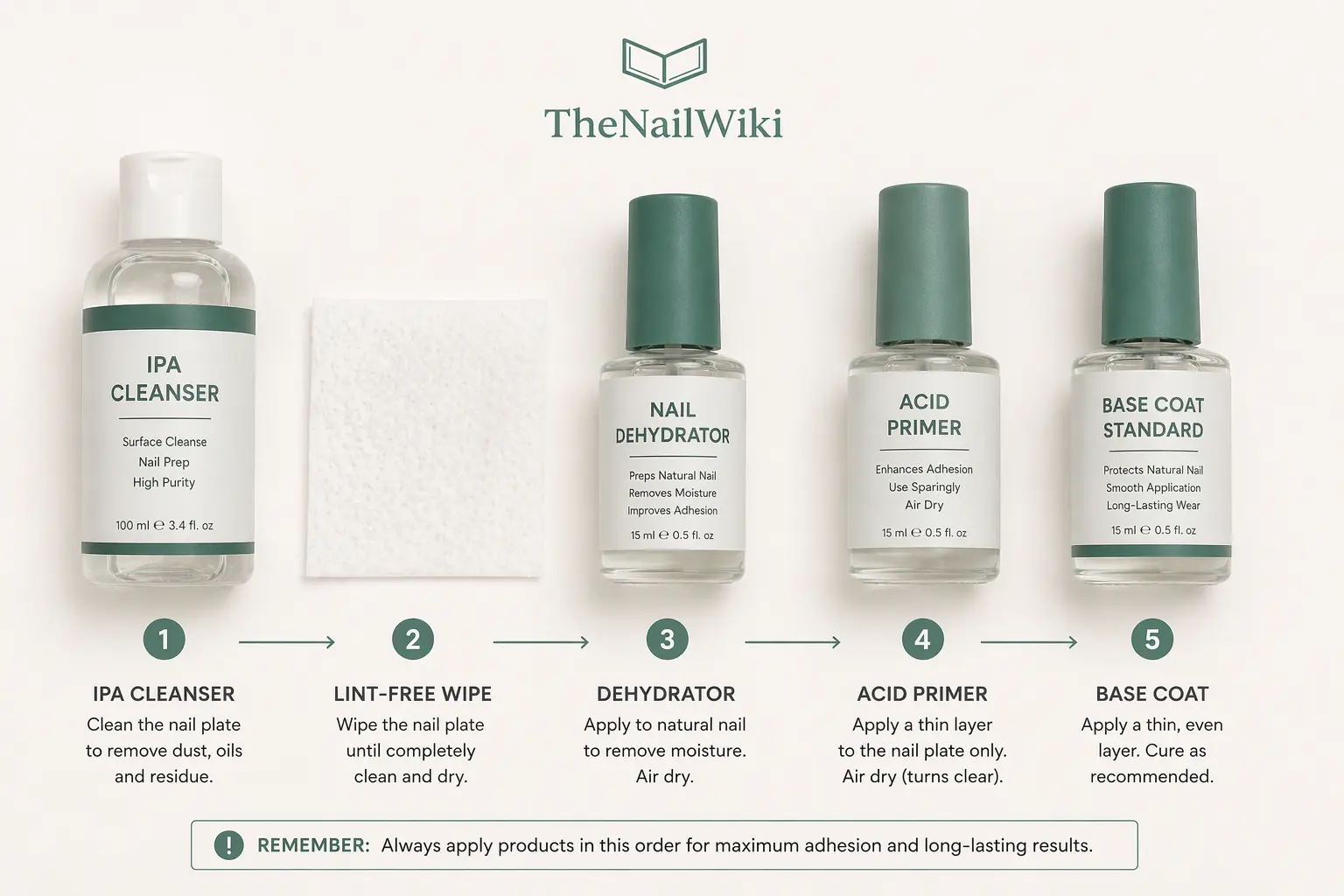
The base coat is always the first cured layer — it follows every preparation step and precedes every product layer. Nothing is applied to the nail plate before the base coat except preparation products. Nothing is applied between the base coat and the nail plate once the base coat has been applied.
Complete preparation and service sequence
- Cuticle work
- Buffing — 240-grit buffer
- Cleansing — Radina Double Cleanse Method or IPA on lint-free wipe
- Dehydrator — allow to evaporate fully
- Primer — where required by the system, allow to dry fully
- Base coat — applied thin and even, capped at the free edge, cured under lamp
- Colour layers, builder product, or enhancement — as required by the service
- Top coat — cured, inhibition layer removed where applicable
© TheNailWiki
How to Apply Base Coat Correctly
Apply thin and even
Base coat should always be applied in a thin, even layer across the entire nail plate surface. The correct technique is to work the product across the nail using small, controlled strokes or light rubbing motions — working the base into the surface rather than simply painting it on. This ensures full, even contact with the nail plate, helps prevent air pockets, and avoids pooling at the cuticle or lateral fold areas. Thin layers cure more evenly and produce a more consistent bond than thick ones. The only base coat type where a slightly thicker layer may be appropriate is rubber base — but even then, the application must be thin and controlled, using rubbing motions to work it evenly across the plate.
Cap the free edge
Seal the free edge of the nail with each product layer by running the brush along the very tip of the nail at the end of the stroke. This closes the edge and reduces the entry point for tip lifting. Always follow the specific guidance of the product system you are using — manufacturers will specify whether and how to seal the free edge as part of their application protocol.
Stay off the skin
Base coat must not contact the surrounding skin, the eponychium, or the lateral folds. Product on the skin that is then cured under a lamp creates an entry point for lifting as the skin flexes away from the product during normal movement. It is also a source of skin exposure to uncured monomers — which carries sensitisation risk. Leave a clean, visible gap between the product and all surrounding skin.
Cure fully before applying the next layer
The base coat must be fully cured before any product is applied over it. Under-cured base coat produces a weak foundation — the colour or builder product applied over an under-cured base will not achieve its full adhesion potential and may lift or separate early. Always cure for the full time specified by the manufacturer for the lamp type in use. See: UV Lamps and LED Lamps for guidance on curing times and lamp compatibility.
Do not apply the next layer immediately after curing if the base still feels tacky in an unusual way. Most gel base coats leave a normal inhibition layer after curing — this is expected. However, if the base coat feels unduly soft, sticky, or has not firmed up as expected after curing, check the lamp compatibility with the base coat formulation before proceeding. An incompatible lamp or insufficient curing time is a common cause of product curing failure.
When the Base Coat Lifts or Shrinks
If the base coat is lifting or the product is shrinking from the edges, the preparation was not done correctly. This is not a product failure and it is not a base coat failure — it is a preparation issue. Before changing products, adding steps, or blaming the system, go back to the preparation sequence and review every step.
Shrinkage at the edges — where the gel pulls back slightly from the cuticle line or lateral walls during or after curing — is a direct indicator that the nail surface was not fully clean and free of oil or moisture at the point of product application. A correctly prepared nail plate does not cause gel to shrink. Lifting at the cuticle area, lateral folds, or tip almost always traces back to one or more of the following:
Common causes of base coat lifting — check these first
- Dead cuticle left on the nail plate surface — the most frequent cause
- Insufficient cleansing — surface oils not fully removed before dehydration
- Dehydrator not applied or wiped away before evaporating — residual moisture in the surface layer
- Nail plate touched after dehydration before base coat is applied
- Base coat applied too thick — pooling at the cuticle creates a weak edge
- Base coat applied onto the surrounding skin — lifts as skin flexes
- Free edge not capped — entry point for tip lifting
- Base coat under-cured — weak bond beneath all subsequent layers
- Wrong base coat for the nail type — standard base on a very thin or flexible nail
If lifting persists after all of the above have been reviewed and corrected, consider whether the base coat type is appropriate for the client’s nail type — moving to a rubber base for flexible nails or a bonding base for persistently oily plates. See also: Product Lifting Issues → and Product Lifting & Adhesion Failure →
Common Mistakes
Using base coat as primer
A base coat is not a primer — it cannot perform the primer’s function of etching the nail plate or creating a molecular bridge between the plate and the product. If primer is required by the product system, it must be applied before the base coat as a separate step.
Applying base coat too thick
Thick base coat pools at the cuticle and lateral fold areas, creating a weak edge that lifts early. It also cures more slowly and less evenly. Thin, controlled application is always correct — for all base coat types including rubber base.
Not capping the free edge
Leaving the tip of the nail unsealed allows water, cleaning products, and daily mechanical contact to enter at the edge and begin separating the coating from the nail plate. Cap the free edge on each product layer and follow the manufacturer’s application protocol for the system in use.
Applying base coat to unprepared nails
Base coat applied without correct preparation — missing cleansing, dehydration, or dead cuticle removal — will lift regardless of its formulation. Preparation is the foundation. The base coat is only as good as the surface it is applied to.
Using the wrong base coat for the nail type
A standard base coat on a very thin, flexible nail plate will lift consistently at the edges — not because of poor preparation but because the rigid base cannot accommodate the nail’s movement. Matching the base coat to the nail type is as important as correct preparation.
Frequently Asked Questions
Is base coat the same as primer?
No. A primer is applied before the base coat and is not cured under a lamp. A base coat is the first curable product layer — applied after primer where required, and cured under UV or LED. They occupy different positions in the preparation sequence and cannot replace each other.
What is the difference between a rubber base and a standard base coat?
A rubber base coat is a thick, flexible gel specifically suited to strengthening weak, brittle, or damaged nail plates. Its elastic, rubbery texture absorbs mechanical shock and moves with the nail rather than resisting it. It is applied with rubbing motions in a thin, even layer rather than in a standard brush stroke. Standard and bonding base coats can also be flexible depending on their formulation — the rubber base distinction is primarily about texture and consistency, not flexibility being exclusive to that type.
Do I need to cap the free edge with base coat?
Yes — seal the free edge with each product layer to close the tip and reduce the entry point for lifting. Always follow the specific application guidance of the product system you are using, as manufacturers will specify how and when to seal the free edge as part of their protocol.
Can I use any base coat with any gel polish?
In most cases yes — gel base coats are generally compatible with gel polish from different brands, as long as both use the same curing chemistry (UV/LED). However, for best results it is always preferable to use the base coat recommended by the gel polish manufacturer. If mixing brands, test on one or two nails first to confirm compatibility before using across a full service.
My gel keeps lifting from the base coat — what should I do?
Lifting between the gel and the base coat is usually either an under-cured base coat issue, a base coat applied too thick issue, or a base coat that is not compatible with the gel polish applied over it. Check the curing time and lamp compatibility, ensure the base coat is applied thin and even, and confirm that both products are designed to work together.
What is a bonding base coat?
A bonding base coat combines the adhesion-enhancing function of a primer with the structural function of a base coat in a single curable layer. It is useful for clients with persistently oily nail plates or those who experience lifting with a standard base coat. It contains bifunctional molecules — similar to those in an acid-free primer — that bond more firmly to the nail plate surface than a standard base coat.
Professional training in nail preparation
Base coat selection, preparation sequencing, and product application technique for all nail systems are covered as part of the structured training courses at Artistic Touch Nail Training Academy.
Related Library Pages
Preparation Sequence
- → Nail Plate Preparation — The Full Sequence
- → Nail Cleansers, Alcohol & Prep Liquids
- → Nail Dehydrator
- → Nail Primers — Acid vs Acid-Free
- → Nail Buffers Guide
- → Nail Files & Grit Guide
Nail Types
Adhesion & Safety
- → Product Lifting Issues
- → Product Lifting & Adhesion Failure
- → Product Curing Failure
- → Contact Sensitisation & Nail Allergies
- → HEMA (Hydroxyethyl Methacrylate)
Product Systems
- → Gel Polish Explained
- → BIAB — Builder In A Bottle
- → Sandwich Dual Form System
- → Gel Base Coat
- → Gel Top Coat
Some linked pages are currently in development and will be published progressively.
Professional Disclaimer
The information on this page is provided for educational purposes and is intended to support the professional knowledge of nail technicians and nail educators. Nail services should only be performed by trained professionals. Any client with nail conditions, skin sensitivities, or relevant health concerns should be assessed by a qualified professional before any nail service is undertaken.
About the Author
Radina Ignatova
Professional Nail Expert since 2014 | International Nail Educator | Founder of TheNailWiki and Artistic Touch Nail Training Academy
Radina Ignatova is a Professional Nail Expert since 2014 and an International Nail Educator specialising in advanced nail preparation, BIAB, dual form systems, e-file techniques, and professional salon safety. Based in Scotland, UK, she teaches nail technicians internationally through structured online courses.
Her teaching philosophy is centred on honest education — demonstrating real salon challenges, practical corrections, and performance-based technique rather than presenting only polished results.
Read full bio →About TheNailWiki
TheNailWiki is an independent educational platform dedicated to providing accurate, safety-led and professionally informed nail care information to professionals and enthusiasts worldwide.
For structured professional training, advanced masterclasses, and specialist technique courses, visit Artistic Touch Nail Training Academy.
This library page is published by TheNailWiki — an independent nail education resource maintained by nail industry professionals. Content is safety-led and professionally informed.