Lateral Nail Grooves: Anatomy, Function, and Clinical Relevance | TheNailWiki
Lateral Nail Grooves: Anatomy, Function, and Clinical Relevance
Author: Radina Ignatova, Professional Nail Expert & International Nail Educator | Last Updated: May 2026
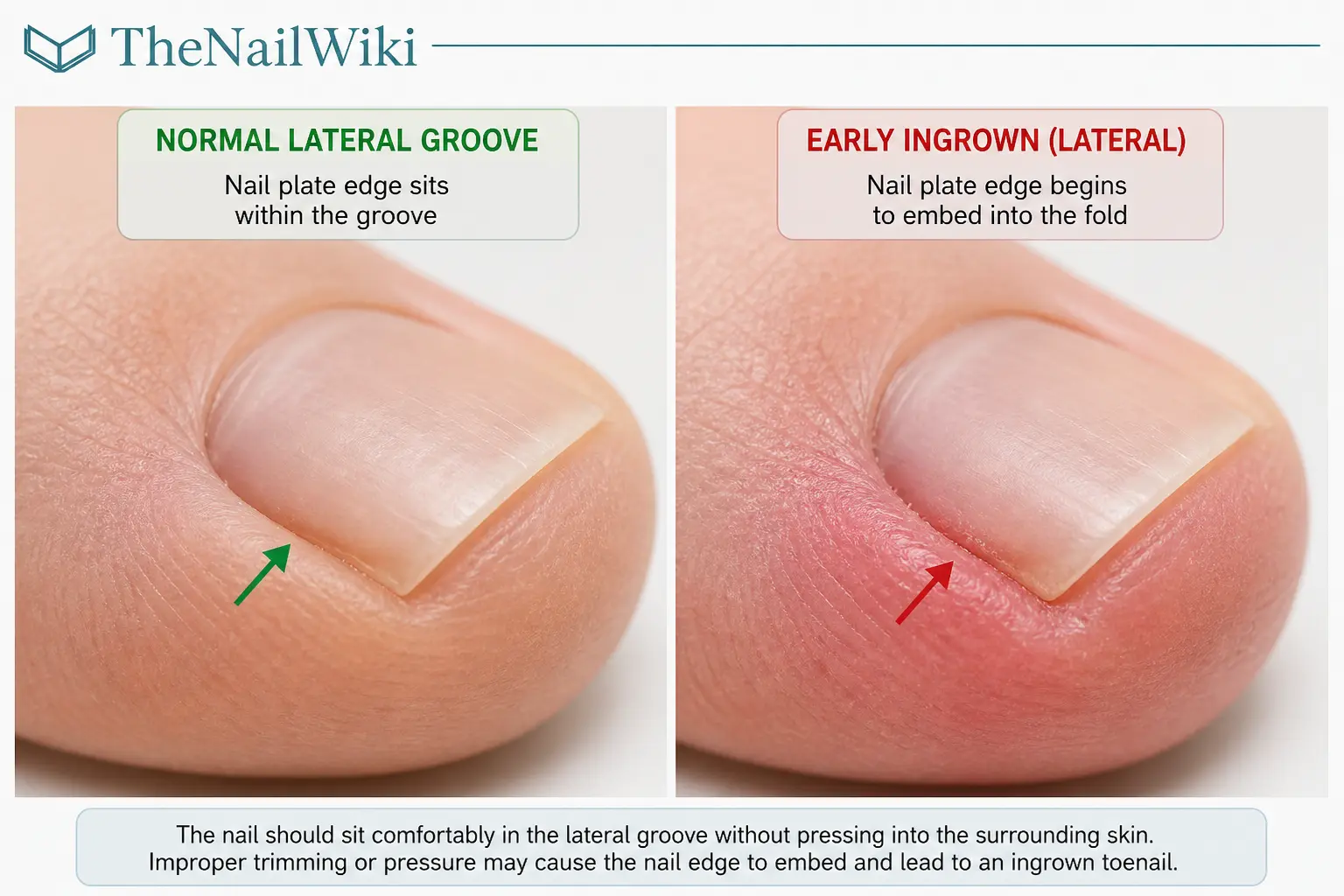
Quick Answer: The lateral nail grooves — also called nail tracks — are the narrow channels running along the left and right edges of the nail plate between the plate edge and the inner surface of the lateral nail folds. They act as guiding tracks that direct the lateral edges of the nail plate as it grows forward. When the nail plate edge deviates out of the groove and into the fold — rather than through it — the result is an ingrown nail.
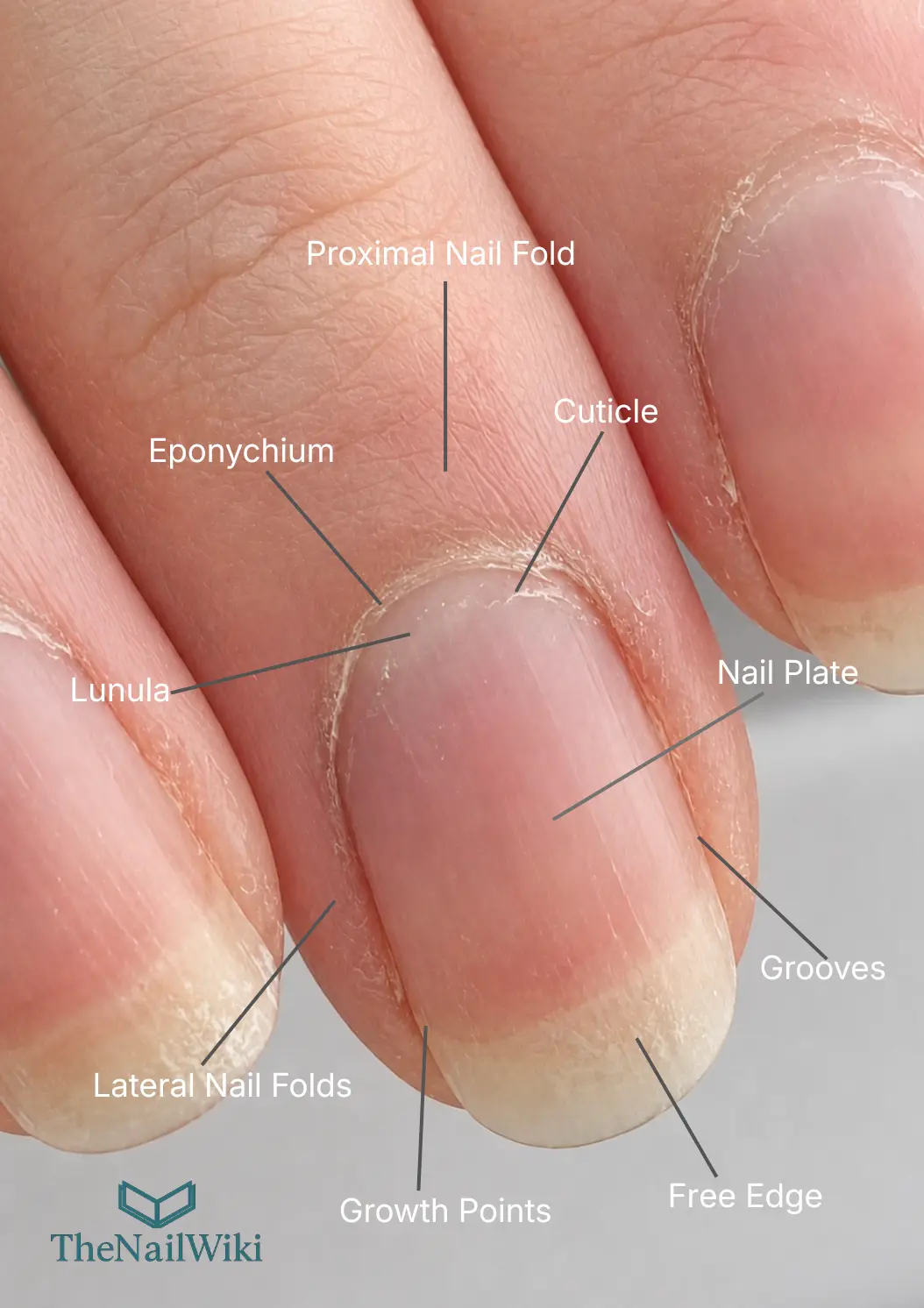
The lateral nail grooves are narrow longitudinal channels — one on each side of the nail plate — running from the base of the nail near the proximal nail fold to the free edge at the fingertip. Each groove is formed by the space between the edge of the nail plate and the inner surface of the adjacent lateral nail fold.
The groove is lined with skin — an extension of the skin of the lateral nail fold. This lining is thin, sensitive, and in close contact with the edge of the nail plate as it grows through the channel. The groove is shallow enough that even slight deviation of the nail plate edge towards the fold can cause pressure and, if sustained, penetration of the plate edge into the fold tissue.
Lateral nail grooves are also referred to as nail tracks — a functional description of their role as channels that guide and constrain the path of the nail plate edges.
Function — Guiding Nail Plate Growth
The primary function of the lateral nail grooves is to guide the lateral edges of the nail plate as they grow forward from the nail matrix. The grooves act as structural constraints — keeping the growing plate aligned within the nail unit and preventing the edges from deviating laterally into the soft tissue of the folds.
This guidance function is particularly important during the period of rapid nail growth. The nail plate grows approximately 3mm per month on average — a slow but continuous forward movement that requires consistent structural containment along its edges. The lateral grooves provide this containment passively, without active muscular or connective tissue tension.
The integrity of the lateral nail groove is therefore directly linked to whether the nail plate grows correctly through the nail unit or begins to deviate — with the most clinically significant deviation being the ingrown nail, where the plate edge exits the groove and penetrates the fold.
Lateral Grooves vs Lateral Folds — the Difference
The lateral nail fold and the lateral nail groove are adjacent but distinct structures that are frequently confused or used interchangeably. They are not the same.
Lateral Nail Fold
Lateral Nail Groove
What it is
The raised ridge of skin running along the side of the nail
The channel between the fold and the nail plate edge
Visible as
The skin border you can see at the side of the nail
The narrow gap between the skin border and the nail plate edge
Primary role
Protects the nail plate edge and contributes to the c-curve
Guides the nail plate edge as it grows forward
When it becomes a problem
Infection, inflammation, thickened skin, compression from dual forms
Ingrown nail — plate edge exits the groove and penetrates the fold
The most clinically significant condition affecting the lateral nail grooves is onychocryptosis — the ingrown nail. This occurs when the lateral edge of the nail plate deviates out of the groove and grows into the soft tissue of the lateral nail fold. The causes include incorrect nail shaping (cutting the corners too short), nail plate curvature that is too pronounced for the groove to contain, tight footwear compressing the folds towards the plate, and trauma.
An ingrown nail that has penetrated the fold causes pain, inflammation, and is highly susceptible to infection. It is a contraindication to nail services in the acute phase. Management ranges from careful reshaping of the free edge (in mild cases) to surgical intervention (in severe or recurrent cases). See: Ingrown Toenail — Onychocryptosis →
Why cutting the corners causes ingrown nails
When the corners of the nail are cut back — shortening the side edges below the level of the fold — the nail plate no longer has a free edge in the groove at that point. As the nail grows forward, the newly forming edge must find its way back into the groove. If the groove is narrow, the fold is soft, or the plate curvature is pronounced, the edge may instead grow into the fold rather than along the groove. The correct approach is to file or cut the free edge straight across with only very gentle rounding at the corners — never cutting into the corners.
Debris accumulation
The lateral nail groove is a narrow channel that can accumulate dead skin cells, product residue, and environmental debris. In clients wearing nail enhancements, product that has flowed into the groove and cured can create a solid deposit that is difficult to remove and may create pressure against the nail plate edge. Keeping the groove clean is part of professional nail maintenance.
Pincer nail
In pincer nails — where the nail plate curvature is extremely pronounced, rolling inward at the sides — the lateral edges of the plate compress inward within the grooves, creating chronic pressure against the groove lining and the nail bed beneath. This is a painful condition that is not managed in the salon and requires professional podiatric or dermatological assessment.
Relevance to Professional Nail Services
Nail shaping — protecting the grooves
Correct nail shaping respects the lateral groove by maintaining the free edge at or slightly beyond the level of the fold at the sides. Filing into the corners or cutting them back disrupts the relationship between the plate edge and the groove, which can initiate ingrown nail formation particularly in clients prone to this condition. When using a nail file to shape the sides, work parallel to the fold rather than angling into it.
Enhancement product and the grooves
Product must never pass the nail plate boundaries during application — this applies to all skin contact including the lateral grooves. Product flooding onto the skin of the lateral fold or into the groove is a sensitisation risk and a sign of incorrect application technique regardless of where it occurs. Keeping product cleanly within the nail plate boundaries is a non-negotiable application standard.
Frequently Asked Questions
What are lateral nail grooves?
The lateral nail grooves are the narrow channels running along each side of the nail plate between the plate edge and the inner surface of the lateral nail fold. They act as guiding tracks that direct the edges of the nail plate as it grows forward. They are also called nail tracks.
What causes an ingrown nail?
An ingrown nail occurs when the lateral edge of the nail plate deviates out of the groove and grows into the soft tissue of the fold. Common causes include cutting or filing the nail corners too short, excessive nail plate curvature, tight footwear compressing the folds, and trauma. Keeping the free edge straight across with very gentle corner rounding helps prevent ingrown nail formation.
How are the lateral grooves different from the lateral folds?
The lateral nail fold is the raised ridge of skin you can see along the side of the nail. The lateral nail groove is the narrow channel between the inside surface of that fold and the edge of the nail plate. The fold is the visible structure — the groove is the functional space between the fold and the plate that guides nail growth.
Can nail products affect the lateral grooves?
Product must never pass the nail plate boundaries during application — this includes the area at the lateral grooves. Product flooding onto the skin of the lateral fold is a sensitisation risk and incorrect application technique. Keeping product cleanly within the nail plate boundaries is a professional application standard that applies across the entire nail perimeter.
Professional training in nail anatomy and technique
Nail anatomy, shaping technique, and product application standards are taught as part of structured professional courses at Artistic Touch Nail Training Academy.
Some linked pages are currently in development and will be published progressively.
Professional Disclaimer
The information on this page is provided for educational purposes and is intended to support the professional knowledge of nail technicians and nail educators. It does not constitute medical advice.
Radina Ignatova is a Professional Nail Expert since 2014 and an International Nail Educator specialising in Russian Manicure, BIAB application, advanced e-file techniques, and nail safety protocols. Based in Dundee, Scotland, UK, she operates a professional salon whilst teaching nail technicians internationally through online courses.
Her teaching philosophy is centred on honest education — demonstrating real salon challenges, practical corrections and performance-based techniques rather than presenting only polished results.