
Fast vs Slow Nail Growth: What It Does and Does Not Mean
Author: Radina Ignatova – Nail Expert, International Nail Educator | Last Updated: July 2026
Quick Answer: Nail growth rate varies naturally between individuals — averaging around 3 millimetres per month, but ranging noticeably from person to person and even between fingers on the same hand. Faster growth does not mean healthier nails, and slower growth does not automatically indicate a problem; growth rate and nail strength are different characteristics. For nail technicians, growth rate matters because it affects how quickly an enhancement moves out of balance with the growing nail and how soon maintenance is needed — not because faster or slower is inherently better.
Contents
What Counts as Faster or Slower Growth
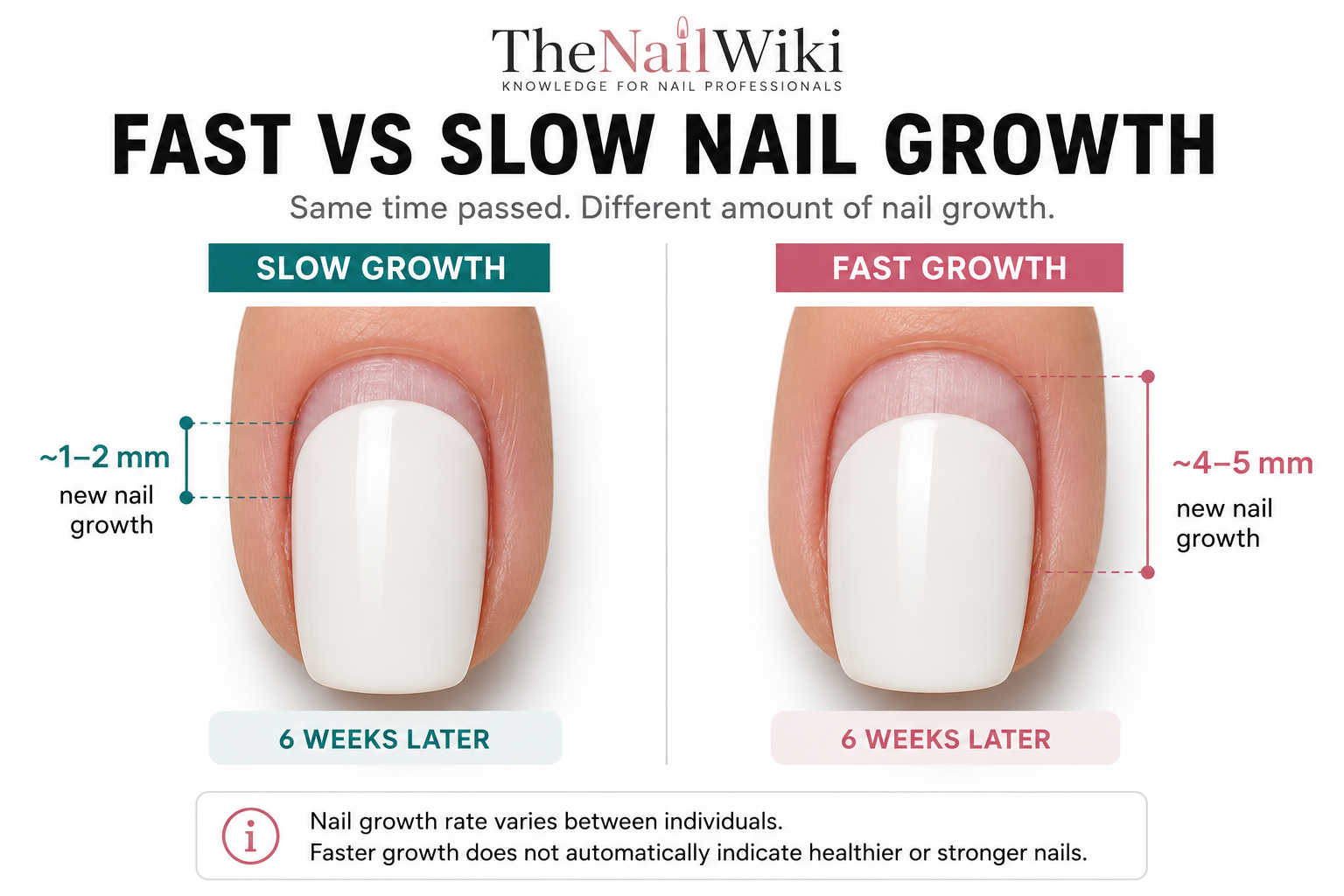
The Nail Growth Cycle page explains that adult fingernails grow at an average rate of around 3 millimetres per month, with complete replacement commonly taking four to six months. That average is a starting reference point, not a target every nail should meet. Growth rate exists on a spectrum: some clients’ nails grow closer to 2 millimetres per month, others closer to 4 or more, and both extremes can be entirely normal for that individual.
There is no fixed threshold at which growth becomes officially “fast” or “slow”. In professional practice, what matters is not where a client’s growth rate sits relative to the population average, but how it compares to their own baseline over time, and how it interacts with the service being provided.
This distinction matters because “fast” and “slow” are relative labels, not diagnostic categories. A client’s growth rate only becomes practically relevant when it is considered alongside their nail condition, their growth direction, and the service they are receiving — not as a number to be judged against everyone else.
© TheNailWiki
Why Growth Rate Varies Between People
Growth rate is not a fixed, universal number — it is shaped by a combination of individual factors, some fixed and some temporary.
- Age — growth rate is often faster in younger adults and tends to slow gradually over time
- Genetics — individual growth rate has a hereditary component, which is part of why growth rate can run in families
- Finger differences — the middle fingernail is commonly reported to grow faster than the little fingernail, though the difference is modest and not identical for every person
- Dominant hand — nails on the dominant hand are sometimes reported to grow slightly faster, possibly linked to increased circulation from greater use
- Overall health and circulation — general health and blood flow to the fingers can influence how efficiently the matrix produces new nail plate
- Hormonal changes — hormonal shifts, including pregnancy, are commonly associated with a temporary change in growth rate
- Season — some research has reported seasonal variation in growth rate, although the effect is not identical for everyone
- Illness or trauma — significant illness or physical trauma can temporarily slow growth
- Medications and medical conditions — certain medications and conditions can influence growth rate; this should not be used to self-diagnose from nail appearance alone
No single factor on this list fully explains an individual’s growth rate. In most clients, growth rate reflects a combination of several of these influences acting together, which is why two otherwise similar clients can have noticeably different rates.
Growth Rate and Nail Health Are Different Characteristics
Growth rate and nail health are frequently assumed to be the same thing. They are not — and treating them as interchangeable can lead to inaccurate client communication and unrealistic expectations.
- Fast nail growth does not automatically mean healthy nails — growth speed and nail quality are separate characteristics
- Slow nail growth does not automatically indicate disease — many clients with entirely normal nails simply have a naturally slower growth rate
- Nail strength and nail growth rate are different characteristics and should be assessed separately
- Fast-growing nails are not automatically thicker — thickness depends on matrix function and nail plate structure, not growth speed
- Faster growth does not make enhancements last longer, and slower growth does not improve retention — retention depends on preparation, product, and architecture, not growth rate alone
A client’s growth rate is worth noting for planning purposes, but it is not a proxy for how healthy their nails are, and it should not be presented to clients as one.
Growth Rate and Enhancement Maintenance
Growth rate has a direct practical relevance for nail technicians, independent of any question of nail health. As the natural nail grows, the relationship between the enhancement and the growing nail changes — and how quickly that happens depends on the individual client’s growth rate.
Faster growth
For a client with a faster growth rate, the visible regrowth area increases more quickly. The apex position moves forward sooner relative to the nail bed, and the stress zone shifts its relationship to the enhancement more quickly than for a slower-growing client. This means rebalancing may be needed earlier, and a maintenance interval that works well for one client may be too long for another with a faster growth rate.
Slower growth
For a client with a slower growth rate, visible damage or discolouration takes longer to grow out, and complete replacement of the nail plate takes correspondingly longer. This does not mean maintenance can simply be scheduled further apart by default — the enhancement’s balance and condition should still guide the decision, not growth rate alone.
This is why a fixed maintenance schedule applied uniformly across all clients is a simplification. A two-to-four-week interval is a common starting point, but the appropriate interval for an individual client depends on their growth rate together with the service, product system, and enhancement architecture involved — not a single number that applies to everyone.
Why Damage Takes Longer to Grow Out for Some Clients
The Nail Growth Cycle page explains that the position of damage on the nail plate is the main factor in how long it takes to grow out — damage near the free edge grows out sooner than damage near the base. Growth rate is the second variable: for two clients with identical damage in an identical position, the client with the faster growth rate will see that damage reach the free edge sooner.
This is a useful distinction to make with clients directly. A client who has been told “it takes several months” may reasonably ask why a friend’s similar damage grew out faster — and the honest answer is usually a combination of where the damage sits and how quickly that particular person’s nails grow, not that anything was done differently between the two services.
Frequently Asked Questions
How fast do fingernails normally grow?
There is no single “normal” rate — fingernail growth typically averages around 3 millimetres per month, but individual rates vary considerably, and both faster and slower rates within a reasonable range are normal for that person.
Why do some people have faster nail growth?
Growth rate is influenced by a combination of factors, including genetics, age, general health, circulation, and hormonal changes. No single factor fully explains why one person’s nails grow faster than another’s, and the exact combination varies by individual.
Does fast nail growth mean healthy nails?
No. Growth rate and nail health are different characteristics. A nail can grow quickly and still be thin, brittle, or poorly structured, and a nail that grows more slowly can be entirely healthy.
Can nail growth be permanently increased?
There is no reliable way to permanently increase an individual’s underlying growth rate. Supporting general nail health may help nails grow in the best condition possible, but growth rate itself is primarily determined by individual physiology.
Does nail growth affect infill appointments?
Yes. A faster growth rate means the visible regrowth area increases more quickly and the enhancement’s balance changes sooner, which can mean earlier rebalancing is needed. A slower growth rate does not automatically mean appointments can be spaced further apart — the enhancement’s condition should still guide the decision.
Why does nail damage take longer to grow out for some people?
The time depends on where the damage sits on the nail plate and on the individual’s growth rate. Damage near the base takes longer to reach the free edge than damage already near the tip, and a client with a naturally slower growth rate will see any given section of damage take longer to grow out than a client with a faster rate.
Continue Your Professional Learning
Understanding that growth rate says nothing about nail health explains why maintenance intervals should be built around the individual client rather than a fixed number of weeks. If you would like to apply this thinking to real service planning, continue your learning below.
🎓 Professional Training
New to Artistic Touch?
🎁 Free Mini Classes — Explore free professional nail education
Professional Disclaimer
This page is provided for professional educational purposes. Nail growth rates vary between individuals and cannot be used alone to assess health. Persistent or unexplained changes in growth rate should be assessed by a qualified medical professional.

About the Author
Radina Ignatova
Professional Nail Expert | International Nail Educator
Radina Ignatova is a Professional Nail Expert since 2014, International Nail Educator, and Founder of TheNailWiki and Artistic Touch Nail Training Academy. She specialises in Russian Manicure, dual form systems, polygel, advanced e-file techniques, and nail safety protocols, and continues to work actively in salon practice, ensuring that all education reflects real client scenarios and current industry standards.
Her teaching philosophy is built on honest education — showing real salon challenges, real mistakes, and real performance testing rather than presenting only perfect demonstrations. This is how genuine technical competence is developed and how nail professionals become truly confident and capable.
Read full bio →© 2026 TheNailWiki. All rights reserved.