
Nail Plate Layers: Dorsal, Intermediate and Ventral Structure
Author: Radina Ignatova – Nail Expert, International Nail Educator | Last Updated: July 2026
Quick Answer: The nail plate is not a single uniform sheet — it is built from three stacked layers, each with a different job. The dorsal layer forms the visible, touchable surface and gives the nail its shine. The intermediate layer sits beneath it, makes up roughly half of the total thickness, and does most of the structural work — it is largely responsible for how well the nail resists bending and splitting. The ventral layer is the thinnest of the three and forms the direct interface with the nail bed underneath. Because each layer has a different function, what happens to a nail depends heavily on which layer is affected — whether that is through filing, damage, or disease reaching the matrix.
Contents
The Three Layers of the Nail Plate
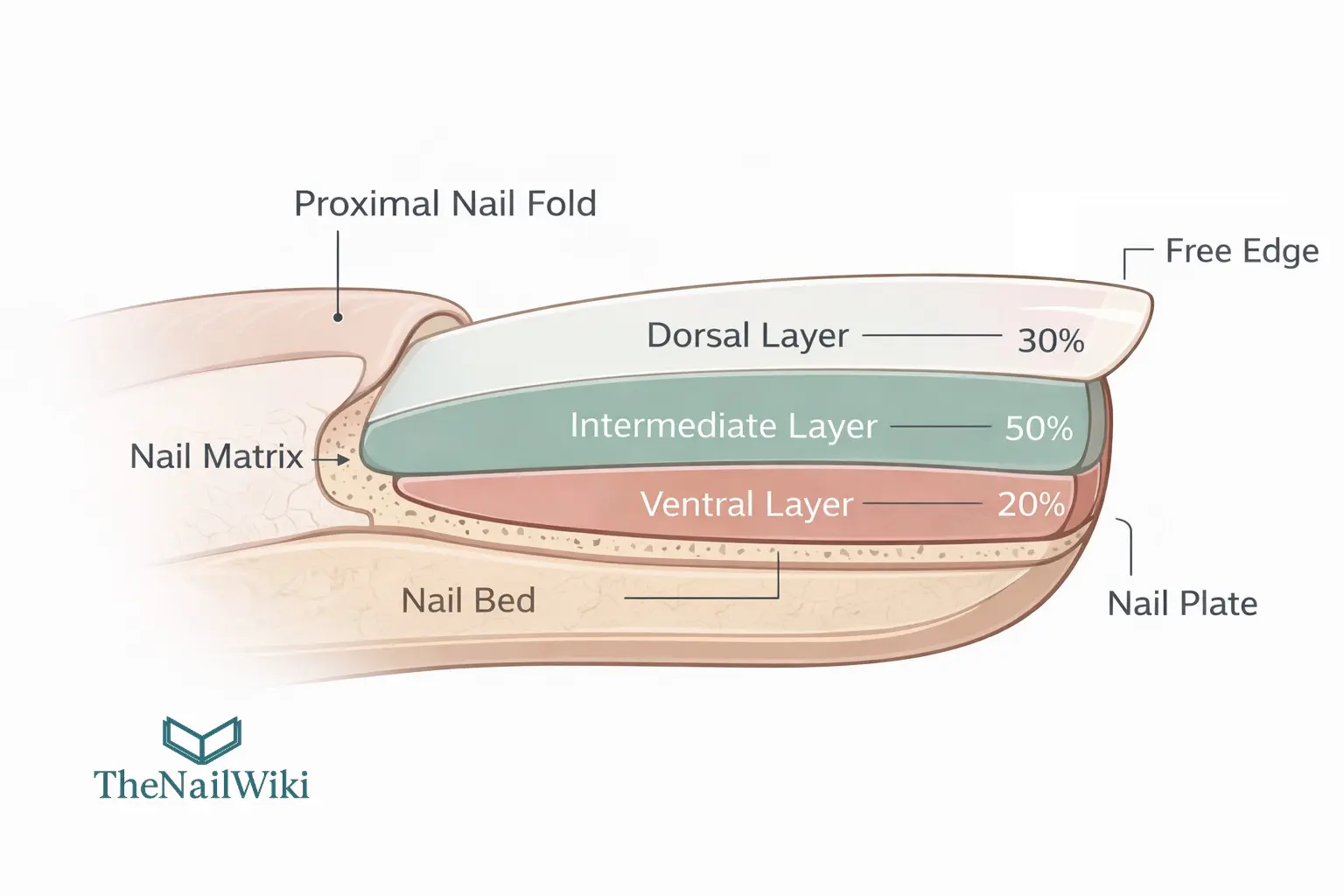
Looking at a nail from above, it appears to be one continuous surface. In reality, the nail plate is a stack of three structurally distinct layers, built up as onychocytes are produced and compacted together. Each layer has its own cell arrangement and its own job, and none of them can substitute for the others.
© TheNailWiki
The dorsal layer — the outer face
This is the part of the nail everyone actually sees and touches. It sits at the top of the stack, is comparatively thin, and is made up of flat, densely packed cells that give a healthy nail its smooth, glossy surface. Because it is the outermost layer, it is also the first to show wear — surface dullness, fine scratching, or a rough texture usually begins here, long before anything structural has changed underneath.
The intermediate layer — the structural core
This is by far the thickest of the three layers, and it is where the nail plate’s actual mechanical strength comes from. The cells here interlock more tightly than in the dorsal layer, which is what allows the nail to resist bending, flexing, and splitting under everyday use. When people talk about a nail being “strong” or “weak,” they are, whether they realise it or not, usually describing the condition of this layer specifically.
The ventral layer — the underside
The thinnest of the three layers sits at the very bottom of the stack, in direct contact with the nail bed underneath. Rather than being smooth, its underside is uneven by design — that irregularity is what allows the nail plate to key into the nail bed and stay attached as it grows forward.
How the Layers Differ
No single layer does everything. Between them, the three layers divide the nail plate’s overall job — appearance, strength, and attachment — into three separate structural tasks.
- Dorsal layer — smallest contribution to overall thickness; governs surface appearance, smoothness, and shine
- Intermediate layer — largest contribution to overall thickness; governs mechanical strength, flexibility, and resistance to splitting
- Ventral layer — thinnest layer; governs attachment to the nail bed rather than surface appearance or strength
This division also explains why damage doesn’t always look or behave the same way. Surface dullness, thinning, and splitting are different problems because they typically originate in different layers, not because they are different severities of the same problem.
The Ventral Layer and Adhesion to the Nail Bed
The ventral layer deserves particular attention because it is the layer most directly responsible for whether the nail plate stays properly attached to the nail bed. When this layer is disrupted or fails to form properly, the result is onycholysis — the plate lifting or separating from the bed beneath it.
This is also why changes affecting the underside of the nail are assessed differently from changes affecting the surface. A dull or roughened dorsal layer is a cosmetic and surface-level issue; a compromised ventral layer is an attachment issue, and the two are not equivalent even if they might both be loosely described as “nail damage.”
What Filing Removes, Layer by Layer
Because the three layers do different jobs, filing does not have the same consequence at every depth. Light surface filing stays within the dorsal layer, refining shape and preparing the surface for product application — this can be repeated across services with minimal structural consequence, provided it does not go any deeper.
Filing that continues past the dorsal layer reaches the intermediate layer — the layer primarily responsible for strength. This is the point at which a client is likely to notice new flexibility, thinning, or sensitivity that was not there before, because material has now been removed from the layer the nail actually depends on structurally. Filing that reaches the ventral layer is rarely intentional and risks affecting the attachment interface with the nail bed itself.
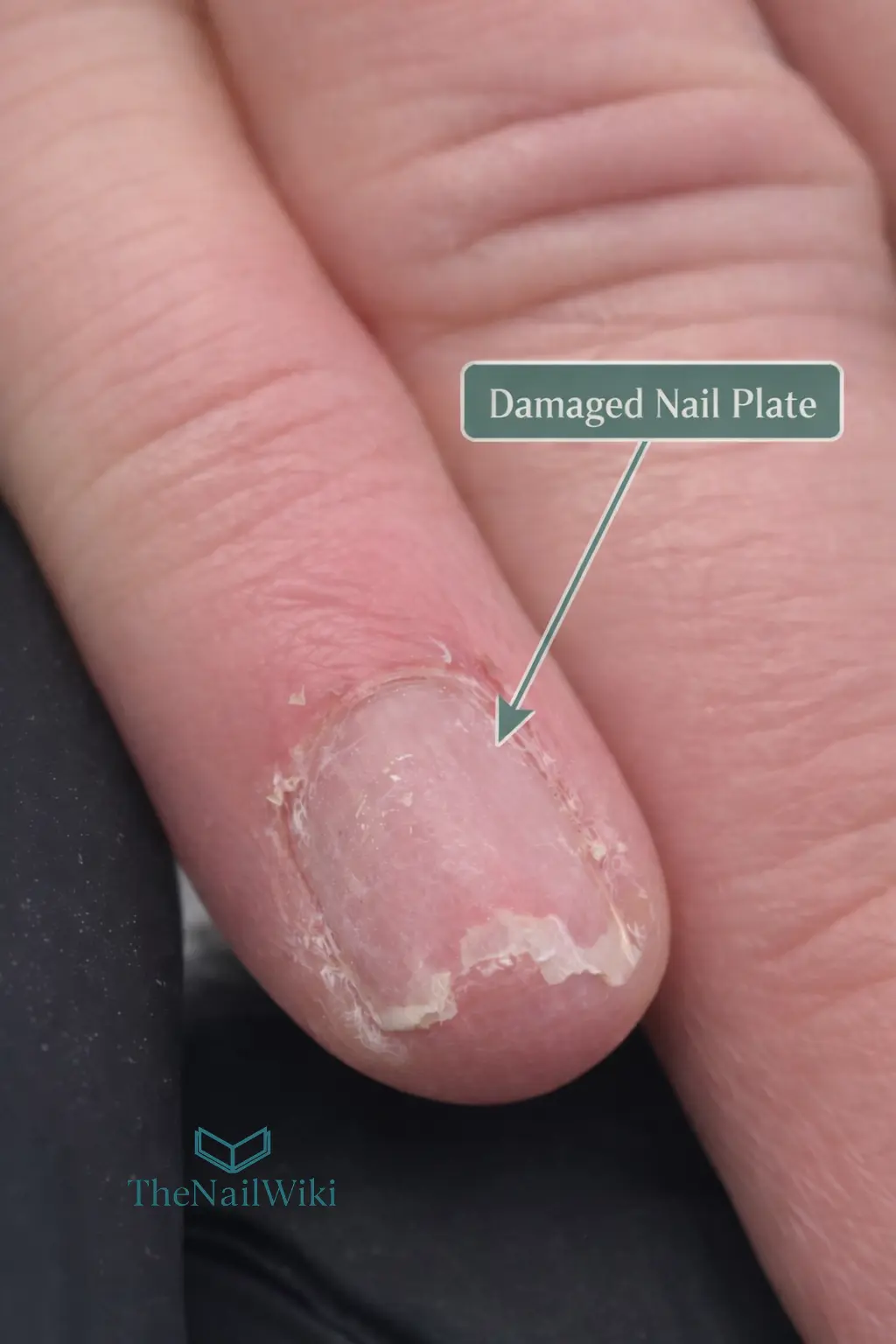
This is why the relevant question after any filing is not how long it took or how much dust was produced, but which layer the technician finished in. Grit and tool selection — covered in full on the Nail Files & Grit Guide page — should be chosen with this in mind, and because a layer that has been over-filed cannot repair or thicken itself, the thinned section simply grows forward as explained on the Nail Growth Cycle page.
Frequently Asked Questions
What are the layers of the nail plate?
The nail plate is built from three layers — the dorsal layer at the surface, the intermediate layer beneath it, and the ventral layer at the base, closest to the nail bed. Each layer has a different structural role.
Which layer gives the nail its strength?
The intermediate layer. It is the thickest of the three layers and its cells interlock more tightly than in the dorsal layer, which is what gives the nail plate most of its resistance to bending and splitting.
What does the ventral layer do?
The ventral layer forms the underside of the nail plate and is responsible for its attachment to the nail bed. Disruption to this layer is closely linked to onycholysis, where the plate lifts or separates from the bed beneath it.
Which layer does filing remove first?
Filing first removes material from the dorsal layer, the outermost portion of the nail plate. Continued or more aggressive filing can go further and reach the intermediate layer beneath it, which has a much greater effect on the nail’s strength.
Can a nail plate layer regenerate once it has been filed away?
No. The nail plate cannot repair or thicken itself once material has been removed from any layer. The thinned section remains part of the plate and must grow out to the free edge before the nail returns to its previous thickness.
Continue Your Professional Learning
Understanding which layer filing has reached explains why some nails recover quickly from a service and others do not. If you would like to build the technique and judgement to file with this in mind, continue your learning below.
🎓 Professional Training
New to Artistic Touch?
🎁 Free Mini Classes — Explore free professional nail education
Related Library Pages
Nail Anatomy
- → Nail Plate
- → Nail Bed
- → Onycholysis
Nail Science & Mechanics
Nail Prep & Application Tools
Professional Disclaimer
This page is provided for professional educational purposes and describes the general layered structure of the nail plate. It is not a diagnostic resource. Persistent or unexplained nail changes should be assessed by a qualified medical professional.

About the Author
Radina Ignatova
Professional Nail Expert | International Nail Educator
Radina Ignatova is a Professional Nail Expert since 2014, International Nail Educator, and Founder of TheNailWiki and Artistic Touch Nail Training Academy. She specialises in Russian Manicure, dual form systems, polygel, advanced e-file techniques, and nail safety protocols, and continues to work actively in salon practice, ensuring that all education reflects real client scenarios and current industry standards.
Her teaching philosophy is built on honest education — showing real salon challenges, real mistakes, and real performance testing rather than presenting only perfect demonstrations. This is how genuine technical competence is developed and how nail professionals become truly confident and capable.
Read full bio →© 2026 TheNailWiki. All rights reserved.