
Nail Thickness & Density: Two Different Properties
Author: Radina Ignatova – Nail Expert, International Nail Educator | Last Updated: July 2026
Quick Answer: Thickness and density are two different properties that are frequently confused. Thickness is simply a measurement — how deep the nail plate is from top to bottom, and it varies naturally between individuals, digits, and age. Density is a different question entirely — how tightly packed and cross-linked the nail plate’s internal structure is. A nail can be thick and still loosely structured, or thin and densely packed. Neither measurement alone predicts strength: thick does not automatically mean strong, and thin does not automatically mean weak. What actually determines how a nail performs is its structure as a whole.
What Thickness Measures
Thickness is straightforward to define: it is the physical measurement of how deep the nail plate is, from the dorsal surface down to the ventral surface. It varies naturally between individuals, between digits on the same hand, and with age — the full reference ranges for fingernails and toenails are covered on the Nail Plate page.
What matters for this page is not the specific figures, but what thickness does and does not tell you on its own. A measurement of thickness tells you how much material is present. It does not tell you how that material is organised, how tightly its onychocytes are packed together, or how well the plate will actually perform under force.
What Density Measures
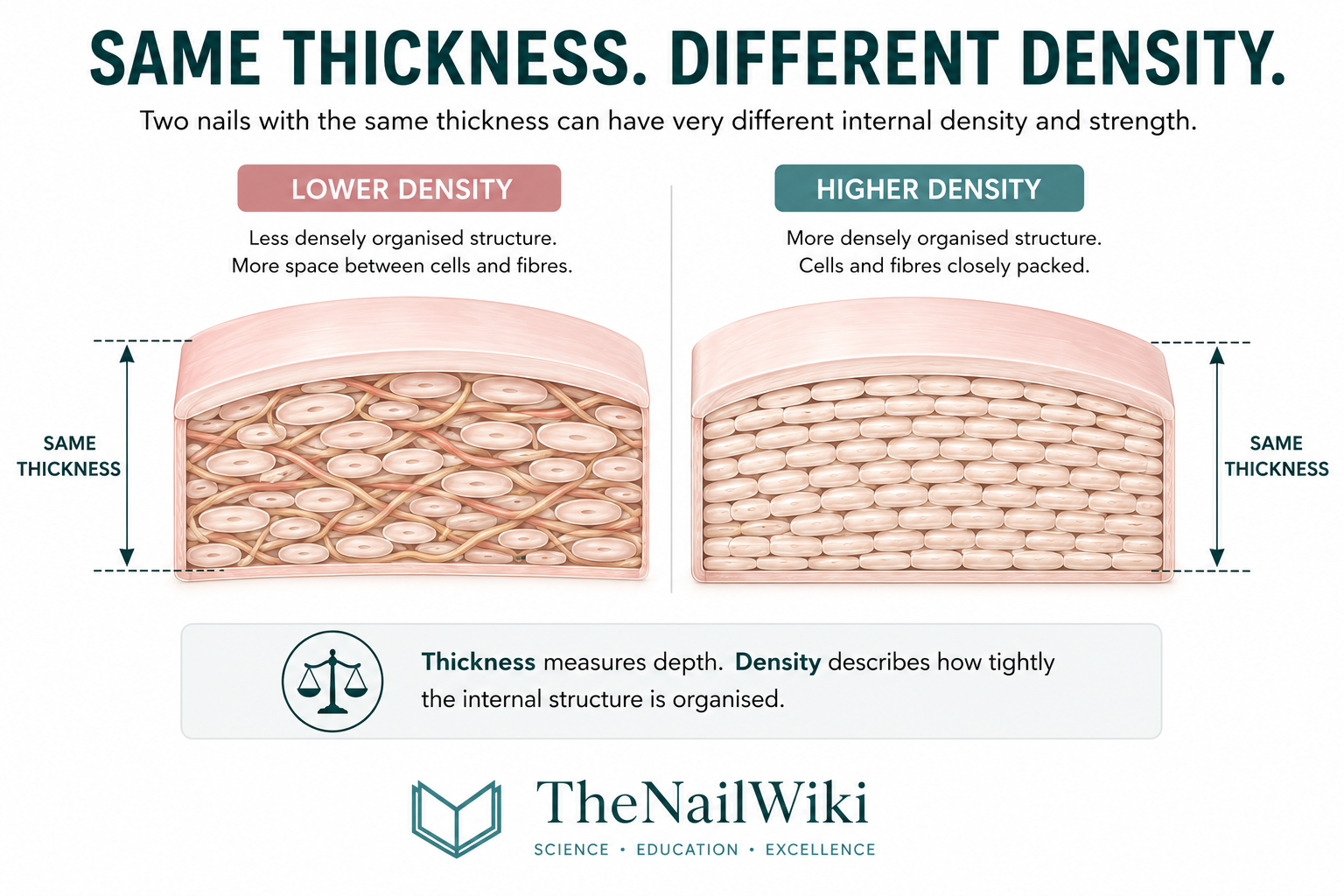
Density describes something thickness cannot: how tightly the nail plate’s internal structure is packed together. This depends on how closely the plate’s layers and cells are arranged, and on how densely the keratin within them is cross-linked — the same disulphide bonding covered on the Nail Composition page.
Two nails can be the same measured thickness and still have meaningfully different density. A loosely packed, poorly cross-linked plate can be just as deep, on a ruler, as a tightly packed, well cross-linked one — but the two will behave very differently under the same force. This is why thickness alone is an incomplete way to assess a nail.
© TheNailWiki
It is worth being clear about what this means in practice: thickness can be measured directly, but density is not something a technician measures during a service. There is no simple tool that reads density the way a gauge reads thickness. Density is an inferred property — it is understood from how the nail plate is composed and organised, not read off a measurement.
Greater structural organisation generally influences several aspects of how a nail plate behaves, including its resistance to deformation, how a crack tends to propagate once started, its bending behaviour, and its overall mechanical performance under everyday use. These are general tendencies rather than fixed rules — a densely organised plate is not immune to damage, and a less densely organised one does not automatically fail.
Density Does Not Mean Hardness
Density, hardness, stiffness, strength, and flexibility are frequently used as though they were interchangeable, but they describe different material properties. A nail plate can be dense without being especially hard. It can be hard without being particularly flexible. None of these properties can be reliably predicted from any one of the others — a fuller explanation of how these terms differ is covered on the Nail Material Science page.
This matters in practice because technicians sometimes use these words as though observing one property tells them about all the others. A nail that feels hard is not necessarily dense in its internal structure, and a nail with good density is not automatically resistant to every kind of mechanical stress. Each property has to be considered on its own terms.
| Property | Describes |
|---|---|
| Thickness | How deep the nail plate is |
| Density | How tightly the internal structure is organised |
| Structure | The overall organisation of the nail plate and how it behaves under force |
These three terms are related but not synonymous, and are frequently used interchangeably in professional conversation even though they describe different things.
Hydration adds a further layer of nuance. A hydrated nail is not automatically thicker in the structural sense — absorbed water does not add to the plate’s physical depth in any meaningful way. What hydration does influence is flexibility and material behaviour more broadly, a relationship that depends on how readily water moves through the plate in the first place, covered in detail on the Nail Porosity page.
Why Thick Does Not Automatically Mean Strong
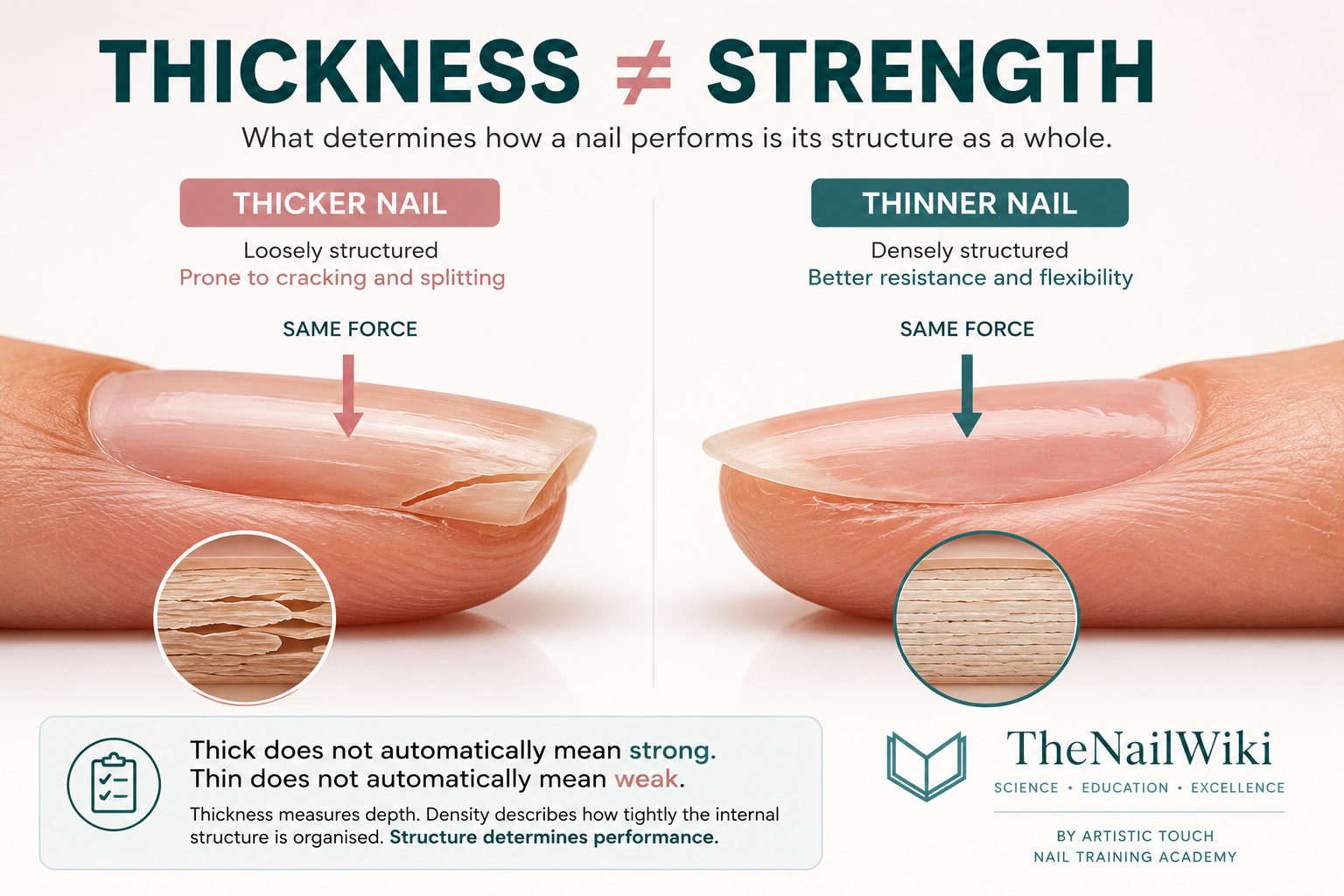
It is intuitive to assume that a thicker nail is automatically a stronger one, in the same way a thicker piece of material is often assumed to be sturdier. This intuition is only partly correct, and treating it as a reliable rule leads to inaccurate assessment.
© TheNailWiki
- Thick does not automatically mean strong — a thick nail with loosely packed structure can still crack or split under force
- Thin does not automatically mean weak — a thin nail with well cross-linked, tightly packed structure can perform well under the same force
- Dense and thick are not the same thing — one measures depth, the other measures how tightly the material within that depth is organised
- Structure matters more than thickness alone — how the plate is built determines performance more reliably than how deep it measures
This distinction is closely related to the broader point explored on the Nail Material Science page: a single measurement, whether that is thickness, hardness, or any other individual property, is rarely enough to predict how a nail or enhancement will actually behave under real-world force.
Practical Implications for Filing, Product Choice, and Enhancement Design
Assessing a nail by thickness alone can lead to two opposite mistakes. Assuming a thick nail is automatically resilient can lead to more aggressive filing or a heavier product than the nail’s actual density can support. Assuming a thin nail is automatically fragile can lead to unnecessarily cautious product choices for a client whose nail, despite its measured thinness, is actually well structured and performing perfectly well.
In enhancement design, this is one more reason product distribution and architecture matter more than simply building more product onto the nail. Simply increasing product volume does not automatically improve performance if architecture, stress distribution, and product placement remain incorrect — a thicker enhancement built on the same flawed structural decisions will still fail in largely the same ways, just with more material involved. What matters is how the material, at whatever thickness, is structured.
Common Misconception
“Thick nails are always stronger than thin nails.” This is not accurate. Strength depends on density and structural organisation as much as depth — a thick nail with loosely packed internal structure can perform worse under force than a thinner nail with a well cross-linked, tightly organised structure. Thickness is one measurable property among several, not a reliable stand-in for overall strength.
Professional nail assessment should never rely on thickness alone. Thickness is only one measurable property of the nail plate. Understanding density, structure, architecture, hydration, and material behaviour provides a far more accurate picture of how a natural nail is likely to perform.
Frequently Asked Questions
What is the difference between nail thickness and nail density?
Thickness is a measurement of how deep the nail plate is. Density describes how tightly packed and cross-linked the plate’s internal structure is. Two nails can be the same thickness and have very different density.
Are thick nails automatically strong?
No. A thick nail with loosely packed internal structure can still crack or split under force. Thickness alone does not determine how well a nail performs — density and overall structure matter just as much.
Are thin nails automatically weak?
No. A thin nail with well cross-linked, densely packed structure can perform well under force, sometimes better than a thicker but loosely structured nail.
Does building a thicker enhancement make it stronger?
Not automatically. As with natural nails, an enhancement’s strength depends on how the product is structured and distributed, not simply on how much of it is applied.
What actually determines whether a nail is strong?
No single measurement does. Strength depends on a combination of factors, including density, layered structure, hydration, and how the nail or enhancement is built, rather than on thickness in isolation.
Is nail density the same as nail hardness?
No. Density, hardness, flexibility, and strength describe different material properties. One cannot be substituted for another when assessing a nail.
Can filing change nail density?
No. Filing reduces nail thickness by removing material. It does not increase or decrease the intrinsic density of the nail plate that remains.
Continue Your Professional Learning
Understanding that thickness and density are different properties explains why a thick nail can still fail and a thin nail can still perform well. If you would like to apply this thinking to real assessment and enhancement decisions, continue your learning below.
🎓 Professional Training
New to Artistic Touch?
🎁 Free Mini Classes — Explore free professional nail education
Related Library Pages
Nail Anatomy
Nail Science & Mechanics
Professional Disclaimer
This page is provided for professional educational purposes and describes general nail plate properties. It is not a diagnostic resource. Persistent or unexplained nail changes should be assessed by a qualified medical professional.

About the Author
Radina Ignatova
Professional Nail Expert | International Nail Educator
Radina Ignatova is a Professional Nail Expert since 2014, International Nail Educator, and Founder of TheNailWiki and Artistic Touch Nail Training Academy. She specialises in Russian Manicure, dual form systems, polygel, advanced e-file techniques, and nail safety protocols, and continues to work actively in salon practice, ensuring that all education reflects real client scenarios and current industry standards.
Her teaching philosophy is built on honest education — showing real salon challenges, real mistakes, and real performance testing rather than presenting only perfect demonstrations. This is how genuine technical competence is developed and how nail professionals become truly confident and capable.
Read full bio →© 2026 TheNailWiki. All rights reserved.