
How to Choose a Trustworthy Nail Salon: A Client's Guide

© TheNailWiki
Quick Summary
A trustworthy nail salon is one that keeps its tools clean and sterilised, treats your natural nails and skin gently, and answers your questions openly. You can judge most of this yourself by watching how the salon works and asking a few simple questions before you book or begin your appointment.
Key things to look for: visible hygiene routines and sterilised or single-use tools, a technician happy to explain their process, a short consultation about your nails and any sensitivities, and no pressure or pain. Qualifications and insurance are reassuring, but good day-to-day practice is what matters most.
What Makes a Nail Salon Trustworthy?
A trustworthy nail salon is simply one that puts your nail health first: it keeps tools clean and sterilised, works gently on your natural nails and the skin around them, and is happy to explain what it is doing and why. Most of these signals are visible if you know where to look, which means you do not need any technical training to make a sensible, confident choice.
It helps to keep a sense of proportion. The great majority of established salons take hygiene seriously, and a well-run appointment carries very little risk. The aim of this guide is not to make you anxious, but to help you recognise good practice so that you can relax once you have found it—and gently move on if something does not feel right.
Think of it as a short, friendly assessment rather than an interrogation. A few minutes of observation and one or two polite questions usually tell you what you need to know, and good technicians tend to welcome them.
A Simple Way to Think About It
"The best salons make their standards easy to see. If tools come out of sealed pouches, disposable items are opened in front of you, and your technician is glad to answer questions, you are usually in safe hands."
— Radina Ignatova, Professional Nail Expert & Educator
Hygiene and Sterilisation Signals
Hygiene is the single most useful thing to observe, because it protects you from the small but real risks associated with any treatment that touches skin and nails. You can assess most of it simply by watching the first few minutes of your appointment.
Tools and Sterilisation
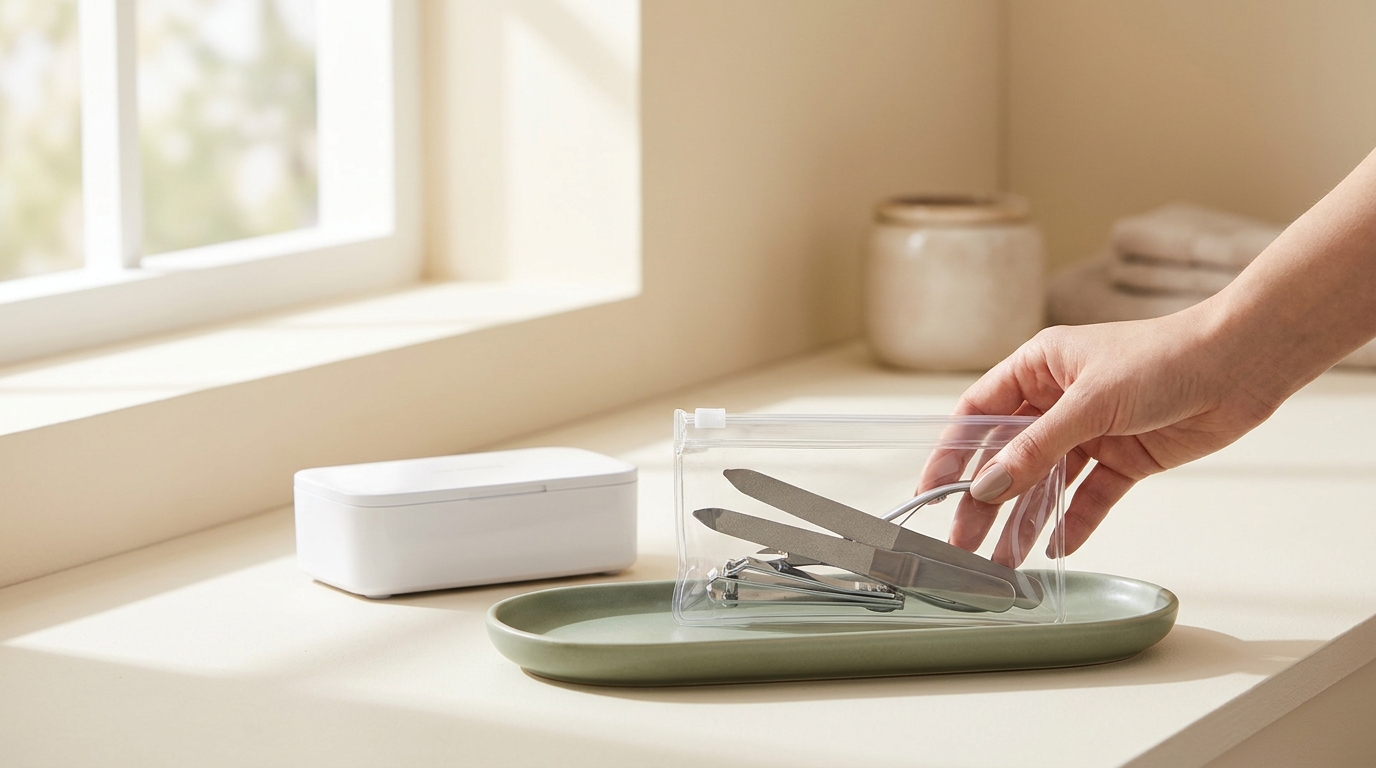
Metal tools such as cuticle pushers and nippers should be cleaned and properly sterilised between clients, ideally in an autoclave, and stored in sealed pouches until they are needed. A reassuring sign is seeing a fresh, sealed pouch opened at your station rather than tools being taken straight from a shared pot or drawer.
- Metal implements: Cleaned and sterilised between every client. Sealed sterilisation pouches opened in front of you are a good sign.
- Files and buffers: Porous items that cannot be fully sterilised should be single-use, or kept for one client only. Watch for a fresh file being opened or your own file being stored for future visits.
- Disposable items: Things like orange wood sticks, cotton pads and toe separators should be new each time and thrown away afterwards, never reused on the next client.
- Foot spas (for pedicures): Basins and any removable parts should be cleaned and disinfected between clients, with fresh liners where used.
The Workspace and General Cleanliness
Beyond the tools, the wider environment tells its own story. Look for clean, wiped-down workstations, fresh towels for each client, and a technician who washes their hands or uses fresh gloves before starting. Reasonable ventilation matters too, particularly where filing dust or product vapours are produced.
A Note on Cutting Cuticles
The cuticle is living tissue that helps seal the nail. Careful technicians usually soften and gently push it back rather than cutting it away, because cutting living skin can create small openings where bacteria may enter. Occasional tidying of loose, dead skin is normal; routine cutting that leaves the area sore or bleeding is worth avoiding. If a treatment ever hurts, it is always fine to ask your technician to stop.
Sensible Questions to Ask
You do not need to memorise a checklist. A few natural, friendly questions—asked when you book or when you sit down—will give you a clear picture. How a technician responds is often as telling as the answer itself: calm, open replies are a good sign, while defensiveness is worth noting.
- How do you clean and sterilise your tools between clients? You are listening for a clear, confident answer that mentions sterilising metal tools and using single-use items where needed.
- Are files and buffers single-use, or kept for me? Either answer can be fine, as long as porous items are not shared between clients.
- I have sensitive skin (or a past reaction)—what products do you use? A good technician will happily discuss products and, where relevant, suggest a patch test before a new gel or enhancement.
- What training and insurance do you have? Most established professionals are glad to mention their qualifications and that they hold insurance.
If you have a specific concern—thinning nails, a recent injury, or a skin condition near the nail—mention it early. A conscientious salon will adapt the treatment or suggest waiting until the area has healed, and that honesty is a strong sign of trustworthiness.
What Qualifications Do and Don't Guarantee in the UK
It surprises many clients to learn that, in much of the UK, there is no single national licence that a nail technician must hold in order to work. The rules that do exist are set locally, so requirements can vary noticeably from one council area to another. Understanding this helps you weigh qualifications sensibly rather than relying on them alone.
What Local Rules Usually Cover
Some local authorities operate registration or licensing schemes for salons or for certain treatments, and standards can differ between areas. Because this is decided locally, a certificate on the wall is one useful piece of information among several rather than proof of a fixed national standard.
What a Qualification Tells You
A recognised nail qualification shows that a technician has completed structured training and learned the principles of safe practice, which is genuinely reassuring. Many also hold professional or public liability insurance, which usually requires a recognised qualification and is a further sign of an established professional.
What a certificate cannot do is prove how carefully those standards are applied on the day. The most reliable evidence remains what you can see and feel: clean tools, a gentle touch, and clear communication. The strongest reassurance comes when qualifications, insurance and visibly good practice all point the same way.
Reasonable Red and Green Flags
The table below gathers the signals worth noticing. None of these need to be dramatic: choosing a salon is usually about a general impression rather than a single deciding factor. Treat green flags as reassurance and red flags as gentle prompts to ask a question or, if you prefer, try somewhere else next time.
A single minor point rarely means much on its own. It is the overall pattern that counts: when the green flags clearly outweigh anything that gives you pause, you can settle in and enjoy your appointment.
Where to Begin Your Search
Personal recommendations remain one of the best starting points—a friend whose nails you admire can point you towards a salon they already trust. Reading recent reviews and looking at a salon's own photos of their space and work can also give you a feel for their standards before you visit.
Some directories go a step further by verifying the professionals they list, which can be a helpful shortcut when you are new to an area. TheNailWiki's verified salon directory is one such option, listing UK salons whose details have been checked. However you find a salon, the same visit-day signals in this guide are still worth applying once you are in the chair.
Frequently Asked Questions
Do nail technicians need a licence in the UK?
In much of the UK there is no single national licence that a nail technician must hold to work. Requirements are set locally, so some councils operate registration or licensing schemes while others do not. This is why it is sensible to judge a salon on its visible standards and communication as well as any certificates on display.
How can I tell if the tools have been properly cleaned?
The clearest signs are sealed sterilisation pouches opened at your station, and single-use items such as files, wood sticks and cotton pads opened fresh and thrown away afterwards. Tools taken straight from a shared pot or drawer, or a porous file reused on the next client, are worth questioning.
Is it safe to have my cuticles cut?
The cuticle is living tissue, and careful technicians generally soften and push it back rather than cutting it away, because cutting living skin can create small openings where bacteria may enter. Tidying genuinely loose, dead skin is normal; if the area is left sore or bleeding, that is a reason to raise it with your technician.
What are the most important red flags?
Reused porous tools, visibly unclean workstations, a technician who is defensive about hygiene questions, and treatments that routinely cause pain or bleeding are the ones worth taking seriously. Strong pressure to add services you did not ask for is also a sign to slow down.
Should I worry about infections from a manicure?
For most people at a well-run salon, the risk is low. Sensible hygiene—clean, sterilised tools and gentle handling of the skin—keeps it that way. If you ever notice persistent redness, swelling, pain or discharge around a nail after a treatment, it is best to seek advice from a pharmacist or GP.
Do qualifications guarantee a good salon?
Qualifications and insurance are genuinely reassuring, because they show structured training and a professional approach. They cannot, however, prove how carefully standards are applied on the day. The strongest reassurance is when training, insurance and visibly good practice all line up together.
A Note on This Guide
This article offers general, educational guidance to help clients choose a nail salon with confidence. It is not medical advice, and local rules vary across the UK. If you notice signs of infection or irritation around a nail—such as persistent redness, swelling, pain or discharge—seek advice from a pharmacist, GP or other qualified healthcare professional.
Note: This guide offers general, client-focused advice on choosing a nail salon and reflects widely accepted hygiene and safety principles. Local rules vary across the UK. TheNailWiki is an independent educational resource and maintains editorial independence from all commercial interests.