
Builder Gel, Soak-Off Builder Gel, and Hard Gel: What the Terms Mean
Author: Radina Ignatova — Nail Expert, International Nail Educator | Last Updated: July 2026
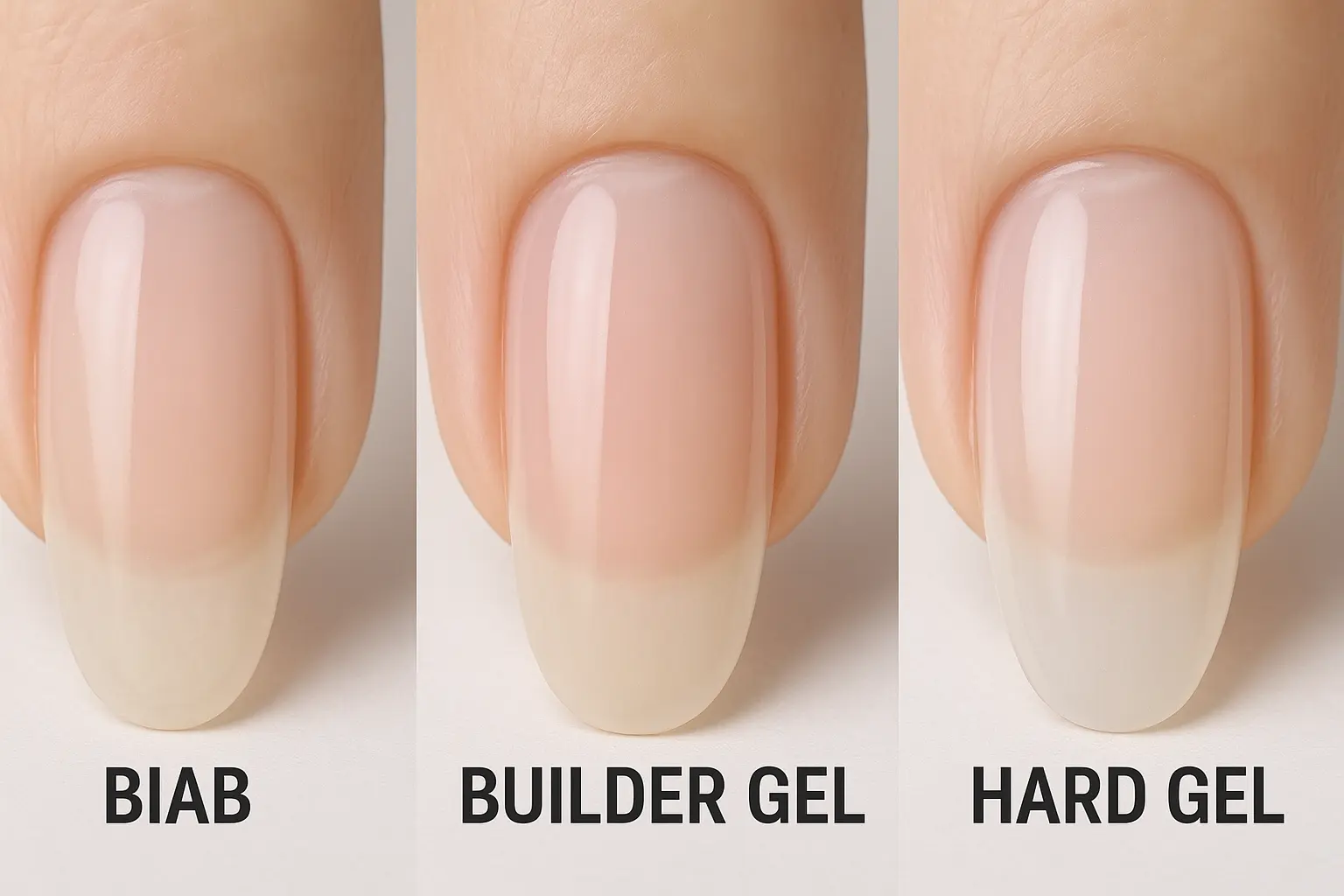
© TheNailWiki
Quick Answer
A soak-off builder gel is designed to soften during the manufacturer’s specified acetone-removal process.
A hard builder gel does not soften sufficiently for soak-off removal and must be reduced or removed through controlled filing.
Builder gel is the wider category and may belong to either removal group. Bottle or pot packaging does not determine whether a product is soak-off, hard gel, flexible, rigid, or suitable for long extensions.
Builder gel, soak-off builder gel, and hard gel are often presented as completely separate nail systems. In practice, these terms describe different characteristics of gel products rather than three fixed levels of strength.
“Builder gel” describes the product’s purpose: creating reinforcement, thickness, or structural architecture. “Soak-off” and “hard gel” primarily describe how the cured material behaves during removal.
A builder gel may therefore be soak-off or file-off, supplied in a bottle or pot, self-levelling or shape-retaining, suitable for overlays or extensions, and more flexible or more rigid after curing. The product name alone does not reveal all of these characteristics. Nail technicians must check the exact manufacturer instructions before selecting, applying, curing, or removing any gel system.
1. What “Builder Gel” Describes
“Builder gel” is a description of what a product is designed to do: build structure, reinforcement, or thickness on the nail. It is not a description of removal method, molecular density, viscosity, or packaging.
The category is broad. Products marketed as builder gels include soak-off formulations, hard gels, self-levelling gels, thick sculptable gels, bottle-format products, and pot-format products. What they share is structural purpose. The remaining characteristics vary by formulation and manufacturer.
Because the term is used inconsistently across training providers, regional markets, and manufacturers, it does not reliably identify a product’s removal method. Technicians encountering a product labelled “builder gel” for the first time should treat the name as partial information only and confirm all relevant properties from the manufacturer’s documentation.
2. Soak-Off Builder Gel
A soak-off builder gel is formulated to soften when exposed to acetone during the manufacturer’s specified removal process. The molecular structure of the cured product allows acetone to penetrate the polymer and break it down sufficiently for removal without complete mechanical filing.
“Soak-off” confirms one thing: removal method. It does not indicate how flexible the cured product is, whether it can support extensions, how thick or self-levelling it is, or how long it is likely to last. Two products both correctly labelled as soak-off builder gel may handle, cure, and perform entirely differently because their formulations differ.
Removal Method vs Flexibility
There is a common assumption that soak-off products are more flexible than hard gel, or that soak-off means the product is a “soft gel.” This is not accurate as a universal rule. Flexibility after curing is a formulation property. Some soak-off builder gels cure with significant rigidity. Some hard gels are formulated to be more flexible. The removal characteristic and the post-cure mechanical behaviour are separate properties determined by different aspects of the formulation.
“Soak-off” describes the removal process the manufacturer has validated for that product. It does not describe what the cured product feels like, how strong it is, or whether it is suitable for nail extensions. These properties must be verified separately.
Soak-Off Is Not Guaranteed by the Label Alone
The manufacturer’s removal instructions specify the method and products required. Some soak-off builder gels require foil wrapping with an acetone-soaked pad. Others require a specific soak duration. Some require light filing of the surface before soaking to allow penetration. Following a general soak-off method with a product that requires a different protocol may produce incomplete removal and is not a reliable test of whether the product is soak-off or file-off.
3. Hard Builder Gel and Hard Gel
A hard builder gel, or hard gel, is a gel product that does not soften sufficiently during acetone exposure for soak-off removal. The cured molecular structure requires controlled filing or grinding to reduce or remove the product from the nail.
The terms “hard gel” and “hard builder gel” are used interchangeably in professional contexts. The relevant characteristic in both cases is the removal method: these products require mechanical reduction rather than chemical softening.
© TheNailWiki
In the context of gel systems, “hard” refers to the removal property, not the physical hardness of the cured product. Some hard gels cure with a degree of flexibility. Some soak-off builder gels cure harder than certain hard gels. Comparing products on the basis of the “hard” or “soak-off” label alone does not produce an accurate assessment of their structural properties.
Removal Requires Controlled Filing
Because hard gel cannot be soaked away, the technician must file or grind the product down to the natural nail surface. The level of product control required during this process means that hands-on training in filing technique is necessary before offering hard gel services. Filing at incorrect pressure or depth removes natural nail plate rather than product.
Professional Note
Filing hard gel generates airborne dust containing product particles and nail material. Appropriate dust extraction and respiratory protection are relevant during removal services, both for the client and the technician. Manufacturer guidance on removal safety should be followed.
4. Packaging Format: Bottle and Pot
Bottle format means the product is supplied with an attached brush and applied directly from the container. Pot format means the product is applied using a separate brush or spatula. These are descriptions of how the product is delivered and applied, not of its removal method, strength, or flexibility.
Bottle-format builder gels tend toward self-levelling viscosities because that characteristic suits application from an attached brush. Pot-format gels are often thicker and more shape-retaining, which suits structural work and apex building using a separate brush. However, both formats exist in soak-off and hard gel versions. Packaging is not a reliable indicator of removal method.
Branded Bottle-Format Builder Gels
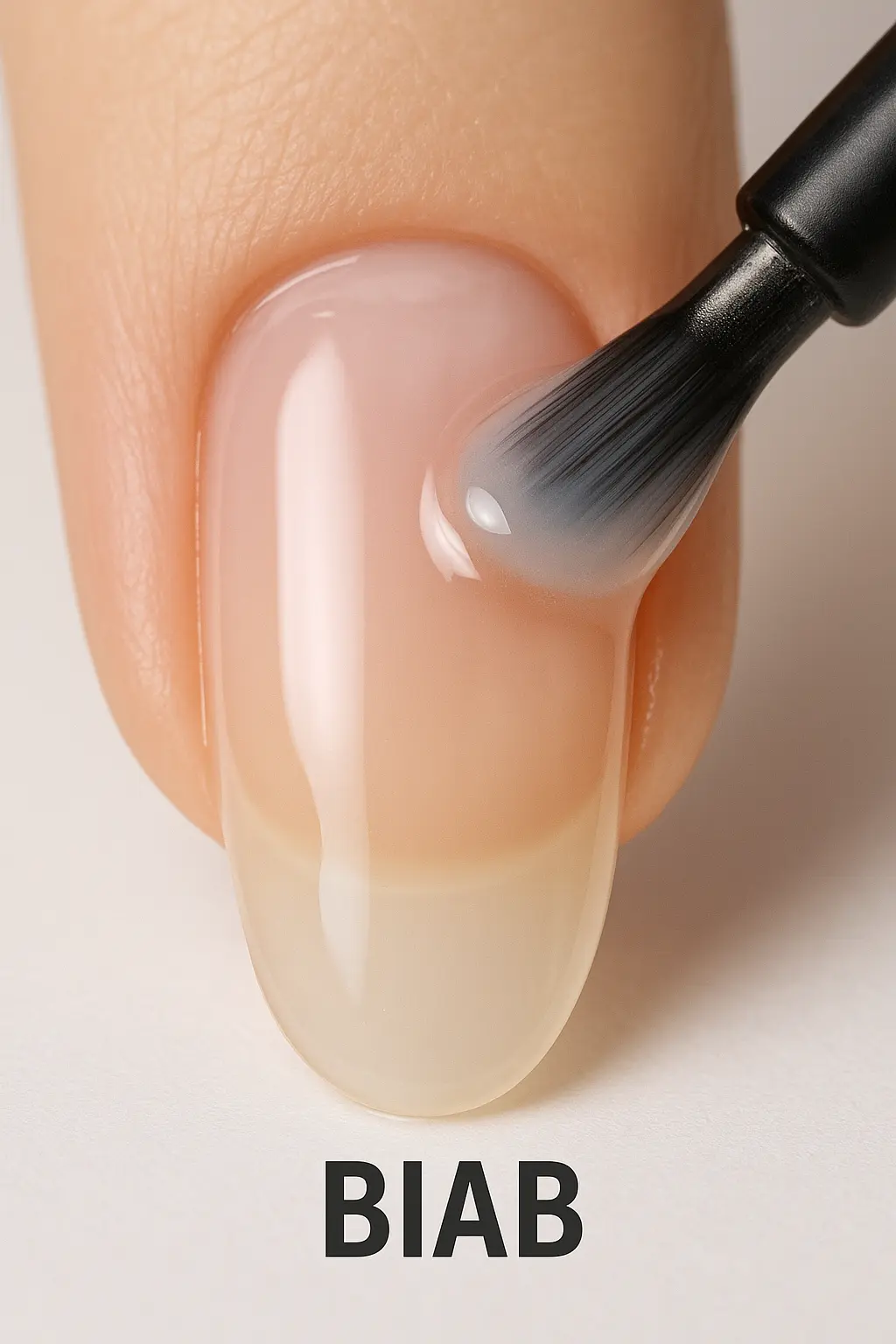
© TheNailWiki
Several manufacturers produce soak-off builder gels in bottle format with an attached brush. BIAB (Builder in a Bottle, by The GelBottle Inc) is one well-known example in this category. Other manufacturers produce bottle-format builder gels under different brand names, with different formulations, different viscosities, different lamp requirements, and in some cases different removal requirements. “Builder gel in a bottle” is not a product category with standardised properties. Checking the manufacturer’s instructions for each specific product remains necessary regardless of the format.
Bottle format is an application convenience. It does not confirm that the product is soak-off, that it is flexible, that it suits overlays, or that it suits extensions. Verify these properties from the manufacturer’s own documentation for the specific product.
5. What Product Labelling Does and Does Not Confirm
The table below summarises what each common term reliably indicates and what it does not. Because product behaviour varies by formulation, these descriptions reflect the terms as general indicators, not as confirmed product specifications for any individual product.
| Term | What It Confirms | What It Does Not Confirm |
|---|---|---|
| Builder gel | Purpose: structural reinforcement or thickness | Removal method, flexibility, viscosity, suitability for extensions |
| Soak-off | Removal: softens during manufacturer’s acetone-removal process | Flexibility, rigidity, strength, suitability for overlays or extensions |
| Hard gel / hard builder gel | Removal: controlled filing required; does not soak off | Physical hardness relative to soak-off products, flexibility, durability |
| Bottle format | Packaging: attached brush, direct application from container | Removal method, flexibility, viscosity, structural suitability |
| Pot format | Packaging: separate brush or spatula required for application | Removal method, flexibility, viscosity, structural suitability |
Soak-Off Builder Gel vs Hard Builder Gel: Characteristic Comparison
The table below compares the two removal categories. Characteristics listed as “formulation dependent” or “product dependent” vary between individual products and must be confirmed from the manufacturer’s documentation for the specific product in use.
| Characteristic | Soak-off builder gel | Hard builder gel |
|---|---|---|
| Primary removal method | Manufacturer-specified soak-off process | Controlled filing or grinding |
| Bottle or pot format | Either | Either |
| Suitable for overlays | Product dependent | Product dependent |
| Suitable for extensions | Product dependent | Product dependent |
| Flexibility after curing | Formulation dependent | Formulation dependent |
| Viscosity | Formulation dependent | Formulation dependent |
| Curing requirements | Manufacturer specific | Manufacturer specific |
6. Checking Manufacturer Instructions Before Use
The manufacturer’s instructions for a specific product are the only reliable source of information about its removal method, curing requirements, lamp compatibility, application method, and whether it is designed for overlay, extension, or both. General category descriptions do not substitute for this.
Before Using a New Builder Gel Product
Confirm the removal method from the manufacturer’s documentation, not from the product name or packaging format. Confirm the recommended lamp — lamp compatibility is specific to the product’s photoinitiator formulation, and wattage alone does not confirm that a lamp will cure the product correctly. Confirm whether the product is intended for overlay services, extension services, or both. Follow the manufacturer’s stated curing times for that product under the specified conditions.
When using a product from a new manufacturer or a new product from an existing manufacturer, these checks apply regardless of whether the category name is familiar. Product formulations change, product lines expand, and a manufacturer that produces soak-off builder gels may also produce hard gel products under a similar name.
When Instructions Are Not Available
If a product arrives without adequate instructions, or if instructions are not available in a readable language, the appropriate response is to contact the manufacturer or distributor before use. Assuming removal method or curing requirements from the product name or from experience with a different manufacturer’s product increases the risk of incorrect application, incomplete curing, and incorrect removal.
Skin contact during application is a relevant safety concern with gel products containing acrylate monomers. Regardless of whether a product is soak-off or hard gel, keeping uncured product away from the skin and following the manufacturer’s application guidance reduces exposure risk. See DermNet — Nail Cosmetics Allergy.
Frequently Asked Questions
Related Pages on TheNailWiki
Continue learning about gel structure, product behaviour, and safe removal through TheNailWiki’s professional nail education library.
Browse the Nail Wiki LibraryProfessional Training
Structured training in builder gel application, product selection, and safe removal is available through Artistic Touch Nail Training Academy.
View Courses at Artistic Touch
Radina Ignatova
Professional Nail Expert | International Nail Educator
Radina Ignatova is a Professional Nail Expert since 2014 and the founder of TheNailWiki and Artistic Touch Nail Training Academy. Her areas of professional experience include Russian Manicure, dual form systems, polygel, advanced e-file technique, and nail safety. She works actively in salon practice alongside developing structured professional education.
Her approach to education prioritises diagnostic understanding over technique replication, and honest assessment of how products and processes behave in real salon conditions.
View Profile on TheNailWiki →© 2026 TheNailWiki. All rights reserved.