
Standard vs Non-Standard Nail Salons: What Clients Need to Know
Author: Radina Ignatova, Professional Nail Expert & International Nail Educator | Last Updated: April 2026
Quick Answer: Not all nail salons operate to the same professional standard. The difference between a standard professional nail salon and a non-standard one is not primarily about price or location — it is about product safety, preparation technique, hygiene protocols, removal practice, and how the business operates. This page explains what separates professional nail services from high-risk ones, what the warning signs look like, and why some clients walk out of one type of salon with healthy nails and walk out of the other with lasting damage.
A Note on How to Read This Page
This page does not make accusations against any individual business, nationality, or group of workers. The issues described — unsafe products, over-filing, poor hygiene, and labour exploitation — are documented problems within a specific type of high-volume, low-cost nail service model. They are not universal across any community or country of origin.
The purpose of this page is to educate clients about the difference between professional, safety-led nail services and high-risk ones — so they can make informed decisions and recognise warning signs before, during, and after a nail service.
Contents
- What a Standard Nail Salon Does
- Insurance and Licensing
- What Makes a Salon Non-Standard
- Product Safety — MMA and Cheap Acrylic Systems
- Over-Filing and E-File Damage
- Why Some Acrylics Feel Like Cement During Removal
- Why Some Products Appear to Last Longer — and Why That Is a Red Flag
- Hygiene Warning Signs
- Very Low Pricing — How It Is Made Possible
- Cash Only, No Booking System, Poor Communication
- UK Public Reports — Labour Exploitation in Nail Bars
- Product Transparency
- Patch Testing and Allergy Awareness
- Air Quality and Dust Control
- Pain During a Nail Service Is Not Normal
- Fast Does Not Mean Better
- Aftercare Guidance and Long-Term Nail Health
- Short-Term Results vs Long-Term Nail Health
- How Clients Can Protect Themselves
- What a Professional Nail Service Should Feel Like
- How to Choose a Safe Nail Technician
- Frequently Asked Questions
What a Standard Nail Salon Does
A standard professional nail salon follows recognised professional practices, safety protocols, and ethical service standards. The focus is not only on how the nails look at the end of the service — it is on how the service is performed and what it means for the health of the nail over time.
Nail health comes first
A professional salon does not damage the natural nail to make products last longer. Preparation is controlled — the nail plate is prepared correctly without aggressive over-filing. Products are chosen based on the client’s nail type. The result is healthier nails over time, reduced risk of thinning or lifting, and safer long-term wear.
Controlled adhesion — not forced retention
In a professional service, the product adheres correctly and wears predictably — typically two to four weeks — and can be removed safely without damage. The product is designed to adhere properly and to break down during removal. This is the difference between healthy retention and over-adhesion that harms the nail plate.
Professional-grade products
Standard salons use regulated professional-grade systems — products selected for safety and performance. This reduces the risk of allergic reactions, overly rigid enhancements that are difficult to remove, and inconsistent product behaviour.
Hygiene and infection control
Tools are cleaned, sanitised, and sterilised between clients. Disposable items — such as sanding bands — are used once and discarded. The workstation is kept clean and surfaces are disinfected between appointments. This is essential to prevent bacterial infections, fungal infections, and cross-contamination.
Proper consultation and communication
A professional service begins with a nail consultation — understanding what the client wants, explaining what is suitable for their nail type, identifying any contraindications, and advising on realistic results. This prevents unsuitable services, mismatched expectations, and poor outcomes.
Safe removal
Removal is treated with the same care as application. Professional salons use controlled technique, soak off where required, and protect the natural nail throughout the removal process. This prevents over-filing, plate thinning, and the long-term weakening that comes from aggressive removal.
Insurance and Licensing — Professional Accountability
Professional insurance
A professional nail salon and every technician working in it should hold valid professional liability insurance — also referred to as treatment liability or beauty therapy insurance. This is not a technicality. It is the financial and legal mechanism that protects a client if something goes wrong during a nail service — a reaction, an injury, an infection, or damage caused by incorrect technique or product use.
Without insurance, a client who suffers harm from a nail service has no practical route to compensation or accountability. The business has no registered obligation to respond to a complaint, and there is no insurer to deal with a claim. In a cash-only, unregistered operation with no client records, there may not even be a named individual to hold responsible.
Professional insurance also requires that the technician holds appropriate training qualifications — insurers do not cover practitioners who cannot demonstrate competence. This means that a properly insured nail technician has, by definition, been assessed as trained to a recognised standard.
What the absence of insurance means for clients
- If you are injured, develop an infection, or have a reaction, there is no insurer to make a claim against
- There is no financial protection if the service causes lasting damage
- The technician has no professional obligation backed by a third party to maintain standards
- There may be no record that you were ever there
Licensing and qualification — where applicable
In the UK, nail technicians are not currently required to hold a mandatory government-issued licence to practise — unlike in many US states, where a cosmetology or nail technician licence is a legal requirement before any paid service can be performed. This absence of mandatory licensing in the UK means that anyone can set up as a nail technician without any formal training, assessment, or registration.
Professional bodies such as BABTAC (British Association of Beauty Therapy and Cosmetology) and VTCT provide qualification frameworks and membership schemes that represent voluntary professional standards. A technician who is a registered member of a professional body and holds recognised qualifications has made a measurable commitment to professional standards. A technician with no qualifications, no insurance, and no professional body membership has made none.
The Independent Anti-Slavery Commissioner has previously recommended that mandatory licensing for nail technicians should be considered — partly as a mechanism for addressing the labour exploitation documented in unregistered operations. Until such licensing exists, the absence of voluntary professional membership and insurance remains a meaningful indicator of how seriously a business takes its professional obligations.
What Makes a Salon Non-Standard
Non-standard nail salons are typically characterised by a high-volume, low-cost, speed-focused service model. They are not defined by location, size, or any specific group of people who work in them — they are defined by the practices they follow and the standards they do not.
The service model is built around reducing time, reducing product cost, and maximising the number of clients per day. The steps that are skipped or abbreviated to make this possible — preparation, consultation, safe removal, proper hygiene — are precisely the steps that protect the client’s health and nail condition.
Many high-volume budget salons are commonly associated with acrylic nail services — quick to apply, requiring no specialist lamp or curing equipment, and using a product system that can be purchased cheaply at very high volume. Not all non-standard salons exclusively offer acrylics, but the service model described here is most frequently associated with this type of offering. The combination of cheap materials, aggressive preparation technique, and minimal finishing time creates a service that looks complete from the outside but carries significant hidden risks.
Product Safety — MMA and Cheap Acrylic Systems
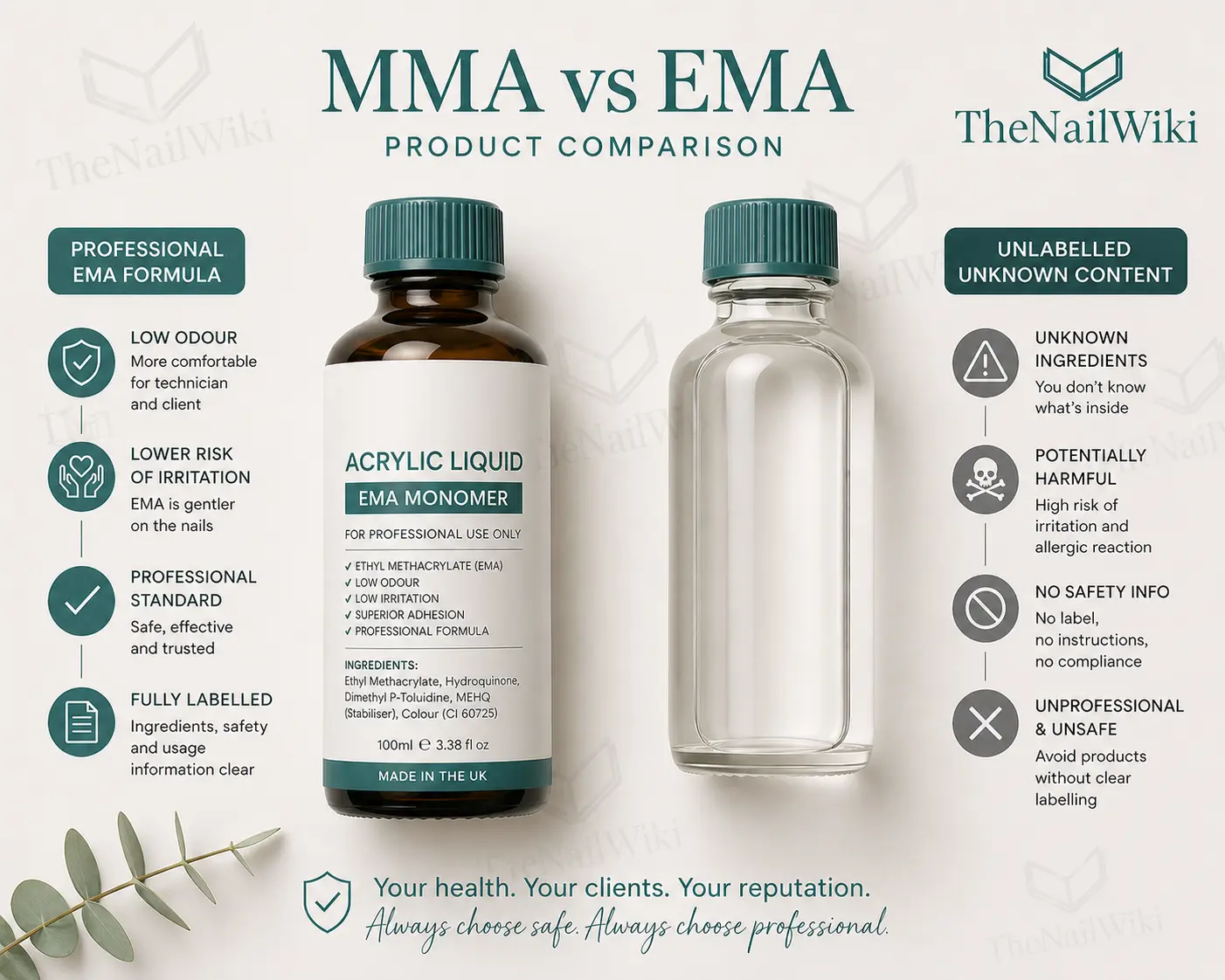
The most significant product safety concern in non-standard nail salons is the use of acrylic liquid monomers containing methyl methacrylate (MMA) — a compound that has been prohibited for use in nail products in the United States since the 1970s following FDA action, and is not recommended for use in UK nail services, with Dudley Council specifically noting that technicians should use EMA or a safer substitute.
MMA-based acrylic creates an extremely hard, dense, rigid structure on the nail. It bonds too aggressively to the nail plate, does not break down predictably with standard acrylic removal solvents, and causes specific patterns of harm: contact dermatitis and sensitisation, permanent nail plate damage, and in serious cases, permanent loss of sensation in the fingertips.
© TheNailWiki
How to recognise MMA-based products
- An unusually strong, sharp, or chemical odour unlike standard acrylic liquid — present during application and when filing the cured product
- Cured enhancements that are extremely hard and very difficult to file even with coarse abrasives
- Enhancements that do not soak off in standard acetone-based removers — can only be filed or drilled off
- A cloudy or milky appearance in the cured product
- Unlabelled containers — the technician will not show or confirm which product brand is being used
Even without MMA, very low-cost acrylic systems bought at bulk discount for high-volume use are often poorly formulated — inconsistent liquid-to-powder ratios in cheap products create an overly rigid, non-flexible structure that behaves similarly to MMA product during removal. The Health and Safety Executive (HSE) has stated that nail dust from artificial nails can cause wheezing, chest tightness, and asthma, and that acrylic fumes can cause headaches, dizziness, and nausea. Proper ventilation and dust extraction are professional requirements — not optional extras.
Over-Filing and E-File Damage
Over-filing is one of the most common and most harmful practices in non-standard nail services. The nail plate is a layered keratin structure — it has a finite thickness and once removed, it does not regenerate at the same rate as surface layers. Filing the nail plate aggressively to create a rough, porous surface for better product adhesion is a technique designed to maximise retention at the cost of nail health.
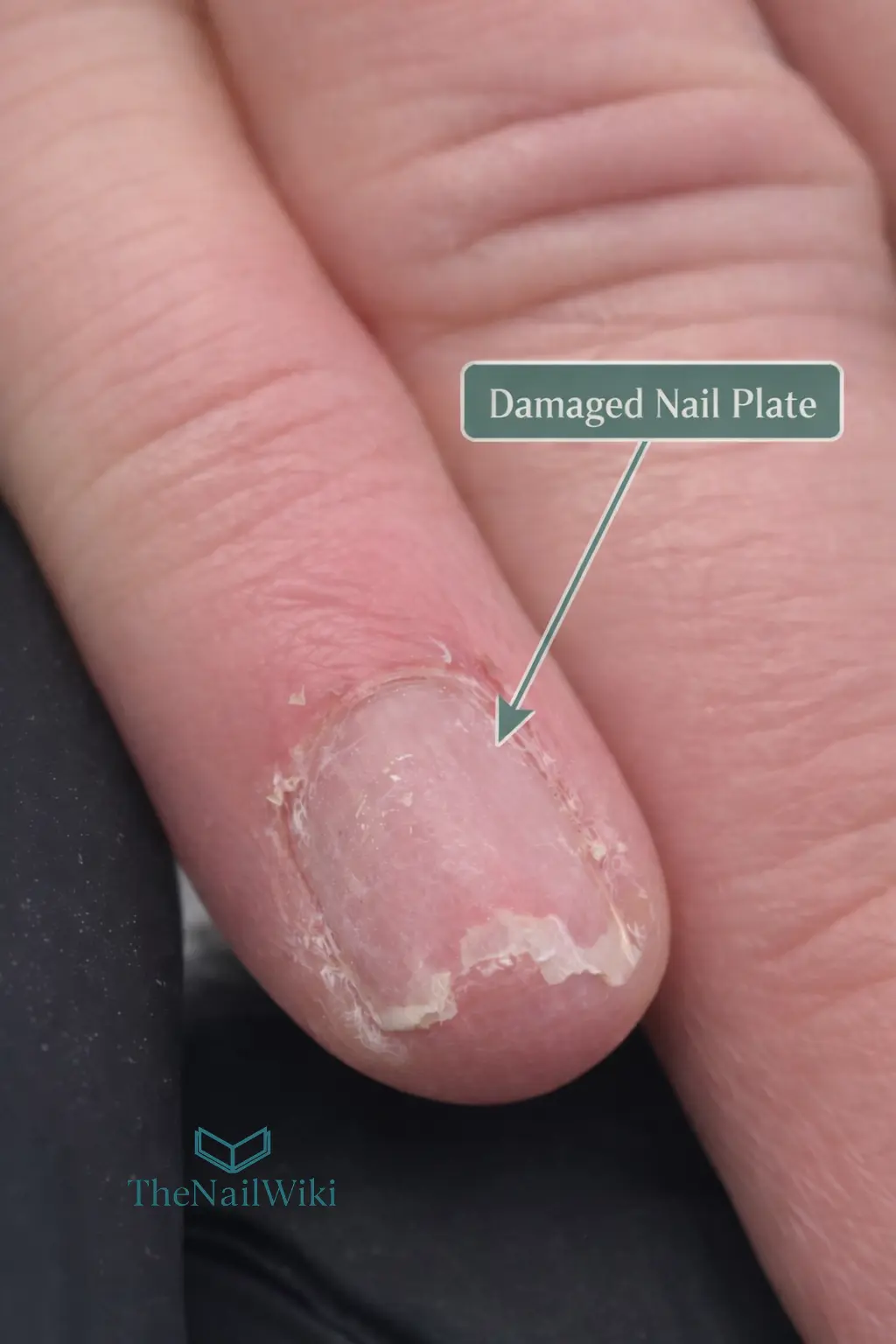
E-file damage — dips, grooves, and thinned plates
Clients who arrive at a professional salon following removal at a non-standard salon frequently present with visible dips, grooves, and thinned areas across the nail plate — the hallmarks of an e-file machine or abrasive tool used at excessive speed with excessive pressure, held stationary in one area rather than kept moving. This damage is not caused by the e-file itself — it is caused by incorrect technique, which is what professional e-file training specifically teaches practitioners to avoid.
In a speed-focused service model, removal is done aggressively — everything is filed off as quickly as possible, without distinguishing between product and nail plate. The client pays the price in damaged nails long after the visible product is gone.
Why Some Acrylics Feel Like Cement During Removal
Professional nail technicians who work on clients transferring from non-standard salons consistently describe the removal experience the same way: the product feels like cement, resists standard solvents, and takes significantly longer to remove safely without causing further damage. This is not accidental — it is the predictable result of several compounding factors.
1. The nail was over-prepared
When the nail plate is aggressively filed, it becomes rough, porous, and deeply scratched. Product applied to this surface does not sit on the nail — it penetrates into the damaged surface layers of the nail plate. Removing it means removing something that has fused into the nail structure rather than sitting on top of it.
2. The product is overly rigid
Dense, inflexible acrylic — particularly when MMA is involved or the product mix ratio is incorrect — creates a structure that does not break down in the way professionally formulated systems are designed to. Standard acetone does not penetrate it in the normal timeframe. The product must be filed or drilled, which increases the risk of going through to the nail plate.
3. Multiple compacted layers
Non-standard salons often do not perform full removal between appointments — they file down the surface and apply new product on top of old. Over repeated visits, layers compress and over-cure, building a dense block of product that has never been fully removed. The professional receiving this client is not removing one fresh set — they are removing months of compacted, over-hardened layers.
4. No soak-off was ever used
In a high-speed service model, soaking off product is too slow. The product is always filed or drilled, never dissolved. So when a client arrives at a professional salon, they have nails that have been drilled repeatedly — thinner with each visit — but never actually soaked off or properly removed. Safe removal takes longer precisely because the technician is trying not to cause further damage to an already compromised nail plate.
“This product is difficult to remove because it has bonded too aggressively into the nail. This usually happens when the nail has been over-prepared or when very rigid systems are used. I will remove it carefully, but it will take longer in order to protect your natural nails.”
— How to explain this to a client in professional language
Why Some Products Appear to Last Longer — and Why That Is a Red Flag
One of the most common things clients say when comparing services is that the cheap salon’s nails lasted longer and nothing lifted. This is not evidence of a better service — it is evidence of forced retention rather than correct adhesion.
When the nail plate is aggressively over-filed, the product is not sitting on a prepared surface — it has penetrated the damaged, porous structure of the nail. It cannot lift because it has nowhere to lift from. This gives the impression of excellent retention while actually indicating that the nail plate has been compromised.
Very rigid acrylic also resists the natural flexing of the nail plate. Rather than lifting at the edges — a predictable and safe failure point — the rigid product transfers stress directly to the nail plate and nail bed, causing onycholysis, nail bed pain, and progressive plate damage that remains hidden until the product is removed.
If a product never lifts at all, it is usually a warning sign — not a positive. Professional systems are designed to last well and to be removed safely. Product that cannot be soaked off or that requires aggressive drilling to remove has not performed better — it has simply failed in a less visible but more damaging way.
© TheNailWiki
Hygiene Warning Signs
Hygiene in nail services matters because the work involves contact with skin, nail plate, and sometimes blood or open skin — all routes through which bacterial, viral, and fungal infections can spread between clients. The HSE notes that nail procedures can spread these infections and that tools must be properly cleaned or sterilised.
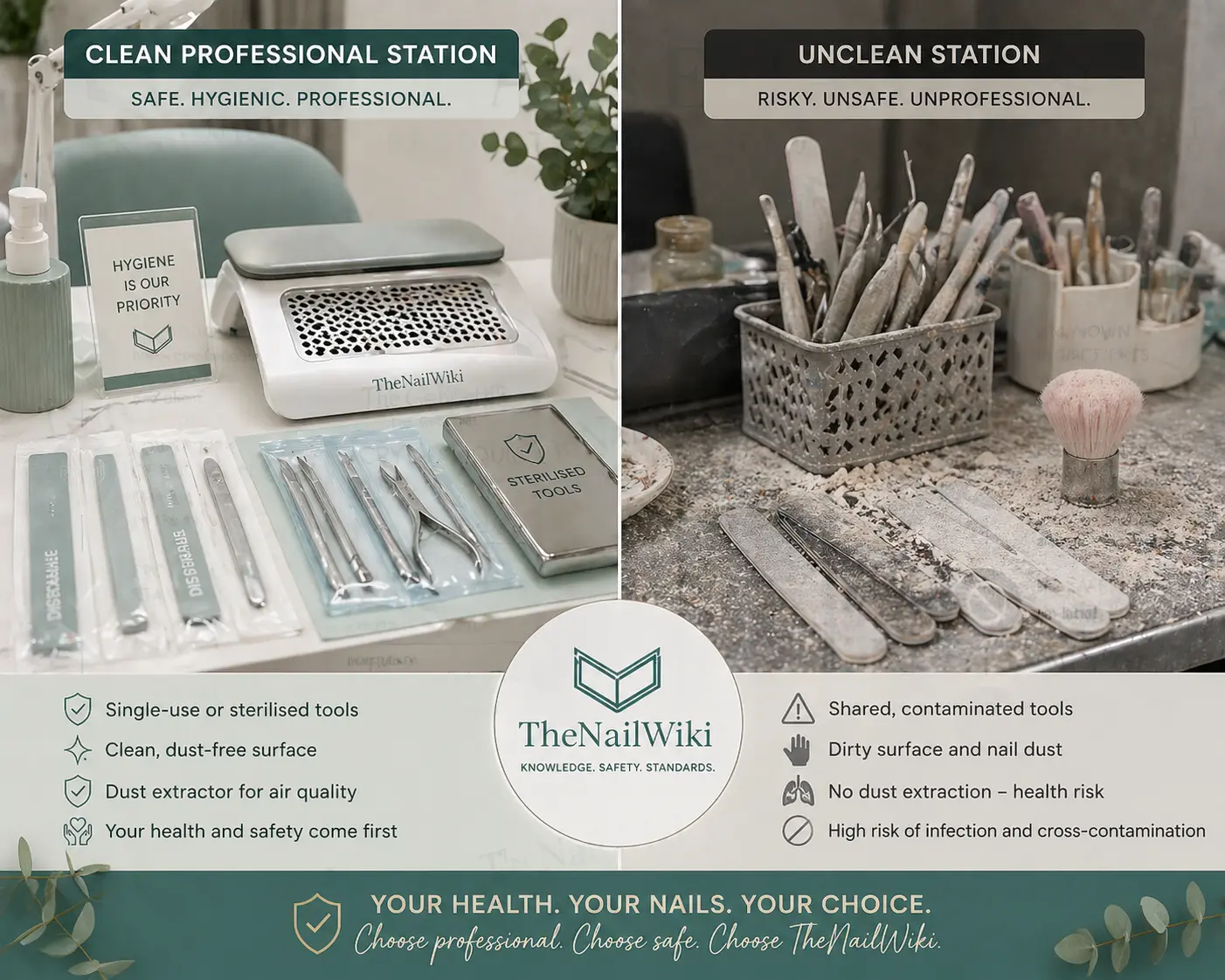
Files and buffers reused between clients
Abrasive nail files and buffers cannot be sterilised — their porous surface retains skin cells, blood, and debris. They should be single-use or client-designated. A file taken from a drawer and used on multiple clients carries infection risk. Professional salons use disposable files per client or keep personal client files.
Metal tools not sterilised between clients
Cuticle nippers, pushers, and e-file bits that contact skin must be sanitised and sterilised between clients. In a high-speed service model, tools are often simply wiped or dipped in liquid — not properly sterilised. This is a direct route for transmitting fungal and bacterial infections.
No dust extraction
Nail dust from artificial product filing contains particles of acrylic, keratin, and product chemicals. Professional services use dust extraction at the workstation to protect both the client and the technician. In the absence of extraction, this dust settles on the work surface and both parties breathe it in throughout the service.
Visibly unclean workstation
Nail dust, product residue, and skin debris on the work surface between clients indicates that decontamination is not being performed between appointments. A clean workstation is a basic professional standard.
Very Low Pricing — How It Is Made Possible
A nail service priced significantly below the professional market rate is not evidence of better value — it is evidence that something has been removed from the service model to make that price possible. Understanding what gets cut helps clients understand what they are actually receiving.
Lower prices come from faster work, cheaper materials, and fewer professional steps. A professional service costs more because it takes more time and uses better products — the price reflects the standard of care, not simply the material cost of acrylic or gel.
Very low pricing, cash-only payment, and the absence of a booking system are often found together in the same operation — and for the same reason. Each one removes a layer of accountability and traceability. A business that keeps no electronic record of transactions, no appointments log, and no client records is a business that has deliberately removed the documentation trail that connects it to its clients, its income, and its working practices. These are not separate warning signs — they are typically part of the same operating model. See: Cash Only, No Booking System, and Poor Communication →
Cash Only, No Booking System, and Poor Communication
Cash only or cash preferred
A salon that accepts only cash — or strongly encourages cash payment over card — creates no electronic record of transactions. This reduces traceability and accountability. It is not a definitive sign of wrongdoing, and some legitimate small businesses still operate cash-only for various practical reasons. However, combined with other warning signs on this page, cash-only payment is a recognised indicator worth noting.
No booking system — no client records
Professional nail salons use a booking and client management system — whether a dedicated software platform or a simple manual record — that documents appointments, client details, consultation outcomes, and service history. This is not just an administrative convenience: it is part of professional accountability.
A salon with no booking system and no client records has no documentation of who was seen, what was done, or what was used on each client. If a client develops a reaction, an infection, or an injury, there is no record to trace. From a client safety perspective, this absence of documentation is a meaningful red flag. No record of who has been in the salon also means no trail for enforcement authorities investigating labour or regulatory concerns.
Communication barriers
A nail service requires clear communication between the technician and the client — about what is wanted, what is suitable, what the client’s nail history is, whether there are any sensitivities, and what to expect from the service and aftercare. When communication is not possible due to a significant language barrier, clients frequently leave with a result that does not match what they asked for, with no understanding of what was applied, and with no ability to ask questions or raise concerns during the service.
This is not a statement about any individual — it is a service safety issue. A client who cannot communicate with their technician cannot give informed consent, cannot report discomfort during the service, and cannot make an informed decision about what they want done to their nails.
UK Public Reports — Labour Exploitation in Nail Bars
The issues described above — cash-only operations, no records, very low pricing, high volume — do not exist in isolation. They exist within a documented pattern of labour exploitation that UK authorities, charities, and journalists have reported on in detail. The following are publicly available sources that clients and professionals can read directly.
Published sources — click to read
Home Office Nationwide Operation — 280+ Nail Bars
One of the most significant publicly reported enforcement operations targeting the nail bar sector involved inspections across more than 280 nail bar businesses in the UK. The operation resulted in 97 people detained, 68 businesses formally warned, and 14 individuals identified as potential victims of modern slavery. This demonstrated that labour exploitation in nail bars has been investigated at national scale, not as isolated incidents.
Read article: The Guardian — Home Office Nail Bar Operation →The Guardian — Wider Investigation: The True Cost of Cheap Nail Bars
An in-depth investigation into what cheap nail bar prices really cost — covering labour exploitation, product safety, and working conditions. Essential reading for anyone wanting to understand the full picture behind the cheap nail bar model.
Read article: The Guardian Investigation →Southwark Nail Bar Raids — Modern Slavery Victims Rescued
Simultaneous police raids across five nail bars in the Southwark area of London — 24 modern slavery victims rescued, arrests on human trafficking charges. Covered by both local press and national broadcasters.
Read: Southwark News → Read: ITV London →HSE — COSHH Guidance for Beauty Salons
The Health and Safety Executive states clearly that dust filings from artificial nails can cause wheezing, chest tightness, and asthma, and that acrylic fumes can cause headaches, dizziness, and nausea. These risks are significantly higher in poorly ventilated, unregulated environments.
Read: HSE COSHH Guidance for Beauty Salons →Dudley Council — Nail Bar Safety and MMA Guidance
Dudley Council’s nail bar safety guidance states that while MMA is not formally banned in the UK, technicians should be using EMA or a less dangerous substitute, and that MMA is harmful to both nail technicians and clients. Covers chemical exposure, hygiene requirements, and safe working practice.
Read: Dudley Council — Nail Bar Safety & MMA Guidance →National Crime Agency — Labour Exploitation in Plain Sight
The National Crime Agency has stated that labour exploitation can be hidden in public-facing businesses including nail bars, and that the warning signs overlap with what consumers may dismiss as simply poor service — cash-only payments, long hours, and workers with limited freedom of movement.
Read: National Crime Agency — Ethical Consumer Choices →BABTAC — Modern Slavery Warning to Consumers
The British Association of Beauty Therapy and Cosmetology has warned consumers that links between very cheap nail treatments and modern slavery concerns are well-documented, and has called for greater consumer awareness and industry action.
Read: BABTAC →Modern Slavery Helpline — Report a Concern
If you suspect a worker in a nail bar or any other business may be a victim of exploitation, do not ask questions or make a scene in the salon — this can put the person at risk. Report directly to the Modern Slavery Helpline. Available 24 hours a day. Calls are confidential.
Report: Modern Slavery Helpline — 08000 121 700 →These reports do not mean that every cheap nail salon is involved in exploitation or trafficking — the vast majority of workers in budget nail services are simply employees of varying skill levels. But the pattern is documented, the warning signs are real, and consumers choosing where to spend their money play a role — however small — in the market that makes this model financially viable.
Product Transparency — A Standard That Is Rarely Discussed
A professional nail technician should be able to tell you exactly what they are applying to your nails — the brand, the product system, and why it is suitable for your nail type. This is not a luxury or an unusual request. It is a basic standard of informed consent, and it matters particularly given the documented concerns around products containing MMA and known sensitising ingredients such as HEMA.
A client who develops a reaction or sensitivity after a nail service has a right to know what was applied so they and their GP or dermatologist can identify the cause. A technician who cannot or will not name their products removes that ability entirely.
Red flags for product transparency
- No product names or brands mentioned at any point during the service
- Unlabelled bottles or containers — particularly acrylic liquid
- The technician avoids or deflects questions about what they are using
- Products are decanted into generic containers with no visible ingredient information
Patch Testing and Allergy Awareness
Most clients are entirely unaware that nail products — particularly gel systems — contain ingredients that can cause contact sensitisation. Sensitisation is cumulative and permanent — once it develops, the affected person may react to that chemical family in any product for the rest of their life. A professional salon understands this risk and manages it through proper technique: keeping product off the skin, recommending patch testing when indicated, and ensuring every layer is fully cured before the next is applied.
In a non-standard service, product regularly contacts the skin around the nail without correction, layers are flash-cured rather than fully cured, and burning or discomfort under the lamp is dismissed as normal. None of these are normal. All of them increase sensitisation risk with every exposure.
Air Quality and Dust Control
Nail dust — particularly dust produced during the filing and shaping of acrylic enhancements — contains particles of cured product, natural nail keratin, and residual chemical compounds from the products used. The Health and Safety Executive (COSHH) states clearly that dust filings from artificial nails can cause wheezing, chest tightness, and asthma, and that acrylic fumes can cause headaches, dizziness, and nausea.
Strong chemical odour — what it means
Walking into a nail salon and being hit immediately by a strong, sharp chemical smell is not simply unpleasant — it is a signal. A powerful acrylic odour that is present throughout the salon, that makes eyes water, that lingers on clothing after leaving, indicates one or more of the following: inadequate ventilation, large volumes of acrylic monomer open and evaporating into the room, or the presence of a product with particularly high vapour output such as MMA-containing acrylic liquid.
MMA has a distinctively strong, sharp, and unusual chemical odour that is noticeably different from standard acrylic liquid. It does not smell like standard EMA-based acrylic. If the smell in a salon is unusually harsh or causes immediate throat or eye irritation, this is a warning sign worth taking seriously alongside other indicators. A professional salon with good ventilation, correctly capped products, and appropriate dust extraction should not smell overwhelmingly of chemicals from the moment you enter.
Professional nail salons use dust extraction systems at the workstation — either a downdraught table or an extraction unit — to remove dust and fumes from the breathing zone of both client and technician during the service. In a high-volume, low-cost setting, this equipment is frequently absent. The dust settles on the work surface and circulates in the air throughout the working day. This is a risk for the workers who spend every day in that environment as well as for clients who visit regularly.
Pain During a Nail Service Is Not Normal
This is one of the most important things a client can understand before sitting down at a nail station: a professional nail service should not hurt. Filing should not cause pain. Cuticle work should not cause bleeding. The e-file should not burn. A brief, mild heat sensation during gel curing can occur and is manageable — see nail lamps and heat spike — but sustained burning, sharp pain, or discomfort during any part of the service is not acceptable and should not be tolerated.
Pain during a nail service is always a signal — not a normal part of the process
- Filing that causes pain = too much pressure, too coarse a file, or the natural nail surface being reached
- E-file that causes burning = excessive speed, excessive pressure, or the bit held stationary — all technique errors
- Cuticle work that causes bleeding = too aggressive, not appropriate technique
- Burning under the lamp that is ignored = under-curing risk and potential sensitisation
- Being told “this is normal” when you are in pain = incorrect and unacceptable
If you experience pain during a service and the technician dismisses it, you have the right to ask them to stop. A professional will always take discomfort seriously and adjust their technique.
Fast Does Not Mean Better
A full set of nail enhancements performed correctly — including consultation, full preparation, application, curing, shaping, finishing, and aftercare guidance — takes time. The preparation sequence alone, done to a professional standard, takes longer than some non-standard salons take to complete an entire set.
Speed in nail services is not efficiency — it is an indicator of which steps have been shortened or removed. Correct nail structure cannot be rushed. Safe preparation cannot be rushed. Proper cuticle work cannot be rushed. When a full set is completed in 30 to 45 minutes, the time has to have come from somewhere — and it almost always comes from the steps that protect the nail.
A professional nail service is measured by how healthy the natural nail is after the product is removed — not by how good it looks immediately after application. The results of rushed, low-standard work show up at removal, not on the day.
Aftercare Guidance and Long-Term Nail Health
A professional nail service does not end when the client leaves the salon. A professional technician provides aftercare guidance — how to care for the nails between appointments, when to book an infill versus a full removal, what to do if anything lifts or changes, and what products to use at home to support nail condition. This is part of the service.
In a high-volume service model, the client pays, leaves, and receives no guidance. There is no follow-up, no aftercare advice, and no accountability for what happens to the nail after the appointment. The service ends at the door.
Infill vs full removal — a professional decision
Repeated infills without periodic full removal can allow problems to develop unseen under the enhancement — lifting at the free edge creating a pocket for moisture, product contamination, or progressive plate thinning. A professional technician assesses whether an infill is appropriate or whether a full removal and reapplication is the safer choice at each visit. In a non-standard service, infills are always done regardless of the condition of the nail underneath — because full removal takes longer and earns the same fee.
Short-Term Results vs Long-Term Nail Health
This is the most important distinction for any client choosing where to have their nails done. A non-standard nail service can produce a visually complete result — coloured, shaped, glossy nails that look good when you leave. The damage that has been done to the nail plate underneath that surface is invisible until the product is removed.
Clients who have had product continuously for years often believe their nails are fine because they have never seen them without a coating. When the product is finally removed professionally, the natural nail reveals the full picture: thin, soft, grooved from repeated e-file damage, sometimes with areas of onycholysis, and with a surface texture that reflects years of aggressive preparation.
The nails looked fine because they were always covered. Professional nail care means that when the product comes off, the natural nail underneath should be in the same or better condition than when it went on.
How Clients Can Protect Themselves
Clients are not passive recipients of nail services — they have the ability to ask questions, observe the environment, and make informed decisions about where they invest their time and money. These are the most practical steps a client can take.
- Ask what product is being applied — by name and brand. A professional should answer this immediately and without hesitation
- Do not accept pain — if filing, e-file work, or curing causes sustained discomfort, ask the technician to stop and explain what is happening
- Insist on card payment — a business that only accepts cash has removed electronic accountability from its operation
- Check that files and tools are clean — a new file should be opened for you; metal tools should come from a sterilised set, not a shared drawer
- Avoid aggressive removal — if a technician begins drilling hard with no soaking, ask about the removal method they are using
- Ask about aftercare — a professional will give you guidance without being asked. If none is offered, ask
- Look at your natural nails before the next set goes on — ask the technician to show you the natural nail before reapplication at each visit
- Choose quality over speed and price — the cost of a proper nail service reflects the time, products, and professional standards it requires
What a Professional Nail Service Should Feel Like
A professional nail service is calm, controlled, and explained. The technician speaks to you about what they are doing and why. You understand what product is being applied. The preparation is thorough but does not cause discomfort. Curing is complete. Finishing is careful. You leave with guidance on how to care for your nails and when to return.
It should not be rushed. It should not be painful. It should not leave you uncertain about what was applied to your nails. And when the product eventually comes off — whether at your next visit or at home — the natural nail underneath should be healthy enough to speak for itself.
“A good nail service is not just about how long it lasts. It is about how safely it is applied, how it wears, and how it is removed. Professional nail care focuses on results you can maintain without damaging your natural nails.”
How to Choose a Safe Nail Technician
The following are practical indicators of a professional, safety-led nail service.
They begin with a consultation
A professional takes time to ask about your nail history, any previous reactions, what you want from the service, and whether anything has changed since your last visit. If you sit down and application begins immediately without any conversation, that is a warning sign.
They use a booking system and keep client records
A salon with an online booking system, appointment software, or even a written appointment book is maintaining records. This is a basic marker of a professionally run operation.
They accept card payment
A professional business accepts card payment as standard. Cash is acceptable as an option — cash as the only option is a red flag.
They can explain what product they are using
A professional should be able to tell you what brand and product system they are applying. If they cannot — or will not — that is a significant warning sign, particularly given the concerns around MMA-containing products.
Their tools are visibly clean and files are new
You should see the technician open a new file, use clean tools, and work at a visibly clean station. If files look used and grey, or tools come from an open communal box, hygiene protocols are not being followed.
The price reflects a real service
Professional nail services require professional products, professional tools, training, insurance, and time. A service priced at a level that cannot cover these costs is a service where something has been removed to make that price work.
Frequently Asked Questions
Are cheap nail salons illegal?
Not automatically — a low price is not itself illegal. The problems arise when the low price is achieved through illegal working, cash-only payment that reduces traceability and accountability, use of prohibited substances, failure to meet health and safety requirements, or labour exploitation. These are documented issues in a specific type of high-volume, low-cost service model, but not universal across all affordable nail services.
Is MMA banned in the UK?
MMA (methyl methacrylate) is not formally banned in the UK in the way it is prohibited in the United States — where the FDA has classified it as a poisonous substance not suitable for nail products since the 1970s. However, UK guidance including from Dudley Council states that nail technicians should use EMA or a safer substitute, and that MMA is harmful to both technicians and clients. The absence of a formal UK ban does not mean it is safe or acceptable for professional use.
Why do my nails look better after a cheap salon service?
They may look complete and polished at the end of the service — acrylic nails can look good immediately after application regardless of how they were applied. The damage from over-filing, poor products, and aggressive preparation is not visible on the surface of the finished nail. It becomes visible during removal, when the natural nail is revealed underneath.
Can my nails recover from damage caused by a non-standard salon?
In most cases, yes — the nail plate grows out over time and healthy new plate replaces damaged areas as long as the nail matrix has not been permanently harmed. Recovery involves keeping the nails short, avoiding further aggressive services, and supporting the nail with cuticle oil and appropriate care. Severely thinned or damaged plates may take six months to a year to grow through fully. A qualified nail technician can assess the condition and advise on the appropriate approach.
What should I do if I suspect a nail salon worker is being exploited?
Do not confront anyone in the salon or ask questions that could put a worker at risk. Contact the Modern Slavery Helpline on 08000 121 700 or report online at modernslaveryhelpline.org. The helpline is available 24 hours a day and calls are confidential.
Professional nail training and education
The standards described on this page — correct preparation, safe products, controlled removal, proper hygiene — are taught as part of structured professional nail training at Artistic Touch Nail Training Academy.
Related Library Pages
Nail Conditions Linked to Poor Salon Practice
Safety and Professional Standards
- → Contact Sensitisation & Nail Allergies
- → Nail Patch Testing
- → Nail Consultation Form
- → Contraindications in Nail Services
- → Salon Hygiene
- → Cross-Contamination
Ingredients
Nail Plate
Some linked pages are currently in development and will be published progressively.
Professional Disclaimer
The information on this page is provided for educational and consumer safety purposes. References to UK public sources are included for reader awareness. This page does not make accusations against any specific individual business. The warning signs described are drawn from documented professional practice concerns and publicly reported issues. Readers are encouraged to consult the cited public sources directly.
About the Author
Radina Ignatova
Professional Nail Expert since 2014 | International Nail Educator | Founder of TheNailWiki and Artistic Touch Nail Training Academy
Radina Ignatova is a Professional Nail Expert since 2014 and an International Nail Educator based in Scotland, UK. She founded TheNailWiki and Artistic Touch Nail Training Academy with a focus on safety-led, honest professional nail education based on real salon experience.
Read full bio →About TheNailWiki
TheNailWiki is an independent educational platform dedicated to providing accurate, safety-led and professionally informed nail care information to professionals and the public.
For structured professional training visit Artistic Touch Nail Training Academy.
This library page is published by TheNailWiki — an independent nail education resource. Content is safety-led and professionally informed.