
Nail Unit: The Complete Structure of the Nail and Surrounding Tissues
Author: Radina Ignatova, Professional Nail Expert & International Nail Educator | Last Updated: May 2026
Quick Answer: The nail unit is the complete anatomical system of the nail — not just the nail plate, but every structure that produces it, supports it, seals it, and surrounds it. It includes the nail plate, nail bed, nail matrix, proximal nail fold, lateral nail folds, hyponychium, and all the connecting tissues between them. Understanding the nail unit as a system — rather than as isolated parts — is foundational to understanding how nails grow, why they change, and how professional nail services interact with living tissue.
Why the Nail Unit Matters in Professional Practice
A nail professional who understands only the nail plate is like a builder who understands only the surface finish. The nail plate is the visible output of a complex system — it is produced by the matrix, supported by the nail bed, sealed by the folds and hyponychium, and guided in its growth by the grooves and sinuses. Every professional service interacts with some part of this system. Every product applied to the nail plate is applied to the surface of a living structure. Every filing decision affects the structural integrity of tissue that took months to produce.
Understanding the nail unit as a complete system is not academic knowledge for its own sake — it is the foundation of safe, informed, high-quality professional nail practice.
Contents
The Components of the Nail Unit
The nail unit is the complete anatomical system of the nail — every structure that is part of producing, supporting, sealing, and surrounding the nail plate. It is not the nail plate alone. The nail plate is one component of the unit — the most visible, but not the most complex. The nail unit includes the following structures, each covered in detail in the TheNailWiki library:
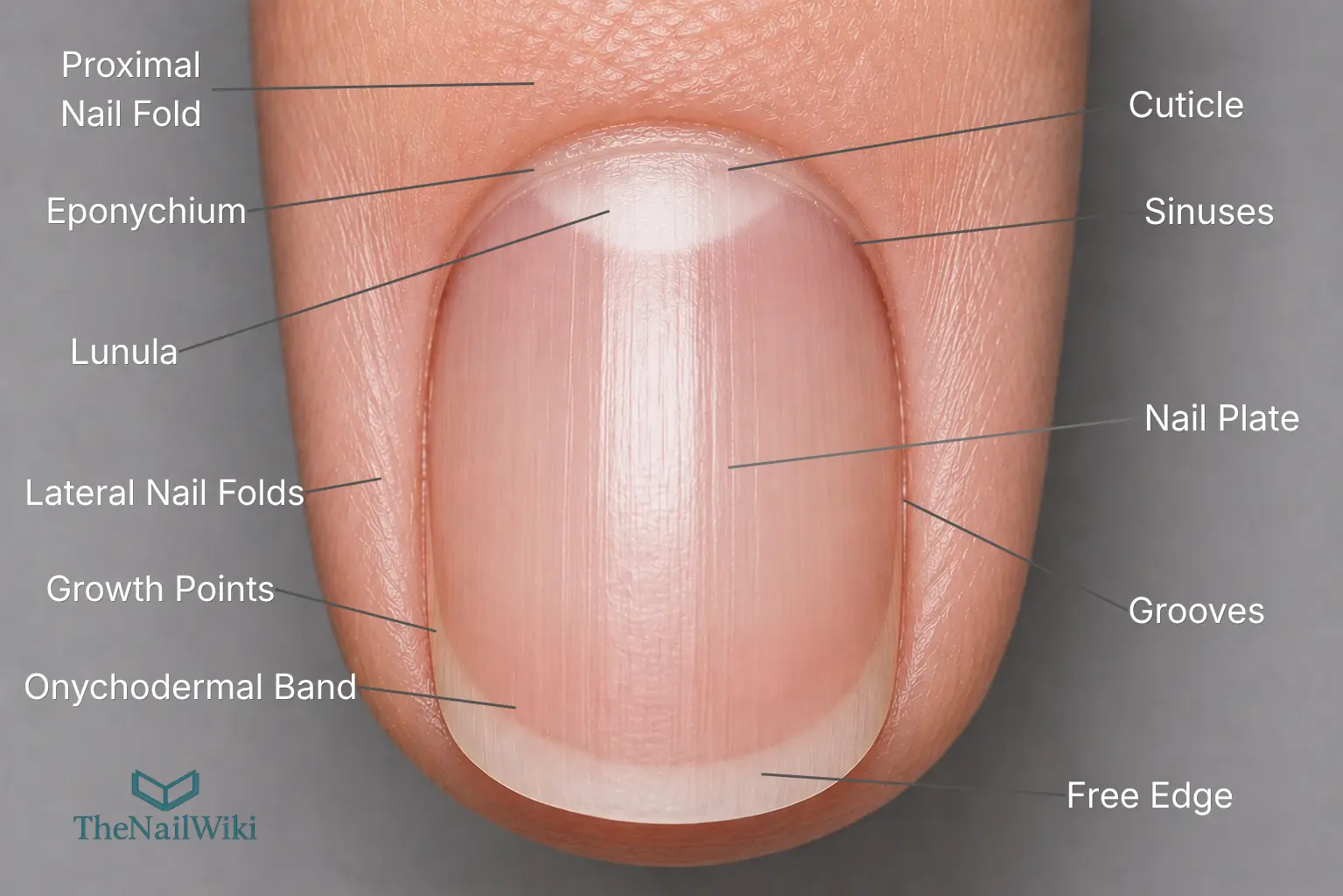
© TheNailWiki
Production — The Nail Matrix
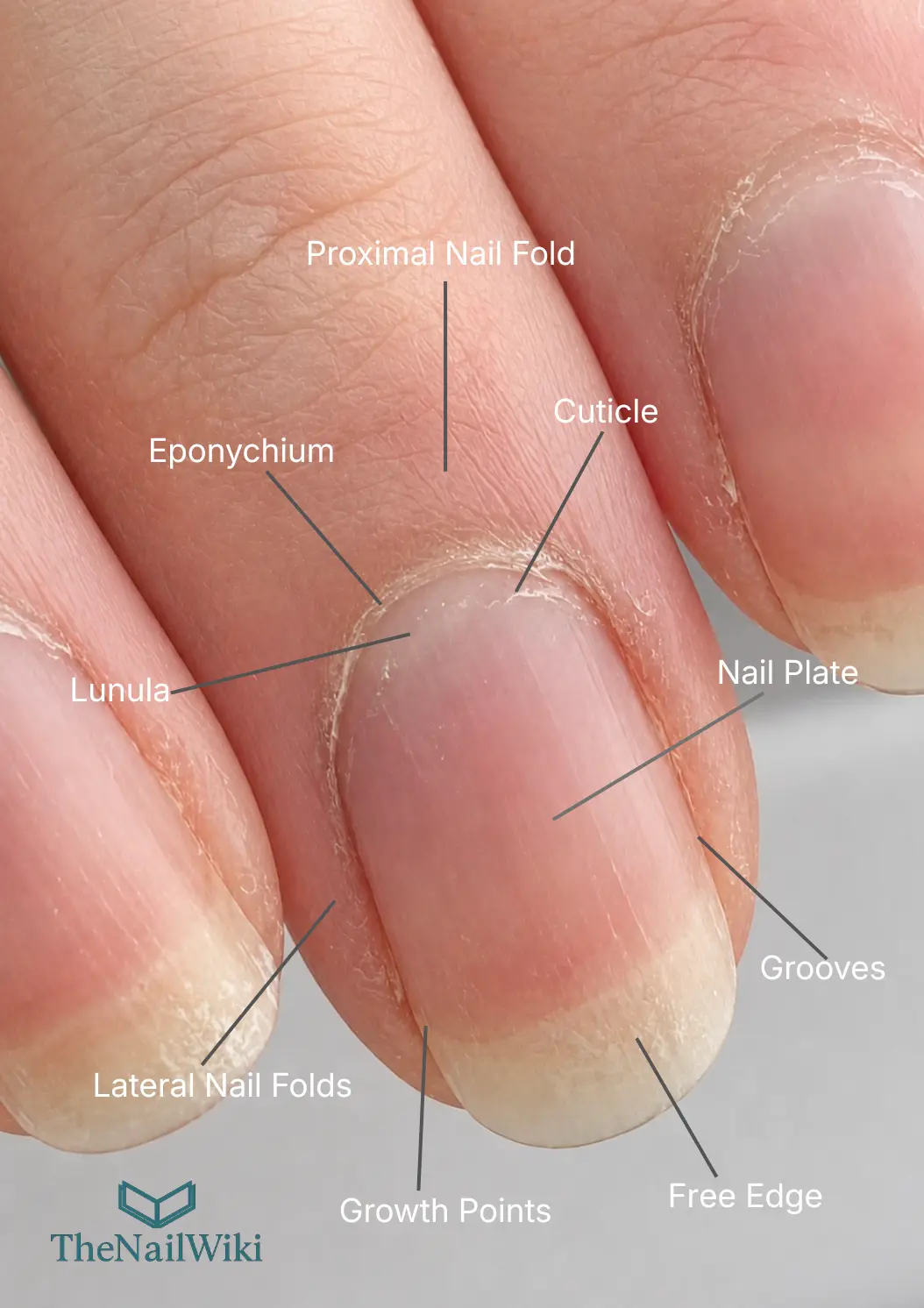
Nail plate characteristics — its thickness, surface quality, and growth rate — all originate at the matrix. The proximal matrix produces the dorsal (top surface) layer. The distal matrix produces the bulk of the plate’s thickness. Understanding matrix anatomy explains why different types of nail change appear in different parts of the plate. See: Nail Matrix →
Support and Adhesion — The Nail Bed
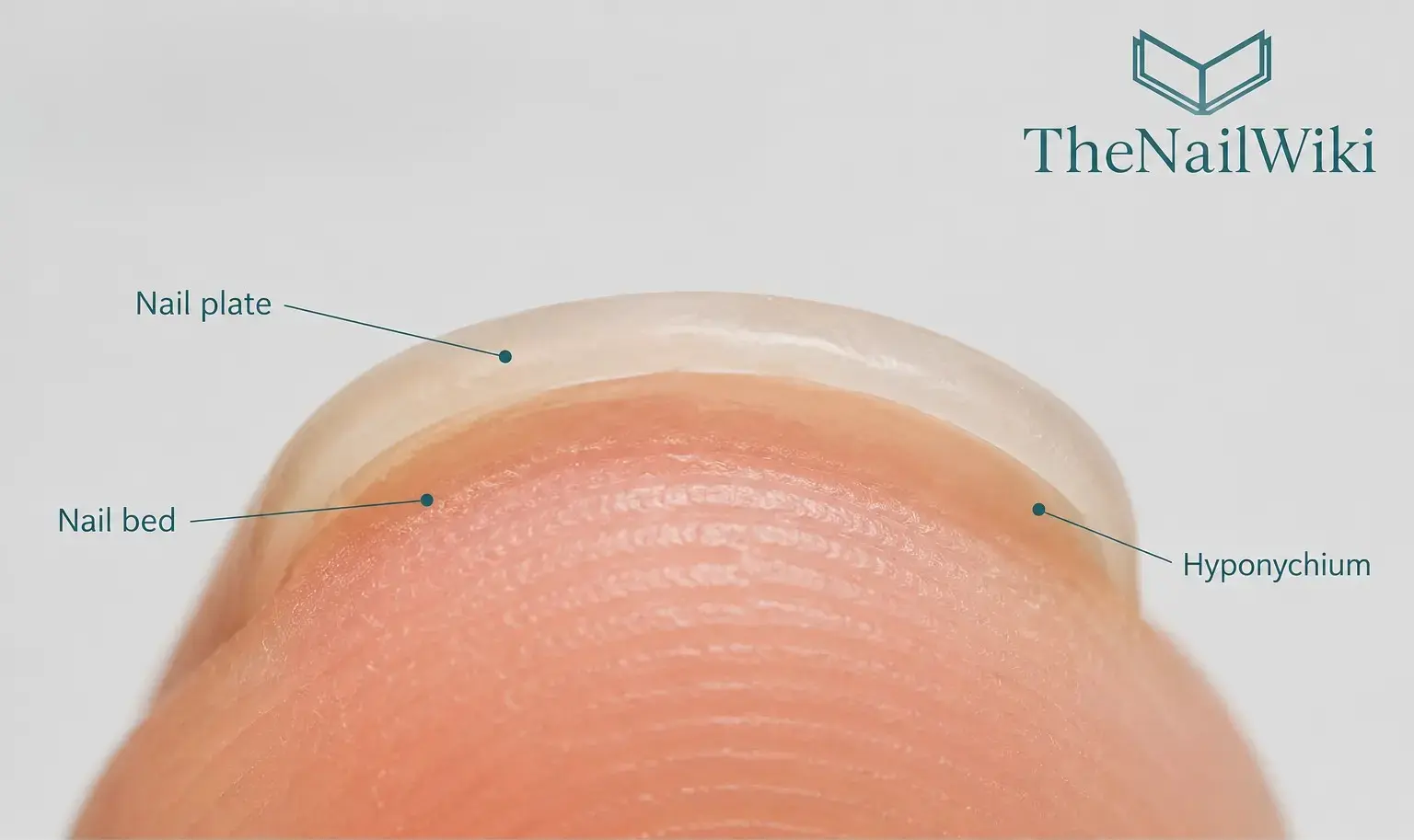
The nail bed and the nail plate move together as a functional unit — the plate does not simply rest on the bed, it is adhered to it across its entire underside. This adhesion is what anchors the nail in place, and its disruption — through trauma, disease, or chemical damage — produces onycholysis. See: Nail Bed →
Sealing — The Folds, Sinuses, and Hyponychium
The nail unit is enclosed on all sides by a sealing system that prevents pathogens, moisture, and debris from reaching the nail bed and matrix. This system works on four sides simultaneously.
At the proximal end, the proximal nail fold overlies the matrix and is sealed to the nail plate surface by the eponychium — the living skin at the fold margin — and the true cuticle, the non-living skin shed by the eponychium onto the nail plate. At the sides, the lateral nail folds frame the plate edges. At the corners, the nail sinuses form the tight pockets where the proximal and lateral folds converge. At the distal end, the hyponychium seals the nail beneath the free edge.
When all four elements of this sealing system are intact, the nail unit is effectively closed — the nail bed and matrix are protected from the external environment. The most common consequence of seal disruption anywhere in this system is the development of a pathway for bacterial or fungal entry, leading to infection beneath or around the nail.
Guidance — The Grooves and Growth Points
The nail plate does not simply grow forward freely — it is guided in its direction and constrained in its lateral movement by the lateral nail grooves. These channels run the full length of the nail on each side, between the lateral fold and the plate edge, directing the plate forward and preventing the edges from deviating into the surrounding soft tissue. The growth points — the lateral corners where the plate transitions from the nail bed to the free edge — are the most structurally significant points in this guidance system and the most vulnerable to damage from incorrect filing or enhancement technique.
The Nail Unit as a System
The value of understanding the nail unit as a system — rather than as a collection of separate structures — is that it explains why changes in one area produce effects in another. A disruption to the proximal nail fold damages the seal and potentially transmits trauma to the matrix below. Over-filing the nail plate reduces its thickness across its full length and compromises the mechanical protection it provides to every structure beneath it. A product applied without regard for the sealing structures at the proximal or distal ends creates a pathway for sensitisation and infection at those boundaries.
Every professional nail service — from a basic manicure to a complex enhancement application — interacts with the nail unit. The quality and safety of that interaction is determined by the practitioner’s understanding of the system they are working with. Knowing where each structure is, what it does, and what happens when it is disrupted is not optional knowledge for a professional — it is the basis of informed, safe, and effective practice.
Explore the full nail unit anatomy
Every structure of the nail unit is covered in detail in the TheNailWiki library. Each page focuses on one structure — its anatomy, its function, how it is damaged, and how it relates to professional nail services.
- Nail Matrix — where the nail plate is produced
- Nail Plate — the hard keratinised structure
- Nail Bed — support and adhesion
- Proximal Nail Fold — matrix protection
- Eponychium and Cuticle — proximal seal
- Lateral Nail Folds — side framing
- Lateral Nail Grooves — growth guidance
- Nail Sinuses — corner pockets
- Lunula — visible distal matrix zone
- Growth Points — lateral corners
- Onychodermal Band — distal adhesion zone
- Hyponychium — distal seal
- Free Edge — unsupported distal plate
Frequently Asked Questions
What is the nail unit?
The nail unit is the complete anatomical system of the nail — every structure that produces, supports, seals, and surrounds the nail plate. It includes the nail matrix, nail plate, nail bed, proximal nail fold, lateral nail folds, lateral nail grooves, nail sinuses, lunula, growth points, onychodermal band, hyponychium, and free edge, as well as the connecting tissues between them.
What is the difference between the nail unit and the nail plate?
The nail plate is one component of the nail unit — the hard, visible structure produced by the matrix. The nail unit is the complete system that includes the nail plate plus every structure that produces it, supports it, seals it, and guides its growth. The nail plate is the output of the system. The nail unit is the system itself.
How many structures make up the nail unit?
The main named structures of the nail unit are the nail matrix, nail plate, nail bed, proximal nail fold, eponychium and cuticle, lateral nail folds, lateral nail grooves, nail sinuses, lunula, growth points, onychodermal band, hyponychium, and free edge — thirteen distinct anatomical structures working as a coordinated system.
Why does nail unit anatomy matter in professional nail services?
Every professional nail service interacts with the nail unit. Product is applied to the nail plate — the surface of a living structure. Filing decisions affect the structural integrity of tissue that took months to grow. Every sealing structure around the nail can be disrupted by incorrect technique. Understanding the system is the basis of safe, informed, high-quality professional nail practice.
Professional training in nail anatomy
Nail unit anatomy, structure, and professional technique are taught as part of structured courses at Artistic Touch Nail Training Academy.
Professional Disclaimer
The information on this page is provided for educational purposes and is intended to support the professional knowledge of nail technicians and nail educators. It does not constitute medical advice.
About the Author
Radina Ignatova
Professional Nail Expert | International Nail Educator
Radina Ignatova is a Professional Nail Expert since 2014, International Nail Educator, and Founder of TheNailWiki and Artistic Touch Nail Training Academy. She specialises in Russian Manicure, dual form systems, polygel, advanced e-file techniques, and nail safety protocols, and continues to work actively in salon practice ensuring that all education reflects real client scenarios and current industry standards.
Her teaching philosophy is built on honest education — showing real salon challenges, real mistakes, and real performance testing rather than presenting only perfect demonstrations. This is how genuine technical competence is developed and how nail professionals become truly confident and capable.
Read full bio →© 2026 TheNailWiki — an independent nail education resource. Content is safety-led and professionally informed.