
Nail Sinuses: The Corner Recesses in Russian and E-File Manicure
Author: Radina Ignatova, Professional Nail Expert & International Nail Educator | Last Updated: May 2026
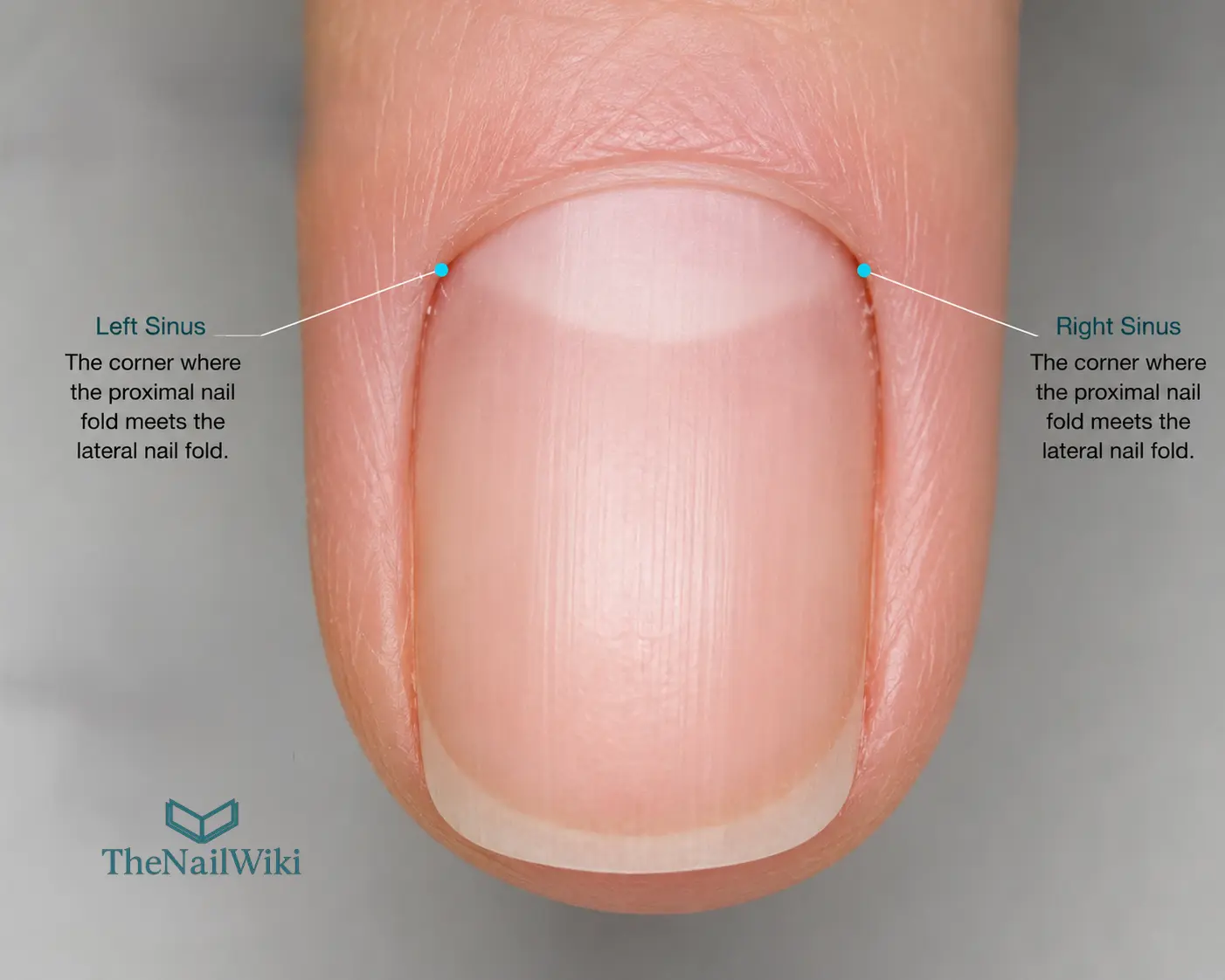
Quick Answer: The nail sinuses are the two tight corner recesses on either side of the nail — precisely where the proximal nail fold meets the lateral sidewalls of the nail plate. In Russian manicure and e-file manicure, the sinuses are the most technically challenging area to work on — the most sensitive, the most frequently injured when technique is incorrect, and one of the most consequential for product adhesion. Dirty or incompletely cleaned sinuses are one of the leading causes of gel and enhancement lifting at the corners and sidewalls — because debris left in the sinus sits between the nail plate surface and the product applied to the plate adjacent to that area.
Quick Summary
There are two nail sinuses — one on each side of the nail. They sit at the junction between the cuticle area and the lateral sidewalls, forming a tight pocket that collects dead skin, cuticle residue, and — in clients wearing enhancements — product debris. Cleaning the sinuses correctly requires specialist technique: opening the pocket first, using the correct bit at the correct angle, minimal pressure, and controlled directional movement.
Incorrect technique in the sinus area causes some of the most common and serious injuries in e-file manicure practice — skin wounds, bleeding, over-filing of the nail plate at the corner, and breaking the protective seal that keeps pathogens away from the nail matrix.
Contents
What the Nail Sinuses Are
The nail sinuses are the two tight, deep corner recesses at the base of the nail — one on each side — where the skin of the proximal nail fold (the cuticle area) transitions sharply into the skin of the lateral nail fold (the sidewall). At this corner, the skin curves steeply and forms a recessed pocket against the nail plate — tight, deep, and difficult to access.
The term nail sinus is used extensively in Russian manicure and e-file manicure education to describe these specific corners — not the anatomical nail grooves running along the sides of the nail, but the acute corner pockets at the proximal end of those grooves where they meet the cuticle zone. These two points are the junction of three structures meeting at once: the proximal nail fold, the lateral nail fold, and the nail plate surface.
Because of the curvature of the nail plate and the tightness of the skin fold at this junction, the sinuses are the hardest area to see clearly, the hardest to access with tools, and the area where dead cuticle, skin debris, and product residue accumulate most readily. In a professional e-file or Russian manicure, the sinuses must be thoroughly cleaned for the service to be complete — and for product applied over them to adhere correctly without lifting at the corners.
© TheNailWiki
Anatomy — Why the Sinus Is Where It Is
The sharp corner formed at the nail sinus is a direct consequence of the nail unit’s three-dimensional structure. The nail plate is a curved structure sitting within a frame of skin folds. At each side of its proximal end, the proximal fold and the lateral fold converge at an angle — and at that angle, the skin pulls tight against the nail plate surface, creating the recessed corner that practitioners refer to as the sinus.
The depth and tightness of the sinus varies significantly between clients. Clients with a pronounced c-curve — a deeper transverse arch across the nail plate — have correspondingly deeper and tighter sinuses, because the plate curves more steeply into the corner. Clients with flatter nail plates have shallower sinuses that are easier to access and less prone to accumulation. Understanding a client’s c-curve before beginning sinus work is part of the pre-service assessment.
The skin inside the deep fold of the sinus is significantly thinner than the skin on the surrounding nail fold surfaces — it receives less mechanical conditioning from daily contact and is more delicate. The nail matrix lies immediately beneath and adjacent to this area, which is one reason why the body has evolved a high density of nerve endings here — as a protective sensory system guarding the matrix.
Why the Sinuses Are So Sensitive
The nail sinus is one of the most sensitive areas on the hand — disproportionately so relative to its size. This sensitivity has a clear anatomical basis. The fingertips and the surrounding soft tissue contain one of the highest densities of sensory nerve endings in the entire body. Within the sinus corner specifically, this nerve density is concentrated to serve as an early warning system protecting the nail matrix that sits immediately adjacent.
The skin inside the sinus fold is thin and more delicate than the outer skin surfaces. Working in the sinus with a flame bit is a standard part of Russian manicure and e-file manicure — but it must be done at the correct angle, with the correct contact point, and with controlled movement. Passing the bit across the sinus skin at the wrong angle, with the tip rather than the belly, or with too much pressure removes the skin’s protective surface and exposes raw tissue. Once compromised, the sinus skin absorbs nail chemicals — dehydrators, primers, and uncured gel — faster than intact skin, producing stinging and contributing to contact sensitisation. The answer is not to avoid the sinus — it is to work in it correctly.
When the sinus skin is cut or abraded, the tissue reacts rapidly — producing localised inflammation, redness, and swelling, and may increase infection risk in the surrounding tissue. The nail matrix lies adjacent to this area, which is one reason the body maintains a high density of protective nerve endings here.
Signs that sinus work has gone too far
- Redness or pinkness at the sinus corner during or after the service — inflammation has been triggered
- The client reports a burning or stinging sensation when product is applied near the corner — the skin barrier has been compromised
- Visible abrasion or raw skin at the corner — the e-file has contacted living tissue
- Bleeding at the sinus corner — the most common injury in sinus work; the bit has contacted the skin at the wrong angle or with the tip rather than the belly
- Sensitivity lasting more than a few hours after the service — inflammation is ongoing
Dirty Sinuses and Product Lifting
The nail sinus is one of the primary locations where gel and enhancement products lift — and the cause is almost always incomplete sinus preparation. True cuticle — the non-living skin shed by the eponychium onto the nail plate surface — accumulates in the deep sinus corner alongside skin debris. Product applied to the nail plate adjacent to the sinus cannot bond correctly if the nail plate surface at the corner is not clean. The product bonds to the debris layer instead of to the plate, and when that debris loosens the product lifts with it at the corner.
This type of lifting characteristically appears at the corners of the nail — the sinus zones — rather than at the cuticle line or the sidewall. It begins as a small bubble or gap at the proximal corner on one or both sides, and progressively extends inward as more debris loosens from beneath. Clients often describe it as “always lifts in the same corner” — which is a reliable indicator that the sinus on that side is not being adequately cleaned during preparation.
The moisture and debris trapped beneath lifted product at the sinus corner also creates the conditions for green nail syndrome and fungal infection if not addressed. A lifted sinus corner is not simply an aesthetic problem — it is an open pocket collecting moisture against the nail plate.
Correct Technique for Working in the Sinuses
Working in the nail sinuses correctly is one of the skills that separates an experienced e-file or Russian manicure practitioner from a beginner. The combination of limited visibility, extreme sensitivity, thin skin, and proximity to the matrix means that every aspect of the approach — tool selection, angle, direction, pressure, and sequence — matters.
Step 1 — Open the pocket first
Before using any rotating bit in the sinus, the pocket must be opened manually — with a pusher or an orangewood stick. The tool is used to gently detach the proximal nail fold from the nail plate surface and open the sinus corner, giving visibility and access to the inside of the pocket. This step also requires care — the pusher must be worked at an angle into the pocket, not pushed straight down into the corner. Even with a manual tool, the sinus skin can bleed from the slightest pressure if the approach is incorrect.
A rotating bit must never be used in an unopened sinus. Without the pocket being opened first, the bit has no clear path — it will dig into the nail plate at the corner rather than working in the groove, and will catch the fold skin at an incorrect angle. Opening the sinus first is not optional preparation — it is what makes safe bit work possible.
Step 2 — Correct bit selection
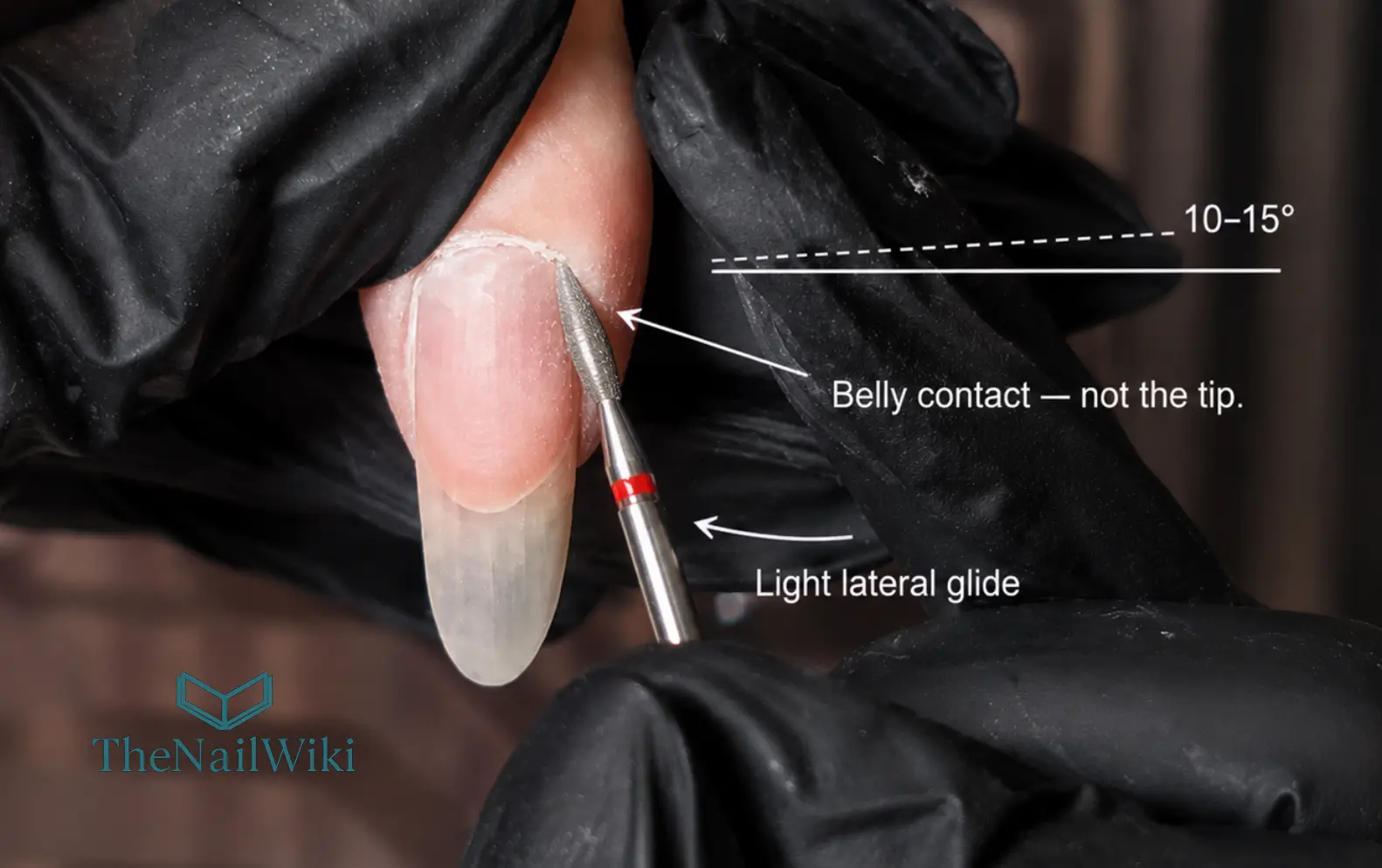
The correct bit for sinus work is a diamond flame bit — the flame or cone shape allows the belly of the bit to glide against the skin surface while the tip accesses the depth of the pocket. The grit of the bit is selected based on the depth of the sinus pocket and the sensitivity of the client’s skin — not on how much debris is visible, which cannot always be assessed before opening the pocket. Carbide bits must never be used in the sinus — they are designed for hard product removal and will cut skin immediately on contact.
Step 3 — Angle and direction
Step 4 — Minimal pressure
The grit of the rotating bit removes debris — pressure does not. Applying pressure in the sinus compresses the bit against the thin skin, increases friction heat, and significantly increases the risk of abrading through to living tissue. The bit should glide with its own weight and rotation, guided by the technician’s control, not pressed into the surface.
Sinus technique summary
- Open the pocket manually with a pusher or orangewood stick before any rotating bit is used — never use a bit in an unopened sinus
- Use a diamond flame bit — never a carbide bit in the sinus area
- Hold the bit almost parallel to the nail plate — approximately 10–20 degrees, never upright
- The belly of the bit is the only contact point — never the tip
- Position the bit inside the lateral groove and slide beside the nail plate, not into the skin
- Move in long, controlled strokes following the natural groove line
- Apply no pressure — let the grit do the work
- Assess the sinus corner after cleaning — it should be clean and debris-free without redness
Risks of Incorrect Sinus Work
Over-filing the nail plate at the corner
Holding the bit at a steep angle and working in the sinus corner digs into the nail plate rather than removing skin debris. The result is a notch or groove in the nail plate at the proximal corner — visible as a dip or thinned area at each side of the cuticle line. This damage is permanent in that section of plate and will take approximately six months to grow out. It also creates a structural weak point at the corner of the nail.
Skin wounds and bleeding
The steep curvature of the sinus corner makes it easy for the bit to catch the fold tissue — particularly if the pocket was not opened first or if the angle is incorrect. Any wound in the sinus must be treated as a significant event: stop the service, treat the wound, document it, and assess whether to continue. Application of product over a wound in the sinus is not appropriate.
Disrupting the sinus skin through incorrect technique
In European and advanced e-file technique, working in and around the sinus is standard professional practice — the question is not whether to work there but how. Incorrect technique — wrong angle, tip contact, excessive pressure, or failing to open the pocket first — disrupts the thin sinus skin, opens the tissue to bacterial and fungal entry, and triggers inflammation close to the nail matrix. Correct technique in this area is one of the clearest markers separating a trained e-file or Russian manicure professional from an undertrained one.
Chemical absorption and sensitisation
Compromised sinus skin — even skin that has not been visibly cut but simply had its lipid barrier abraded — absorbs nail chemicals significantly faster than intact skin. Applying dehydrator, primer, or uncured gel product to compromised sinus skin produces intense stinging and contributes to the development of contact sensitisation — a permanent, cumulative chemical sensitivity that cannot be reversed.
Product lifting from incomplete sinus preparation
Leaving hidden cuticle, dead skin, or debris in the sinus before applying product produces corner lifting that will appear within days of the service. Product cannot bond to the nail plate through a layer of debris. The sinus must be clean and dry before any product is applied in the proximal and sidewall zones.
Frequently Asked Questions
What are the nail sinuses?
The nail sinuses are the two tight corner recesses at the base of the nail — one on each side — where the proximal nail fold meets the lateral sidewall of the nail plate. In Russian manicure and e-file manicure, the sinuses are the most technically demanding area to clean and one of the most frequent sites of injury when technique is incorrect.
Why do my nails always lift in the corner?
Lifting that consistently begins at one or both corners of the nail is almost always caused by incomplete sinus preparation — dead cuticle or debris left in the sinus corner prevents the product from bonding directly to the nail plate. The product bonds to the debris instead, and lifts when that debris loosens. Thorough sinus cleaning before product application resolves this.
Why are the sinuses so painful during a manicure?
The sinus corner has a very high density of nerve endings — evolved to protect the nail matrix that lies immediately adjacent. The skin inside the sinus is thinner than surrounding skin and more sensitive. Any mechanical contact — even correct technique — produces sensation in this area. Pain or burning that continues after the bit has moved away, or that intensifies when product is applied, indicates the skin barrier has been compromised.
What bit should be used in the nail sinuses?
A diamond flame bit is the correct tool for sinus work — the flame shape allows the belly to contact the skin safely while the tip accesses the depth of the pocket. Carbide bits must never be used in the sinus — they are designed for hard product and will cut skin on contact. Grit selection depends on the amount of debris and the client’s skin sensitivity.
Do all clients have the same sinus depth?
No — sinus depth varies significantly. Clients with a deeper c-curve (more pronounced transverse arch) have deeper, tighter sinuses. Clients with flat nail plates have shallower, more accessible sinuses. Assessing the c-curve and sinus depth before beginning sinus work is part of the professional pre-service assessment and informs bit selection and technique approach.
Professional training in e-file technique and Russian manicure
Sinus technique, e-file work, and Russian manicure are taught as part of structured professional courses at Artistic Touch Nail Training Academy.
Related Library Pages
Services
Nail Anatomy
- → Proximal Nail Fold
- → Lateral Nail Folds
- → Eponychium and Cuticle
- → Nail Matrix
- → C-Curve (Transverse Arch)
- → Points of Growth
Safety
Some linked pages are currently in development and will be published progressively.
Professional Disclaimer
The information on this page is provided for professional nail education purposes only. It is intended to support trained nail technicians and educators in understanding nail anatomy, e-file technique, and salon safety.
This content does not constitute medical advice, diagnosis, or treatment. Nail technicians should not work on broken, inflamed, bleeding, infected, painful, or medically concerning skin or nails. Clients with suspected infection, persistent pain, abnormal nail changes, or skin conditions should be referred to a qualified medical professional.
Russian manicure and e-file cuticle work should only be performed by trained professionals using appropriate hygiene, tool control, disinfection, and safety procedures. If the skin barrier is compromised during a service, product application over that area should be avoided.
About the Author
Radina Ignatova
Professional Nail Expert | International Nail Educator
Radina Ignatova is a Professional Nail Expert since 2014, International Nail Educator, and Founder of TheNailWiki and Artistic Touch Nail Training Academy. She specialises in Russian Manicure, dual form systems, polygel, advanced e-file techniques, and nail safety protocols, and continues to work actively in salon practice ensuring that all education reflects real client scenarios and current industry standards.
Her teaching philosophy is built on honest education — showing real salon challenges, real mistakes, and real performance testing rather than presenting only perfect demonstrations. This is how genuine technical competence is developed and how nail professionals become truly confident and capable.
Read full bio →© 2026 TheNailWiki — an independent nail education resource. Content is safety-led and professionally informed.