
Common Free Edge Problems: Why Nail Tips Chip, Lift and Discolour
Quick Answer: Why Do Problems Start at the Free Edge?
Problems at the tip of the nail usually come from one of three causes: force acting on an unsupported edge, an exposed or unsealed edge, or damage to the seal beneath the edge. The free edge has no nail bed beneath it, it is the oldest part of the plate, and it is the part that meets the outside world first. A chip, a lifting tip and a discoloured edge can look similar to a client, but each points to a different part of the structure and calls for a different response.
Why it matters: identifying which of the three is involved decides whether the answer is a change of length, a change of technique, or a referral.
What Makes the Free Edge Different From the Rest of the Nail
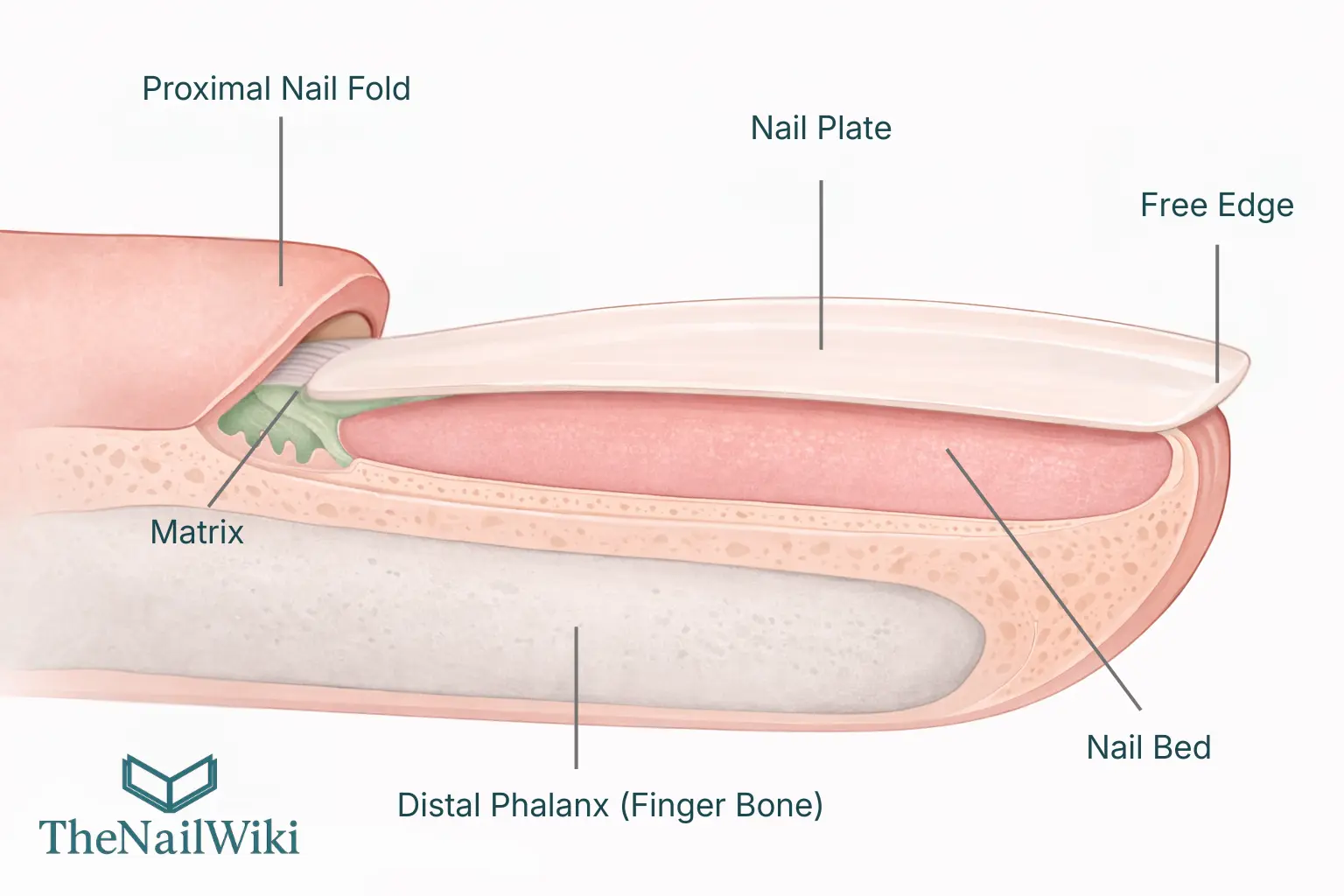
The nail plate is anchored to the nail bed along most of its length. At the fingertip it leaves the bed at the hyponychium and continues forward as the free edge, unsupported from beneath. Three consequences follow, and most free edge problems can be traced to one of them.
- It is unsupported. Any force applied near the tip has nothing under it, so the plate bends and the load travels back along the nail towards the point where the plate is attached.
- It is the oldest part of the plate. The tip has been exposed to water, products, friction and impact for the longest time, because the plate grows forward from the matrix over months.
- It is white. Where no pink nail bed lies beneath the translucent plate, no colour shows through and the plate appears white or opaque. The onychodermal band sits in the transition between the pink zone and the white edge.
Chipping and Splitting at the Tip
Chips and splits at the very end of the nail are the most common free edge complaint. They are usually a sign of wear or impact on an area that is thin, flexible or long for its structure, rather than evidence of a single fault.
The Library page on the stress zone explains why length matters: as the free edge extends further, force applied near the tip creates more demand elsewhere in the nail. Thinner plates have less resistance to bending, and more flexible nails absorb force differently from rigid ones (see nail thickness and density and nail flexibility). Repeated use of the nail as a tool, such as prising or scraping, adds cumulative load on the same area.
Chipping can also follow from the way an edge has been filed. A tip that has been thinned or left rough is more likely to catch and peel, and the effect shows up gradually. For that reason it is worth asking how the client files or trims their own nails between appointments.
Breaks That Keep Occurring in the Same Place
When a client reports that nails always break at the same point, the position of the break is useful information. A break that repeatedly occurs around the junction of the pink and white zones suggests that this area is under repeated stress. It does not prove that the nail is defective or that there is only one cause.
Questions that narrow down the cause
- How long is the free edge compared with the width and thickness of the plate?
- Does the client use the nails as tools, or type and grip heavily?
- Is the plate noticeably thin or flexible?
- Has the nail been over-filed or damaged previously?
These questions mirror the factors listed on the stress zone page: length, thickness, flexibility, curvature and the direction and frequency of force. On enhancements, product distribution and the overall design also contribute, which is covered under nail architecture and the nail apex.
Tip Lifting on Enhancements
Lifting at the tip of a coating or enhancement is a separate problem from lifting at the base. It often begins where the edge of the product has been left unsealed, so that the cut edge of the nail and the end of the coating are exposed to water, friction and impact. Sealing the free edge means bringing the coating over the end of the nail so that the edge is covered rather than left open.
An unsealed or poorly sealed edge matters for a second reason. Once the end of the coating begins to lift, moisture and debris can enter the gap. This is why tip lifting and discolouration are often seen together.
⚠️ Discolouration beneath a lifting tip
Green discolouration beneath a lifting product is caused by Pseudomonas bacteria colonising the warm, moist space that lifting creates. It is not mould. The Library guidance is to remove all product, trim the plate back to solid attachment, keep the area clean and dry, and not apply new product until the discolouration has completely grown out. See green nail syndrome.
When the Problem Is Beneath the Edge, Not On It
Sometimes the visible problem at the tip is a sign that the structures beneath it have been disturbed. The free edge ends where the hyponychium and the onychodermal band mark the distal seal. If a client presents with a white or discoloured arc that has moved back from the tip, the plate may be separating from the bed.
A small white arc at the edge may indicate early or mild separation, whereas a boundary that has moved well into the plate indicates a more significant disruption. The onychodermal band page explains how to use the normal position of the band as a reference, and the onycholysis page covers the condition itself. For causes and what to do, see the article Why Do Nails Lift? The Nail Bed and Onycholysis.
How Shape and Curvature Affect the Edge
The shape of the free edge affects how force is distributed across it. A curved nail spreads load across its arc, while a flatter nail handles lateral force differently. Flatter nails are not automatically weak, and many clients with flat nails have no difficulty with breakage. The C-curve is one variable alongside length, thickness and the way the client uses their hands.
Shape also interacts with the corners of the plate. Where the free edge meets the sides of the nail, the growth points mark the transition from supported to unsupported plate, and an unsuitable shape on a short nail can place unnecessary demand there.
A Practical Free Edge Assessment
A short, consistent check at the start of a service takes a minute and gives a reason for each decision that follows.
- Look at the edge itself. Is it smooth, chipped, split or peeling?
- Note where breaks occur. A consistent position suggests repeated stress.
- Check the length against the structure. Consider thickness, flexibility and curvature.
- Locate the boundary of the white zone. A boundary that sits further back than expected may indicate separation.
- Look for debris or discolouration beneath the edge. Do not probe beneath the plate.
- Ask how the client uses and cleans their nails.
Frequently Asked Questions
Why is the free edge white?
The pink colour of the nail comes from the blood-rich nail bed showing through the translucent plate. At the free edge there is no nail bed beneath the plate, so no colour shows through and the plate appears white.
Why does my nail keep breaking in the same place?
A repeated break point, often near the junction of the pink and white zones, suggests that this area is under repeated stress. Length, thickness, flexibility, curvature and habits all contribute, so there is rarely a single cause.
Why do tips lift on enhancements?
Tip lifting often begins where the edge of the product is unsealed or exposed to water, friction and impact. Once a gap forms, moisture and debris can enter.
Is green discolouration under a lifting tip mould?
No. It is caused by Pseudomonas bacteria, and the product must be removed rather than covered.
Should the underside of the free edge be cleaned with a tool?
Nothing should be pushed beneath the plate. Cleaning beneath the nail separates the seal at the hyponychium and can enlarge the gap. A soft brush used gently across the visible underside is the approach described in the Library.
Related Library Pages
- Free Edge
- Nail Bed
- Hyponychium
- Onychodermal Band
- Growth Points
- Stress Zone
- C-Curve — Transverse Arch
- Nail Architecture
- Onycholysis
- Green Nail Syndrome