
Why Do Nails Lift? The Nail Bed and Onycholysis
Quick Answer: Why Do Nails Lift?
A nail lifts when the bond that holds the nail plate onto the nail bed breaks down, so the plate no longer sits flat against the tissue beneath it. The clinical name for this separation is onycholysis.
Lifting almost always begins at the free edge and shows as a white or pale patch, because air has filled the space where the plate and bed have come apart. It is a sign, not a diagnosis — the important question is always what caused the bond to break.
What matters most: once the attachment breaks it does not simply re-stick. Recovery comes from removing the cause and letting the nail bed re-bond to new plate as it grows forward. Product should never be applied over a lifted area.
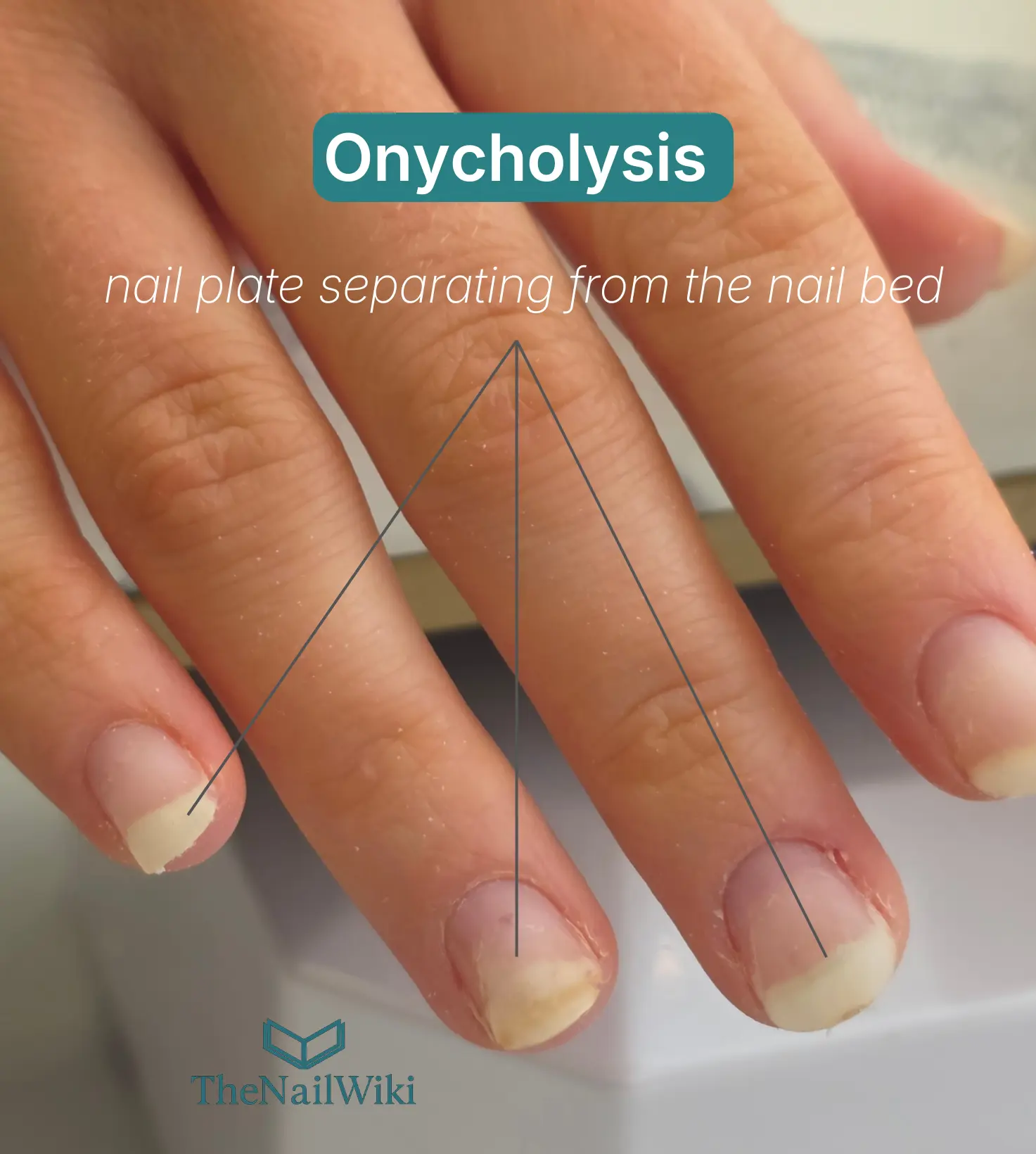
What "Lifting" Actually Means: The Plate-to-Bed Bond
To understand why nails lift, it helps to know what holds them down in the first place. The nail bed is the layer of specialised soft tissue directly beneath the nail plate. It runs the full length of the underside of the plate — from the base, where the plate emerges from the nail matrix, to the hyponychium at the free edge, where the plate naturally lifts away from the fingertip.
The nail bed does not produce the nail plate — that is the job of the matrix. Its role is supportive: it anchors the plate, contributes to its structural integrity, and supplies it with moisture and blood flow. Because the plate is translucent, the dense network of blood vessels in the bed shows through it, which is why a healthy, well-attached nail looks pink and sits flat.
The attachment itself is a genuine biological bond, not just surface contact. The upper (epidermal) layer of the nail bed bonds continuously to the underside of the plate and is carried forward with it as the nail grows. Fine longitudinal ridges and grooves on the bed interlock with matching ridges on the underside of the plate, adding a mechanical connection that reinforces the bond. This attachment begins at the lunula, where newly formed plate first meets the bed, and is maintained all the way to the hyponychium.
The strength of this bond varies naturally from person to person, and can be influenced by hydration, general health, and the mechanical demands placed on the nails through daily life or enhancement wear. When any part of that bond breaks down, the plate lifts — and the nail no longer has the stable, continuous support beneath it that keeps it flat and resilient. A plate that has lost contact with its bed becomes noticeably more fragile and prone to breakage across the separated zone, precisely because the support underneath has gone.
Onycholysis: The Clinical Word for a Lifted Nail
Onycholysis is the clinical term for detachment of the nail plate from the nail bed. The word comes from the Greek for nail and dissolution. In everyday conversation it is often called nail lifting, nail separation, or simply a lifted nail — but onycholysis is the correct term, and the one to use when recording a nail condition in client notes.
It is important to remember that onycholysis is a sign rather than a diagnosis in itself. It is the visible result of an underlying cause — and identifying that cause matters as much as managing the separation. In many cases the cause is mechanical and straightforward to resolve; in others, lifting is the presenting sign of a skin or systemic condition that needs medical assessment.
On a bare nail, lifting is usually easy to spot. The separated zone looks white, pale, or slightly opaque because air has entered the space between the lifted plate and the exposed bed. This contrasts clearly with the healthy pink zone, where the plate is still attached and the bed's colour shows through. The separation almost always progresses from the free edge towards the base — distal to proximal — and its boundary tends to follow a curved line that mirrors the shape of the hyponychium.
Lifting hidden under a coating
Onycholysis beneath gel polish or an enhancement is not always visible until the product is removed. A hollow sound when a nail is gently tapped, or a client reporting sensitivity at the free edge, can be an early clue that a separation is developing under the product. This is one reason careful nail bed assessment should be part of every appointment before anything is reapplied.
Where Lifting Begins: The Distal Seal
Most lifting starts at the very tip of the nail, at the distal seal — the point where the plate finishes its attachment and becomes free edge. Two structures work together here. The onychodermal band is a narrow transverse band at the distal end of the nail bed and represents the last point of firm adhesion between plate and bed. Just beyond it, the hyponychium forms a seal beneath the free edge that closes off the space under the nail from moisture, debris, and microbes.
Looked at through the translucent plate, the distal nail shows three zones: the pink zone where the plate is fully adhered over the bed; the onychodermal band, sometimes visible as a faint pale or pinkish-white line; and the white free edge, where no bed lies beneath the plate. Onycholysis almost always begins at or just beyond the onychodermal band. When that band is disrupted, the plate separates from its last firm anchor, a pocket opens beneath it, and the hyponychium can no longer hold its seal against the underside of the now-detached plate.
For this reason, how far the white or discoloured zone extends back from the free edge is a useful guide to how much the nail has lifted. A small white arc at the tip suggests early or mild separation; a boundary that has moved well into the mid-nail means the lifting has extended beyond the normal distal zone into more firmly attached bed.
Why Nails Lift: The Common Causes
Onycholysis has a wide range of causes. They fall broadly into mechanical, chemical and environmental, salon- and product-related, dermatological, and systemic groups. More than one can be at work at the same time, which is why identifying the cause is central to preventing it recurring.
Mechanical causes
- Direct trauma — catching, crushing, or a knock to the nail tip that breaks the plate-to-bed adhesion
- Repetitive low-grade pressure — typing, playing an instrument, or any activity that repeatedly stresses the free edge
- Long nails that flex excessively under pressure, transmitting stress to the attachment
- Aggressive cleaning beneath the free edge with a pointed tool, which levers the seal apart a little further each time
- Lifting enhancements left in place — a rigid product that has lifted at the tip acts as a lever, forcing the plate away from the bed every time it catches or flexes
⚠️ The "cleaning under the nail" trap
Digging under the free edge with a pointed implement to remove debris is one of the most common causes of a disrupted hyponychium — and clients often believe it is good hygiene. In reality the hyponychium is a functional seal that keeps the space under the nail clean by stopping debris entering in the first place. Each time an instrument is pushed beneath the plate, the seal is separated a little further back, progressively enlarging the space and setting up exactly the conditions that lead to lifting.
Chemical and environmental causes
- Prolonged or repeated water immersion, which softens the epidermal bond between plate and bed
- Harsh detergents, cleaning products, and solvents in regular skin contact
- Sulphur-containing mineral hot pools and bleach-based products, which can degrade the distal seal — in some cases with a single prolonged exposure
- Photo-onycholysis — separation triggered by UV light in combination with photosensitising medication, most commonly tetracycline antibiotics (particularly doxycycline), psoralens, and some fluoroquinolones. The client typically reports tender separation of the fingernails after sun exposure while taking the drug
Salon- and product-related causes
In a salon context, the most frequently seen causes are mechanical and product-related — and understanding them helps prevent recurrence:
- Overfiling the natural nail plate — thinning the plate, with a manual file or an e-file, to the point where it can no longer hold its bond with the bed. Severe cases from overfiling can take close to a year to grow out
- Heat spike during curing — thicker gel layers or certain builder gels can generate enough heat to disrupt the plate-to-bed bond. A client who reports a sudden burning sensation during curing should never be dismissed
- Incorrect shape or apex placement on an enhancement, which distributes force unevenly and concentrates stress at the point of weakest attachment
- Lifting enhancements not removed promptly, so a small lifted area advances into the nail bed zone before the next appointment
- Aggressive filing under the free edge, which disrupts the hyponychium seal and initiates separation
- Product contact sensitisation — in clients who have become sensitised to nail product chemistry, particularly acrylates, the bed can react to the product above it. This type of lifting does not settle until all contact with the sensitising product stops, which is one reason patch testing matters
Dermatological and systemic causes
Lifting is not always mechanical. Skin and whole-body conditions are common causes and are among the reasons a lifted nail sometimes needs medical assessment rather than a salon fix:
- Psoriasis — one of the most common causes; psoriatic separation often has a characteristic red or pink border, and may come with a build-up of scale beneath the plate
- Fungal nail infection advancing from the nail bed, along with lichen planus and contact dermatitis
- Thyroid disorders (both over- and under-active), anaemia and nutritional deficiencies, certain medications including some chemotherapy agents and oral retinoids, and connective tissue disorders
Why a Lifted Nail Won't Simply Re-attach
A common hope — and a common misconception — is that pressing a lifted plate back down will re-stick it. It will not. Once the plate-to-bed attachment has broken, it does not spontaneously re-form in the separated area, and it cannot be mechanically restored by pushing the plate back against the bed. Pressing a lifted plate down simply forces it against the exposed bed with no adhesive mechanism to hold it, and risks pushing debris or bacteria into the space.
The bond can only re-establish itself biologically. As new plate grows forward from the matrix over a recovering bed, the epidermal attachment re-forms and the onychodermal band re-establishes at the distal end of the reattaching plate. This is why recovery is measured in months of growth rather than days, and why it depends entirely on the original cause having been resolved. If the cause continues, the separation simply continues or recurs.
The Hidden Risk Once a Nail Lifts: Infection
The space created by a lifted nail is not just a cosmetic problem. It is a dark, warm, and often moist pocket between the plate and the exposed bed — an ideal environment for micro-organisms to colonise. The most common coloniser is Pseudomonas aeruginosa, a bacterium widely present in the environment, which produces a blue-green pigment (pyocyanin) that stains the bed and the underside of the plate.
This green discolouration is frequently — and incorrectly — called mould. It is not mould, and it is not caused by the nail product itself. It is a bacterial colonisation, and that distinction matters because the management is completely different: green nail syndrome resolves with a clean, dry environment as the nail grows out, and where treatment is needed it is antibacterial, not antifungal. Fungal organisms can also colonise the same lifted space, which is a further reason a separation should be kept open, clean, and dry rather than sealed over.
Colour Changes to Watch For
Because the plate is translucent, a change in the colour seen through it is often the first clue that the nail bed — or the space beneath a lifting plate — has changed. The table below summarises the changes covered across TheNailWiki's anatomy pages and the general course of action. None of these is a reason to panic; they are simply prompts to assess carefully and refer when appropriate.
| Colour change | Possible cause | General action |
|---|---|---|
| White / pale | Onycholysis (plate-to-bed separation), anaemia, or reduced circulation | Assess the attachment; refer if a systemic cause is suspected |
| Yellow | Fungal infection, psoriasis, product staining, or yellow nail syndrome | Do not apply product; refer for medical assessment |
| Green | Bacterial colonisation (commonly Pseudomonas aeruginosa) in a separation space | Do not apply product; refer for medical assessment |
| Dark red / purple / black | Subungual haematoma (blood beneath the plate) from trauma | Refer if painful, if there is no known trauma, or if it is not resolving |
| Dark streak (lengthwise) | Melanocytic activity — usually benign, but occasionally not | Always refer for dermatological assessment without delay |
⚠️ One change always warrants referral
Any dark streak running the length of a nail — especially if it is new, widening, or accompanied by pigment spreading onto the surrounding skin — should always be referred for medical assessment. Diagnosing or treating this is not within the scope of a nail professional, and timely referral is a core professional responsibility.
What to Do If a Nail Is Lifting
The professional approach to a lifted nail is straightforward, but it needs to be communicated clearly — clients often hope for a quicker fix than is actually possible.
- Trim back to solid attachment. Trim the lifted plate back to the point where it is still firmly attached to the bed — no further. Do not attempt to push the plate back down
- Never apply product over the separation. Sealing the gap with gel or acrylic traps moisture and debris against the exposed bed and significantly increases infection risk
- Keep it clean and dry. Moisture in the separation space encourages colonisation. Advise the client to clean gently, avoid prolonged water contact, and keep the nail short while it recovers
- Identify and address the cause. Work through the likely causes with the client — trauma, moisture, products used, cleaning habits, any skin conditions — and change what can be changed
- Document it. Record the condition, its extent, likely cause, and the advice given in the consultation notes. This protects both client and professional
🚫 Onycholysis is a contraindication for coatings
A lifted nail is a contraindication for gel polish and enhancements. Applying a coating over separated nail traps moisture underneath and encourages bacterial or fungal growth — see What Is Gel Polish? for how coatings behave over compromised nails. The separation must be trimmed back to solid attachment first; product can be applied to the remaining attached nail, but the separated zone is left bare until the bond re-establishes as new plate grows forward.
Clients with a lifting nail should also be advised to keep the nails short, wear gloves for cleaning and dishwashing, avoid water immersion where possible, and never try to clean beneath the lifted area with a pointed instrument — each of these can extend the separation or introduce infection.
When to Seek Medical Assessment
Not every lifted nail needs a doctor — but some do. The following should always prompt a recommendation to seek medical assessment rather than continued salon management:
- Lifting with no identifiable mechanical or environmental cause
- Separation beginning at the base or sides of the nail rather than the free edge
- Rapid or progressive separation
- Several nails affected at once without a clear shared cause
- Pain, swelling, redness, or pus around the nail
- Associated skin changes on the fingers or elsewhere on the body
- Discolouration that does not resolve as the nail grows out
- Any dark or pigmented streaking, a new pigmented band, pigment spreading onto the surrounding skin, a visible mass, ulceration, or bleeding from a single nail — these need urgent dermatology assessment, not monitoring
- Clients with diabetes, peripheral vascular disease, or a condition affecting healing, where earlier medical involvement is warranted
How Long a Lifted Nail Takes to Grow Out
Once the cause has been resolved and the lifted section trimmed back, the nail bed re-bonds to the plate as it grows forward. How long that takes depends on how far the separation extended and on the individual's growth rate.
Recovery timeline reference
- Fingernails grow approximately 3.0–3.5 mm per month
- A separation extending halfway up the nail may take three or more months to fully resolve
- Full regrowth from matrix to free edge takes roughly six months
- Toenail recovery is much longer — up to 12–18 months for full regrowth
Setting this expectation from the first appointment where lifting is identified is important. Many clients expect a normal-looking nail within a few weeks; understanding that recovery is measured in months — and depends on the cause being genuinely removed — prevents frustration and keeps trust through the recovery period.
Frequently Asked Questions
Why do my nails lift?
Nails lift when the bond between the nail plate and the nail bed breaks down — a change called onycholysis. Common triggers include physical trauma, prolonged moisture or chemical exposure, lifting enhancements that are not removed promptly, overfiling of the natural nail, skin conditions such as psoriasis, fungal infection, thyroid disorders, and certain medications. Because there are so many possible causes, identifying the specific one is essential to stopping it recurring.
Is a lifting nail painful?
The separation itself is usually painless, because the nail plate has no nerve supply and the lifting happens gradually. However, the exposed nail bed is sensitive, and a lifted area that catches on clothing or objects can be uncomfortable. Significant pain may point to a secondary infection or an underlying condition and warrants medical assessment.
Can I still have gel polish or enhancements on a lifting nail?
Not over the lifted area. Product should never be applied over a separation, because it seals in moisture and debris against the exposed bed and increases infection risk. The lifted section must be trimmed back to solid attachment first; product may be applied to the remaining firmly attached nail, but the separated zone is left bare until the bond re-establishes.
Will a lifted nail re-attach if I push it back down?
No. Once the plate-to-bed bond has broken it cannot be re-stuck mechanically. It re-forms only as new plate grows forward over a recovering bed. Pressing a lifted plate down achieves nothing and can push debris or bacteria into the space.
Is the green colour under a lifted nail mould?
No. The green stain associated with a lifted nail or lifting product is caused by Pseudomonas aeruginosa bacteria, not mould, and it is not caused by the product itself. It resolves with a clean, dry environment as the nail grows out, and where treatment is needed it is antibacterial rather than antifungal. See green nail syndrome for the full picture.
How long does a lifted nail take to grow out?
It depends on how far the separation extends and how fast the nail grows. Fingernails grow about 3 to 3.5 mm per month, so a separation halfway up the nail may take three or more months to fully resolve after the cause is addressed. Toenails take much longer — up to twelve to eighteen months.
Related Library Pages
- → The Nail Bed
- → Onycholysis
- → The Hyponychium
- → The Onychodermal Band
- → The Nail Plate
- → The Nail Matrix
- → The Free Edge
- → Green Nail Syndrome
- → Nail Psoriasis
- → Contraindications in Nail Services
Professional Disclaimer
The information on this page is provided for educational purposes and is intended to support the professional knowledge of nail technicians and nail educators. It does not constitute medical advice. Any client whose nail lifting has no clear identifiable cause, or who has additional nail or skin changes — particularly dark streaks, progressive discolouration, or unexplained nail bed changes — should be advised to seek assessment from a qualified medical professional without delay.