
Why Product Still Lifts When Prep Looks Clean: The Nail Prep – Adhesion & Retention Online Course
Industry News · Education and Training · 12 November 2026
Product lifting is not always caused by poor preparation or by the products being used. For nail technicians who repeatedly see lifting, understanding how the natural nail, preparation, contamination and product behaviour work together can be more useful than changing products again.
Radina Ignatova teaches this in Nail Prep – Adhesion & Retention, an online nail preparation course delivered through Artistic Touch – Nail Training Academy.
Disclosure: Radina Ignatova is the founder of both Artistic Touch – Nail Training Academy and TheNailWiki.
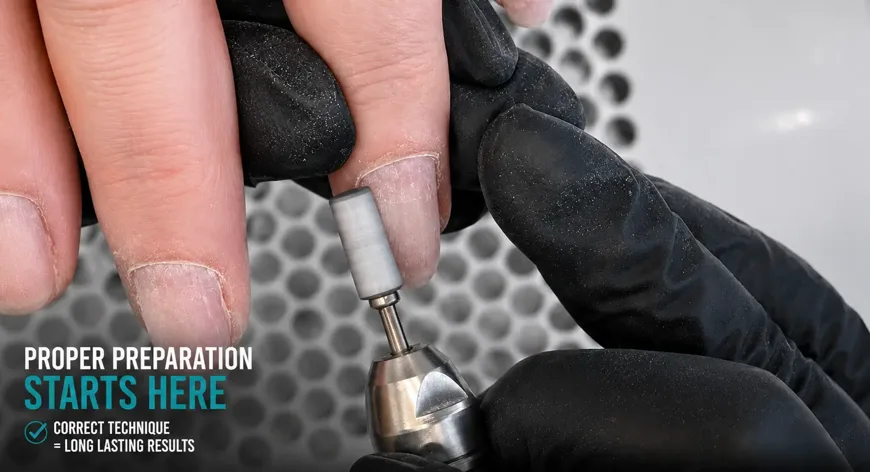
Why Changing Products Does Not Always Solve Lifting
Many nail technicians change products often, follow every routine and still see lifting within days. The surface work looks correct, so the next step is usually another product or more filing. Radina Ignatova teaches that the problem is incomplete understanding, not effort: most preparation focuses on the surface, without explaining product connection, workflow timing, contamination control or how different nail plates behave.
Over-preparing is part of the same pattern. Aggressive filing does not create a better connection, and the course teaches controlled mechanical preparation that does not over-file the natural nail. For the principles behind this, see TheNailWiki guides to nail plate preparation, nail primers and nail cleansers.
What Retention Depends On
The course treats preparation as a connected system, not a list of separate steps. Radina Ignatova, a Professional Nail Expert since 2014 who still works in a salon every day, teaches the factors that decide whether a product stays on:
- Product connection: how products actually bond to the natural nail, and why retention is more complex than removing shine.
- Nail plate behaviour: how dryness, oils and flexibility affect retention differently from one nail to the next.
- True cuticle and hidden residue: why residue left around the cuticle area causes lifting even when prep looks clean.
- Contamination control and workflow timing: how the order and timing of steps change the result, including primer timing.
For a broader explanation of product lifting, including preparation, curing and structural causes, read TheNailWiki’s guide to why gel nails lift.
How the Course Teaches It
The course is built around real salon workflow: demonstrations that show timing, organisation and troubleshooting, nail plate type identification, and the base coat and flexibility principles that support retention. Radina Ignatova teaches every lesson herself.
It is self-paced, with about 4.5 hours of text lessons and video demonstrations in four modules, lifetime access and a private student support group. Downloadable resources include a Prep Checklist, a Troubleshooting Guide and a Nail Plate Type Guide. Students receive a non-accredited Certificate of Completion, which is not intended for insurance or licensing.
Who It Is For
Nail technicians who keep experiencing lifting and want troubleshooting education rather than surface-level tutorials. If you have changed products and routines without lasting results, the cause may not be the product.
Frequently Asked Questions
Why does product lift even when preparation looks clean?
Radina Ignatova teaches that lifting is often a problem of understanding, not effort. Product connection, workflow timing, contamination control and the behaviour of different nail plates all affect retention, so changing products does not always solve it.
Who is the Nail Prep – Adhesion & Retention course for?
Nail technicians who keep experiencing lifting and want troubleshooting education rather than surface-level tutorials.
Is the Nail Prep certificate accredited?
Students receive a non-accredited Certificate of Completion. It is not intended for insurance, licensing or regulated qualification purposes.