Why Gel Nails Lift: A Diagnostic Guide for Nail Technicians
© TheNailWiki
Gel nails lift when stable adhesion is not created or when the bond can no longer tolerate the movement and forces placed upon it.
Common contributing factors include cuticle or contamination remaining on the nail plate, excessive preparation that has weakened the plate, product touching the surrounding skin, incorrect application thickness or placement, incomplete curing or an incompatible lamp, structural imbalance and excessive leverage, natural-nail flexibility, repeated mechanical pressure, and nail changes that indicate the service should be postponed.
The correct response is not to add more primer, file more aggressively, or immediately change brands. First identify where the lifting began, when it appeared, and whether it affects one nail, one client, or multiple clients. These details help determine which part of the system should be investigated.
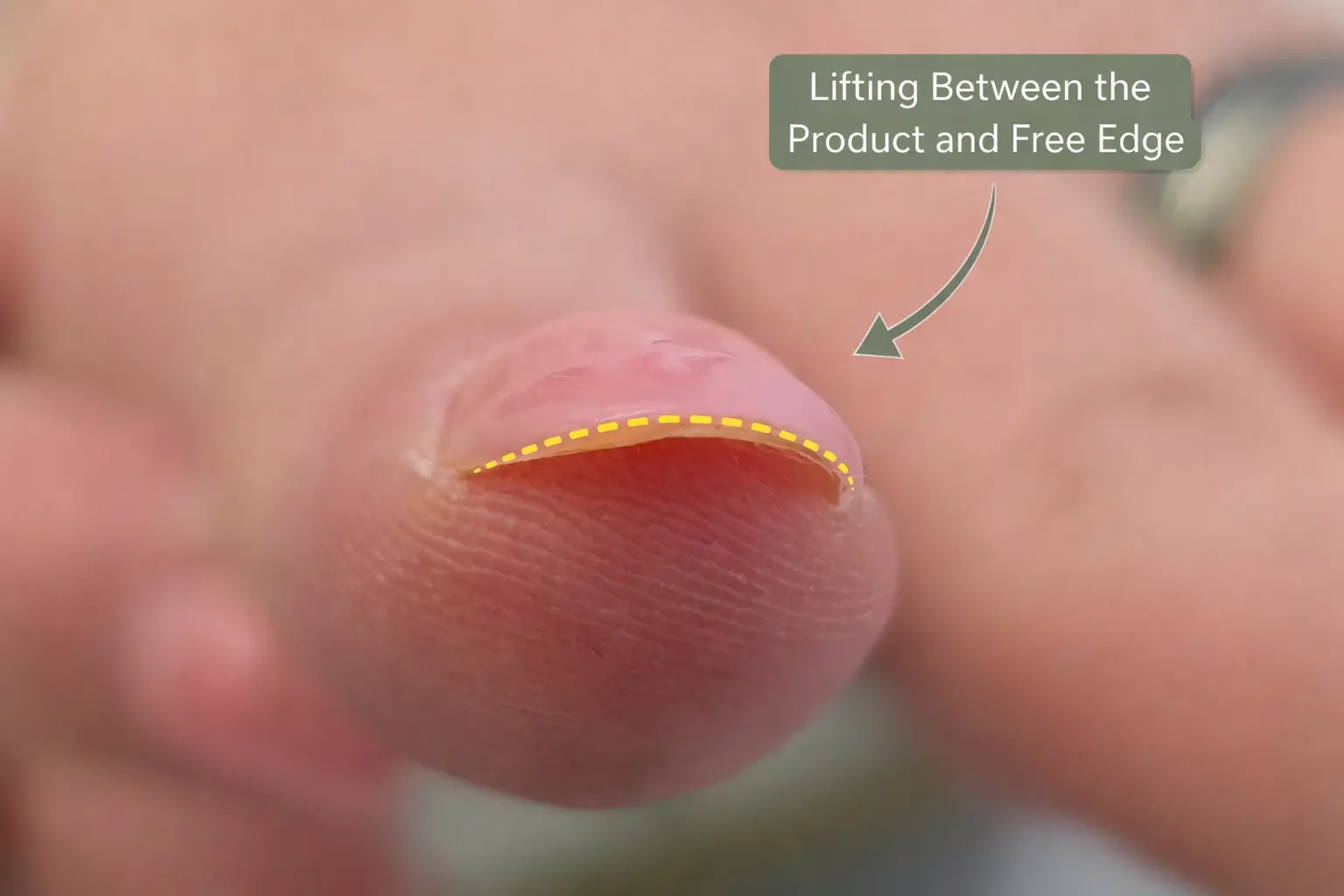
Gel lifting is the separation of a cured nail product from the natural nail plate before the service reaches its intended maintenance stage.
It is often blamed on preparation, the client, or the product brand. However, lifting is not a single fault with a universal solution. Its position, timing, and distribution provide clues about what happened during preparation, application, curing, or wear.
1. Lifting Is an Outcome, Not a Diagnosis
When a client reports that her nails are lifting, she is describing what she can see. She is not identifying the reason it happened.
Treating “lifting” as a diagnosis leads to generic responses: more primer, longer filing, a different brand. These responses may coincidentally address the actual problem, or they may simply add variables to an already unclear situation.
A professional approach begins with four questions.
Four Diagnostic Questions
- Where did the separation begin?
- How soon after the appointment did it appear?
- Which nails and clients are affected?
- What changed in the service, product system, or client’s routine?
For example, proximal lifting across several clients suggests a different investigation from repeated free-edge separation on the same client’s index fingers. The aim is not to memorise a list of possible causes. It is to learn how the lifting pattern narrows the investigation.
2. Identify the Lifting Pattern First
Different lifting patterns consistently point towards different areas of the service. The table below is a guide to where the investigation should begin, not a guaranteed diagnosis. Multiple causes can produce similar patterns, and real-world cases often involve more than one contributing factor.
| Observed pattern | Investigate first | Other possibilities |
|---|---|---|
| Proximal lifting (near cuticle) | Cuticle remaining on the plate, product contact with skin, application control | Product compatibility, client picking at edges |
| Sidewall lifting | Incomplete preparation, product touching the lateral fold, missed coverage | Nail shape, lateral pressure from use |
| Free-edge separation | Existing nail delamination, unsuitable length, mechanical stress | Application method, product selection for nail type |
| Central pocket (air bubble) | Product movement before curing, structural imbalance, incomplete polymerisation | Contamination or application error |
| Entire enhancement detaches | Major adhesion failure — review all preparation and product variables | Contamination, incompatible preparation, severe mechanical stress |
| Several clients suddenly lifting | Shared system fault — lamp, product batch, changed protocol, or environment | Environmental change, new product batch |
| One client repeatedly lifting | Client-specific variable — nail flexibility, occupation, habits, medication | Nail health changes requiring assessment |
3. Cause Group One: Preparation and Surface Contamination
Preparation errors account for a significant proportion of premature gel failure. What makes them difficult to diagnose is that they are invisible in the final result — there is no external evidence that preparation was incomplete until lifting begins.
Cuticle Remaining on the Nail Plate
The term “cuticle” is frequently misused. The eponychium is the living skin at the base of the nail. The cuticle is the non-living tissue that migrates from the eponychium onto the nail plate surface. Gel product cannot bond to this tissue in the same way it bonds to the keratin of the nail plate itself. When cuticle remains on the plate — even in areas not immediately visible — the product adheres to the tissue rather than the nail. As that tissue naturally loosens, the product lifts with it.
This pattern typically presents as proximal lifting and can be consistent across multiple clients if preparation depth is routinely insufficient.
Surface Contamination
Dust, natural skin oils, hand product residue, or contact between the prepared nail and a finger all create adhesion barriers. These are not always visible. A nail that looks clean may still carry enough surface contamination to prevent adequate bonding. Lint-free wipes and proper cleansing products are necessary; cotton pads can deposit fibres onto the plate.
Touching the Prepared Plate
After preparation and surface cleansing, any contact with the nail plate — even from the technician’s own finger — introduces oil. Once a nail has been prepared and cleansed, it should not be touched with bare skin before product application.
Over-Preparation and Excessive Thinning
Aggressive filing removes the surface shine required for adhesion but also thins the nail plate. A thinner plate is more flexible. Increased natural-nail movement creates more stress at the product–nail interface, which can contribute to lifting. Filing pressure and file choice should be appropriate to the nail — not a default routine applied uniformly regardless of nail condition.
Incorrect Use of Cleansers, Dehydrators, and Primers
Preparation products work within the context of a specific product system. A dehydrator that performs well with one brand’s base coat may not produce the same result with another. Primers vary in formulation and purpose. Following the manufacturer’s recommended preparation sequence for the specific products being used is more reliable than combining products from multiple systems without establishing compatibility.
Preparation is not a checklist. It is a diagnostic process. When lifting recurs despite adequate time spent on preparation, the question to ask is not “did I prepare?” but “where specifically did the preparation fail to create the surface this product needs?”
When preparation is treated as a routine rather than a diagnostic process, technicians often respond to lifting by filing more or adding stronger adhesion products. The Nail Prep – Adhesion & Retention course teaches how nail condition, preparation depth, and product behaviour work together before application begins.
See Full Course Details4. Cause Group Two: Product Placement
Adhesion failures caused by application errors tend to follow predictable patterns depending on where the placement error occurred. Understanding those patterns makes it possible to correct the specific issue rather than adjusting the entire application process.
Product Touching the Skin
When gel product contacts the surrounding skin or fold, it creates a physical lifting point. As gel cures, it contracts slightly. Product that has bonded to the skin will pull at the edges as this contraction occurs, which begins the process of proximal or sidewall separation. The margin between product and skin is determined by application control — not by a universal measurement. Different products and different service types require different approaches. The manufacturer’s guidance for the specific system being used is the relevant reference point.
Sidewall Coverage
Missed coverage at the sidewalls leaves exposed nail plate that can absorb moisture and create entry points for separation. This is more common where nails are wide relative to the brush being used, or where the technician’s working angle makes the lateral areas difficult to see clearly. Adjusting hand positioning during application often resolves consistent sidewall problems.
Excessively Thick or Uneven Layers
Thick application creates uneven stress distribution within the product layer. During curing, thicker areas may experience differential contraction, and areas that did not fully cure introduce weak points within the enhancement. Multiple thinner layers, each cured fully, produce more structurally consistent results than attempting to achieve coverage or structure in one heavy application.
Product Moving Before Curing
If gel shifts between application and lamp insertion, the final product position may differ from the intended placement. This can introduce skin contact, gaps in coverage, or uneven thickness — each of which contributes to lifting. Minimising movement time and working in manageable sequences reduces this variable.
Lifting patterns reveal placement patterns. Consistent proximal lifting across multiple clients often reflects application margin. Consistent sidewall lifting on one hand suggests positioning. Central pockets typically point to structural or curing variables rather than placement alone.
5. Cause Group Three: Curing Compatibility
Incomplete curing is a preparation, application, and safety issue simultaneously. It contributes to lifting when the product layer retains insufficient structural integrity to withstand normal wear. It is also relevant to sensitisation risk, because uncured or insufficiently cured methacrylate-containing products that contact the skin during application increase the likelihood of developing a product allergy.
Lamp and Product Compatibility
A lamp cures a product correctly when its emission wavelength, irradiance, LED placement, and physical design match the specific photoinitiator in the product formulation. Wattage alone does not confirm that a lamp will cure a given product. A higher-wattage lamp that does not emit at the correct wavelength for the product’s photoinitiators will not produce complete polymerisation. Manufacturers validate specific lamp and product combinations through testing. Following those validated pairings is the most reliable approach to confirming cure.
Manufacturer-Stated Cure Times
Cure times are established through manufacturer testing of specific product layers at specific thicknesses under specific lamp conditions. Extending curing time beyond these instructions does not correct an incompatible lamp; it is not a substitute for using the correct equipment. If lifting or surface problems persist despite following stated cure times, the lamp and product pairing should be reviewed.
Positioning
Thumbs and sidewall areas are frequent positioning problems. When the hand is not placed fully inside the lamp, or when nail angles prevent even light exposure, some nails receive less irradiance than others. Reviewing positioning — particularly for the thumb and for wider nails — can resolve inconsistent curing results that appear as soft spots or central separation.
Pigmentation and Product Thickness
Highly pigmented products and thicker layers can reduce light penetration through the product. If using intensely pigmented colours, additional curing time may be indicated — but only within the manufacturer’s guidance for that specific product, not as an arbitrary extension.
Lamp Condition
Dirt or product residue on the lamp’s reflective surfaces reduces the amount of light reaching the nails. The interior of a lamp used regularly should be cleaned and the LED array should be assessed periodically for physical damage or deterioration. If a lamp has been dropped or shows visible damage, its curing performance should be verified before continued professional use.
Repeated or prolonged skin contact with uncured or insufficiently cured methacrylate-containing nail products is associated with an increased risk of product sensitisation. Once sensitisation develops, it is typically permanent and extends to products across the methacrylate group. Correct lamp-product pairing and application technique that keeps product away from skin are both relevant to managing this risk. See: DermNet — Nail Cosmetics Allergy.
6. Cause Group Four: Structure and Mechanical Stress
This cause group is where the investigation becomes more specific to the individual — and where generic preparation advice offers limited help. Structural and mechanical causes explain cases where preparation appears thorough, application appears correct, and lifting still occurs.
Product Rigidity Versus Natural-Nail Movement
Natural nails flex. They respond to typing, gripping, pressing, and bending. When a product is more rigid than the natural nail’s own movement range, every flex creates stress at the product–nail interface. Over time, this stress exceeds the adhesive bond, and the product lifts. Clients with naturally thin or flexible nails experience this pattern more frequently, and the lifting is not caused by preparation failure — the bond may be correct, but the mechanical mismatch eventually breaks it.
Selecting product systems that are formulated to flex with the natural nail reduces this failure mode. Rubber-base and flexible builder formulations are specifically designed for this purpose.
Length and Leverage
Longer nails create more leverage when they encounter impact. The force applied at the free edge transmits to the product–nail junction with greater effect as length increases. For clients whose nails consistently lift at a specific length, conservative length management is a more targeted solution than altering preparation.
Apex and Stress Distribution
Correct structural distribution — with appropriate product build at the stress area — spreads mechanical load across a larger surface rather than concentrating it at one point. A flat application without structural consideration leaves the product vulnerable to failure under normal use. This is a structural design issue, not a preparation issue.
Nail Shape and Growth Direction
Hooked nails, upward-growing nails, and laterally curved nail plates all create specific stress patterns that a flat gel application cannot accommodate. Repeated lifting on nails with particular morphological characteristics often reflects a mismatch between product behaviour and nail structure rather than preparation failure. For some nail shapes, certain product systems are more compatible than others.
Repeated Lifting on Specific Fingers
Consistent lifting on the same fingers — particularly dominant-hand index fingers and thumbs — frequently reflects use patterns rather than a service error. These nails sustain higher mechanical load in most daily activities. Identifying which fingers are affected and relating them to the client’s use habits is more informative than adjusting the full service protocol.
Over-Filing and Plate Thinning
Repeated aggressive filing thins the nail plate progressively. A thinner plate is more flexible, which increases mechanical stress at the product–nail interface and can worsen lifting over successive appointments. This is a service pattern to review rather than an individual-appointment preparation error.
7. Cause Group Five: Client and Service Variables
Some factors that influence gel longevity are outside the technician’s direct control. Identifying them allows for realistic service planning and informed maintenance intervals — not blame.
Mechanical Impact and Occupation
Manual labour, frequent keyboard use, instrument practice, healthcare work, and cleaning occupations all place higher mechanical demands on nail services. Clients in these categories may experience shorter wear times despite correct application. Setting clear maintenance expectations during the initial consultation is more useful than investigating preparation after every appointment.
Picking and Edge Damage
Clients who pick at edges or use nails as tools accelerate separation at the free edge and sidewalls. This is not always disclosed without specific enquiry during consultation. Lifted areas that show a consistent mechanical pattern — clean separation along an edge rather than adhesion failure underneath — often indicate this.
Medication and Health Changes
Certain medications, including chemotherapy, some antibiotics, and other systemic drugs, alter nail composition and hydration in ways that can affect how products bond. Clients may not connect a change in nail behaviour to a recent prescription. Asking about health changes as part of a thorough consultation — rather than only when problems arise — makes it possible to identify this earlier. Nail technicians are not in a position to advise on medications or their effects on nail structure; the role is to identify the potential variable and adjust the service or maintenance plan accordingly.
Existing Onycholysis and Nail Abnormalities
Onycholysis — the separation of the nail plate from the nail bed — has multiple possible causes. These include trauma, dermatological conditions such as psoriasis, medication effects, and systemic health factors, as well as infectious causes. Cleveland Clinic — Onycholysis. A nail technician is not equipped to determine which cause is present. Nail changes that are unexplained, progressive, or involve discolouration should be referred for medical assessment rather than treated as a preparation or retention problem.
Nail technicians should recognise when a nail presentation requires medical referral rather than a nail service. Continuing to apply product over unexplained nail changes — particularly where the plate appearance has altered, where pain is present, or where previous referral has been given and not followed — is outside professional practice standards. The appropriate response is to pause the service and recommend the client seek assessment from a healthcare professional.
8. Troubleshoot the System Before Changing Products
Changing products is one of the most common responses to persistent lifting, and one of the least informative. When the cause has not been identified, a product change introduces new variables without removing old ones. If lifting continues with the new products, nothing useful has been learned. If it resolves, it is not clear which variable was responsible.
A systematic troubleshooting sequence produces more useful information:
9. When Lifting Is Normal Wear and When It Is Premature
Not every instance of gel separation represents a service failure. Expected wear varies considerably depending on the product system, service type, nail condition, natural growth rate, nail length, and the client’s use patterns and maintenance schedule.
Early separation — appearing within days of application — requires investigation. It is unlikely to reflect normal wear and suggests a preparation, application, or curing variable worth examining.
Visible product lift at the proximal area after several weeks, accompanied by visible natural nail growth below the product, is often growth-related displacement rather than adhesion failure. The two look different: growth displacement shows new nail plate visible at the proximal margin without product separation from the existing plate; adhesion failure shows the product lifting from the nail beneath it.
Product at the maintenance stage that has seen weeks of use, occupational stress, or lifestyle exposure may begin to show edge wear. This is not the same as adhesion failure at the initial application. Making this distinction matters for how the client is advised about maintenance scheduling and realistic wear expectations.
Promising specific wear durations — such as “two to four weeks guaranteed” — without accounting for the variables above sets clients up for dissatisfaction and technicians up for repeated unpaid repairs. A more accurate conversation at the consultation stage builds realistic expectations and reduces conflict later.
10. What Not to Do
- Do not glue lifted product back down. Moisture, debris, and contamination can become trapped beneath the separation, complicating both observation and nail health.
- Do not file repeatedly until the nail plate becomes thin. Aggressive filing at each appointment progressively weakens the plate and can worsen retention over time.
- Do not continue increasing primer strength without identifying the cause. Stronger adhesion products address the symptom, not the source. If the cause is structural or mechanical, a stronger primer will not resolve it.
- Do not extend curing time arbitrarily. Additional time does not correct an incompatible lamp and does not substitute for a validated lamp-product pairing.
- Do not continue applying over unexplained nail changes. When the nail plate, surrounding skin, or nail bed shows visible changes that cannot be attributed to the service, the service should pause and the client should be referred for assessment.
- Do not replace the entire product system before checking what changed. A systematic review using the steps above will produce more useful information than a product change made without a clear diagnosis.
If lifting continues despite changing products, the missing step may not be another brand. It may be the ability to identify which part of the system is failing. The Nail Prep – Adhesion & Retention course develops a more systematic approach to preparation, adhesion, and retention troubleshooting.
See Full Course DetailsFrequently Asked Questions
How do I tell the difference between adhesion failure and growth displacement?
Why are some nails lifting consistently while others on the same client hold well?
Can a lamp that is “working” still cause lifting?
How should I advise a client whose gel consistently lifts due to their occupation or lifestyle?
When should I refer a client for medical assessment rather than investigating a retention problem?
Should I change products if lifting does not resolve after investigating my technique?
Related Pages on TheNailWiki