
Working Safely Around the Lateral Nail Folds
Quick Answer: Working Around the Sidewalls
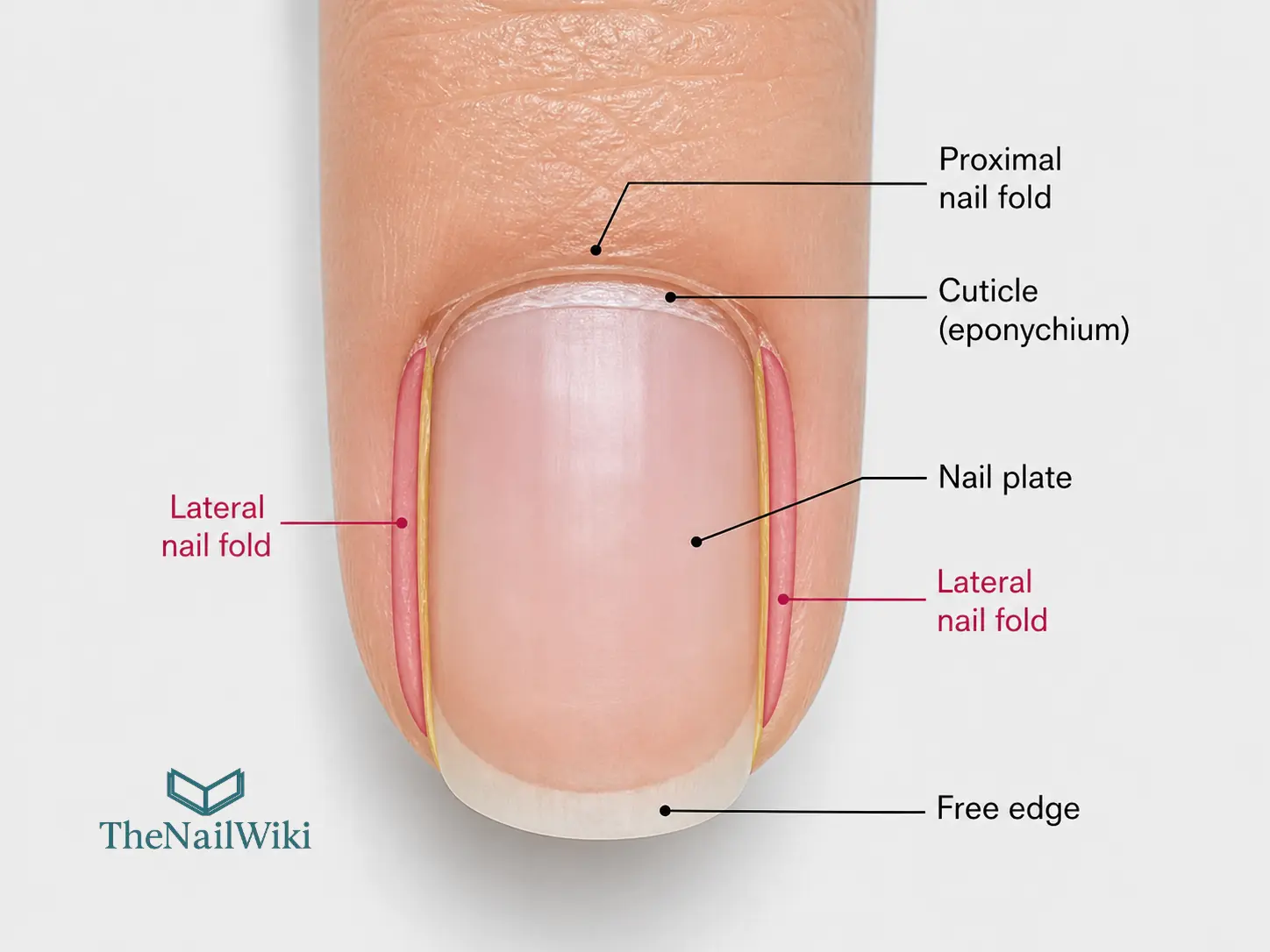
The lateral nail folds — commonly called the sidewalls or nail walls — are the two ridges of skin running along each side of the nail plate from the base to the free edge. Working safely around them means treating the folds as a boundary to protect rather than a surface to cover: shape the free edge without cutting into the corners, fit forms without compressing the folds, keep every product off the skin, and refine fold skin only with light, controlled technique.
Why it matters: the sidewalls guide nail growth, protect the plate edges, and shape the c-curve. Careless work here can trigger lifting, pressure, contact sensitisation, or disrupted growth.
Where the Lateral Folds Sit in the Nail Unit
Before working around the sidewalls, it helps to picture exactly what you are working next to. The lateral nail folds are two longitudinal ridges of skin — also called the nail walls or side walls — that run along each side of the nail plate. They begin where they meet the proximal nail fold at the base of the nail and run down to the free edge, where they meet the skin of the fingertip. Together with the proximal fold, they form the three-sided frame of skin that borders and supports the plate.
Each fold overlaps the edge of the plate slightly, creating a raised border on either side. The narrow channel between the inner surface of the fold and the edge of the plate is the lateral nail groove — the track through which the side edge of the nail grows forward. The fold is the skin ridge you can see; the groove is the space between that ridge and the plate. Keeping the two distinct in your mind matters, because almost every practical mistake around the sidewalls comes from treating the groove as if it were empty space rather than a guided track.
Sidewall, nail wall, lateral fold — same structure
Clients and technicians use "sidewall" and "nail wall" loosely, but they all refer to the lateral nail fold. Using the anatomical term in your notes keeps consultation records precise and consistent.
Assessing the Sidewalls Before You Start
The lateral folds are one of the first things to inspect during consultation, because several conditions that affect them are contraindications to a service in that area. Check each sidewall for redness, swelling, tenderness, or broken skin before any product or filing goes near it.
⚠️ Sidewall findings that stop or modify a service
Ingrown nail (onychocryptosis): when the edge of the nail plate grows into the lateral fold rather than along the groove, the fold becomes inflamed, painful, and sometimes infected. In the acute phase this is a contraindication to nail services.
Paronychia: infection at a lateral fold typically presents as redness, swelling, and tenderness along the side of the nail. Acute infection is a contraindication to services in that area.
Callused or thickened skin: hard, built-up skin at the folds — common in clients who work with their hands or whose nails press against adjacent fingers — is not a contraindication, but it should be noted and managed gently rather than aggressively.
Where any doubt exists, refer the client to a medical professional rather than proceeding. A structured consultation and a clear record of what you found protects both the client and you — see the full guide to contraindications in nail services.
Shaping the Free Edge Without Disturbing the Folds
How you shape the free edge directly affects the sidewalls, because the lateral folds define the natural width of the nail plate at each side. The safest approach is guided by how the grooves work: keep the side edges of the free edge at, or slightly beyond, the level of the fold, and work parallel to the fold rather than angling in towards it.
When shaping with a nail file, filing or cutting into the corners disrupts the relationship between the plate edge and the lateral groove. If the corner is shortened below the level of the fold, the newly forming edge has to find its way back into the groove as the nail grows — and if the groove is narrow, the fold is soft, or the plate curvature is pronounced, the edge may grow into the fold instead. Filing the free edge straight across with only very gentle rounding at the corners keeps the plate tracking correctly in the groove.
⚠️ Don't over-narrow the sides
Removing too much from the sides of the free edge undermines the plate's structural support at exactly the point where the lateral folds provide their guidance and protection. This overlaps with the stress zone — the area of the plate most prone to breakage — so over-narrowing increases the risk of side cracking and breakage.
Fitting Dual Forms at the Sidewalls
In dual form and Sandwich Dual Form work, the lateral folds are a primary assessment point when selecting a form. The form must fully cover the growth points — where the nail plate meets the lateral folds — without compressing the folds or leaving gaps at the sidewalls.
- A form that is too narrow compresses the lateral folds, creating pressure that causes discomfort, uneven product distribution, and lifting at the sides.
- A form that is too wide will not seal correctly at the folds, allowing product to spread unevenly.
Correct form selection accounts for the width and curvature of the nail at the lateral folds, not just the overall width of the plate. The prominence of the folds also feeds into the c-curve: nails with prominent folds tend to have a deeper transverse arch, while lower, less-defined folds tend to sit flatter. Because that curvature varies between clients, assess each nail's sidewalls individually before fitting.
Keeping Product Off the Sidewalls
Product control at the folds is both a quality standard and a safety standard. Product that flows onto the lateral fold skin during gel or enhancement application and stays in contact while uncured is one of the pathways to contact sensitisation. The rule is simple: product must never pass the nail plate boundaries — and that includes the skin of the lateral folds and the lateral grooves.
- Leave a clean margin. Maintain a gap of roughly 1–2mm from the cuticle and sidewalls throughout application, so uncured coating never touches skin.
- Clean spills immediately. If product does reach the fold skin, wipe it away with alcohol before curing rather than curing over it.
- Flooding is a technique fault. Coating that flows into the sidewalls or grooves signals too much product, application sitting too close to the skin, or the hand moving before cure — not a cosmetic detail to trim off afterwards.
Sound nail plate preparation underpins all of this: a correctly prepared, defined plate boundary makes it far easier to keep coating inside the nail and off the folds. Where a client has a history of reactions, patch testing is part of a cautious approach.
Protecting the technician too
Repeated skin contact with uncured product is an occupational risk as well as a client one. Wearing nitrile gloves during application and cleaning any spill immediately keeps uncured product off your own skin around the sidewalls and cuticles.
E-File Skin Work at the Folds
In Russian manicure and e-file manicure, the skin at the lateral folds is refined as part of the full cuticle and skin work. This is where a light touch matters most: the skin of the lateral fold — and the lining of the groove, which is an extension of that same skin — is thinner and more sensitive than the skin of the fingertip.
- Refine dead or callused skin at the fold with appropriate bits — primarily diamond bits at low speed.
- Use lighter pressure and slower, more controlled movements than you would over the fingertip skin.
- Work along the fold, keeping the bit tracking with the sidewall rather than pressing down into it.
Callus and thickened skin at the folds is manageable through gentle e-file work in this way. Aggressive or heavy-handed work here risks the sensitive fold skin and the groove lining beneath it.
Keeping the Lateral Grooves Clean
The lateral groove is a narrow channel that readily accumulates dead skin cells, product residue, and debris. In clients wearing enhancements, coating that has flowed into the groove and cured forms a solid deposit that is difficult to remove and can press against the edge of the plate. Clearing the grooves is part of routine professional maintenance — and it is far easier to prevent build-up by keeping product out of the groove in the first place than to remove cured deposits later.
When to Refer Rather Than Work
Some sidewall presentations sit outside salon scope. An acute ingrown nail or an infected fold is a contraindication in the acute phase and should be referred. Pronounced, painful inward curvature of the plate at the sides is likewise not a salon matter and warrants podiatric or dermatological assessment. Growth disruption at the folds — whether from trauma, infection, or chronic pressure — can alter the direction in which the plate grows, so persistent changes are worth flagging to the client and, where appropriate, to a medical professional.
Frequently Asked Questions
Are the sidewalls and the lateral nail folds the same thing?
Yes. "Sidewalls" and "nail walls" are everyday names for the lateral nail folds — the two ridges of skin running along each side of the nail plate from the base to the free edge. The lateral nail groove is the separate narrow channel between the inner surface of each fold and the edge of the plate.
Why shouldn't I file into the corners of the free edge?
Filing or cutting the corners back shortens the side edge below the level of the fold. As the nail grows, the newly forming edge has to find its way back into the lateral groove, and if the groove is narrow, the fold soft, or the plate curvature pronounced, the edge may grow into the fold instead. Filing straight across with only very gentle rounding at the corners keeps the plate tracking in the groove.
How do I stop product lifting at the sidewalls?
Keep uncured product off the fold skin entirely. Maintain a gap of roughly 1–2mm from the cuticle and sidewalls, clean any spill with alcohol before curing, and avoid over-flooding the area. Product that reaches the fold acts as a barrier and a sensitisation risk, and a form that compresses the folds also causes lifting at the sides.
Can I use my e-file on the skin at the sidewalls?
Dead and callused skin at the lateral folds can be refined with appropriate bits — primarily diamond bits at low speed — as part of a Russian or e-file manicure. Because the fold skin is thinner and more sensitive than the fingertip skin, it requires lighter pressure and careful, controlled technique.
When is a sidewall problem a reason not to proceed?
An acute ingrown nail (onychocryptosis) or an infected fold (paronychia) — presenting as redness, swelling, tenderness, or broken skin — is a contraindication to services in that area during the acute phase. Refer the client to a medical professional and record your findings.
Professional training in nail anatomy and technique
Nail anatomy, form selection, product control, and safe e-file technique around the folds are taught as part of structured professional courses at Artistic Touch Nail Training Academy.
Related Library Pages
Nail anatomy
- Lateral Nail Folds: Anatomy, Function, and Salon Relevance
- Lateral Nail Grooves
- Proximal Nail Fold
- Nail Plate
- Free Edge
- Growth Points
- Stress Zone
- C-Curve (Transverse Arch)
- Nail Bed
- Nail Unit
Services and preparation
- Nail Plate Preparation
- Nail Files: Grit Guide
- Dual Forms
- Sandwich Dual Form System
- Russian Manicure
- E-File Manicure
- E-File Bits
Conditions and safety
Professional disclaimer: The information on this page is provided for educational purposes and is intended to support the professional knowledge of nail technicians and nail educators. It does not constitute medical advice.