
Stress Zone: What It Is, Why It Matters, and How Enhancement Architecture Responds
Author: Radina Ignatova – Nail Expert, International Nail Educator | Last Updated: July 2026
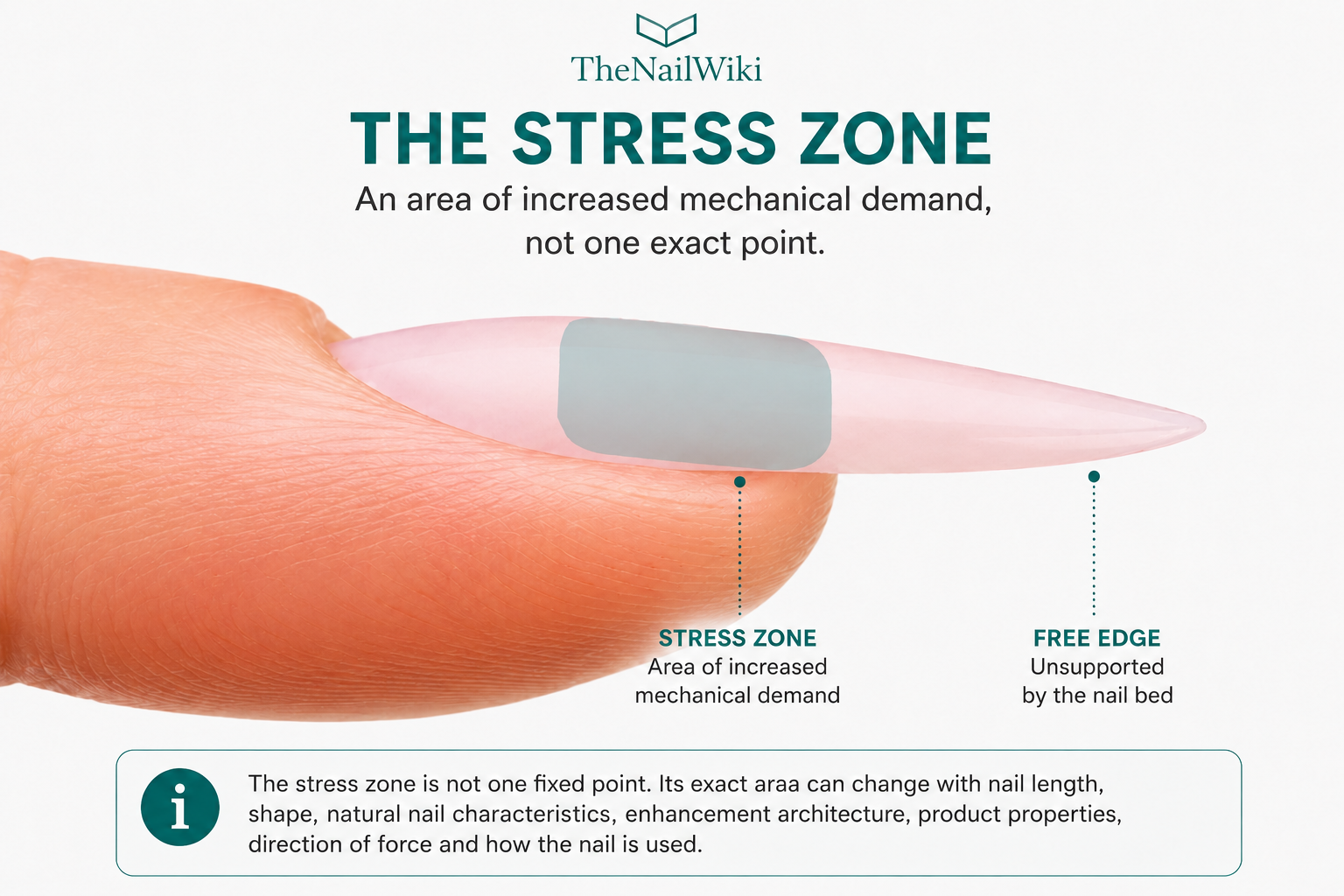
Quick Answer: In professional nail practice, the stress zone is a term used for the area of a natural or enhanced nail exposed to significant mechanical stress during use. It is often discussed around the transition between the attached nail plate and the free edge, but it should not be treated as one universally fixed point. The area under greatest stress can change with nail length, shape, natural nail characteristics, enhancement design, product properties, and the direction of force applied.
Contents
What the Stress Zone Is
The stress zone is a professional nail-industry term, not a named anatomical structure. It describes an area of the nail or enhancement that is exposed to increased mechanical demand during use — an area where the nail or product is under significant stress from the forces of daily hand activity. Many educators discuss the stress zone around the transition from the attached nail plate to the free edge, because this region can experience considerable bending and leverage during use. However, the exact area under greatest stress is not a single fixed point that is the same for every nail.
The area under greatest stress changes depending on the nail length, the shape, the natural nail characteristics, the enhancement design, the product properties, and the type and direction of force being applied. The term should be understood as a functional concept — describing where stress is greatest for a particular nail at a particular time — rather than as a specific anatomical location.
The onychodermal band — the last zone of firm adhesion between the nail plate and the nail bed — marks an important structural transition at the distal end of the nail bed. The area around this transition is often where stress concentrates, particularly on shorter nails with natural free edges. However, the onychodermal band is an anatomical structure. The stress zone is a mechanical concept. They are related but not the same thing, and the stress zone does not always occupy a single fixed position at the onychodermal band for every nail and every service.
Key points about the stress zone
- A professional nail-industry term, not a named anatomical structure
- Describes the area under significant mechanical demand during use
- Often discussed around the transition from attached nail to free edge
- Can shift depending on nail length, shape, enhancement design, and the forces involved
- Should not be treated as a single universal fixed point on every nail
© TheNailWiki
Length, Leverage, and Mechanical Demand
A useful way to think about how a nail experiences stress is to picture a simple lever: the attached portion of the nail plate acts as the anchored section, and the free edge extends beyond the fingertip without support beneath it. As force is applied toward the end of the free edge — through typing, gripping, or impact — it creates mechanical demand elsewhere in the structure. This is a simplified analogy, not a precise engineering calculation. A nail is a curved, layered biological structure, and an enhancement adds further material with its own thickness, stiffness, and shape. The actual stress pattern is more complex than any simple beam model.
What the analogy does illustrate usefully is that increasing length can increase leverage. As the free edge extends further, force applied near the tip can create greater mechanical demand further back in the nail or enhancement. This is one reason why longer nails and enhancements need more careful design consideration — the architecture that works well for a short nail will not always be appropriate for a longer one.
The direction and type of force also matter. A nail may respond differently to downward pressure at the tip, lateral pressure at the sidewall, upward force beneath the free edge, or repeated low-level impact over time. The area under greatest stress changes with these variables. Treating one fixed point as the universal stress zone for every nail in every situation does not reflect this.
The Stress Zone on Natural Nails
On a natural uncoated nail, how the nail responds to stress depends on a range of individual characteristics: its length, thickness, natural flexibility, curvature, existing condition, and the direction and frequency of force applied. No two nails are identical, and no single factor determines vulnerability on its own.
Natural nails with more curvature — a defined c-curve and a visible longitudinal arch — may handle stress differently from flatter nails. A curved surface can spread load across its arc. However, flat nails are not automatically weak or defective. Many clients with flatter nails have no particular problem with breakage, depending on their length, habits, and nail thickness.
When a client reports breaking nails consistently at the same point — typically around where the pink meets the white — this break pattern is worth noting. It may indicate that this area of the nail is under repeated stress. It does not automatically confirm that the nail is defective, or that only one cause is responsible. Length, habits, nail condition, and the individual nail’s characteristics all contribute.
Natural nail characteristics that can influence stress response
- Length — longer free edges increase leverage and can increase demand on the nail
- Thickness — thinner plates may have less resistance to bending under force
- Flexibility — a more flexible nail may absorb force differently from a rigid one
- Curvature — how the nail curves both along its length and across its width
- Existing damage or changes — nails with structural changes may respond differently to stress
- Direction and frequency of force — repeated impact or lateral pressure affects different areas
The Stress Zone in Enhancement Services
In professional enhancement work, understanding where the nail or enhancement is likely to experience the greatest stress is an important part of designing the service. How product is distributed across the nail — its thickness, profile, and the overall architecture — influences how the enhancement performs under the demands of daily use. This applies across systems: hard gel, BIAB, acrylic, polygel, dual forms, and Sandwich Dual Forms all require considered design.
Product distribution and enhancement architecture
Product distribution must be designed for the complete enhancement. The appropriate thickness and profile depend on the natural nail, the length, the shape, the product system, the material properties, and how the client uses their hands. There is no single universal rule about where product must be thickest on every nail. Even thickness across the full length is not automatically wrong — in some systems and some shapes it may be appropriate. The goal is a design that suits the specific nail and service.
When an enhancement fails — through breakage, lifting, or separation — the break pattern can provide useful information. A clean transverse break in the mid-nail area may lead a technician to look at product distribution and overall architecture. However, enhancement failure involves several interacting factors: natural nail characteristics, preparation, adhesion, product compatibility, curing, length and shape, thickness distribution, impact, and repeated client use. A break pattern is a starting point for assessment, not confirmation of a single cause.
Length and enhancement design
As enhancement length increases, the leverage acting on the nail can also increase. Longer enhancements generally need the whole architecture to be reconsidered — not just one element moved or increased. This can involve changes to the profile, the product distribution across the length, the c-curve, and the overall balance of the design. What works structurally on a short nail will often need to be adapted significantly for a longer one.
What Increases Stress in This Area
Certain conditions place greater mechanical demand on the nail or enhancement and increase the likelihood of cracks or breakage occurring around the stress zone area:
- Poor enhancement architecture or an incorrectly designed product profile — the nail lacks the structural balance to manage the forces placed on it
- An overlay or enhancement that has grown out significantly — the product is now further from the nail bed and the unsupported length has increased
- A free edge or enhancement length that is too long for the structure supporting it — the leverage acting on the nail exceeds what the design can handle
- Repeated use of the nail as a tool, or repeated impact — cumulative force on the same area accelerates the onset of cracking or separation
These factors often combine. An enhancement that was appropriately designed at the time of application may become more vulnerable as it grows out, particularly if the length increases without the architecture being reconsidered. When a crack or break occurs in this area, assessing which of these factors is involved gives more useful information than applying a single explanation.
The Apex, the C-Curve, and the Stress Zone
The nail apex is one part of complete enhancement architecture. It contributes to how the longitudinal profile of the enhancement is designed and how product is distributed along the length of the nail. The c-curve contributes to the transverse profile — how the nail curves across its width. Both work together as part of the complete design.
The apex should not be thought of as a single bump placed directly above one fixed stress point. The complete architecture — the upper and lower profile, the c-curve, the sidewalls, the free edge, and the thickness distribution — all influence how the enhancement handles the demands placed on it. The apex is one element within that complete design, not the single controlling factor.
An apex that is placed and proportioned well for the individual nail and length can contribute to a balanced enhancement design. An apex alone — regardless of how pronounced it is — does not guarantee performance if preparation, curing, product compatibility, length, or client use are not also considered. The relationship between the apex, the c-curve, and the overall product distribution is what determines how an enhancement performs. Understanding how these elements work together — and how to adapt them for each individual nail — is the foundation of informed enhancement work.
Frequently Asked Questions
What is the stress zone on a nail?
The stress zone is a professional nail-industry term for the area of a nail or enhancement exposed to significant mechanical stress during use. It is often discussed around the transition from the attached nail plate to the free edge, because this area can experience considerable bending and leverage. However, it is not one fixed anatomical point — the area under greatest stress changes with nail length, shape, natural nail characteristics, enhancement design, and the direction of force.
Why do nails sometimes break in the same place?
When a nail breaks repeatedly at the same location, it is worth assessing why that area is under repeated stress. The length, curvature, thickness, habits, and overall design of the nail all contribute. It is not a simple mechanical inevitability that applies equally to every nail. Understanding the specific factors involved for that client gives more useful information than applying a universal explanation.
Where is the stress zone?
The stress zone is not one universally fixed location. Many educators discuss it around the area where the attached nail plate transitions to the free edge — near the onychodermal band — because this region can experience significant mechanical demand. However, where stress is greatest on any individual nail depends on its length, shape, natural characteristics, and enhancement design.
How does a longer nail affect the stress zone?
As nail length increases, leverage can also increase. Force applied toward the end of a longer free edge can create greater mechanical demand on the nail or enhancement. Longer enhancements generally need the complete architecture to be reconsidered — not just one element adjusted — to account for the increased demands of the extra length.
What can cause enhancement failure in the stress zone area?
Enhancement failure in this area can involve several interacting factors: natural nail characteristics, preparation, adhesion, product compatibility, curing, the length and shape of the enhancement, product distribution, the overall architecture, impact, and repeated client use. A break pattern can be a useful starting point for assessment, but no single factor should be assumed to be the sole cause without considering the full picture.
Is the stress zone the same as the apex?
No — they are related concepts but describe different things. The stress zone is a term for the area under significant mechanical demand. The apex is a professional term for the highest point of the longitudinal enhancement profile — one element of the complete enhancement architecture. The apex is not a structural fix placed directly above one fixed stress point. Both the apex and the c-curve contribute to the overall design, which in turn influences how the enhancement handles stress.
Continue Your Professional Learning
Understanding where mechanical demand concentrates on an enhancement explains why some nails fail in the same place service after service. If you would like to build the skill to design architecture that manages this demand properly, continue your learning below.
🎓 Professional Training
New to Artistic Touch?
🎁 Free Mini Classes — Why Your Sandwich Dual Forms Are Not Working
Related Library Pages
Nail Science & Mechanics
Nail Anatomy
- → Nail Plate
- → Nail Bed
- → Free Edge
- → Onychodermal Band
Nail Enhancement Systems
Professional Disclaimer
This page is provided for professional educational purposes. Enhancement design principles vary between systems, nail lengths, and individual clients. Professional training is recommended before applying these principles in a salon environment.

About the Author
Radina Ignatova
Professional Nail Expert | International Nail Educator
Radina Ignatova is a Professional Nail Expert since 2014, International Nail Educator, and Founder of TheNailWiki and Artistic Touch Nail Training Academy. She specialises in Russian Manicure, dual form systems, polygel, advanced e-file techniques, and nail safety protocols, and continues to work actively in salon practice, ensuring that all education reflects real client scenarios and current industry standards.
Her teaching philosophy is built on honest education — showing real salon challenges, real mistakes, and real performance testing rather than presenting only perfect demonstrations. This is how genuine technical competence is developed and how nail professionals become truly confident and capable.
Read full bio →© 2026 TheNailWiki. All rights reserved.