
How the Nail Plate's Layers Decide How Much You Can Remove During Preparation
Quick Answer: How Much of the Nail Plate Can Be Filed or Buffed?
As little as the service requires, because the nail plate is thin, layered and cannot repair itself. A fingernail is commonly reported at about 0.25 to 0.60 mm thick, and all of its cells are keratinised, so abrasion removes structural material and not a layer of dead cells. Whatever is removed stays missing until the plate grows out, which takes about six months for a fingernail.
Why it matters: preparation is repeated at every appointment, so small removals accumulate, and a plate that has been thinned offers less protection against product chemistry and recovers slowly.
What Each Layer Does
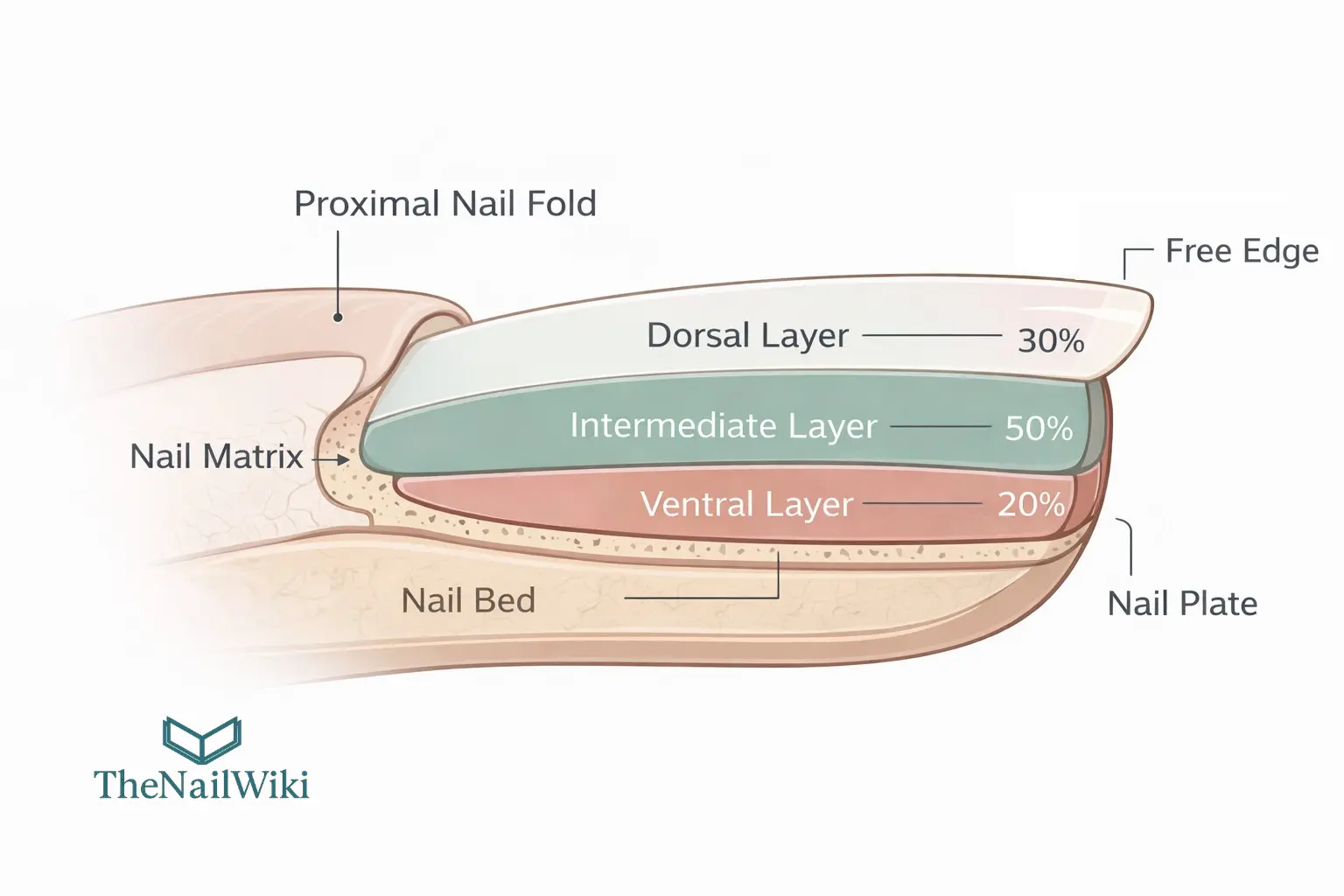
The plate has three layers, and the effects of abrasion differ depending on how far down it reaches. The proportions below are indicative figures from nail biology literature, not exact measurements for any one client.
- Dorsal layer (about 30 per cent). The outer surface, made of flat, tightly packed cells that give hardness, smoothness and shine. It is the first layer to show the effects of filing and buffing, as dullness, roughness or micro-peeling.
- Intermediate layer (about 50 per cent). The thickest layer and the structural core. Its cells interlock firmly and provide most of the plate's strength. Damage here shows as thinning, splitting, structural weakness or visible ridging.
- Ventral layer (about 20 per cent). The thinnest layer, lying directly above the nail bed. Its deliberately irregular underside supports the plate's attachment, so problems here relate to onycholysis.
The practical consequence is that abrasion can reach the intermediate layer more quickly than the proportions suggest, particularly on a thin plate. Once the dorsal layer is gone, the strength-bearing layer is next.
How Much Plate Is There to Lose?
Fingernail thickness is commonly reported between about 0.25 and 0.60 mm, with many mean values between 0.35 and 0.50 mm. The dorsal layer on its own might be roughly 0.10 to 0.18 mm. A plate at the lower end of the range has little margin before it is mechanically compromised.
Research cited on the Library page reports average thickness reductions of about 0.04 mm per cosmetic service involving surface abrasion. The loss is measurable and cumulative, and across eight or ten appointments a thin plate can lose a meaningful proportion of its depth. For clients with naturally thin plates, or those who have been over-filed before, the starting thickness is therefore the most important piece of information in the consultation. See also nail thickness and density, which explains why thickness alone does not predict strength.
Why "Filing Only Removes Dead Cells" Is Not Accurate
With skin, surface cells are dead and shed naturally, so removing them is a cosmetic matter. The nail plate does not work in that way. All its cells are keratinised, so there is no separate layer of dead surface cells to remove. Filing the surface removes structural material from the dorsal layer and disrupts the plate's barrier behaviour. Research has shown that abrasion significantly increases the rate at which water passes through the plate, and that the effect does not resolve immediately once abrasion stops.
The justification for roughening the surface is therefore product adhesion, not cell removal. That reasoning sets a limit: once the surface is suitable for adhesion, further abrasion adds risk without adding benefit.
What Over-Preparation Looks Like and Why It Matters
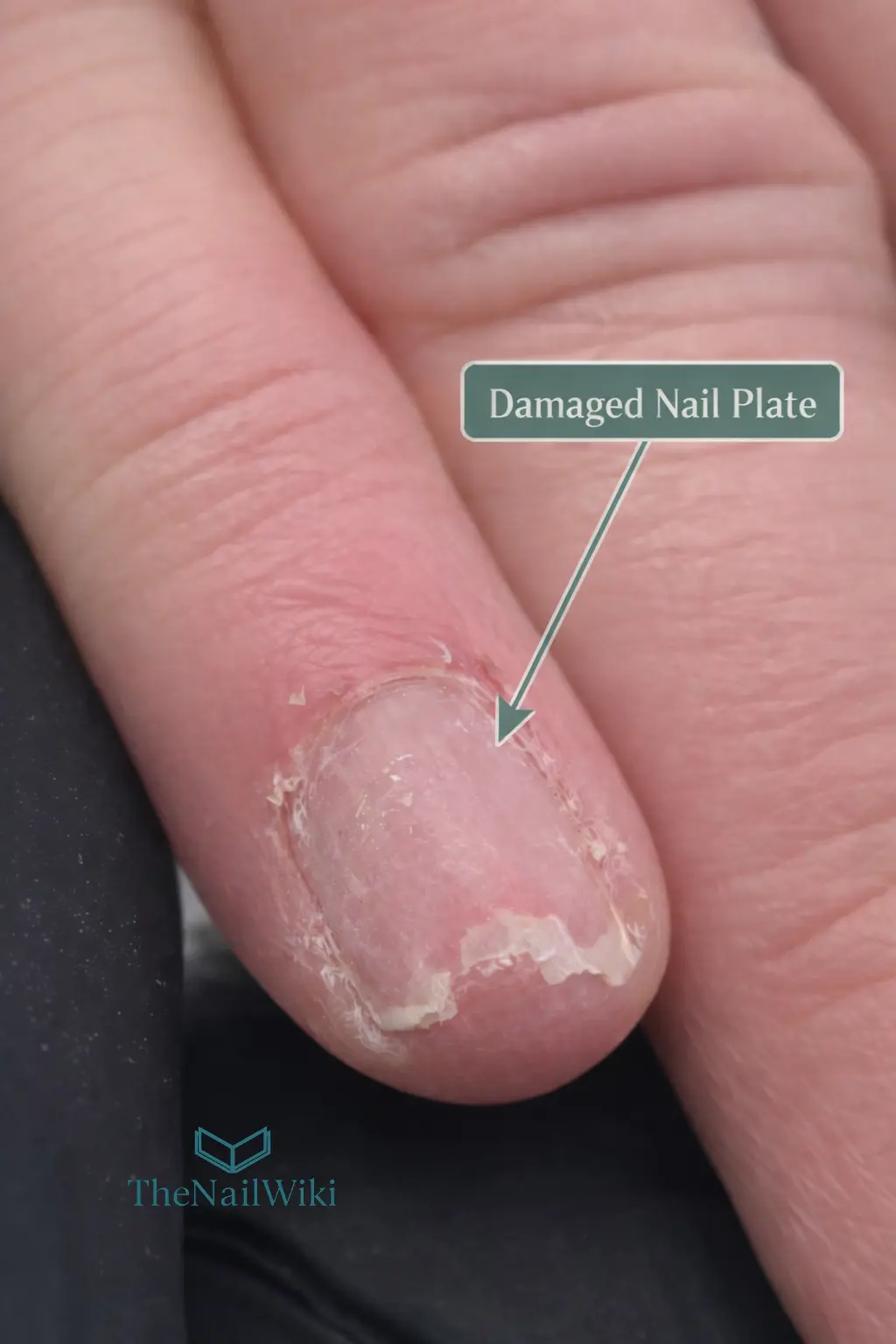
A plate that has been over-prepared can appear translucent, flexible beyond its usual behaviour, peeling at the surface and flatter than it was. Beyond the structural damage, there is a safety consequence. Nail product chemistry is formulated on the assumption that the plate provides a physical barrier between the product and the living tissue beneath. When the plate has been thinned, that barrier is reduced and chemical penetration into the surrounding tissue increases, which raises the risk of contact sensitisation. Sensitisation is a lasting immune response, so prevention matters more than correction.
Recovery is slow. The Library gives the example of a client whose plate needed about eight months of regular manicures, cuticle care and conditioning, with no enhancements, before it returned to near-healthy condition. The damaged section has to grow out entirely and be replaced.
A Preparation Decision Framework
- Assess the plate first. Look at thickness, flexibility, surface condition and any signs of earlier over-filing, and ask about previous services.
- Decide the minimum abrasion needed. The aim is a clean, suitably textured surface for adhesion. A thin or previously damaged plate calls for less.
- Choose tools to match. Grit and technique determine how much is removed per pass. See nail files and grit and nail buffers.
- Keep the surface clean as well as prepared. Residual oils, moisturiser or inadequate dehydration reduce the surface energy available for bonding, so cleanliness is part of preparation. See nail plate preparation.
- Take care near the base and sides. Heavy abrasion near the base is carried out immediately over living tissue, as explained in Working Near the Lunula.
- Record what you did. A note of thickness, condition and the preparation used lets the next appointment be planned rather than repeated automatically.
When to Decline or Refer
⚠️ Changes that need assessment before any product
Onycholysis of unknown cause, unexplained pitting, rapid structural changes, pigmentation within the plate, or persistent brittleness that does not respond to appropriate care all warrant a conversation with the client and usually a referral for medical assessment. Applying product over pathological change does not resolve it and may delay assessment. See contraindications in nail services.
Common Misunderstandings
- "A thicker nail is a stronger nail." Thickness and structural integrity are different. Infected plates that were nearly twice as thick as healthy ones had lower tensile strength in research cited by the Library.
- "Brittle nails just need moisture." Hydration supports flexibility, but brittleness has several structural causes and cannot be corrected by moisture alone.
- "Nails need to breathe." The plate is inert and does not exchange gases. Oxygen reaches the nail bed and matrix through the blood supply.
Frequently Asked Questions
How much nail plate can safely be removed during preparation?
There is no universal figure. The aim is the minimum abrasion needed for adhesion, adjusted for the thickness and condition of that client's plate.
Does filing the nail only remove dead cells?
No. All cells in the plate are keratinised, so abrasion removes structural material from the dorsal layer and affects the plate's barrier properties.
How long does it take for an over-filed nail to recover?
The damaged plate must grow out and be replaced, which takes months. A fingernail takes about six months to grow from matrix to free edge, and one documented case needed about eight months of care.
Why does over-filing increase the risk of reactions?
A thinned plate gives less of a barrier between product chemistry and living tissue, so more chemical penetration can occur, raising the risk of contact sensitisation.
Related Library Pages
- Nail Plate
- Nail Plate Layers
- Nail Thickness and Density
- Nail Plate Preparation
- Nail Files and Grit Guide
- Nail Buffers Guide
- Nail Hydration