
Nail Bed Length and How It Affects Shape and Length Decisions
Quick Answer: Why Does Nail Bed Length Matter?
Nail bed length is the distance from the base of the nail to the hyponychium, and it changes how a nail looks at any given length. A long nail bed produces a longer pink area and a shorter-looking free edge, even at the same overall nail length. A short nail bed makes the white free edge look proportionally longer, so extensions look more pronounced against the bed beneath them.
Why it matters: two clients can ask for the same length and shape and get very different visual results. Understanding bed proportions allows a technician to set realistic expectations before the service rather than explaining afterwards.
What Nail Bed Length Means and How to See It
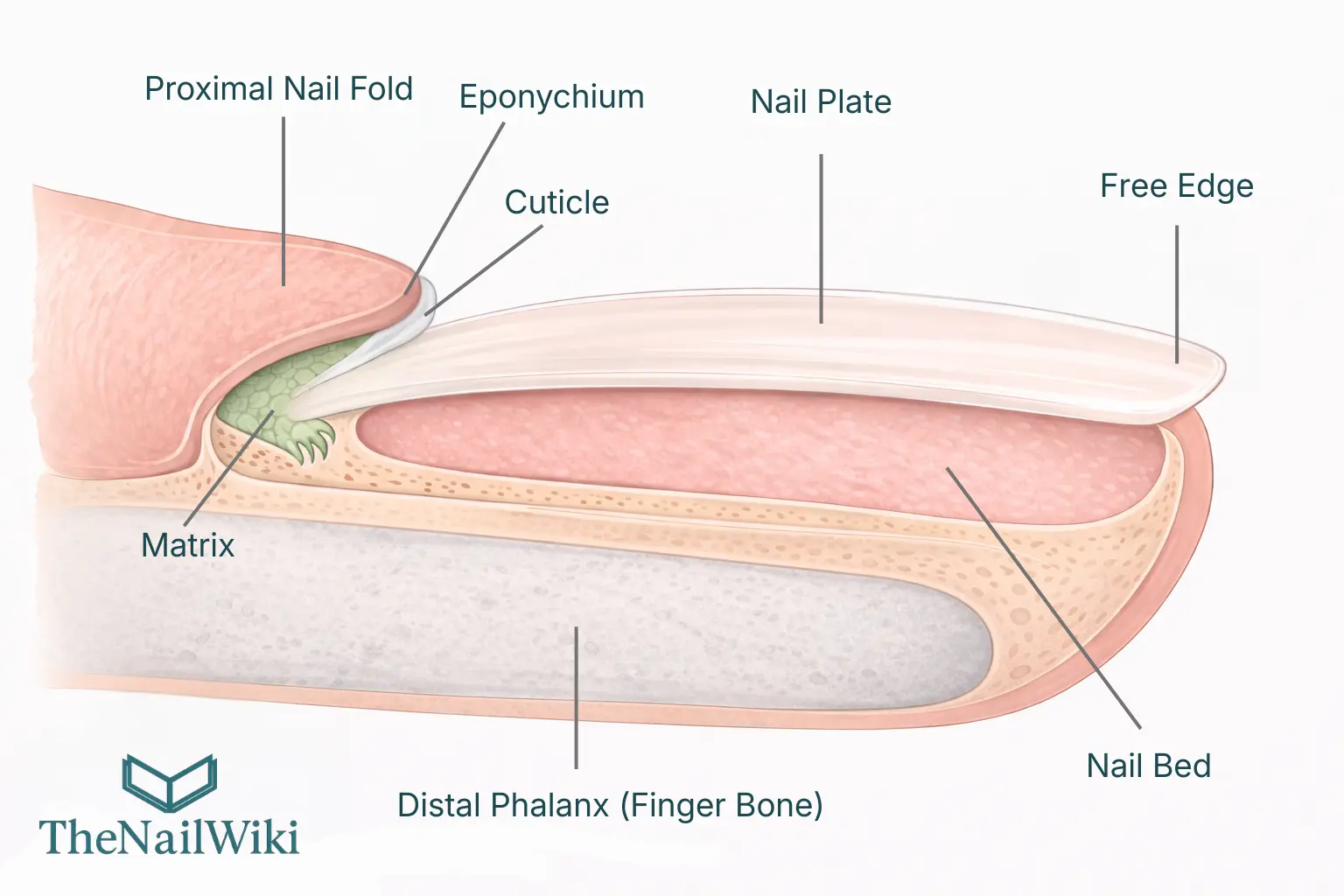
The nail bed is the soft tissue beneath the nail plate, extending from the base of the plate forward to the point where the plate lifts away at the hyponychium. Because the plate is translucent, the pink colour of the bed shows through, and the length of that pink zone is the visible expression of nail bed length. Where the pink ends, the onychodermal band sometimes shows as a faint pale line, and the white free edge follows.
Two measurements are easily confused. The first is the length of the nail bed, which is largely fixed by anatomy. The second is the length of the free edge, which is the part of the plate that has grown beyond the fingertip and can be shortened or extended. A technician controls the second but only influences the first through care.
Why Two Clients With the Same Nail Length Look Different
Overall nail length is the combination of the bed and the free edge. Where the bed is long, more of the visible nail is pink and the free edge looks shorter in proportion. Where the bed is short, the pink area is smaller and the same free edge looks longer.
- Long nail bed: a more balanced appearance, even at a shorter overall nail length.
- Short nail bed: the free edge is proportionally more prominent, and an extension looks longer relative to the bed.
This explains a common situation in the salon. A client brings a photograph of a nail that looks neat and balanced, and asks for the same length. On a client with a different nail bed, the same length and shape produce a different proportion. The result is not a fault in the service. It reflects the anatomy beneath.
What This Means for Length and Shape Conversations
The Library notes that bed proportions can limit which styles and lengths a nail naturally supports, and that this should be taken into account when discussing options. In practice, a few points follow.
Set expectations with the client's own nail
Looking at the client's nail bed during consultation gives a concrete starting point. It is easier to say that the free edge will look more prominent on a short bed than to explain the difference once the nails are finished.
Remember that shape depends on available length
Tapered shapes require the sides of the plate to be filed back progressively towards the tip. On a nail with enough free edge length, the taper begins well beyond the growth points and the corners keep their structure. On a short nail, there is little length to work with and the taper has to begin close to the growth points, which places the file near a structurally important area. This is a matter of free edge length rather than bed length, but the two interact when a client wants a particular style.
Plan the structure for the length chosen
Where a client asks for more length, the architecture of an enhancement needs reconsidering as a whole. Increasing length increases leverage, so the profile, product distribution and curvature should be planned together. See nail architecture, the nail apex and the stress zone.
Can Nail Bed Length Change?
The length of the bed is largely fixed, so it cannot simply be lengthened. It is not entirely fixed in its visible effect, however. The hyponychium recedes in response to habits such as nail biting and repeated trauma, which makes the effective bed shorter. Consistent care, keeping the nails clean and trimmed, and avoiding the habits that cause the hyponychium to recede can preserve, and in some cases gradually extend, the effective nail bed length over time.
This is a useful point to share with clients who are unhappy with the proportions of their nails. It is not a promise of change, because the amount of change varies between individuals, but it shows that daily habits have an effect. The related adaptation of the seal beneath the nail is described in Four Client Situations That Change the Hyponychium.
What Bed Length Does Not Tell You
Bed length describes proportion. It does not describe strength, health or how a nail will behave under load. How a nail performs depends on several variables together, including thickness, flexibility, curvature, length and how the hands are used. No single measurement predicts it. A short bed does not mean a weak nail, and a long bed does not guarantee a strong one.
Consultation prompts
- Look at the length of the pink zone as well as the free edge.
- Show the client how their proportions will affect the finished look at the length requested.
- Ask whether the nails have been bitten or traumatised, since the bed may have receded.
- Choose a shape that suits the available length, particularly on short nails.
- Record the client's baseline so that changes can be seen over time.
Frequently Asked Questions
Does nail bed length affect how enhancements look?
Yes. A longer bed gives a greater pink area relative to the free edge and a more balanced look, even with shorter overall nail length. A shorter bed makes the free edge look proportionally more prominent.
Can a short nail bed be made longer?
The length of the bed is largely fixed by anatomy. Regular care and avoiding habits such as biting, which make the hyponychium recede, can preserve and sometimes gradually extend the effective bed length.
Is the nail bed the same as the free edge?
No. The nail bed is the living tissue beneath the plate. The free edge is the part of the plate that extends beyond the bed, with nothing beneath it.
Does a short nail bed mean weak nails?
No. Bed length describes proportion, not strength.
Related Library Pages
- Nail Bed
- Hyponychium
- Onychodermal Band
- Free Edge
- Growth Points
- Nail Architecture
- Nail Apex
- Stress Zone