
Four Client Situations That Change the Hyponychium: What to Expect and What to Advise
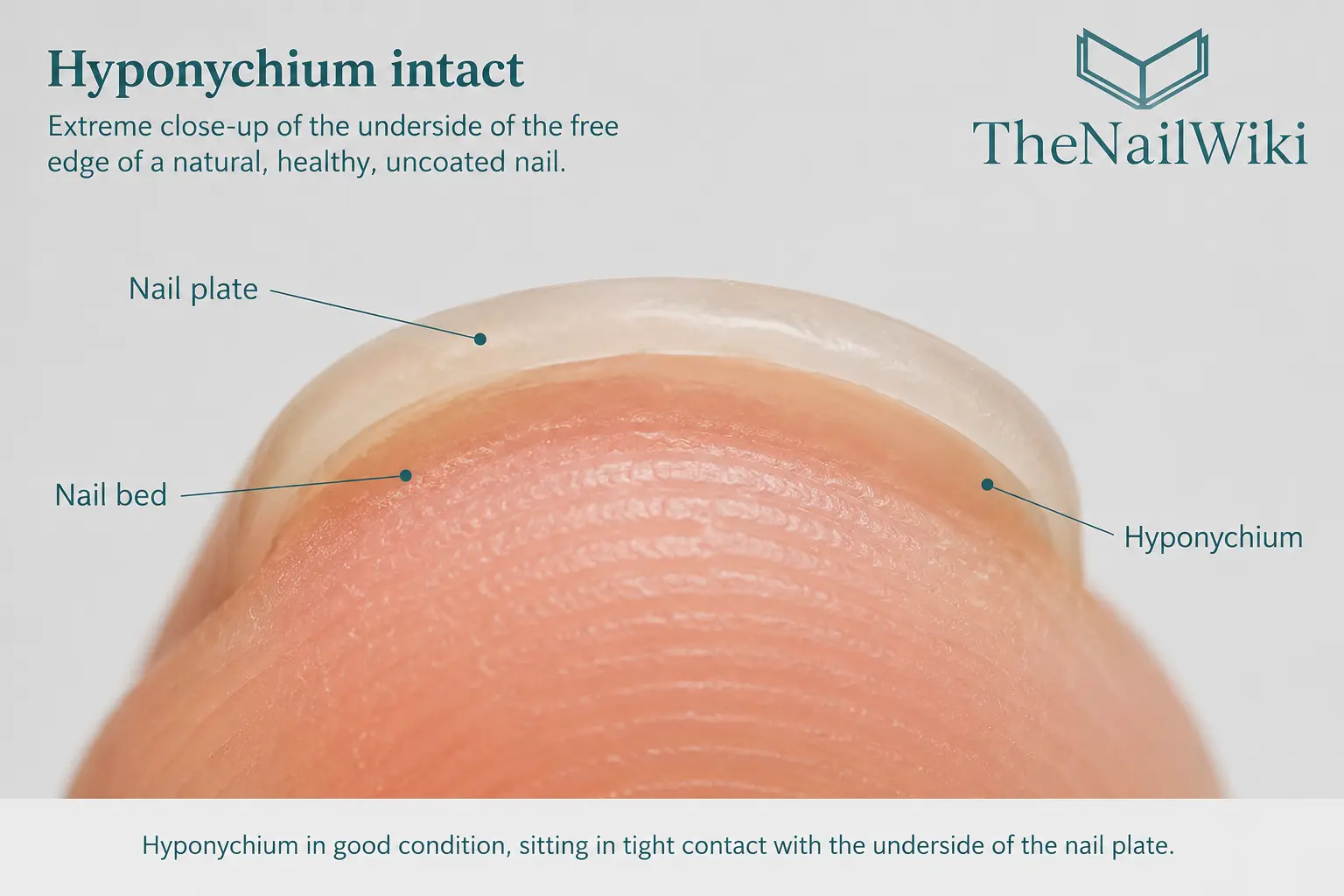
Quick Answer: Why Does the Hyponychium Look Different on Different Clients?
The hyponychium is living tissue that adapts to the nail it seals, so its appearance depends on the client's recent history. It moves forward beneath long nails, retracts beneath short ones, and is easily disturbed by cleaning habits and chemical exposure. Four situations account for most of what technicians see: long extensions that have just been removed, a history of nail biting, nails that grow downward at the tip, and habitual cleaning beneath the nail.
Why it matters: each situation can look alarming to a client, and the correct response, which is usually to leave the tissue alone and explain it, is easy to get wrong.
Why the Hyponychium Is Not the Same on Every Client
The hyponychium is thickened epithelium at the distal end of the nail bed, where the plate leaves the bed and becomes the free edge. It is not callus and it is not debris. It has its own blood supply and nerve endings, which is why cuts or tears here are painful out of proportion to their size, and it forms the distal part of the seal that keeps the space beneath the nail closed.
Two features explain why it varies. First, it follows the plate: as the free edge lengthens, the tissue migrates forward to keep sealing it. Second, its thickness reflects the plate above it, so clients with thin plates tend to have a thinner and more easily disrupted hyponychium. The sections below apply these two facts to real situations.
Situation One: Long Extensions Have Just Been Removed
A client who has worn long extensions for a long time may arrive with a visible ridge of skin beneath a much shorter natural free edge. The hyponychium has followed the longer plate forward and has not yet retracted. Clients sometimes believe that something has grown over or under the nail and needs removing.
- What it is: normal adaptive tissue that has followed the nail. It is not pathological.
- What not to do: do not cut, file, trim or push it back. Doing so breaks the seal, risks bleeding and can be significantly painful.
- What to expect: as the nails are kept shorter, the tissue gradually retracts on its own, typically over several months.
The useful advice here is reassurance and patience. The change is a reflection of how long the nails were worn, and it resolves without intervention.
Situation Two: A History of Nail Biting
In clients who bite their nails very short, the hyponychium retracts and thins over time. When the client begins to grow the nails out, or starts to wear extensions, the tissue has not yet adapted to the new plate length. During this transition the space at the free edge can be more open than usual.
- These clients can be more susceptible to debris accumulating beneath the edge and to infection during the transition period.
- The nail bed may appear short, because the hyponychium has receded. According to the Library, steady care and giving up the habits that make the tissue recede can maintain the effective nail bed length and may gradually increase it.
This is a good moment to talk about habits rather than only appearance. Keeping nails clean and trimmed and avoiding picking supports the tissue as it adapts. For the appearance side of nail bed length, see Nail Bed Length and How It Affects Shape and Length Decisions.
Situation Three: Hooked or Downward-Growing Nails
When a nail plate curves downward at the free edge, the hyponychium can follow the curve and begin to adhere to the top surface of the plate at the tip instead of staying beneath it. The free edge can then appear to have skin growing over it, and shortening the nail may be uncomfortable or difficult.
⚠️ Do not cut into this tissue
This is an adaptation to the direction in which the nail grows and is not a pathological condition. It does call for careful technique when shaping or filing the free edge, because cutting into the tissue causes pain and bleeding.
Situation Four: The Client Who Cleans Beneath the Nail or Works in Water and Chemicals
Many clients clean beneath the free edge with a pointed tool because they believe it is good hygiene. In fact the hyponychium keeps the space clean by preventing debris from entering in the first place. Pushing an instrument beneath the plate levers the hyponychium away from the underside of the nail, and each repetition disrupts the seal slightly further back. The enlarged space then collects more debris and moisture, not less.
The same effect can come from using the nail as a lever, from a brush with bristles that are too coarse, and from chemical exposure. Bleach-based products, harsh detergents, extended dishwater exposure and sulphur-containing mineral pools can degrade the seal. Clients whose plates are already thinned are more susceptible, because a damaged plate gives the tissue beneath less protection.
Advice that is easy for clients to follow
- Clean the visible underside of the free edge with a soft brush, gently and across the edge, without pushing anything beneath the plate.
- Wear rubber or nitrile gloves for cleaning tasks involving bleach, detergents or harsh products.
- Limit time in mineral pools, particularly sulphur-based hot pools, and rinse hands afterwards.
- Apply cuticle oil to the underside of the free edge and the hyponychium as well as the cuticle area, because the seal is skin and benefits from the same conditioning.
When to Stop and Refer
If the seal has been disrupted for long enough, the plate may begin to separate from the bed, a condition called onycholysis, and the warm, enclosed space that results can become colonised. Signs that call for a pause or a referral include a white or discoloured arc that has moved back from the tip, green discolouration beneath the plate (see green nail syndrome), persistent pain, swelling or bleeding. The onychodermal band marks the normal limit of firm attachment, and the separation boundary can be compared against it. The article Why Do Nails Lift? explains causes and responses in more detail.
Frequently Asked Questions
Why is there a ridge of skin under my nail since my extensions came off?
The hyponychium migrates forward beneath long nails. When the nails are shortened, the tissue is still in its forward position and is visible as a ridge. It is normal and gradually retracts over several months.
Should the hyponychium be trimmed or pushed back?
No. It contains blood vessels and nerves, and cutting or forcing it back breaks the seal, risks bleeding and is painful.
Why does the nail bed look shorter after nail biting?
Biting causes the hyponychium to retract and thin. With care and without the habit, the effective nail bed length can be preserved and sometimes gradually extended.
Is it unhygienic not to clean under the nails?
The seal prevents debris from entering. Cleaning beneath the plate with a tool disrupts the seal and tends to make the space collect more debris. A soft brush across the visible underside of the edge is the approach recommended.