
The Proximal Nail Fold and Safe Cuticle Work
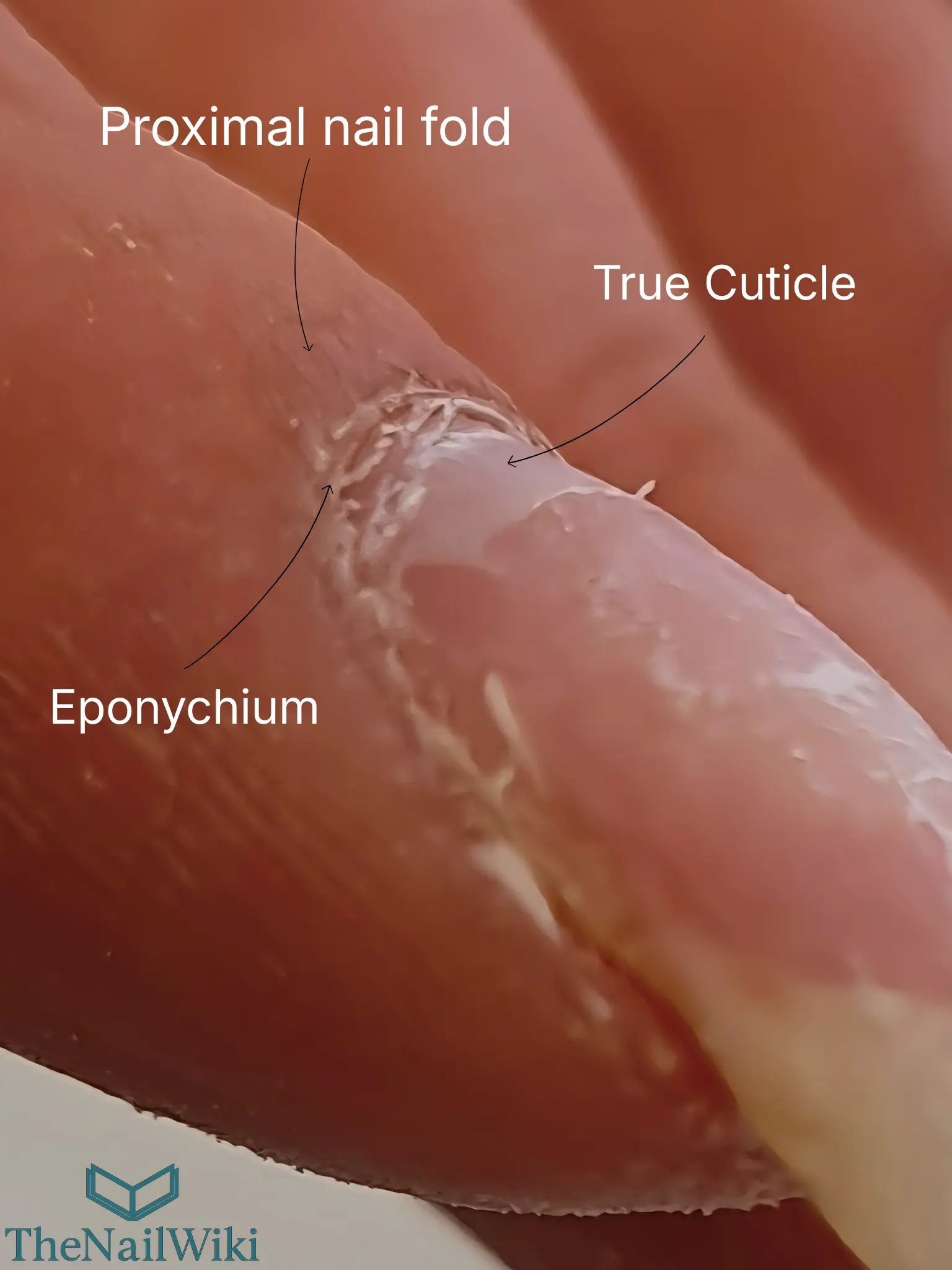
Quick Answer: What Is Safe to Touch?
In cuticle work at the proximal nail fold, only one thing can be removed freely: the non-living true cuticle sitting on the surface of the nail plate. It is dead, keratinised tissue with no blood or nerve supply, and taking it off the plate is standard, safe professional preparation.
The proximal nail fold itself and the eponychium at its edge are living tissue sitting directly over the nail matrix. The fold must not be cut in routine preparation. Working on the eponychium is a standard, accepted part of European and Russian manicure technique — but it is advanced work that depends on training, correct tools and controlled technique, not something to be forced.
Contents
Three Structures, One Small Area
The confusion around “cuticle work” comes from a single word doing three jobs. At the base of the nail, where the nail plate emerges from beneath the skin, three separate structures occupy a very small space, and in everyday salon language all of them get called the cuticle. Deciding what is safe to touch means telling them apart.
| Structure | What it is | Living tissue? | Safe to remove from the plate? |
|---|---|---|---|
| Proximal nail fold | The visible fold of skin that overlaps the base of the nail plate, made of ordinary living skin with a blood supply and nerve endings | Yes — living skin | No — not cut in routine preparation |
| Eponychium | The living skin at the lower edge of the fold, produced by its underside, where it meets and seals against the nail plate surface | Yes — living skin | Advanced trained work only, not routine removal |
| True cuticle | The thin, translucent, non-living tissue shed from the underside of the fold onto the surface of the nail plate | No — non-living tissue | Yes — standard, safe professional preparation |
The proximal nail fold is a double-layered fold of skin at the base of the nail unit. The word proximal means closest to the body — here, closest to the knuckle. It has a dorsal (outer, visible) surface continuous with the skin of the finger, and a ventral (inner, underside) surface that lies against the top of the nail plate. Where the fold turns back on itself it forms the nail sinus, the shallow pocket the plate is tucked into as it grows forward. Along the sides of the plate, the fold system continues as the lateral nail folds.
The eponychium is not a separate organ — it is the living skin at the very lower edge of that fold, produced by the fold's underside, extending a short distance onto the plate surface. In nail education it is sometimes called the “living cuticle”, a helpful nickname but not correct anatomical language. The correct term is simply the eponychium.
The true cuticle is the non-living remnant of the eponychium. As the plate grows forward and emerges from beneath the fold, it carries with it a thin film of shed, keratinised tissue deposited onto its surface. This is the tissue that is genuinely worked on in cuticle removal — translucent, often near-invisible, with no blood supply and no nerve supply. For the full breakdown of these structures, see the eponychium and cuticle.
Why the Proximal Nail Fold Decides the Rules
The reason these distinctions carry weight — rather than being academic — is what sits underneath. The proximal nail fold lies directly over the nail matrix, the structure that produces the nail plate. The matrix is entirely protected from outside contact by the fold, which makes the fold the primary anatomical barrier between the matrix and the outside world.
Any permanent damage to the matrix produces permanent change in the plate it makes: ridging, thinning, abnormal growth, or in severe cases loss of the nail. Because the fold sits over the matrix, trauma to the fold does not stop at the skin. Inflammation or damage transmitted through the fold to the matrix beneath can alter the plate being formed, so that ridges, white spots or pitting appear weeks later as the affected plate grows forward towards the free edge. The angle and growth direction of the emerging plate are influenced by the fold too, and chronic distortion of the fold can gradually change them.
This is why the fold's protective seal matters. The proximal nail fold and the eponychium together close the nail pocket against contaminants. That seal is not put at risk by professional technique performed with proper training and appropriate tools — the risk comes from unskilled, uncontrolled or forced work.
What Is Safe to Remove: The True Cuticle
The true cuticle is non-living tissue adhered to the plate surface, so it can be removed during professional preparation without bleeding or damage to living structures — provided the removal stays on the non-living tissue on the plate and does not extend into the living eponychium at the fold edge. That single proviso is the safety line in cuticle work.
Removing it is not only safe, it is functional. Residual cuticle left on the plate is a barrier: product applied over it cannot bond to the plate directly, and as the film gradually separates during wear it lifts the product with it. This is a leading cause of proximal lifting in gel and enhancement services. On many clients the true cuticle is almost invisible, which is why manual preparation so often leaves a thin layer behind even when the plate looks clean — clean-looking is not the same as prepared. Thorough removal of the true cuticle is therefore part of good nail plate preparation.
Wet versus dry removal of the true cuticle
Both are legitimate. In wet preparation, a remover product or a soak softens the tissue, which is then loosened with a pusher or orange stick and any excess at the fold edge nipped away. Its limitation is that the near-invisible true cuticle is rarely removed completely, leaving residue on the plate.
In dry e-file preparation — the method used in e-file manicure and Russian manicure — a fine, appropriate bit removes the true cuticle from the plate mechanically at a controlled speed and angle, taking off even the residue that wet preparation leaves behind.
Working on the Living Eponychium
The eponychium is living skin with a blood supply and nerve endings. It forms the seal between the fold and the plate — the body's barrier against pathogens and debris reaching the space beneath the fold where the matrix sits. When that seal is broken through cutting, aggressive pushing or chronic mechanical disruption, infection risk rises.
That does not make the eponychium untouchable. In European nail technique and Russian manicure, working on the eponychium is standard, accepted and expected practice. The position taken by some that cutting or working the eponychium is always wrong is not accurate. The difference between good work and poor work in this zone is anatomy knowledge, correct tools and trained technique — not avoidance. A professional who understands exactly what the structure is, what it seals and what lies beneath it can work on it with precision and intention, and how they choose to approach it in their own practice is an informed decision for them to make.
The counterpoint holds at the same time: the fold and eponychium are living tissue and must not be cut in routine preparation. Cutting or aggressively pushing back the proximal nail fold without that training and control risks bleeding, infection, and — because the matrix lies directly beneath — potential permanent disruption of nail plate production. Advanced work on the eponychium and casual cutting of it are not the same action, even though salon language often gives them the same name.
Safe Technique at the Proximal Nail Fold
The proximal nail fold is the central working zone of cuticle work in professional e-file and Russian manicure services. Refining it fully — the eponychium and the surrounding skin included — is what produces the clean, defined result that sets these services apart, and it is a level of finish manual preparation cannot match. Because of what sits beneath, it is not beginner work.
Working the proximal nail fold — key principles
- It requires training, precision and correct technique; treat it as skilled work, not a routine step.
- The e-file must run at the correct low speed with appropriate bits — primarily diamond bits for work on skin.
- Forcing or rushing the area risks transmitting trauma to the matrix beneath.
- Any bleeding is a signal to reassess technique, pressure or speed — not to continue regardless.
Keeping Product Off the Living Skin
Preparation is only half of safe work at this zone; product application is the other half. The proximal nail fold area is exactly where product is most likely to flood onto living skin. Sensitisation is an immune response that develops through repeated skin exposure to acrylate chemistry in gel and acrylic systems, and once it develops it is irreversible.
The important point for technique is where the risk actually comes from: uncured or partially cured product repeatedly contacting living skin — not from e-file work on the eponychium. Russian manicure and European dry manicure have been practised for decades without a widespread sensitisation problem, so the preparation method is not the issue. Product that is applied cleanly, kept off the living skin of the fold and cured fully does not present the same risk as product habitually flooded onto the surrounding skin and left to cure in contact with it.
No-contact placement
Keep a small, consistent gap — around 1–2 mm — between the product edge and the skin at the proximal fold and sidewalls, so uncured chemistry is never deposited onto skin that can absorb it. This applies to gel polish, builder gel, acrylic and any other acrylate-based system, whatever preparation method was used. Thorough removal of the true cuticle first supports this: residue on the plate lets product lift at the proximal edge and migrate onto the surrounding skin during wear.
Because sensitisation is permanent, clients with a history of reaction to nail products should be assessed carefully; see nail patch testing.
When You Must Not Work the Fold
Some presentations at the proximal nail fold are contraindications or conditions that must not be manipulated in the salon, regardless of technique.
Paronychia
Infection of the proximal nail fold, most commonly bacterial, showing as redness, swelling, warmth and sometimes pus at the base of the nail. Acute paronychia is a contraindication to nail services — see the guide to contraindications in nail services.
Pterygium unguis
In conditions such as nail lichen planus, the proximal nail fold skin can adhere to and advance over the plate. This is an irreversible change caused by scarring of the matrix beneath, and it must not be manipulated.
Habit tic deformity
Repeated picking or rubbing of the fold, typically with the opposing thumb, causes chronic low-level trauma to the fold and the matrix beneath, producing a characteristic central ridge or washboard pattern running the length of the plate. The lesson for the technician is the same in reverse: repeated mechanical trauma to this zone has visible, lasting consequences.
Ragged or overgrown cuticle
Where the true cuticle is not regularly maintained it accumulates on the plate and the fold can look thickened and unkempt. This is the most common presentation in salon clients and is entirely addressable through professional cuticle work — it is not a contraindication.
Frequently Asked Questions
What is safe to touch in cuticle work?
The true cuticle — the thin, non-living tissue on the surface of the nail plate — is safe to remove and is standard professional preparation. The living proximal nail fold and eponychium are not removed in routine work; the fold is not cut, and the eponychium is worked on only with proper training in advanced technique.
What is the difference between the proximal nail fold and the cuticle?
The proximal nail fold is the living fold of skin at the base of the nail. The true cuticle is the non-living, dead tissue the fold sheds onto the plate surface. The fold is a structural part of the nail unit; the cuticle is a surface deposit that can be safely removed.
Can the proximal nail fold be worked on?
Working on the fold and eponychium is a standard part of professional e-file and Russian manicure, but it depends on proper training, correct bit selection, appropriate low speed and controlled technique. The matrix directly beneath means precision matters — the fold is a working area for a trained professional, not an untouchable zone, and equally not a routine one for the untrained.
Is it safe to remove the cuticle?
Removing the true cuticle from the plate surface is safe and standard. The risk arises only when the work extends past the non-living tissue into the living eponychium. Correct technique keeps preparation confined to the non-living tissue on the plate.
What happens if the proximal nail fold is damaged?
Damage disrupts the protective seal over the matrix. Inflammation or trauma reaching the matrix can alter the plate being produced, giving ridges, pitting, white spots or abnormal growth weeks later as the affected plate grows forward. Repeated damage can cause lasting change to plate quality.
Why does gel product lift at the base of the nail?
Proximal lifting is frequently caused by residual true cuticle left on the plate during preparation. Product cannot bond to non-living cuticle tissue as it bonds to the plate itself, and as that film separates during wear it carries the product with it. Thorough removal of the true cuticle is the primary prevention.
Related Library Pages
Nail anatomy
- Proximal Nail Fold: Anatomy, Function and Role in Nail Services
- The Eponychium and Cuticle
- The Nail Matrix
- The Nail Plate
- The Nail Bed
- The Lateral Nail Folds
- The Hyponychium
- The Lunula
Technique and safety
Professional Disclaimer
The information on this page is provided for educational purposes and is intended to support the professional knowledge of nail technicians and nail educators. It does not constitute medical advice. Any client presenting with signs of infection, inflammation or structural nail changes should be referred to a qualified medical professional for assessment.