
Why Some Clients Get Ingrowing Nail Edges: Groove Anatomy, Curvature and Habits
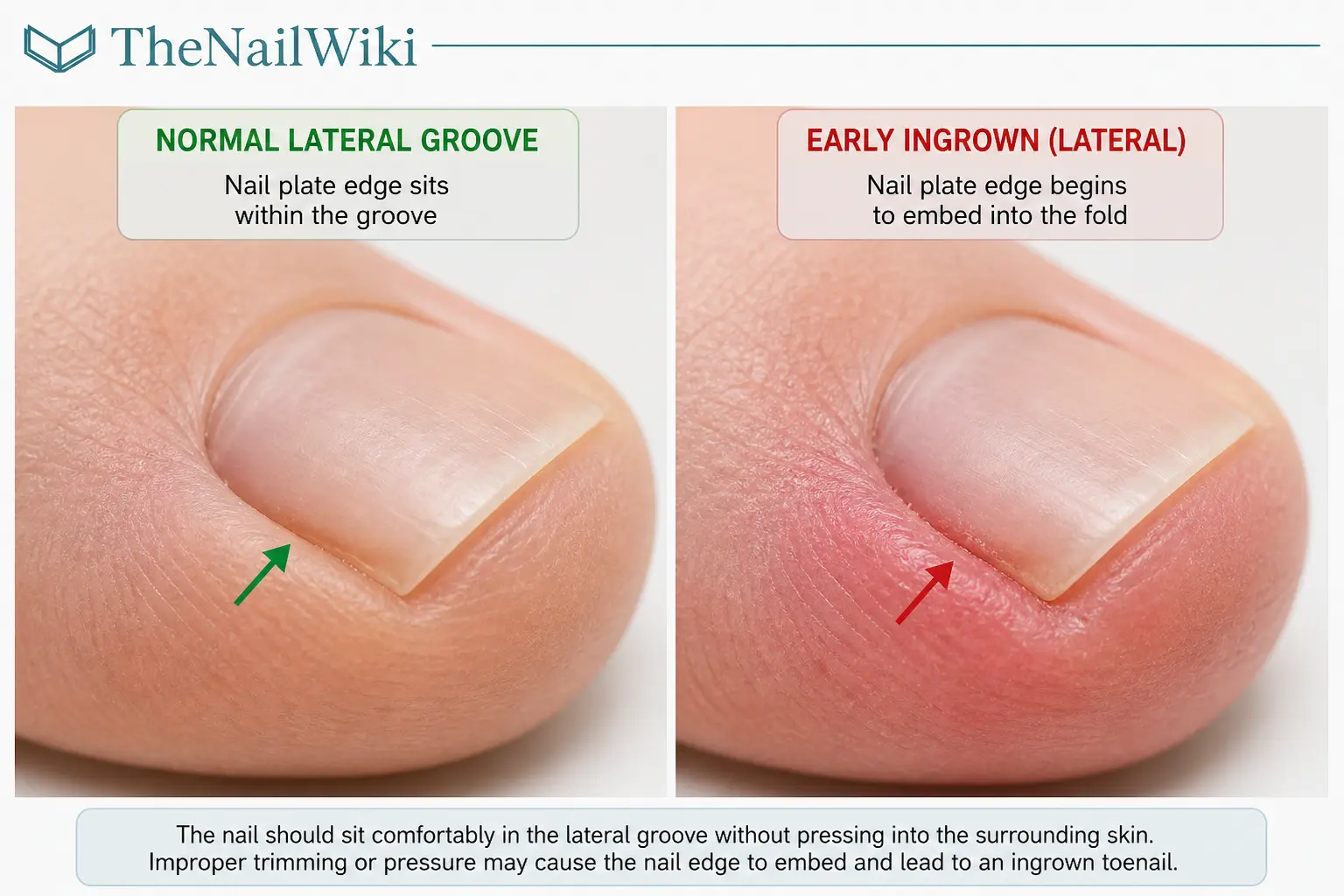
Quick Answer: Why Does an Ingrowing Edge Affect Some Clients Repeatedly?
An ingrowing edge occurs when the side of the nail plate leaves the lateral nail groove and grows into the fold beside it, and some clients are more prone to it than others because of their anatomy and habits. A narrow groove, a soft fold, a strongly curved plate, corners that have been cut too short, pressure from footwear and trauma all raise the likelihood. Understanding which of these applies to a client explains why the problem returns and what a technician can sensibly do about it.
Why it matters: an ingrown nail that has penetrated the fold is painful, prone to infection and a contraindication to services in the acute phase. Prevention is far easier than correction.
How the Groove Normally Works
The groove is a narrow channel between the edge of the plate and the inner surface of the lateral nail fold. It is lined with thin, sensitive skin that is in close contact with the plate edge as the nail advances, roughly 3 mm each month. The groove acts as a passive track, keeping the plate aligned. Because it is shallow, even a slight deviation of the plate edge towards the fold can cause pressure and, if it continues, penetration of the edge into the fold tissue.
The groove and the fold are different structures, and the distinction affects how a problem is described. The fold is the visible skin ridge. The groove is the channel between that ridge and the plate. A groove problem occurs when the plate edge leaves the channel.
Anatomical Features That Increase the Risk
The Library identifies several features that influence whether a plate edge stays in the groove.
- A narrow groove. Less room means less tolerance if the edge deviates.
- A soft fold. A fold that yields easily is more readily penetrated by an edge that is pointing towards it.
- Pronounced curvature of the plate. A plate that is too curved for the groove to contain may press into the surrounding tissue. In extreme cases, such as pincer nails where the plate rolls inwards at the sides, there is chronic pressure against the groove lining and the nail bed. That condition is not managed in the salon and needs podiatric or dermatological assessment. See also the C-curve.
- Prominent folds. Nails with more prominent folds tend to have a deeper natural curve, so the two features often occur together.
None of these makes an ingrown edge inevitable, but a client who has several of them deserves a more cautious approach to shaping.
Shaping and Habits That Initiate the Problem
Corners cut or filed too short
This is the most common initiating factor in the salon. When the corners are shortened below the level of the fold, the plate no longer has a free edge in the groove at that point. As the nail grows forward, the new edge must find its way back into the groove. If the groove is narrow, the fold soft or the curvature strong, the edge may grow into the fold instead. The safer approach is to file or cut the free edge straight across with only very gentle rounding at the corners, and to work parallel to the fold rather than angling into it.
Shapes that need more length than the nail has
Tapered shapes require the sides to be filed back towards the tip. On a short nail there is little free edge to work with, so the taper starts at or near the growth points. This removes material from the corners, which is the situation most likely to start the problem. The relationship is covered in growth points and the article Why the Corners of the Nail Lift.
Pressure from footwear
Tight footwear compresses the folds towards the plate and is one of the recognised causes of ingrown toenails. For clients who present with recurrent problems in the toes, advice about footwear belongs alongside advice about shaping.
Trauma
An injury to the fold or plate can alter the path of the plate edge. A client who reports that the problem began after a knock or a crush injury should be asked about it.
What Else Contributes: Debris and Product in the Groove
The groove is narrow and can collect dead skin, product residue and environmental debris. In clients who wear enhancements, product that flows into the groove and cures forms a solid deposit that is hard to remove and can press against the edge of the plate. Product must stay within the boundaries of the plate for this reason, as well as for the risk of sensitisation. Keeping the groove clean is part of routine maintenance. The practical technique for doing so is set out in Working Safely Around the Lateral Nail Folds.
Assessing a Client Who Has Had the Problem Before
Questions and checks
- Which nails are affected, and are they fingers or toes?
- How does the client shape or trim their own nails?
- How deep is the curve of the plate, viewed end-on?
- Is the fold soft, thickened or inflamed?
- Has the client had trauma to the area, or do they wear tight footwear?
- Is the groove clean, or is there a deposit of product or debris?
The answers decide what to do. In a client with a deep curve, a soft fold and a history of trimming the corners, the most helpful step is often to leave the corners alone and let the edge grow past the fold.
When to Stop and Refer
⚠️ An ingrown nail that has penetrated the fold
If the fold is red, swollen, painful or discharging, the nail should not be worked on in that area. Acute ingrown nails and infection are contraindications to services. Do not attempt to cut the edge out. Refer the client to a medical professional. Mild cases may be managed by careful reshaping of the free edge, while severe or recurrent cases can need surgical treatment. See contraindications in nail services.
Frequently Asked Questions
What causes an ingrown nail?
The side edge of the plate leaves the lateral groove and grows into the fold. Common causes include cutting or filing the corners too short, a plate that is too curved for the groove to contain, tight footwear and trauma.
Why do some people keep getting ingrown nails?
A narrow groove, a soft fold, a strongly curved plate and habitual trimming of the corners all increase the likelihood, so a client with several of these features is more prone to recurrence.
How should the corners of a nail be shaped to avoid ingrowing edges?
The free edge is filed or cut straight across with only very gentle rounding at the corners, working parallel to the fold and never cutting into the corners.
Can a technician treat an ingrown nail?
Not when it is acute. Pain, swelling, redness or discharge calls for referral to a medical professional.
Related Library Pages
- Lateral Nail Grooves
- Lateral Nail Folds
- Growth Points
- C-Curve — Transverse Arch
- Nail Files and Grit Guide
- Onycholysis