
Why the Corners of the Nail Lift: Growth Point Damage Explained for Technicians
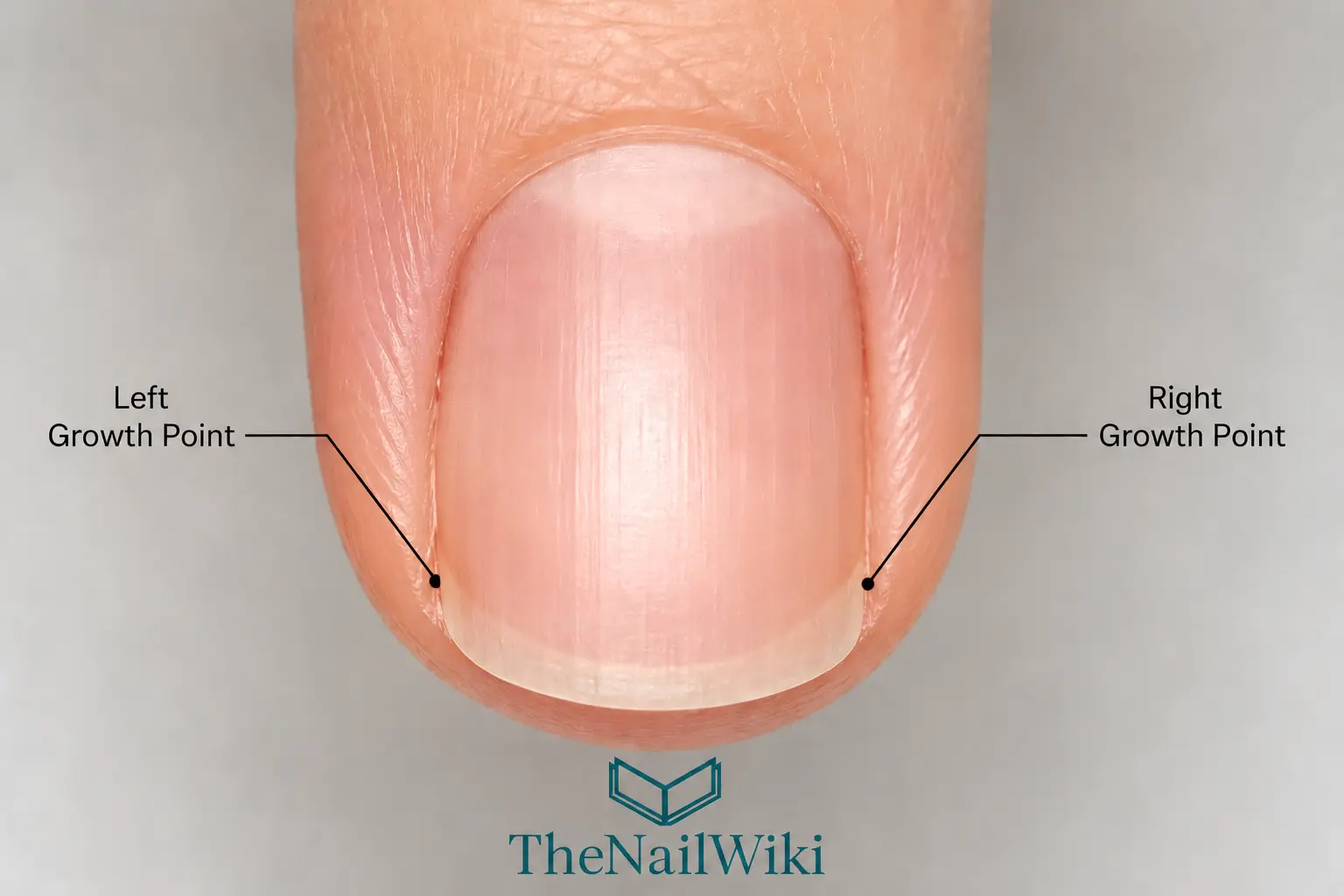
Quick Answer: Why Do the Corners of a Nail Lift?
Lifting at the corners usually means that the growth points, the two lateral corners where the plate leaves the nail bed, have been weakened, compressed or left without support. It takes two forms that look similar but have different causes: an enhancement that is lifting from a nail that is still sound, and the natural plate itself separating from the bed at the sides. Working out which one is present is the first step.
Why it matters: the corners are the lateral endpoints of the stress zone, so damage here produces repeated breakage and lifting that can persist for months unless the cause is removed.
Why the Corners Are Vulnerable
The growth points are not where the nail is produced. That is the matrix. They are the places where the plate, already formed, moves from the supported nail bed zone to the unsupported free edge on each side. The plate draws much of its lateral strength from these corners, and the area where force is greatest, the stress zone, runs across the nail at about this level.
When the corners are intact and correctly shaped, the free edge extends forward symmetrically with full lateral support. When they are filed into, compressed or left uncovered, that support is lost and the nail breaks or lifts more readily at the sides.
Step One: Enhancement Lifting or Natural Plate Separation?
A technician sees a lifted corner and needs to know what has lifted.
- The enhancement has lifted from the plate. The natural nail beneath looks intact, and the gap is between the product and the plate. Causes are usually structural, such as coverage, form fit or adhesion.
- The natural plate has separated from the bed. A white or discoloured area is present at the corner beneath the plate, which is onycholysis at the lateral edge. Causes include damage to the corner from filing or e-file work, and the problem is in the nail itself.
Both can occur together, and an enhancement over a damaged corner will fail more quickly. It is worth looking at the corner after removing product, before applying anything new.
Causes Related to Technique
Filing into the corners
Angling a file towards the plate at the sides, rather than keeping it parallel to the sidewall, removes material from the corners. Over several sessions this creates a notch at each growth point, making the corner thinner and more likely to split or tear, and altering the shape of the free edge as it grows forward.
E-file work in the corner zone
The e-file removes material faster than a manual file and gives less tactile feedback, so significant thinning can occur before resistance appears to change. Bits should not be applied directly to the growth point corners. The area is left alone or approached with extreme care at a very shallow angle.
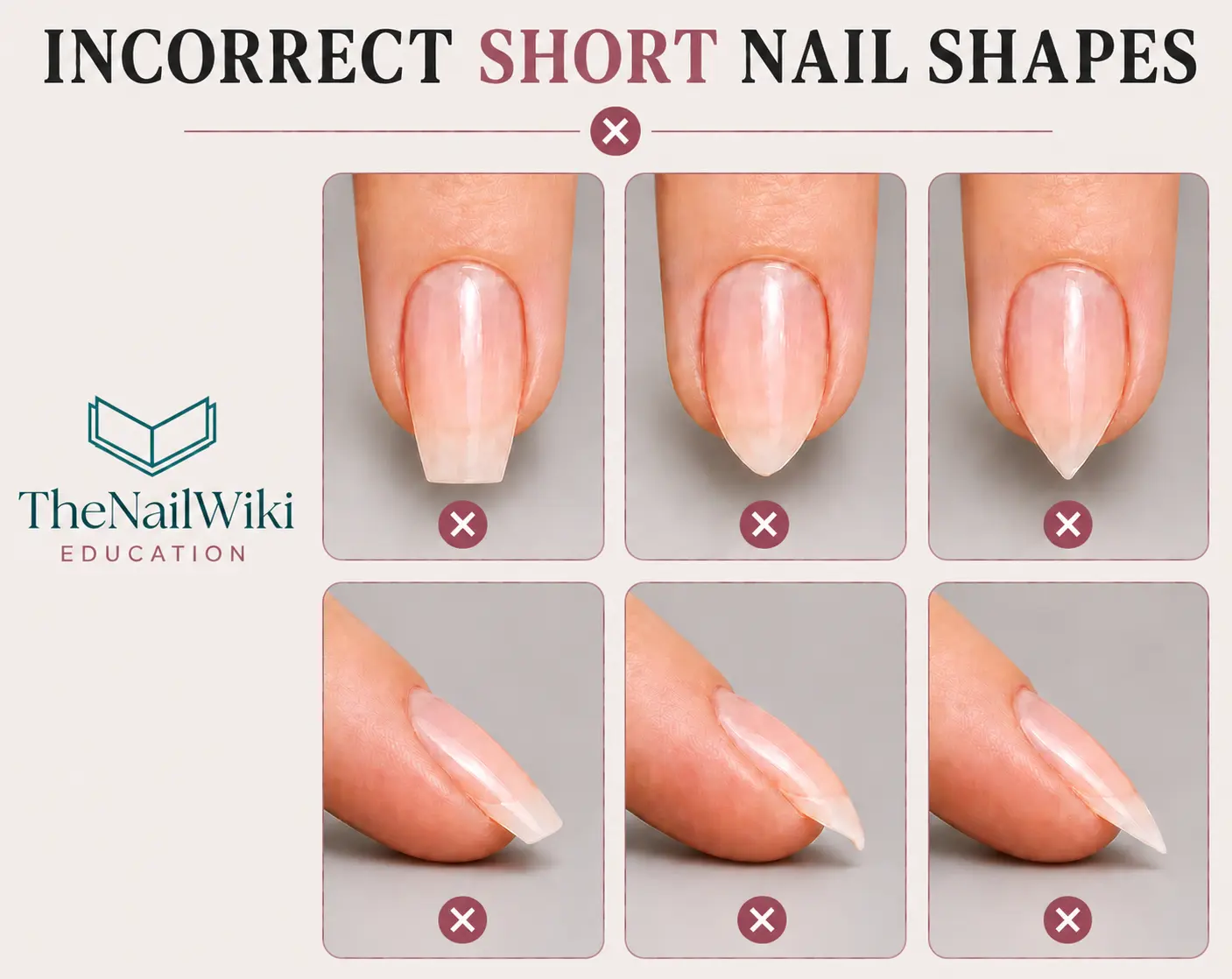
A shape that needs more length than the nail has
Tapered shapes such as almond, coffin and stiletto require the sides to be filed back towards the tip. On a nail with enough free edge, the taper begins forward of the growth points and the corners keep their width. On a short nail, the taper must begin at the growth points, which removes the lateral support the plate needs. The Library notes that these shapes require extension length to be structurally viable, and that square, squoval or oval shapes suit shorter nails. See the free edge page for context, and C-curve for how curvature interacts with shape.
Causes Related to Enhancement Structure
A form that does not enclose the corners
A form that is too narrow compresses the growth points as it is pressed on, which can alter the direction of growth at the corners and cause lifting and weakness where the enhancement needs the most support. A form that does not reach the growth points cannot be rescued by technique and should be replaced.
Product that stops short of the corners
If the product does not reach the full width of the nail, a rigid enhancement ends before the corners are reinforced. This creates a step between the hard product and the more flexible natural nail, and force concentrates at that transition. The natural nail often cracks horizontally exactly where the coverage stops. Sidewall cracking, splitting near the grooves and edge fractures follow from the same mismatch. After form removal, coverage at both growth points should be checked visually before finishing. A gap is a structural defect and should be corrected, not filed smooth.
Catching points
Exposed lateral edges catch on hair and fabric. Repeated pulling weakens adhesion and can lead to lifting, and in severe cases a layer of the natural plate can tear away at the corner.
Cumulative Damage
A single service with exposed or damaged corners usually recovers as the nail grows out. Repeated services with the same fault damage the same area each time. The plate becomes progressively thinner and weaker, onycholysis at the sides becomes more likely, and the damage can take far longer to resolve. The pattern is easy to miss because each appointment looks like an isolated lift.
What to Do When the Corners Are Already Damaged
Recovery depends on removing the cause and letting the affected plate grow out. Because the growth point sits roughly midway along the nail, the plate at that level takes about three months to reach the free edge, and severe or repeated damage may take longer. During this time:
- Stop all filing and shaping that touches the corners.
- Avoid aggressive e-file work in the sidewall zone on the affected side.
- Keep the corners clean, because debris in a damaged area encourages infection.
- Advise daily cuticle oil on the sidewall and corner area.
- Let the nail grow at a shorter length, which reduces mechanical stress on the damaged corner.
⚠️ Redness, swelling or tenderness at the corner
An inflamed corner should be assessed for infection before any service continues. Do not apply product over an inflamed growth point. See contraindications in nail services.
For the wider picture of lifting, including causes beyond the corners, see Why Do Nails Lift? For technique at the sidewalls, see Working Safely Around the Lateral Nail Folds, and for a symptom-based review of sidewall problems, see Sore, Tight or Lifting Sidewalls After a Service.
Frequently Asked Questions
Why does my nail lift at the corners?
Either the enhancement is lifting because of fit or coverage problems at the corners, or the natural plate is separating from the bed there, often because the corners have been over-filed or compressed.
Are growth points the same as the nail matrix?
No. The matrix produces the plate. The growth points are the lateral corners where the produced plate moves from the nail bed into the free edge.
Why should the corners not be filed?
They do not need direct work in a correctly performed service. Filing into them causes thinning, irregular growth and onycholysis at the sides.
How long do damaged growth points take to recover?
Roughly three months for the affected plate to reach the free edge, and longer if the damage is severe or repeated.