
Nail Growth Direction: Upward, Downward and Lateral Growth
Author: Radina Ignatova – Nail Expert, International Nail Educator | Last Updated: July 2026
Quick Answer: Nail growth direction describes the path the nail plate follows as it grows towards the free edge. Nails may grow broadly forwards, angle upwards, curve downwards, or deviate slightly to one side. The usual growth pattern is influenced mainly by the structures that produce and support the nail — the nail matrix and nail bed — although injury, disease, or long-term pressure may sometimes alter it. Growth direction is an important part of professional nail assessment because it can influence enhancement planning, form or dual-form selection, product distribution, and the finished appearance.
Contents
What Nail Growth Direction Means
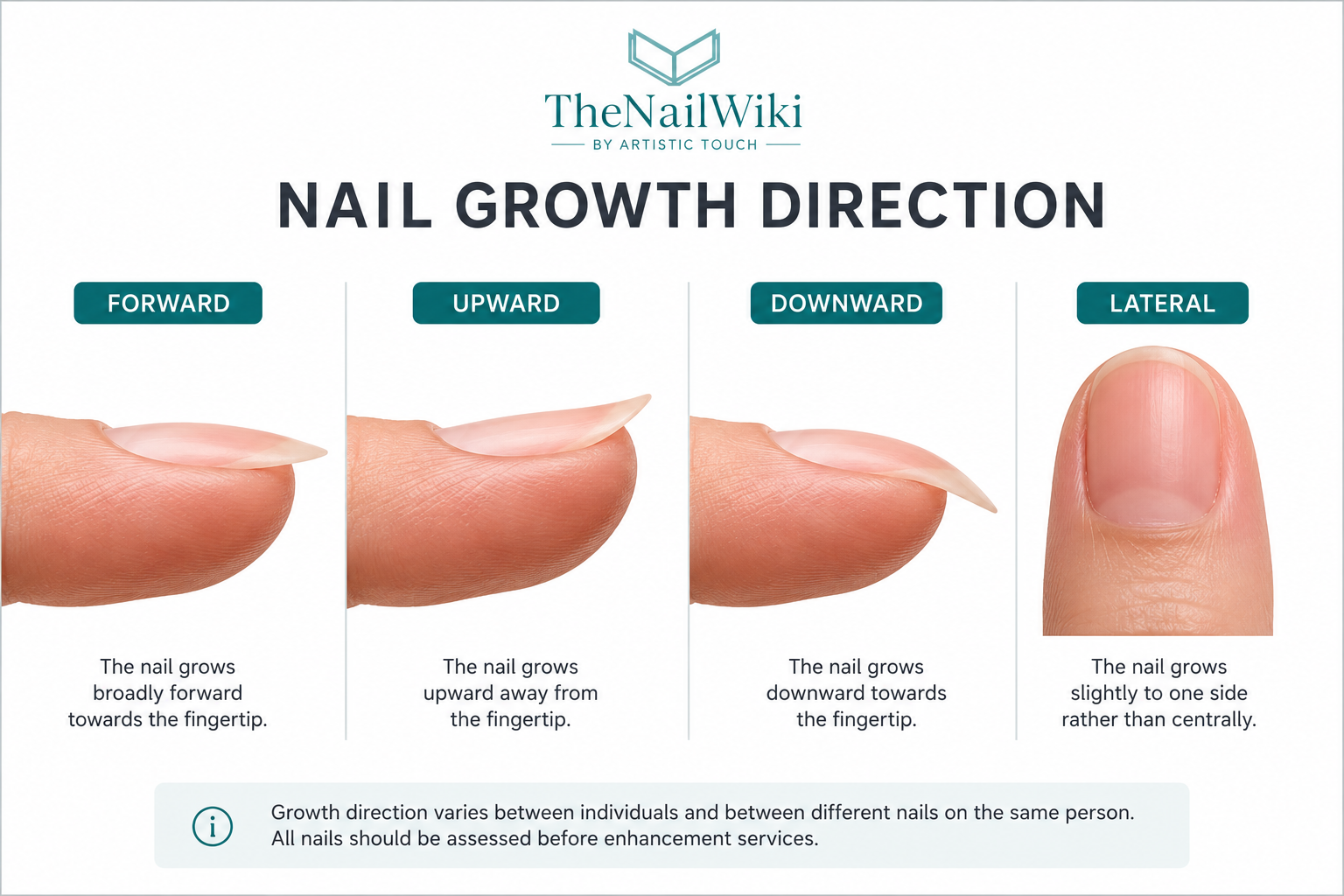
Nail growth direction describes the angle and trajectory of the nail plate as it grows forward from the matrix. When viewed from the side — the profile view — the nail plate can be seen either growing in a broadly horizontal direction, angling upward away from the fingertip, or curving downward toward the pad of the finger. When viewed from above, the growth direction may also deviate laterally — the plate growing slightly to one side rather than centrally.
Growth direction is not the same as the curvature of the nail plate. The C-Curve describes how the nail arches across its width. Growth direction describes the overall path the plate takes as it advances forward. A nail can have a more pronounced or flatter transverse curve while also growing forwards, upwards, downwards, or laterally — the two are independent characteristics.
Understanding growth direction matters in professional nail practice because it can influence what the nail looks like naturally, how enhancement products will sit on it, and what design choices are needed to produce a visually correct and appropriate result for that specific nail.
Common Growth Direction Patterns
Forward-growing nails
The most common growth pattern — the nail plate grows broadly horizontally forward across the nail bed toward the fingertip. The free edge extends in approximately the same plane as the nail bed. This is a common growth pattern, and many standard forms and application demonstrations are based on nails that grow broadly forwards.
Upward-growing nails (ski-jump nails)
Some nails grow at an upward angle — the free edge lifts away from the fingertip rather than extending in line with it. This is commonly referred to in professional practice as a ski-jump nail. The degree of upward growth varies: some nails have a subtle upward angle that is only noticeable when viewed from the side; others have a pronounced ski-jump where the free edge curls visibly upward. This pattern is often linked to individual matrix anatomy or a naturally thinner nail plate, though the exact contributing factors vary between clients and are not always identifiable. Upward growth can make standard form or dual-form positioning unsuitable without adjustment. If the technician follows the upward angle automatically, the finished enhancement may continue that direction rather than creating the intended profile. The appropriate adjustment depends on the natural nail, service, product system, length, and construction method.
Downward-growing nails (hooked nails)
Other nails grow at a downward angle — the free edge curves toward or underneath the fingertip. Severely downward-growing nails are often described as hooked nails or claw nails. The nail plate may have an exaggerated C-Curve alongside the downward growth direction. Beyond matrix anatomy, a pronounced hook is sometimes associated with an overly long free edge, or with the nail plate losing moisture and curling under its own length; more than one factor may be involved on any given nail. Pronounced downward growth can limit the suitability of some overlay or extension approaches. The technician must assess the natural nail, length, product properties, service plan, and how the structure will change as the nail grows. In some cases, shortening, restructuring, or choosing a different construction method may be more appropriate than simply following the existing downward direction.
Lateral deviation
Some nails grow at a slight lateral angle — the plate advancing slightly to one side rather than straight forward. This can result in a free edge that appears off-centre when the finger is viewed from above. Lateral deviation is often more pronounced on specific digits — the little finger in particular may show a natural lateral angle. More marked or asymmetric lateral growth is sometimes linked to an underlying asymmetry in the matrix itself, or to previous trauma affecting that digit. When enhancement product is applied without accounting for lateral deviation, the finished nail may look visually asymmetrical even if the application technique was otherwise correct.
Growth direction patterns in summary
- Forward-growing — broadly horizontal, free edge extends in line with the nail bed. Many standard forms and techniques are based on this pattern
- Ski-jump (upward) — free edge lifts away from the fingertip. Form or dual-form selection and positioning may need adjustment, depending on the service
- Hooked (downward) — the free edge curves towards or beneath the fingertip. Pronounced downward growth may require a different service plan or construction method
- Lateral deviation — plate advances slightly to one side. Can affect visual symmetry; must be accounted for in form placement and product application
© TheNailWiki
What Determines Growth Direction
The usual growth direction develops from the anatomy and function of the nail unit, including the matrix where the nail plate is produced and the structures over which the plate advances. Individual anatomy helps explain why growth direction varies between people and between different nails on the same person. The usual pattern is relatively stable, but this does not mean that growth direction can never change. Injury, disease, scarring, or sustained pressure may sometimes alter nail growth.
Filing the free edge in a different direction, cutting the nail at a particular angle, or applying enhancement product that pushes the free edge in a different direction does not change the underlying growth direction. The natural growth direction will reassert itself as the nail grows forward. A client who has worn enhancements for some time may have a free edge that appears to grow in a slightly different direction once enhancements are removed — but this is the natural direction becoming visible again rather than a change caused by the enhancements.
Growth direction may sometimes change after injury, disease, scarring, or long-term pressure affecting the nail unit. These changes develop for different reasons and should not be confused with the temporary visual correction created during an enhancement service. A new or unexplained change in growth direction may require medical assessment.
Assessing Growth Direction in Professional Practice
Growth direction is assessed by viewing the nail from the side — the profile view — and noting the angle of the nail plate relative to the finger. The technician looks at whether the free edge grows in line with the nail bed, lifts above it, or curves below it. The same view also reveals the overall longitudinal profile and whether any curvature exists along the length of the plate.
One view is not enough. Side view shows upward or downward growth, while top view helps reveal lateral deviation. Each nail should be assessed individually rather than assuming that all ten nails share the same direction.
Growth direction should be assessed before an enhancement service. It can influence the service plan, form or dual-form selection, positioning, and the intended finished profile.
Lateral deviation must be assessed from above and in relation to both the natural nail and the finger. The technician must decide whether the aim is to follow the existing growth direction, visually correct it, or create a controlled transition. This decision depends on the degree of deviation, available natural nail, intended length, shape, and construction method.
Growth Direction and Enhancement Services
Growth direction is one of the most frequently overlooked variables in enhancement work. It is easy to focus on product application, C-Curve, and apex design while not fully accounting for the direction in which the nail is growing — which can influence how the finished enhancement looks and behaves.
For ski-jump nails, the primary challenge is that following the natural free edge upward when placing the form produces an enhancement that angles upward visually. The technician must adapt the form position and product distribution to produce an enhancement that looks balanced and forward-directed. This requires understanding why the form is being adjusted and what the product distribution needs to achieve — not simply pressing the form into a standard position.
For hooked nails, the challenge is more significant. The downward curvature of the free edge means that building an extension forward requires the product to transition from a downward-growing natural plate into a forward-extending enhancement. Creating a forward-directed enhancement on a pronounced downward-growing nail may require a significant change between the natural nail direction and the intended finished profile. The technician must assess whether the chosen service can create and maintain that transition appropriately. Understanding the growth direction is what allows the technician to make an informed decision about suitability rather than applying a product system and hoping for a satisfactory result.
It is worth being clear with clients on this point: the underlying growth direction itself cannot be permanently corrected through a nail service. What a technician can achieve is a cosmetic correction — building a new structural profile in hard or builder-based product over the natural nail, so that the visible result follows a straighter or more forward direction than the nail grows naturally. This is considered an advanced technique, since it depends on accurate assessment of the natural nail and careful, ongoing management of the transition as the nail grows out with each fill.
The goal is not to force every nail into the same design or automatically follow every natural growth direction. The technician must first identify how the nail grows, then decide whether the service should follow, compensate for, or visually correct that direction.
Frequently Asked Questions
What is nail growth direction?
Nail growth direction describes the path the nail plate follows as it grows towards the free edge. Nails may grow broadly forwards, angle upwards, curve downwards, or deviate slightly to one side. Growth direction can vary between people and between different nails on the same person.
What is a ski-jump nail?
A ski-jump nail is a nail whose free edge grows upward away from the fingertip rather than extending in line with the nail bed. The degree of upward growth varies — from a subtle angle to a pronounced lift. Ski-jump nails may require adapted form or dual-form selection, positioning, and product distribution, depending on the service and intended result.
Can nail growth direction be changed?
Filing and enhancement products do not normally change the underlying natural growth pattern. They can change the visible shape or direction of the finished nail, but new nail growth will usually continue according to the existing pattern. Growth direction can sometimes change after injury, disease, scarring, or long-term pressure affecting the nail unit.
Why does growth direction matter in enhancement services?
Growth direction can influence form or dual-form selection, positioning, product distribution, and the finished appearance. If it is not assessed, the technician may unintentionally follow an unwanted upward, downward, or lateral direction, or choose a construction method that does not suit the individual nail.
Is growth direction the same as the C-Curve?
No. They are separate characteristics. The C-Curve describes how the nail arches across its width. Growth direction describes the path the nail takes as it grows forwards, including upward, downward, or lateral deviation. A nail can have different combinations of transverse curvature and growth direction, so both should be assessed separately.
Continue Your Professional Learning
Understanding that growth direction is a separate characteristic from C-Curve explains why some nails need form adjustment that has nothing to do with curvature. If you would like to build the skill to assess and adapt for individual growth direction, continue your learning below.
🎓 Professional Training
The Ultimate Dual Forms — dual-form selection, fit and positioning
New to Artistic Touch?
🎁 Free Mini Classes — Explore free professional nail education
Related Library Pages
Nail Science & Mechanics
Nail Anatomy
- → Nail Matrix
- → Nail Plate
- → Nail Bed
- → Free Edge
Nail Enhancement Systems
Professional Disclaimer
This page is provided for professional educational purposes. Nail growth direction varies between individuals and digits. Persistent or unusual changes in nail growth direction should be assessed by a qualified medical professional to rule out underlying causes.
About the Author
Radina Ignatova
Professional Nail Expert | International Nail Educator
Radina Ignatova is a Professional Nail Expert since 2014, International Nail Educator, and Founder of TheNailWiki and Artistic Touch Nail Training Academy. She specialises in Russian Manicure, dual form systems, polygel, advanced e-file techniques, and nail safety protocols, and continues to work actively in salon practice, ensuring that all education reflects real client scenarios and current industry standards.
Her teaching philosophy is built on honest education — showing real salon challenges, real mistakes, and real performance testing rather than presenting only perfect demonstrations. This is how genuine technical competence is developed and how nail professionals become truly confident and capable.
Read full bio →© 2026 TheNailWiki. All rights reserved.